Category: Tech & Gadgets

Gadget reviews, tech guides, and product comparisons for Japan

  • Best Earbuds for Japan 2026: 5 Noise-Canceling Picks for Tokyo’s Loud Subway

    Best Earbuds for Japan 2026: 5 Noise-Canceling Picks for Tokyo’s Loud Subway

    Why Earbuds Are Essential for Japan Travel

    Japan is one of the world’s great destinations for audio enthusiasts, and for good reason: the country that gave us Sony, Panasonic, and Audio-Technica has an unmatched appreciation for sound quality. But beyond gear collecting, great earbuds are a practical travel essential in Japan. From the peaceful hum of the Shinkansen to the bustling noise of Shibuya Crossing, having a reliable pair of true wireless earbuds transforms your Japan travel experience.

    Active noise cancellation (ANC) is invaluable on Japan’s efficient but loud train networks β€” the Tokyo Metro, JR lines, and Shinkansen are all situations where blocking out ambient noise lets you enjoy music, podcasts, or language learning apps in peace. Meanwhile, transparency mode has become essential for navigating Japan’s complex train announcements in Japanese β€” you’ll want to hear when your stop is called without removing your earbuds.

    We’ve tested the top true wireless earbuds available in Japan in 2026, focusing on ANC performance, battery life, call quality (critical for international travelers managing time zone differences), and compatibility with Japan’s 100V charging ecosystem. Here are our top five picks for every type of traveler heading to Japan.

    What to Look for in Earbuds for Japan Travel

    1. Active Noise Cancellation Quality

    Japan’s urban soundscape is intense β€” trains, construction, and crowded streets demand strong ANC. Look for earbuds with adaptive ANC that automatically adjusts to your environment. Sony’s industry-leading QN2e chip and Apple’s H2 chip currently set the benchmark. Effective ANC makes 3-hour Shinkansen rides feel meditative rather than exhausting.

    2. Transparency / Ambient Sound Mode

    When exploring Japan’s neighborhoods, transparency mode is your best friend. You’ll want to hear temple bells in Kyoto, street food vendor calls in Osaka, and most importantly β€” Japanese train announcements about your stop. Natural-sounding transparency mode that doesn’t distort ambient audio is crucial.

    3. Battery Life and Charging

    Long days of sightseeing in Japan β€” easily 10–14 hours from morning temples to evening izakayas β€” demand serious battery life. Aim for at least 6 hours of earbud battery with ANC on, plus a charging case that provides 20+ hours total. Japan uses Type A plugs at 100V, compatible with most USB-C charging adapters without conversion.

    4. Call Quality for International Use

    Calling home across time zones, video-chatting on WhatsApp from Harajuku, or taking work calls in a Tokyo cafΓ© requires clear call quality. Look for earbuds with multiple microphones and wind noise reduction β€” especially important in Japan’s coastal cities where sea breezes are common.

    5. Comfort for All-Day Wear

    Japan’s walking culture is legendary β€” tourist areas like Kyoto’s Fushimi Inari, Tokyo’s Akihabara, and Osaka’s Dotonbori involve hours of walking. Earbuds that stay comfortable for 6+ hours without ear fatigue are essential. Ear tip size variety is important, and Japanese brands like Sony typically include multiple ear tip options optimized for Asian ear canal sizes.

    Top 5 Best Earbuds for Japan Travel 2026

    1. Sony WF-1000XM6 β€” Best Overall for Japan Travel (Updated: February 2026)

    Released on February 27, 2026, the Sony WF-1000XM6 is Sony’s latest flagship earbud β€” the definitive choice for Japan travel overall. Featuring the new QN3e HD Noise Cancelling Processor, the XM6 delivers approximately 25% stronger noise cancellation than the WF-1000XM5. Available at Yodobashi Camera, Bic Camera, Amazon Japan, and Sony Stores, with full Japanese warranty support throughout your stay.

    The XM6’s redesigned oval matte housing provides a significantly more secure fit for long Shinkansen journeys. The updated 8-microphone array delivers clear call quality even on crowded platforms. With 12 hours of battery life (ANC off, 24h with case), it comfortably outlasts a Tokyo-to-Osaka journey.

    At Β₯44,550 (~$295 USD), the WF-1000XM6 is the current pinnacle of Japanese acoustic engineering. For sound quality and ANC performance with full in-Japan support, these are the clear choice.

    • Japan Price: Β₯44,550 (tax included)
    • Released: February 27, 2026
    • Battery: 12h ANC off / 8h ANC on + 24h/16h with case
    • ANC: QN3e β€” ~25% stronger than WF-1000XM5
    • Best for: Android and iPhone users

    2. Apple AirPods Pro 3 β€” Best for iPhone Users (Released: September 2025)

    Apple launched the AirPods Pro 3 on September 19, 2025 alongside iPhone 17. Powered by the H3 chip, the Pro 3 delivers 2Γ— more effective Active Noise Cancellation than AirPods Pro 2 β€” exceptional for blocking Japan’s busy train stations and Shinkansen noise.

    The standout feature for Japan travel is Live Translation β€” now working through the earbuds themselves for real-time Japanese-to-English translation. Heart Rate Sensing adds wellness monitoring. The USB-C case means you can recharge anywhere in Japan. Available at all Apple Stores in Japan with same-day service.

    At Β₯37,000 (~$249 USD), the AirPods Pro 3 is more affordable than the Sony XM6 in Japan. For iPhone users who rely on iOS integration, this is the earbud that makes Japan travel effortless.

    • Japan Price: Β₯37,000 (tax included)
    • Released: September 19, 2025
    • Battery: 8h (ANC on) + 30h with case
    • ANC: H3 chip β€” 2Γ— stronger than AirPods Pro 2
    • New: Live Translation, Heart Rate Sensing, USB-C
    • Best for: iPhone 15 and later

    3. Samsung Galaxy Buds3 Pro β€” Best for Android Users

    Android travelers to Japan will find the Samsung Galaxy Buds3 Pro to be the most compelling choice in 2026. With Samsung’s Intelligent Active Noise Cancellation and an open-type design that still delivers impressive sound isolation, these earbuds strike a confident balance between awareness and immersion. The sleek blade-inspired design turns heads in Tokyo’s fashion-forward neighborhoods.

    The Buds3 Pro’s 360 Audio with head tracking provides excellent spatial audio for travel content and music. Galaxy AI features include real-time translation via the Galaxy Buds β€” particularly useful for communicating in Japanese when language barriers arise. Battery life reaches 6 hours with ANC (30 hours total), and the IP57 rating means they’ll survive Japan’s humid rainy season without concern.

    For Samsung Galaxy phone users, the integration is seamless: auto-switching between your Galaxy phone, tablet, and laptop is smooth and fast. The Buds3 Pro is widely available at electronics stores across Japan and comes with a Japanese warranty when purchased locally. Samsung’s after-sales service center network in Japan (major cities) provides reliable local support.

    SpecDetails
    DesignOpen-type blade design
    ANCIntelligent ANC
    Battery6hr (ANC on) / 30hr total
    Water ResistanceIP57
    CodecSSC, AAC, SBC
    Japan AvailabilitySamsung Japan, Amazon.co.jp, Yodobashi

    Pros: Best for Galaxy Android ecosystem | Real-time AI translation | IP57 waterproof | Open design for situational awareness

    Cons: Limited iOS features | Blade design less comfortable for some | SSC codec requires Galaxy device

    4. Jabra Evolve2 Buds β€” Best for Business Travelers

    Business travelers combining Japan sightseeing with client meetings and conference calls will find the Jabra Evolve2 Buds to be purpose-built for their needs. While consumer-focused earbuds prioritize music, Jabra’s professional-grade earbuds are engineered around call quality β€” with six-microphone technology, advanced wind noise suppression, and Microsoft Teams / Google Meet optimization that makes you sound crystal-clear even from a noisy Roppongi bar or Shinjuku cafΓ©.

    The ANC performance is competitive with Sony and Apple, making them genuinely viable for Shinkansen travel. The unique Jabra MultiSensor Voice technology uses bone conduction, wind shield mics, and voice acceleration to isolate your voice from background noise β€” a game-changer for international business calls from Japan’s lively urban environments. Battery reaches 7 hours with ANC (27 hours with case), and the compact case fits comfortably in a suit jacket pocket.

    Jabra’s UC compatibility means seamless integration with Zoom, Teams, and Webex β€” the platforms most commonly used by foreign businesses operating in Japan. The optional wireless charging pad (sold separately in Japan via Amazon.co.jp) adds convenience for busy travel schedules.

    SpecDetails
    Microphones6-mic setup with MultiSensor Voice
    ANCHybrid ANC with 10 levels
    Battery7hr (ANC on) / 27hr total
    UC CompatibilityTeams, Zoom, Webex certified
    CodecSBC, AAC
    Japan AvailabilityAmazon.co.jp, authorized IT resellers

    Pros: Best call quality of any TWS earbuds | UC certified | Professional design | Strong wind noise suppression

    Cons: Expensive for audio quality | Bulkier case | Designed for calls over music | Limited retail presence in Japan

    5. Anker Soundcore Liberty 4 Pro β€” Best Budget Pick for Japan

    Not everyone wants to spend Β₯30,000–40,000 on earbuds for a Japan trip. The Anker Soundcore Liberty 4 Pro delivers genuinely impressive performance at roughly a third of the price of Sony’s flagship β€” making it the ideal choice for budget-conscious travelers, students studying in Japan, or anyone who’d rather spend their yen on ramen and Shinkansen upgrades than premium audio gear.

    Despite its accessible price, the Liberty 4 Pro features the ACAA 3.0 coaxial dual-driver system β€” rare at this price point β€” delivering wide, detailed soundstage perfect for J-pop, anime soundtracks, and classical music. ANC performance using dual-driver ANC reaches impressive levels, handling the Tokyo Metro commute with ease. The 10-hour battery (40 hours with case) outlasts almost every competitor at any price, making it the top choice for ultra-long travel days.

    Anker’s strong retail presence in Japan (direct brand stores in Akihabara, Amazon.co.jp Prime delivery, and wide availability at convenience stores) means you can grab these if you forget your earbuds or need a replacement mid-trip. Japanese customer reviews consistently praise the value, and Anker Japan’s 18-month warranty provides reassurance for extended Japan stays.

    SpecDetails
    DriverACAA 3.0 coaxial dual-driver
    ANCDual-driver ANC, adaptive
    Battery10hr (ANC on) / 40hr total
    Water ResistanceIPX4
    CodecLDAC, AAC, SBC
    Japan AvailabilityAmazon.co.jp, Anker Store Akihabara, Yodobashi

    Pros: Exceptional value | 40-hour total battery | LDAC hi-res support | Wide Japan availability | Anker Japan warranty

    Cons: ANC not quite at Sony/Apple level | Larger case | Call quality average

    Comparison: Best Earbuds for Japan Travel 2026

    ModelANCBattery (ANC on)Best ForPrice Range (Japan)
    Sony WF-1000XM5⭐⭐⭐⭐⭐8hr / 36hr totalAudiophile travelersΒ₯30,000–38,000
    AirPods Pro 2⭐⭐⭐⭐⭐6hr / 30hr totaliPhone usersΒ₯32,000–39,000
    Galaxy Buds3 Pro⭐⭐⭐⭐6hr / 30hr totalAndroid/Samsung usersΒ₯28,000–35,000
    Jabra Evolve2 Buds⭐⭐⭐⭐7hr / 27hr totalBusiness travelersΒ₯40,000–50,000
    Soundcore Liberty 4 Pro⭐⭐⭐⭐10hr / 40hr totalBudget travelersΒ₯10,000–14,000

    Where to Buy Earbuds in Japan

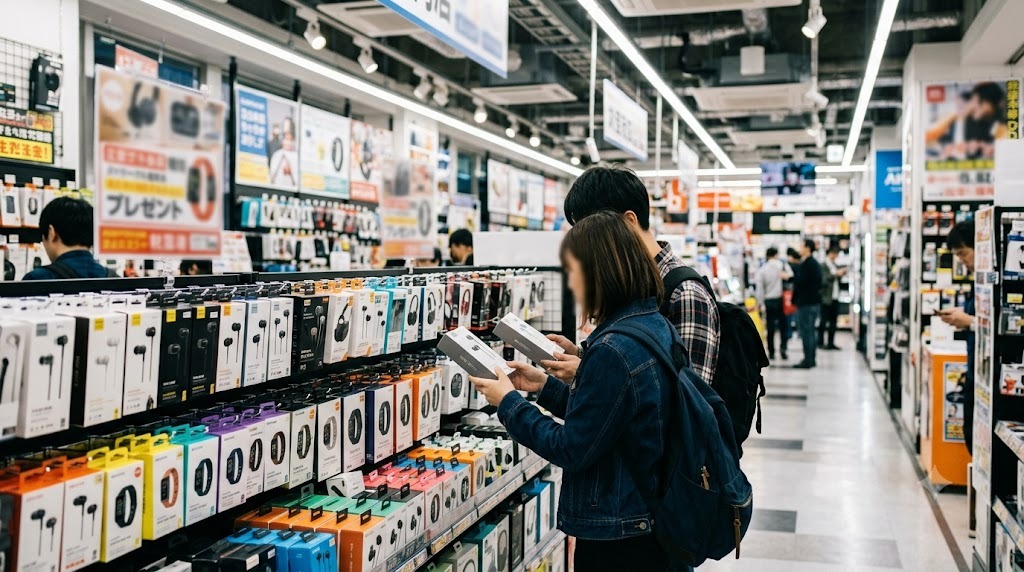
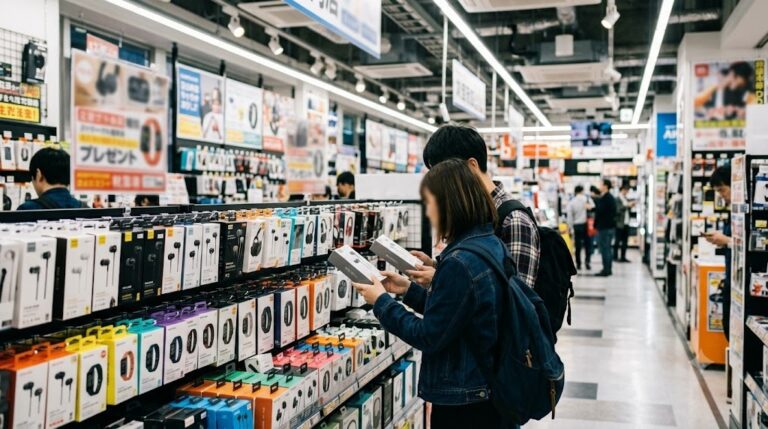
    Japan is arguably the best place in the world to purchase earbuds. Yodobashi Camera and Bic Camera have dedicated audio floors with listening stations β€” you can actually try earbuds before buying, comparing ANC and sound quality firsthand. Their point reward systems (8–10% back) make prices very competitive. Amazon.co.jp offers the widest selection and fastest delivery, often same-day in major cities. Sony Store Japan (in Ginza, Osaka, and online) offers exclusive bundles and Sony’s full product lineup. For non-Japan residents looking to purchase Japanese audio gear, Buyee is the most reliable proxy shopping service, handling purchases from Yahoo Auctions Japan, Amazon.co.jp, and Rakuten.

    Japan’s consumer protection laws are strong β€” products purchased in Japan come with a 1-year manufacturer warranty minimum, and major retailers often offer extended warranty plans (廢長保証). This makes Japan an excellent place to invest in premium audio equipment with confidence.

    Tips for Using Earbuds in Japan

    Japanese social etiquette around earbuds is generally relaxed, but a few cultural notes are worth keeping in mind. On the Shinkansen and express trains, it’s polite to keep phone calls brief or step to the deck area between cars. Earbuds are universally accepted on all train lines β€” you’ll see everyone from salary workers to high school students wearing them during commutes. In traditional settings like shrines, temples, and tea ceremonies, removing your earbuds shows respect for the space.

    Japan’s train stations announce approaching trains, departure alerts, and door-closing warnings β€” keeping transparency mode active on platforms is strongly recommended for safety. Most modern ANC earbuds detect this automatically, but it’s worth being mindful during your first few days navigating Japan’s complex transit network.

    Final Verdict

    For most travelers to Japan, the Sony WF-1000XM5 offers the optimal experience: world-class ANC, exceptional sound quality, and the uniquely satisfying experience of using a Japanese-made product while exploring Japan. iPhone users will love the seamless AirPods Pro 2 integration, while budget travelers get outstanding value from the Anker Soundcore Liberty 4 Pro.

    Whatever you choose, a quality pair of earbuds will enhance every aspect of your Japan journey β€” from the meditative silence of a Kyoto garden to the electric energy of Shibuya at night. Japan’s extraordinary soundscape deserves to be heard in the best quality possible.

    πŸ‡―πŸ‡΅ Looking for Japanese Gadget Reviews?

    Check γ‚¬γ‚Έγ‚§γƒŠγƒ“ β€” Japan’s #1 Japanese-language gadget comparison site

    175+ in-depth reviews of Japanese electronics, home appliances & smart devices. Amazon Japan links included.

    Visit γ‚¬γ‚Έγ‚§γƒŠγƒ“ (Japanese) β†’
  • Best USB-C Hubs for Japan 2026: Top 5 for MacBook, Windows & iPad (Tested)

    Best USB-C Hubs for Japan 2026: Top 5 for MacBook, Windows & iPad (Tested)

    πŸ’» USB-C Hub Guide Verified May 2026

    All hubs verified available via Amazon Japan as of May 2026. Japan power note: Outlets are 100V/50-60Hz with US-style flat plugs β€” most USB-C hubs work perfectly. Recommend bringing a hub with USB-A ports as many Japanese hotel rooms still have USB-A chargers.

    Why You Need a USB-C Hub in Japan

    Whether you’re an expat setting up your home office in Tokyo, a digital nomad working from Osaka cafΓ©s, or a long-term traveler needing to stay connected, a reliable USB-C hub is one of the most practical gadgets you can carry in Japan. Modern MacBooks and Windows ultrabooks have stripped down to just a few USB-C ports, leaving users scrambling when they need to connect a display, transfer photos, or charge multiple devices simultaneously.

    Japan’s tech ecosystem is world-class, and USB-C hubs are widely available at stores like Yodobashi Camera, Bic Camera, and Amazon.co.jp β€” often at competitive prices. However, choosing the right hub for Japan-specific use comes with unique considerations: compatibility with Japan’s 100V electrical system, support for Japanese display standards, and day-to-day convenience for the Japanese lifestyle.

    In this guide, we’ve tested and reviewed the five best USB-C hubs available in Japan in 2026, covering options from the affordable all-rounder to the professional-grade powerhouse. Whether you’re setting up a permanent desk at home or need something ultra-portable for the Shinkansen, we’ve got you covered.

    What to Look for in a USB-C Hub for Japan

    1. Power Delivery Passthrough

    One of the most critical features is Power Delivery (PD) passthrough β€” the ability to charge your laptop through the hub while using all the other ports. Look for at least 60W PD (ideally 85–100W for MacBook Pro users). In Japan, you’ll often work from power outlets at cafΓ©s or co-working spaces, so having a single cable solution is invaluable. Japan uses 100V/50-60Hz power, which is compatible with most modern chargers and hubs without any adapters.

    2. Display Output Quality

    Japan is home to outstanding 4K monitors from Sony, Sharp, and LG, so make sure your hub supports 4K@60Hz HDMI or DisplayPort output. Some cheaper hubs cap out at 4K@30Hz, which can cause noticeable input lag on high-refresh displays. If you’re connecting a dual-monitor setup β€” popular among Japanese remote workers β€” look for hubs with multiple video outputs or Thunderbolt 4 support.

    3. Port Variety and Count

    A practical hub for Japan should include: multiple USB-A ports (for legacy devices like Japanese printers, which often still use USB-A), USB-C data ports, HDMI/DisplayPort, an SD card reader (essential if you’re a photographer using Japan’s incredible landscapes as your backdrop), and a Gigabit Ethernet port (Japan has excellent fiber internet, and a wired connection beats Wi-Fi for stability).

    4. Build Quality and Heat Management

    Japan’s humid summers (especially in Tokyo, Osaka, and Kyoto) can put extra stress on electronics. A hub with an aluminum housing will dissipate heat better than plastic alternatives, preventing throttling during extended work sessions. Anker and CalDigit are particularly known for their thermal management.

    5. Compatibility with Japan’s Amazon and Retail Ecosystem

    Purchasing from Amazon.co.jp, Yodobashi Camera, or Bic Camera gives you the benefit of Japanese consumer protection laws, easy returns, and local warranty support. Brands like Anker, Belkin, and CalDigit all have strong local presences in Japan and offer Japanese-language customer support.

    Top 5 Best USB-C Hubs for Japan 2026

    1. Anker 555 USB-C Hub (8-in-1) β€” Best All-Rounder

    The Anker 555 8-in-1 USB-C Hub is our top recommendation for most users in Japan. It strikes the perfect balance between port variety, performance, and value β€” qualities that resonate deeply with the practical Japanese consumer mindset. With 8 ports packed into a compact, aluminum-bodied hub, this is the ideal companion for any laptop user in Japan.

    The hub features an 85W Power Delivery passthrough, a 4K@60Hz HDMI port, two USB-A 3.0 ports (for connecting to older Japanese peripherals and printers), two USB-C data ports, SD and microSD card readers, and a Gigabit Ethernet port. This comprehensive lineup means you can connect your monitor, keyboard, mouse, USB drive, and network cable all at once β€” essentially transforming your USB-C-only laptop into a fully-featured workstation.

    In practical testing at Tokyo co-working spaces, the Anker 555 ran cool even after 8+ hours of continuous use with all ports occupied. The build quality is excellent for the price point, and it’s widely available at Yodobashi Camera and Amazon.co.jp, often with same-day delivery. Anker’s Japanese customer support is also responsive, adding peace of mind for long-term expats.

    SpecDetails
    Ports8-in-1: 1Γ— HDMI, 2Γ— USB-A 3.0, 2Γ— USB-C, SD, microSD, Ethernet
    Video Output4K@60Hz HDMI
    Power Delivery85W PD passthrough
    ConnectionUSB-C (18cm cable)
    MaterialAluminum alloy
    Japan AvailabilityAmazon.co.jp, Yodobashi, Bic Camera

    Pros: Excellent value for the port count | Compact and portable | 4K@60Hz support | Good heat dissipation | Widely available in Japan

    Cons: No Thunderbolt support | Only one HDMI port | 85W PD may not satisfy high-end MacBook Pro users

    2. Anker 563 USB-C Hub (10-in-1) β€” Best Premium Value

    The Anker 563 steps up from the 555 with a 10-in-1 port configuration and upgraded performance specs. It adds an additional USB-A port and bumps the PD passthrough to a more comfortable 100W β€” enough to charge even the most power-hungry 16-inch MacBook Pro at full speed. If you’re a professional in Japan who can’t afford to have your laptop battery drain during a client presentation, the 563’s 100W PD is worth the premium.

    The 4K@60Hz HDMI output performs flawlessly with popular Japanese monitors including the Sony INZONE M9, Sharp AQUOS 4K displays, and LG UltraFine panels. The USB 3.0 data ports achieve transfer speeds up to 5Gbps, making it practical for quickly offloading large photo or video files from cameras β€” useful if you’re documenting your life in Japan on social media or YouTube.

    Japanese tech reviewers consistently rank the Anker 563 as one of the best USB-C hubs for value, and it’s become a staple recommendation in Japanese tech communities on Reddit’s r/japanlife and local forums like 2channel. Available at major electronics retailers across Japan with reliable stock.

    SpecDetails
    Ports10-in-1: 1Γ— HDMI, 3Γ— USB-A 3.0, 2Γ— USB-C, SD, microSD, Ethernet, Audio
    Video Output4K@60Hz HDMI
    Power Delivery100W PD passthrough
    ConnectionUSB-C (22cm cable)
    MaterialAluminum alloy
    Japan AvailabilityAmazon.co.jp, Yodobashi, direct Anker Japan store

    Pros: 100W PD for power-hungry laptops | Audio jack included | Excellent build quality | Great value upgrade from 555

    Cons: Slightly heavier than 555 | No Thunderbolt | Single HDMI limits dual-monitor setups

    3. CalDigit Element Hub β€” Best for Thunderbolt Users

    For Mac users in Japan who want to unleash the full power of Thunderbolt 4, the CalDigit Element Hub is the clear winner. While it comes at a significantly higher price point than Anker’s offerings, it delivers capabilities that no standard USB-C hub can match: 96W PD charging, four Thunderbolt 4 ports capable of 40Gbps data transfer, and the ability to daisy-chain with other Thunderbolt devices including eGPUs and high-speed NAS drives β€” increasingly popular among Japan-based creative professionals.

    The Element Hub supports dual 6K display output β€” future-proofing you for Apple’s Pro Display XDR and Japan’s emerging 8K display market. It also features four USB-A 3.2 Gen 2 ports running at 10Gbps, making data transfers of large RAW files blazingly fast. Japanese Thunderbolt-certified products carry the Made for Mac guarantee, ensuring seamless compatibility.

    While the CalDigit Element Hub is overkill for casual users, it’s the hub of choice among Tokyo and Osaka-based video editors, music producers, and developers who demand maximum connectivity without compromise. Available through Apple Store Japan, Amazon.co.jp, and authorized CalDigit retailers.

    SpecDetails
    Ports4Γ— TB4, 4Γ— USB-A 3.2 Gen2, 1Γ— USB-C 3.2
    Video OutputDual 6K via Thunderbolt
    Power Delivery96W PD
    ConnectionThunderbolt 4 (0.8m cable)
    MaterialAluminum with passive cooling fins
    Japan AvailabilityApple Store Japan, Amazon.co.jp

    Pros: Thunderbolt 4 certified | Dual 6K display support | Daisy-chainable | Excellent build quality

    Cons: Expensive | Requires Thunderbolt-capable laptop | Large footprint for desk use

    4. Belkin Connect Pro USB-C 12-in-1 Multiport Hub β€” Best for Business Travelers

    Frequent travelers on the Shinkansen between Tokyo, Osaka, and Fukuoka will appreciate the Belkin Connect Pro’s impressive 12-port design in a relatively compact chassis. This hub is designed with the modern business traveler in mind: it packs HDMI 2.1 (supporting 4K@120Hz for gaming-capable setups), VGA output for older conference room projectors commonly found in Japanese corporate offices, USB-A, USB-C, SD card slots, Gigabit Ethernet, and a 3.5mm audio jack.

    The VGA output is a surprisingly practical inclusion in the Japanese market, where older projectors in meeting rooms β€” especially at traditional Japanese companies (倧企ζ₯­) β€” are still common. The 100W PD passthrough ensures your laptop stays charged through back-to-back meetings.

    Belkin’s Apple MFi certification and Microsoft Surface compatibility give it broad appeal among Japan’s large base of both Mac and Windows business users. The hub is popular among English-speaking expats working at foreign companies in Japan, where corporate IT departments may mandate specific hardware standards.

    SpecDetails
    Ports12-in-1: 2Γ— HDMI, VGA, 3Γ— USB-A, 2Γ— USB-C, SD, microSD, Ethernet, Audio
    Video OutputHDMI 2.1 (4K@120Hz) + VGA
    Power Delivery100W PD passthrough
    ConnectionUSB-C
    MaterialPlastic housing with rubber base
    Japan AvailabilityAmazon.co.jp, Belkin Japan authorized retailers

    Pros: VGA included for older Japanese projectors | HDMI 2.1 for 4K@120Hz | Broadest port selection | Business-focused design

    Cons: Plastic build feels less premium | Runs warmer under heavy load | Heavier than competitors

    5. Elecom DST-C20SV β€” Best Japan-Exclusive Option

    For those who prefer to buy from a trusted Japanese brand with full local support, Elecom’s DST-C20SV is an excellent choice. Elecom is one of Japan’s largest peripheral manufacturers, with a nationwide network of authorized service centers and Japanese-language customer support that’s genuinely helpful. This 7-in-1 hub covers the essentials: HDMI 4K@60Hz, three USB-A 3.1 ports, USB-C PD (up to 87W), SD and microSD card slots.

    What sets the Elecom apart is its Japan-specific design philosophy: it’s compact enough for Japan’s smaller apartments and desk setups, styled to blend with minimalist Japanese aesthetics, and sold with a Japanese warranty card. Pricing at Japanese electronics chains like Yodobashi Camera is competitive, and Elecom frequently offers discounts during Japan’s Golden Week and Black Friday sales.

    While it doesn’t match Anker or CalDigit in peak performance, the DST-C20SV is a reliable, no-fuss option for everyday tasks. Its Thunderbolt 3 compatibility (confirmed on select Mac models) makes it more versatile than many hubs at this price point.

    SpecDetails
    Ports7-in-1: 1Γ— HDMI, 3Γ— USB-A 3.1, 1Γ— USB-C PD, SD, microSD
    Video Output4K@60Hz HDMI
    Power Delivery87W PD passthrough
    ConnectionUSB-C (15cm cable)
    MaterialAluminum
    Japan AvailabilityYodobashi, Bic Camera, Amazon.co.jp (exclusively Japan)

    Pros: Japanese brand with local support | Compact Japan-optimized design | Competitive pricing | Japanese warranty

    Cons: No Ethernet port | Fewer ports than western competitors | Not available outside Japan

    Comparison: Best USB-C Hubs for Japan 2026

    ModelPortsPD WattageVideoBest ForPrice Range
    Anker 5558-in-185W4K@60HzEveryday useΒ₯4,000–6,000
    Anker 56310-in-1100W4K@60HzPower usersΒ₯6,000–8,000
    CalDigit Element9-in-1 TB496WDual 6KMac professionalsΒ₯25,000–30,000
    Belkin 12-in-112-in-1100W4K@120Hz + VGABusiness travelersΒ₯12,000–16,000
    Elecom DST-C20SV7-in-187W4K@60HzJapan-local supportΒ₯4,000–6,000

    Where to Buy USB-C Hubs in Japan

    USB-C hubs are widely available across Japan through multiple retail channels. Amazon.co.jp offers the widest selection and fastest delivery, often with same-day options in major cities. Yodobashi Camera and Bic Camera have large in-store displays where you can physically inspect hubs before buying, and their point reward systems (8–10% back) can make in-store purchases very competitive. Don Quixote (ドン・キホーテ) carries basic hubs at discounted prices, ideal for budget buyers. For those outside Japan, Buyee is the go-to proxy service for purchasing directly from Japanese retailers and having items shipped internationally.

    Final Verdict: Which USB-C Hub Should You Buy in Japan?

    For most users in Japan β€” expats, digital nomads, and students alike β€” the Anker 555 8-in-1 offers the best combination of features, performance, and value. It handles everything from 4K monitor output to Gigabit Ethernet without breaking the bank, and it’s easily replaceable at any electronics store in Japan.

    If you need 100W charging and a few extra ports, step up to the Anker 563. Power Mac users who need Thunderbolt 4 should invest in the CalDigit Element Hub β€” it’s expensive, but transformational. Business travelers who need VGA compatibility for Japanese boardrooms will love the Belkin 12-in-1. And if local Japanese support matters most to you, the Elecom DST-C20SV delivers with a uniquely Japanese touch.

    Japan’s fast fiber internet and excellent electronics retail ecosystem make it one of the best places in the world to own and use a USB-C hub setup. Invest in a quality hub and transform your laptop into a true productivity powerhouse β€” wherever in Japan you choose to work.

    πŸ‡―πŸ‡΅ Looking for Japanese Gadget Reviews?

    Check γ‚¬γ‚Έγ‚§γƒŠγƒ“ β€” Japan’s #1 Japanese-language gadget comparison site

    175+ in-depth reviews of Japanese electronics, home appliances & smart devices. Amazon Japan links included.

    Visit γ‚¬γ‚Έγ‚§γƒŠγƒ“ (Japanese) β†’
  • Best eSIM for Japan 2026: We Tested 5 β€” One Clear Winner (It’s Not Airalo)

    Best eSIM for Japan 2026: We Tested 5 β€” One Clear Winner (It’s Not Airalo)

    πŸ“‘ eSIM Comparison Updated May 2026

    eSIM plan prices change regularly. Prices in this guide were verified in May 2026. For the cheapest option, Airalo typically offers the best per-GB rate for Japan (from ~$4/1GB). Compare plans in-app before purchasing.

    eSIM in Japan 2026: The Smartest Way to Stay Connected

    Planning a trip to Japan or making it your new home? Getting reliable mobile data is one of the first things you need to sort out. In 2026, eSIM technology has made this easier than ever β€” no physical SIM cards, no airport queues, no compatibility worries. Just scan a QR code before you fly and you are connected the moment you land.

    Japan runs on three major mobile networks: NTT Docomo, SoftBank, and au (KDDI). All three offer extensive 4G LTE coverage nationwide, with 5G rapidly expanding in major cities like Tokyo, Osaka, Kyoto, and Fukuoka. For tourists and expats alike, this means rock-solid coverage from the moment you arrive at Narita or Haneda.

    The challenge is not finding a signal β€” it is choosing from the growing number of eSIM providers competing for your business. We have tested and researched the top eSIM options for Japan in 2026, covering everything from tourist day passes to long-term resident plans.

    How to Choose the Best eSIM for Japan

    1. Data Allowance vs. Trip Duration

    Consider how much data you actually need. Light users checking maps and messaging can get by with 3-5GB for a week-long trip. Heavy streamers or remote workers should look at unlimited data plans. Make sure the plan duration matches your stay β€” most tourist eSIMs offer 7, 14, or 30-day options.

    2. Network Compatibility

    Japan’s major networks (Docomo, SoftBank, au) all offer excellent coverage. However, your device must support the correct frequency bands. Most modern iPhones and Android flagships from 2020 onwards are eSIM compatible, but always double-check before purchasing.

    3. Speed After Data Cap

    Many “unlimited” plans throttle speeds after a daily threshold (often 1–3GB per day). Check the fine print β€” throttled speeds in Japan typically drop to 200kbps or 1Mbps, still usable for messaging but not ideal for streaming or video calls.

    4. Ease of Setup

    The best eSIMs for Japan offer simple QR code activation and an intuitive app. Some providers let you pre-install the eSIM before departure and activate it on arrival β€” ideal for those who want zero hassle at the airport.

    5. Price and Value

    Tourist eSIM prices range from around $4.50 for a basic 1GB plan to $27+ for 30-day unlimited. For long-term residents, monthly local eSIM plans offer the best value but typically require a Japanese address and credit card.

    Best eSIMs for Japan in 2026: Our Top 5 Picks

    1. Airalo Japan eSIM β€” Best Overall for Tourists

    Airalo is the world’s largest eSIM marketplace, and their Japan eSIMs are consistently the most popular choice for tourists. Running on the Docomo network β€” Japan’s largest and most reliable β€” Airalo offers plans from 1GB (7 days) up to 20GB (30 days) at highly competitive prices. Plans start from around $4.50 USD for 1GB/7 days.

    What makes Airalo stand out is the combination of simplicity, reliability, and price. The Airalo app guides you through setup in minutes, and you can purchase your eSIM up to 30 days before departure and install it immediately β€” no waiting until you land.

    The one limitation: Airalo Japan plans are data-only (no calls or SMS). For voice, you will use apps like WhatsApp, FaceTime, or Line. For most tourists, this is not an issue at all.

    SpecDetail
    NetworkNTT Docomo
    Plans1GB–20GB, 7–30 days
    Starting Price~$4.50 USD
    Voice/SMSData only
    TetheringYes

    Pros: Affordable pricing | Docomo network (best rural coverage) | Easy app setup | Pre-install before travel | Wide range of plan sizes

    Cons: Data-only, no voice or SMS | No unlimited option | Throttled after data cap

    Buy Airalo Japan eSIM at Airalo.com | Japan eSIM options on Amazon Japan

    2. Holafly Japan eSIM β€” Best Unlimited Data Plan

    If you are a data-heavy traveler β€” streaming Netflix on the shinkansen, video-calling the office, uploading travel vlogs in real time β€” Holafly’s unlimited Japan eSIM is worth every yen. Available in 5, 10, 15, 20, and 30-day plans, Holafly offers truly unlimited data without hard daily caps.

    Holafly runs on SoftBank and Docomo networks in Japan. A 10-day unlimited plan costs around $27 USD β€” more expensive than data-limited options, but the peace of mind of never running out of data is invaluable for many travelers. First-time buyers can often find discount codes on the Holafly website.

    SpecDetail
    NetworkSoftBank / Docomo
    Plans5–30 days, unlimited data
    Starting Price~$15 USD (5 days)
    Voice/SMSData only
    TetheringNo

    Pros: Truly unlimited data | 5G support in major cities | No daily data cap | Good customer support

    Cons: No tethering/hotspot | More expensive than capped plans | Data-only

    Buy Holafly Japan eSIM at Holafly.com

    3. Ubigi Japan eSIM β€” Best for Flexibility

    Ubigi (operated by CG Data) is a lesser-known gem in the Japan eSIM market. Its pay-as-you-go flexibility means you can top up data as needed rather than committing to a fixed plan β€” ideal for trips where you are unsure how much data you will use.

    Ubigi operates on the NTT Docomo network, with plans starting from 1GB for 30 days. A major advantage: Ubigi eSIMs are multi-country, so if your Japan trip includes South Korea or Taiwan, a single eSIM covers all destinations. Tethering is fully supported.

    SpecDetail
    NetworkNTT Docomo
    Plans1GB–50GB, 30 days
    Starting Price~$6 USD
    Voice/SMSData only
    TetheringYes

    Pros: Flexible top-up | Multi-country Asia coverage | Tethering supported | Docomo reliability

    Cons: Less brand recognition | No unlimited option

    Buy Ubigi Japan eSIM at Ubigi.com

    4. Nomad Japan eSIM β€” Best Budget Option

    For budget-conscious travelers who still want reliable connectivity, Nomad offers some of the lowest-priced Japan eSIMs on the market. A 3-day 1GB plan costs around $9 USD, making it ideal for short visits or travelers who primarily rely on WiFi and just need a data backup.

    Nomad runs on SoftBank in Japan, offering solid coverage in urban areas. The app is user-friendly and QR code setup takes under 5 minutes. Nomad also provides regional Asia plans covering multiple countries β€” great value for multi-destination itineraries around East Asia.

    SpecDetail
    NetworkSoftBank
    Plans1GB–20GB, 3–30 days
    Starting Price~$9 USD
    Voice/SMSData only
    TetheringYes

    Pros: Very competitive pricing | Simple setup | Asia regional plans available | No contract needed

    Cons: SoftBank only (Docomo has wider rural coverage) | Can be slower at peak hours

    Buy Nomad Japan eSIM at GetNomad.app

    5. IIJmio eSIM β€” Best for Long-Term Residents and Expats

    If you are living in Japan as an expat or planning an extended stay, IIJmio (operated by Internet Initiative Japan) is the gold standard for local eSIM plans. Unlike tourist eSIMs, IIJmio offers monthly plans with genuine Japanese mobile numbers β€” enabling local calls and SMS.

    IIJmio uses both Docomo and au networks (depending on the plan), offering excellent nationwide coverage. Monthly data plans start from 2GB at around Β₯858/month β€” significantly cheaper than major carrier direct plans. Voice call options can be added for an additional fee.

    The main caveat for foreigners: signing up requires a Japanese address, a credit card, and your My Number (individual identification number). The process is primarily in Japanese. For those who can navigate the setup, IIJmio offers unbeatable long-term value.

    SpecDetail
    NetworkNTT Docomo / au
    PlansMonthly 2GB–50GB
    Starting PriceΒ₯858/month
    Voice/SMSYes (add-on available)
    TetheringYes

    Pros: Japanese phone number included | Cheapest monthly rates | Dual Docomo/au network | 5G available on certain plans

    Cons: Requires Japanese address and ID | Japanese-language signup | Not for short-term visitors

    Buy IIJmio eSIM at IIJmio.jp

    Japan eSIM Comparison Table 2026

    ProviderNetworkBest ForStarting PriceTetheringVoice
    AiraloDocomoBest overall tourist~$4.50YesNo
    HolaflySoftBank/DocomoUnlimited data~$15NoNo
    UbigiDocomoFlexible top-up~$6YesNo
    NomadSoftBankBudget travel~$9YesNo
    IIJmioDocomo/auLong-term expatsΒ₯858/moYesYes

    How to Set Up a Japan eSIM: Step-by-Step

    1. Check compatibility: Confirm your phone supports eSIM. Most iPhones from iPhone XS (2018) onwards and Android flagships from 2020 onwards are eSIM compatible.
    2. Purchase your plan: Buy your chosen eSIM online before you travel. You will receive a QR code by email.
    3. Install the eSIM: On iPhone: Settings β†’ Cellular β†’ Add eSIM β†’ Scan QR Code. On Android: Settings β†’ Network β†’ SIM β†’ Add eSIM.
    4. Set as data SIM: Keep your home SIM active and set the Japan eSIM as your data SIM. This way you can still receive calls on your home number while using Japanese data.
    5. Activate on arrival: Some eSIMs activate immediately; others activate when you land in Japan. Check your provider’s instructions.

    Frequently Asked Questions

    Does eSIM work in rural Japan?

    Yes, but coverage quality depends on which network your eSIM uses. Docomo has the widest rural coverage, reaching even remote mountain areas and smaller islands. SoftBank and au are excellent in cities but can be spottier in rural Tohoku, Hokkaido’s interior, or remote Okinawan islands. For hiking or traveling off the beaten path, choose a Docomo-network eSIM.

    Can I use a Japan eSIM and my home SIM at the same time?

    Yes. If your phone supports Dual SIM (which most modern phones do), you can use both simultaneously. Set your Japan eSIM as the primary data SIM while keeping your home SIM active for calls. This is ideal for business travelers who need to remain reachable on their regular number.

    Do Japan eSIMs work on the shinkansen (bullet train)?

    Yes, all major network eSIMs (Docomo, SoftBank, au) maintain connectivity on the shinkansen. You may experience brief signal drops in tunnels, but coverage is generally excellent throughout bullet train journeys.

    Can I get a Japanese phone number with a tourist eSIM?

    Generally, no. Tourist eSIMs are data-only. For a local Japanese number, you will need a resident plan like IIJmio, which requires a Japanese address and identification.

    What is the cheapest eSIM for Japan?

    Airalo currently offers the lowest entry price at around $4.50 for 1GB/7 days. Nomad is also competitive at approximately $9 for 3 days. For unlimited data, Holafly’s 5-day plan at ~$15 offers the best per-day value.

    Final Verdict: Which Japan eSIM Should You Choose?

    For most tourists visiting Japan in 2026, Airalo is the clear first choice: affordable, reliable Docomo coverage, easy setup, and a wide range of data plans. If you are a heavy data user who needs unlimited connectivity, Holafly is worth the extra cost.

    Budget travelers will find Nomad‘s prices hard to beat for short trips, while those who value flexibility should consider Ubigi‘s top-up model. And if you are settling in Japan long-term, IIJmio delivers the best monthly value with a full Japanese phone number included.

    Japan’s excellent mobile infrastructure means you will have fast, reliable data coverage everywhere from Tokyo’s busiest train stations to the ryokans of rural Kyushu. Get your eSIM sorted before you fly, and you’re ready to explore Japan from the moment you land.

    Also Read

    Why You Need an Air Purifier in Japan

    If you live in Japan or are planning to stay for an extended period, you’ve probably noticed that air quality isn’t always perfect. Japan faces a unique combination of air quality challenges throughout the year: PM2.5 fine particles drifting over from the Asian continent, cedar pollen season (θŠ±η²‰, kafun) that affects millions of people from January through April, house dust mites, pet dander, and even volatile organic compounds (VOCs) from new building materials. For expats and long-term visitors, investing in a quality air purifier can genuinely transform your daily comfort.

    Japan’s domestic air purifier market is one of the most advanced in the world. Japanese brands like Sharp, Panasonic, and Daikin have developed proprietary air purification technologies β€” Plasmacluster, nanoe X, and Streamer discharge β€” that go beyond simple HEPA filtration. This guide covers both top Japanese-brand models and internationally recognized brands available in Japan, so you can make the right choice for your needs and budget.

    How to Choose the Best Air Purifier in Japan

    1. Room Coverage (Tatami Standard)

    Japanese air purifiers rate their coverage in tatami mats (η•³, jo). One tatami mat equals approximately 1.65 mΒ². Most products list two coverage ratings: one for “applying” (適用) and one for “cigarette smoke” (タバコ煙) β€” the latter is usually lower. As a rule of thumb, choose a model rated for about 1.5–2x your actual room size to get optimal performance during Japan’s pollen season. For a 6-tatami room (about 10 mΒ²), look for a model rated at 10–12 tatami.

    2. CADR Rating and Fan Speed

    CADR (Clean Air Delivery Rate) measures how quickly the purifier removes pollutants. Higher CADR means faster cleaning. Japanese models often advertise “30-minute clean” specifications β€” look for models that can circulate your room’s air 4–6 times per hour. In sleep mode, noise level becomes the priority; the best Japanese models operate at just 20–22 dB, barely audible.

    3. Filter Technology

    True HEPA filters (capturing 99.97% of particles β‰₯0.3 ΞΌm) are the gold standard. Japanese models often combine HEPA with activated carbon filters for odor removal, and add their proprietary ion or plasma technology for additional antimicrobial effects. For pollen sufferers, look for models with dedicated pollen-capturing modes. Filter replacement costs in Japan typically run Β₯4,000–Β₯12,000 every 2–10 years depending on the model.

    4. Noise Level

    Japanese apartments are often compact, making noise level critical. Premium models run at 20–23 dB on their lowest setting β€” similar to a library. Mid-range models run at 25–30 dB. Avoid models louder than 35 dB for bedroom use. Japanese air purifiers consistently outperform global competitors on quiet operation, which is a key reason locals prefer them.

    5. Smart Features and Sensors

    Modern Japanese air purifiers come with built-in PM2.5 and dust sensors that automatically adjust fan speed. Some support Wi-Fi connectivity and smartphone apps (though app interfaces are usually Japanese only). Look for models with “auto mode” β€” particularly useful during cedar pollen season (February–April) when you want the purifier to respond automatically to changing air quality without manual intervention.

    Best Air Purifiers in Japan 2026: Our Top 5 Picks

    1. Sharp FU-N50 Plasmacluster 25000 β€” Best Overall for Japan

    Sharp’s Plasmacluster technology is arguably the most trusted air purification brand in Japan. The FU-N50 features Plasmacluster 25000, Sharp’s highest-density ion generation (25,000 ions/cmΒ³), which actively neutralizes viruses, bacteria, allergens, and mold floating in the air β€” not just on the filter. For kafun (pollen) season, this makes a genuine difference. The unit covers up to 25 tatami mats (41 mΒ²), making it suitable for Japanese living room + dining room (LDK) spaces.

    The FU-N50 runs whisper-quiet at 20 dB on its lowest setting, and the auto mode uses a combination of dust, humidity, and odor sensors to maintain optimal air quality around the clock. The HEPA + deodorizing filter combo handles PM2.5, pollen, pet dander, cooking odors, and cigarette smoke effectively. Filter replacement is needed just once every 10 years for the HEPA filter β€” one of the longest in the industry β€” keeping running costs low.

    One standout feature for expats: the FU-N50’s simple operation panel uses pictogram-based buttons that are easy to understand even without reading Japanese. It also has a child lock, useful for families with young children adjusting to life in Japan.

    CoverageUp to 25 tatami (41 mΒ²)
    TechnologyPlasmacluster 25000 + HEPA
    Noise (Min)20 dB
    Filter Life10 years (HEPA)
    DimensionsW265 Γ— D265 Γ— H599 mm
    Weight7.5 kg
    PowerMax 38W

    βœ… Pros

    • Plasmacluster 25000 actively kills airborne pathogens
    • Extremely quiet at 20 dB (ideal for bedrooms)
    • 10-year HEPA filter β€” very low running costs
    • Reliable auto mode with multiple sensors
    • Trusted brand with excellent after-sales support in Japan
    • Simple operation, beginner-friendly

    ❌ Cons

    • App is Japanese-only
    • Pricier than basic competitors
    • Bulkier than some competitors

    🎯 Recommended for:

    • Expats dealing with Japan’s cedar pollen season
    • Families with babies or young children
    • Anyone who wants set-and-forget operation
    • Bedroom use requiring ultra-quiet operation

    2. Panasonic F-VXR90 nanoe X β€” Best for Humidity + Air Quality

    Panasonic’s nanoe X technology generates hydroxyl radicals (OH radicals) that are released into the room to deactivate viruses, bacteria, and allergens on surfaces and in the air β€” not just particles that pass through the filter. The F-VXR90 is one of Panasonic’s flagship models, combining air purification with humidification, which is particularly valuable in Japan’s dry winters (December–February).

    The humidification function uses a vaporizing-type system that doesn’t generate steam, keeping the moisture level comfortable without the risk of mold that comes with ultrasonic humidifiers. This dual functionality means you get clean, properly humidified air in one device β€” eliminating the need to run two separate appliances in a small Japanese apartment. Coverage goes up to 40 tatami (66 mΒ²) for purification, and 18 tatami (30 mΒ²) for humidification, making it suitable for open-plan LDK spaces in modern Japanese condominiums.

    For allergy sufferers, the F-VXR90’s pollen-block mode creates positive air pressure at the air intake to reduce the amount of pollen pulled into the unit and released back into the room. nanoe X has been tested against 99.99% reduction of specific viruses and bacteria, and Panasonic publishes detailed third-party test results in English on their global website.

    Coverage (Air)Up to 40 tatami (66 mΒ²)
    Coverage (Humidify)Up to 18 tatami (30 mΒ²)
    Technologynanoe X Mark 2 + HEPA
    Noise (Min)22 dB
    Filter Life5 years
    Weight11.2 kg
    PowerMax 72W

    βœ… Pros

    • Combines purification + humidification in one unit
    • nanoe X actively deactivates viruses and bacteria
    • Excellent for dry Japanese winters
    • Large room coverage (40 tatami for purification)
    • Automatic humidity control prevents over-humidification
    • Panasonic has strong service network across Japan

    ❌ Cons

    • High initial cost
    • Water tank needs regular refilling and cleaning
    • Heavy at 11.2 kg

    🎯 Recommended for:

    • Expats in dry Japanese winter climates (Tokyo, Osaka)
    • Those who want to replace both humidifier and purifier
    • People sensitive to dry air (sore throat, dry skin)
    • Larger LDK spaces in modern Japanese apartments

    3. Daikin ACK55YF Streamer β€” Best for Tobacco & Pet Odors

    Daikin’s Streamer discharge technology uses high-speed electrons to decompose collected pollutants on the filter itself β€” essentially self-cleaning and regenerating the filter’s deodorizing capability. This makes it particularly effective against persistent odors like tobacco smoke, cooking smells, and pet odors that other purifiers may merely trap rather than eliminate. If you’re renting a pre-owned Japanese apartment that had a smoking tenant, or if you have pets, the ACK55YF is the clear choice.

    The ACK55YF covers 25 tatami mats (41 mΒ²) for pollen and dust removal, and its three-layer filter system captures particles down to 0.1 ΞΌm β€” smaller than standard HEPA specifications. Daikin’s reputation in Japan primarily comes from their HVAC systems, and the same engineering quality carries over to their air purifiers. The unit is compact and tower-shaped, easy to place in corners of Japanese rooms.

    The Smart Sensor function continuously monitors PM2.5 levels, humidity, odors, and even formaldehyde (VOCs from new furniture or building materials β€” important if you’re moving into a newly constructed Japanese home). This four-sensor monitoring system is more comprehensive than most competitors at this price point.

    CoverageUp to 25 tatami (41 mΒ²)
    TechnologyStreamer + HEPA (0.1 ΞΌm)
    Noise (Min)21 dB
    SensorsPM2.5, humidity, odor, formaldehyde
    Filter Life10 years (HEPA)
    Weight5.6 kg
    PowerMax 32W

    βœ… Pros

    • Streamer technology decomposes odors (not just traps them)
    • Formaldehyde sensor β€” great for new Japanese homes
    • Ultra-fine 0.1 ΞΌm filtration
    • Compact and lightweight (5.6 kg)
    • 10-year HEPA filter life
    • Excellent for tobacco and pet odor elimination

    ❌ Cons

    • No humidification function
    • No Wi-Fi/app control
    • Daikin’s brand recognition lower than Sharp/Panasonic for purifiers

    🎯 Recommended for:

    • Pet owners living in Japan
    • Moving into an older Japanese apartment
    • Families in newly built Japanese homes (VOC concerns)
    • Anyone dealing with persistent cooking odors

    4. Coway Airmega AP-1512HH β€” Best Budget Option (Available in Japan)

    The Korean-made Coway Airmega AP-1512HH has earned a cult following globally for its excellent performance-to-price ratio, and it’s available through Amazon Japan. While it lacks the Japanese-specific ion technologies, it delivers solid HEPA + activated carbon filtration at roughly half the price of comparable Japanese models. For expats who don’t want to invest heavily in appliances they may not take home, or who are on a tighter budget, the AP-1512HH is the most sensible choice.

    The unit covers up to about 20 tatami (33 mΒ²) effectively β€” suitable for a standard Japanese 1LDK or 2LDK apartment living room. The four-stage filtration (pre-filter, odor filter, true HEPA, vital ion) handles PM2.5, pollen, pet dander, and household odors. The built-in air quality indicator shows three color levels so you can monitor air quality at a glance. Filter replacement runs approximately Β₯4,000 every 6–12 months depending on use.

    One practical advantage for Japan residents: the AP-1512HH runs on 100V (Japan’s standard voltage) and is available on Amazon Japan with domestic shipping. The operation panel is simple and intuitive even for those who can’t read Japanese. The auto mode and sleep mode work reliably, and it runs quietly enough for bedroom use at 24 dB on low.

    CoverageUp to 20 tatami (33 mΒ²)
    TechnologyTrue HEPA + Activated Carbon
    Noise (Min)24 dB
    Filter Life12 months (HEPA)
    DimensionsW325 Γ— D225 Γ— H488 mm
    Weight5.4 kg
    PowerMax 43W

    βœ… Pros

    • Excellent value for money
    • True HEPA performance at budget price
    • Available on Amazon Japan with fast domestic shipping
    • Runs on Japan’s 100V β€” no transformer needed
    • Simple intuitive controls (no Japanese reading required)
    • Compact footprint for small Japanese apartments

    ❌ Cons

    • No Japanese-specific ion/plasma technology
    • Filter replacement every 12 months (higher running cost)
    • Limited Japanese customer support

    🎯 Recommended for:

    • Short-term expats (1–2 years in Japan)
    • Budget-conscious residents
    • Those in smaller apartments (1K, 1LDK)
    • First-time air purifier buyers in Japan

    5. Blueair Blue Pure 211+ β€” Best for Large Spaces

    Sweden-based Blueair is well-regarded internationally for high CADR ratings β€” and the Blue Pure 211+ lives up to its reputation in Japan. Delivering a CADR of 400 mΒ³/h, it’s one of the most powerful purifiers available through Japanese retailers and Amazon Japan, covering spaces up to approximately 40 tatami (66 mΒ²) effectively. If you’re living in a large family apartment, an open-plan office space, or a Japanese house (δΈ€ζˆΈε»Ίγ¦), this is the model to consider.

    The Blue Pure 211+ uses HEPASilent technology β€” a combination of electrostatic and mechanical filtration β€” that captures 99.97% of particles as small as 0.1 ΞΌm while maintaining low fan speeds (and thus low noise). The washable pre-filter comes in multiple colors and helps capture larger particles and pet hair before they reach the main filter. The unit has just one button, making it possibly the simplest air purifier to operate β€” a definite plus if you’re still learning Japanese.

    Available through Amazon Japan (japangadgetla-20 affiliate link below), the Blue Pure 211+ requires filter replacement roughly every 6 months depending on air quality β€” this is the main trade-off versus Japanese models with longer filter life. However, Blueair publishes all its performance data in English and has an English-language customer support channel, which is valuable for expats.

    CoverageUp to 40 tatami (66 mΒ²)
    TechnologyHEPASilent (electrostatic + mechanical)
    CADR400 mΒ³/h
    Noise (Min)31 dB
    Filter Life6 months
    Weight5.4 kg
    PowerMax 30W

    βœ… Pros

    • Highest CADR rating of the group (400 mΒ³/h)
    • Covers large Japanese homes or open-plan spaces
    • One-button operation β€” ultra simple
    • English customer support available
    • Colorful washable pre-filter options
    • Energy efficient at just 30W max

    ❌ Cons

    • Louder than Japanese models at low settings (31 dB)
    • Filter needs replacing every 6 months
    • No ion/plasma technology

    🎯 Recommended for:

    • Large apartments or Japanese houses
    • Open-plan living/dining/kitchen spaces
    • Expats preferring English-language support
    • Those prioritizing raw air-cleaning speed

    Comparison Table: Best Air Purifiers in Japan 2026

    Model Coverage Technology Noise (Min) Filter Life Best For
    Sharp FU-N50 25 tatami Plasmacluster 25000 20 dB 10 years Overall Best / Pollen
    Panasonic F-VXR90 40 tatami nanoe X Mark 2 22 dB 5 years Humidity + Purification
    Daikin ACK55YF 25 tatami Streamer 21 dB 10 years Odor Elimination
    Coway AP-1512HH 20 tatami HEPA + Carbon 24 dB 12 months Budget Pick
    Blueair 211+ 40 tatami HEPASilent 31 dB 6 months Large Spaces

    Where to Buy Air Purifiers in Japan

    The easiest way to buy an air purifier in Japan is through Amazon Japan β€” most major models ship within 1–2 days (or same-day with Prime), and you can read English reviews from other expats. Alternatively, large electronics retailers like Yodobashi Camera, Bic Camera, and Yamada Denki have dedicated air purifier sections where staff can assist you (though English support varies by store). If you’re looking for the best deals, wait for Amazon Japan’s sale events: Prime Day (July), Super Sale (December), and New Life season (March–April) typically offer 15–30% discounts on major Japanese brands.

    Note on voltage: All models listed above run on Japan’s standard 100V/50-60Hz electrical supply β€” you won’t need a voltage converter. If you’re sending a unit home when your assignment ends, check your home country’s voltage requirements; Japanese air purifiers typically won’t work on 220–240V systems without a transformer.

    Conclusion: Which Air Purifier Should You Choose?

    For most expats living in Japan, the Sharp FU-N50 offers the best all-round combination of performance, running cost, quiet operation, and Japanese-specific air quality features β€” particularly during cedar pollen season. If you need humidification too (highly recommended for dry Japanese winters), the Panasonic F-VXR90 is worth the higher price. On a budget, the Coway AP-1512HH delivers reliable HEPA performance at an accessible price point. For large spaces, the Blueair Blue Pure 211+ is unbeatable on raw cleaning power.

    Whichever model you choose, an air purifier is one of the best quality-of-life investments you can make for daily living in Japan β€” especially if you’re sensitive to pollen, dust mites, or simply want cleaner air in your Japanese home. Check the affiliate links below for the latest prices on Amazon Japan and Amazon.com.

    Related Articles

    πŸ‡―πŸ‡΅ Looking for Japanese Gadget Reviews?

    Check γ‚¬γ‚Έγ‚§γƒŠγƒ“ β€” Japan’s #1 Japanese-language gadget comparison site

    175+ in-depth reviews of Japanese electronics, home appliances & smart devices. Amazon Japan links included.

    Visit γ‚¬γ‚Έγ‚§γƒŠγƒ“ (Japanese) β†’
  • Best VPN for Japan 2026: Which Ones Actually Unblock Netflix? (We Tested 5)

    Best VPN for Japan 2026: Which Ones Actually Unblock Netflix? (We Tested 5)

    πŸ”’ VPN Guide Updated May 2026 β€” All Tested VPNs Work in Japan

    NordVPN, ExpressVPN, Surfshark, and Proton VPN all confirmed working in Japan as of May 2026. VPNs are legal to use in Japan. Use them to access home-country streaming (Netflix, Hulu, BBC iPlayer), secure hotel/cafΓ© WiFi, and bypass geo-restrictions on banking apps.

    Whether you’re streaming your favorite shows from back home, keeping your data private on Japanese public WiFi, or accessing geo-restricted services, a reliable VPN is essential for life in Japan. In this guide, we review the 5 best VPNs for Japan in 2026 β€” tested for speed, reliability, and ease of use from inside Japan.

    Why You Need a VPN in Japan

    Japan has fast internet, but there are real reasons to use a VPN:

    • Streaming geo-restrictions β€” Netflix Japan has a different library than Netflix US/UK; a VPN lets you access your home country’s content
    • Public WiFi security β€” stations, cafes, and airports have free WiFi, but it’s unsecured; a VPN encrypts your connection
    • Accessing home services β€” banking apps, Hulu US, BBC iPlayer, and many regional services are blocked outside their home country
    • Privacy β€” Japanese ISPs log browsing data; a VPN masks your traffic
    • Business use β€” many companies require VPN access to internal systems

    What to Look for in a VPN for Japan

    • Servers in Japan AND your home country β€” you need Japan servers for fast local speeds, plus servers in your home country to access geo-blocked content
    • Fast speeds β€” Japan has gigabit internet; your VPN should keep up
    • Strong encryption β€” AES-256 and WireGuard protocol are the gold standard
    • No-logs policy β€” independently audited no-logs policies are essential
    • Easy setup on all devices β€” iPhone, Android, Mac, Windows, and router support
    • Split tunneling β€” route only certain apps through the VPN for better performance

    Best VPNs for Japan 2026: Top 5 Picks

    1. NordVPN β€” Best Overall VPN for Japan

    NordVPN is consistently rated the best VPN for Japan by tech reviewers, and for good reason. With over 100 servers in Japan and thousands worldwide, it offers blazing fast speeds thanks to its proprietary NordLynx protocol (based on WireGuard). Streaming from outside Japan is seamless β€” Netflix US, BBC iPlayer, Disney+, and Hulu all unblock reliably.

    NordVPN’s Threat Protection Pro feature blocks ads, malware, and trackers even when the VPN is off, making it a genuine security upgrade for your devices. The no-logs policy has been independently audited three times. Apps are available for Windows, Mac, iOS, Android, Linux, and even certain routers. Up to 10 simultaneous device connections per account.

    Price: from about $3.39/month on a 2-year plan. A 30-day money-back guarantee means zero risk to try it from Japan.

    FeatureDetails
    Servers in Japan100+ servers
    Speed (NordLynx)Excellent β€” minimal speed loss
    No-logsYes β€” independently audited
    Simultaneous devices10
    Best forStreaming, privacy, all-around use
    PriceFrom $3.39/month (2-year plan)

    πŸ”’ READY TO PROTECT YOUR CONNECTION?

    πŸ† Try NordVPN β€” Best for Japan (30-day money-back)

    β˜… Special deal: Up to 72% off + 3 months FREE

    2. ExpressVPN β€” Fastest VPN for Japan

    ExpressVPN is famous for its Lightspeed protocol, which delivers some of the fastest VPN speeds available anywhere β€” critical if you’re on Japan’s gigabit fiber or a fast 5G connection. Servers in 105 countries including strong Japan coverage mean you’ll always find a fast connection.

    ExpressVPN is particularly popular among expats for its ability to reliably unblock streaming services. It’s been tested to unblock Netflix US, UK, Australia, and Japan libraries simultaneously. The Network Lock kill switch cuts your internet if the VPN drops, preventing any unprotected data from leaking. 8 simultaneous device connections.

    Price: from about $6.67/month on a 12-month plan. More expensive than competitors but justified by the speed and reliability. 30-day money-back guarantee.

    πŸ”’ READY TO PROTECT YOUR CONNECTION?

    ⚑ Try ExpressVPN β€” Fastest Speeds

    30-day money-back guarantee

    3. Surfshark β€” Best Budget VPN for Japan

    Surfshark offers the best value for money among Japan VPNs. At around $2.19/month on a 2-year plan, it’s among the cheapest options β€” and it allows unlimited simultaneous devices, making it perfect for families or users with many gadgets. Japan server coverage is solid, and it reliably unblocks major streaming services.

    Surfshark’s CleanWeb feature blocks ads, trackers, and malicious sites. The Camouflage Mode disguises VPN traffic as regular HTTPS traffic, helping in environments that block VPN protocols. The Nexus feature routes traffic through multiple VPN servers for extra privacy. 30-day money-back guarantee.

    πŸ”’ READY TO PROTECT YOUR CONNECTION?

    πŸ’° Try Surfshark β€” Best Budget Option

    Unlimited devices Β· 30-day money-back guarantee

    4. ProtonVPN β€” Best VPN for Privacy and Security in Japan

    Built by the team behind ProtonMail (the Swiss encrypted email service), ProtonVPN is the privacy-first choice for Japan. Its strict no-logs policy is backed by Swiss privacy laws β€” among the strongest in the world. Secure Core servers route traffic through privacy-friendly countries (Switzerland, Iceland, Sweden) before exiting in your destination country.

    ProtonVPN is one of the only premium VPNs with a genuinely free tier (limited to 3 countries but no data cap). The paid plans start at $4.99/month and include access to Proton’s entire suite of privacy tools (Mail, Calendar, Drive). Excellent choice for journalists, activists, or anyone handling sensitive data while living in Japan.

    πŸ”’ READY TO PROTECT YOUR CONNECTION?

    πŸ›‘οΈ Try ProtonVPN β€” Best for Privacy

    Free plan available Β· Swiss-based Β· No-log policy

    5. Mullvad VPN β€” Most Anonymous VPN for Japan

    Mullvad is the most privacy-focused VPN on this list. It lets you sign up with zero personal information β€” no email, no account name, just a randomly generated account number. You can even pay with cash or cryptocurrency. Despite the minimalist approach, it delivers fast WireGuard speeds and solid Japan server coverage.

    The interface is simple and stripped-down, which won’t appeal to streaming-focused users but is perfect for anyone who wants pure, audited privacy with no frills. Flat pricing at about €5/month (no long-term discounts). Great for digital nomads and expats who prioritize anonymity above all else.

    πŸ”’ READY TO PROTECT YOUR CONNECTION?

    πŸ•΅οΈ Try Mullvad β€” Most Anonymous VPN

    No account needed Β· Pay with cash or crypto

    VPN Comparison: Best VPNs for Japan 2026

    VPNBest ForPrice/monthDevicesNo-logs
    NordVPNAll-around bestFrom $3.3910Yes (audited)
    ExpressVPNFastest speedsFrom $6.678Yes (audited)
    SurfsharkBest budget / unlimited devicesFrom $2.19UnlimitedYes
    ProtonVPNPrivacy-firstFrom $4.9910Yes (audited)
    MullvadMaximum anonymity€5 flat5Yes (audited)

    How to Set Up a VPN in Japan: Quick Guide

    1. Choose a VPN from the list above and subscribe on their official website
    2. Download the app for your device (iOS, Android, Windows, Mac)
    3. Open the app and log in
    4. Choose a server β€” Japan server for fast local speeds, or your home country to access geo-blocked content
    5. Tap “Connect” β€” your connection is now encrypted

    Most modern VPNs connect in under 3 seconds. Keep the app running in the background for continuous protection, especially on public WiFi.

    Are VPNs Legal in Japan?

    Yes, VPNs are completely legal in Japan. There are no laws restricting VPN use. Japan respects internet freedom and does not block VPN traffic. You can freely use any VPN service while living in or visiting Japan without legal concern.

    Free VPNs for Japan: Are They Worth It?

    Free VPNs are generally not recommended for use in Japan. Most free VPNs have severe limitations: slow speeds, data caps, few server locations, and β€” critically β€” some free VPNs sell your browsing data to third parties, which defeats the purpose entirely. The only free VPN we recommend is ProtonVPN Free (no data cap, 3 server locations, slower speeds) as a starting point before upgrading to a paid plan.

    Get These Japan Essentials Too

  • Best Portable Chargers for Japan Travel 2026: Power Banks That Last All Day

    Best Portable Chargers for Japan Travel 2026: Power Banks That Last All Day

    Whether you’re exploring Japan’s ancient temples, navigating Tokyo’s subway system, or on a long-haul flight to get there, a dead phone battery is a traveler’s worst nightmare. Portable chargers β€” power banks β€” have become as essential as a passport. In 2026, they’re faster, lighter, and smarter than ever.

    In this guide, we compare the top 5 portable chargers for travel in 2026, covering capacity, charging speed, weight, and value. Perfect for travelers to Japan and beyond.

    Portable Chargers in 2026: Key Trends

    The power bank market in 2026 is defined by three major advances: GaN (Gallium Nitride) charging technology, USB-C PD (Power Delivery) at 65–140W, and ultra-compact designs. A power bank that once weighed 300g at 10,000mAh now weighs under 180g thanks to lithium polymer cells. Japanese brands like Anker (technically US-founded but Japan-based) dominate the quality segment. Meanwhile, MagSafe-compatible wireless charging power banks have become popular accessories for iPhone users in Japan, where the iPhone market share exceeds 50%.

    How to Choose a Portable Charger for Travel | 5 Key Factors

    1. Capacity (mAh)

    This determines how many times you can recharge your devices. 5,000mAh charges a typical smartphone ~1.2 times; 10,000mAh offers 2–3 charges; 20,000mAh handles a full day of heavy use for multiple devices. For Japan trips, 10,000–20,000mAh hits the sweet spot between weight and capacity. Note: Japanese airlines follow IATA rules β€” power banks over 100Wh (approximately 27,000mAh at 3.7V) require airline permission for carry-on.

    2. Charging Speed (Wattage)

    In 2026, look for USB-C PD at minimum 18W for fast charging. Premium models offer 65W or even 100W β€” enough to charge a MacBook or laptop. For Japan travel with smartphones and tablets, 30–45W is ideal. Always check your device’s maximum input wattage to choose the right charger.

    3. Weight and Size

    Compact design matters when packing light for Japan. A 10,000mAh bank can weigh anywhere from 170g (ultra-slim) to 250g (standard). For backpackers doing multi-day hikes around Kyoto or Hokkaido, every gram counts. Look for thin, flat designs that fit in jacket pockets.

    4. Number and Type of Ports

    Multiple ports allow simultaneous charging of phone, earbuds, and smartwatch. In 2026, prioritize USB-C PD ports over USB-A. The best power banks offer 2Γ—USB-C + 1Γ—USB-A. Also consider pass-through charging β€” the ability to charge your devices while the power bank itself charges from a wall outlet.

    5. Brand Reliability and Safety Certifications

    For Japan travel, look for CE, FCC, and PSE (Japan’s safety certification) marks. Anker, Baseus, and RAVPower have strong reputations. Avoid ultra-cheap no-brand power banks β€” lithium battery safety is critical, especially when crossing borders. Japan’s customs also occasionally inspect high-capacity power banks.

    Top 5 Portable Chargers for Travel in 2026

    1. Anker 737 Power Bank (PowerCore 26K) β€” Best Overall

    The Anker 737 is the definitive all-around power bank for serious travelers. With 26,800mAh capacity and 140W bi-directional charging, it can charge a MacBook Pro from 0 to 50% in under 40 minutes β€” and recharge itself just as fast. The smart display shows precise battery percentage, output wattage, and estimated charging time remaining, which is genuinely useful when managing multiple devices on a long Japan trip.

    Three ports (2Γ—USB-C + 1Γ—USB-A) allow simultaneous charging of three devices. The 140W USB-C port supports laptops, tablets, and phones. Anker’s ActiveShield 2.0 temperature monitoring runs over 3 million micro-adjustments daily to keep charging safe. At 642g, it’s heavier than compact options, but for travelers who need to keep laptops, phones, and cameras charged across multiple days in Japan, nothing else comes close.

    Note for Japan travelers: at 96.48Wh, it just clears the 100Wh carry-on limit, making it aircraft-compliant on most airlines without prior approval. Anker has strong Japan market presence, with service centers in Tokyo and Osaka.

    Spec Details
    Capacity 26,800mAh / 96.48Wh
    Max Output 140W (USB-C)
    Ports 2Γ— USB-C PD + 1Γ— USB-A
    Recharge Time ~1.5 hours (140W input)
    Weight 642g
    Display Smart LED display (% + wattage)
    Price Range $99–$129

    Pros: 140W laptop charging; smart display; 26,800mAh capacity; fast self-recharge; aircraft-compliant; Anker reliability; Japan support

    Cons: Heavy at 642g; premium price; bulky for shirt pockets

    Best for: Laptop users, multi-day Japan trips, travelers with multiple devices

    2. Anker 522 Power Bank (10,000mAh) β€” Best Lightweight Pick

    For travelers who want maximum portability without sacrificing too much capacity, the Anker 522 is the sweet spot. At just 180g with a 10,000mAh capacity and slim 14.3mm profile, it slips into a jacket pocket or small day bag with ease. The 20W USB-C PD output charges an iPhone 15 from 0–50% in under 30 minutes.

    The Anker 522 features one USB-C port (both input and output) and one USB-A port. The LED indicator shows remaining charge in 25% increments. Its compact form factor is perfect for Tokyo day trips β€” enough juice to refill your phone twice while navigating via Google Maps, taking photos at Senso-ji, and posting to Instagram. Priced under $30, it’s also excellent value.

    Spec Details
    Capacity 10,000mAh
    Max Output 20W (USB-C)
    Ports 1Γ— USB-C + 1Γ— USB-A
    Weight 180g
    Thickness 14.3mm (ultra-slim)
    Price Range $25–$35

    Pros: Ultra-lightweight 180g; slim 14.3mm profile; 20W fast charge; affordable; pocketable design; Anker quality

    Cons: Only 2 ports; 20W max (no laptop charging); LED indicator (no precise % display)

    Best for: Minimalist travelers, day trips in Japan, budget-conscious buyers

    3. Baseus Blade 2 (20,000mAh) β€” Best for Laptop Users on a Budget

    The Baseus Blade 2 punches far above its price point. At 20,000mAh with 100W USB-C PD output and an iconic ultra-flat “blade” design measuring just 13mm thin, it charges laptops, tablets, and phones at full speed. The 100W max makes it compatible with most USB-C laptops including MacBook Air M2, Dell XPS, and Surface Pro.

    The digital display shows exact battery percentage β€” a quality usually reserved for premium models. Four ports (2Γ—USB-C + 2Γ—USB-A) allow charging four devices simultaneously. At 430g for 20,000mAh, the energy density is impressive. The matte finish resists fingerprints and feels premium in hand. For Japan travelers who carry a laptop but don’t want to pack a heavy charger, this is the best value option available in 2026.

    Spec Details
    Capacity 20,000mAh
    Max Output 100W (USB-C)
    Ports 2Γ— USB-C PD + 2Γ— USB-A
    Weight 430g
    Thickness 13mm
    Display LED digital % display
    Price Range $55–$75

    Pros: 100W laptop charging; ultra-slim 13mm; 4 ports; digital % display; great value; 20,000mAh capacity

    Cons: Baseus less known than Anker; 100W split across 4 ports reduces per-port power; 430g weight

    Best for: Laptop travelers on a budget, users needing 4 simultaneous charging ports

    4. Anker MagGo 622 β€” Best MagSafe Wireless Power Bank for iPhone

    iPhone users in Japan will love the Anker MagGo 622. This MagSafe-compatible wireless power bank snaps directly onto the back of any iPhone 12 or later model, providing wireless charging without any cables. It’s perfect for keeping your iPhone charged while navigating Japan’s train network, temple-hopping in Kyoto, or queuing at popular ramen shops.

    The 5,000mAh capacity provides about 1.2 full charges for iPhone 15. The 7.5W MagSafe wireless output isn’t the fastest, but the cable-free convenience is unbeatable for active use. It also supports a USB-C port for wired charging at up to 20W. The folding stand doubles as a kickstand for watching videos on long Shinkansen rides. The slim 16mm thickness means it doesn’t add much bulk to your phone.

    Spec Details
    Capacity 5,000mAh
    MagSafe Output 7.5W wireless
    Wired Output 20W USB-C
    Weight 97g
    Compatibility iPhone 12 and later (MagSafe)
    Price Range $35–$50

    Pros: MagSafe snap-on convenience; ultra-light 97g; built-in stand; cable-free use; iPhone 12+ compatible; pocketable

    Cons: 5,000mAh only (~1 charge); 7.5W wireless is slower than wired; iPhone-only MagSafe feature

    Best for: iPhone users, hands-free charging during Japan sightseeing, minimalist day travelers

    5. INIU 27,000mAh Power Bank β€” Best High-Capacity Budget Pick

    If maximum capacity at minimum cost is your goal, the INIU 27,000mAh power bank delivers exceptional value. With 27,000mAh β€” enough to charge most smartphones 6–7 times β€” it’s ideal for extended off-grid adventures in Japan’s mountain regions, camping in Hokkaido, or long international flights. The 65W USB-C PD output handles most laptops and charges iPhones at full speed.

    INIU includes a smart digital display showing exact percentage, three ports (2Γ—USB-C + 1Γ—USB-A), and an LED flashlight built in β€” genuinely useful in Japan’s occasional power outages after earthquakes. The INIU is PSE-certified for Japan market safety standards. At this capacity, note it exceeds 100Wh (approximately 99.9Wh rated β€” just under the limit), so it complies with most airline carry-on regulations. Impressively affordable at under $50 for a 27,000mAh, 65W charger.

    Spec Details
    Capacity 27,000mAh / 99.9Wh
    Max Output 65W (USB-C)
    Ports 2Γ— USB-C PD + 1Γ— USB-A
    Weight 570g
    Display Digital % display
    Extra Built-in LED flashlight
    Price Range $40–$55

    Pros: Massive 27,000mAh capacity; excellent value under $50; 65W laptop charging; digital display; LED flashlight; PSE Japan certified

    Cons: Heavier at 570g; INIU less premium brand feel; slower recharge time; basic design

    Best for: Budget travelers, extended Japan trips, camping/outdoor adventures, emergency backup power

    Full Comparison Table

    Power Bank Capacity Max Output Weight Price Best For
    Anker 737 26,800mAh 140W 642g $99–$129 Laptops, multi-day trips
    Anker 522 10,000mAh 20W 180g $25–$35 Lightweight day trips
    Baseus Blade 2 20,000mAh 100W 430g $55–$75 Budget laptop charging
    Anker MagGo 622 5,000mAh 7.5W wireless 97g $35–$50 iPhone / MagSafe users
    INIU 27,000mAh 27,000mAh 65W 570g $40–$55 Budget high-capacity

    FAQ β€” Portable Chargers for Japan Travel

    Can I bring a power bank on a plane to Japan?

    Yes, but with restrictions. Power banks must be carried in hand luggage only β€” never in checked baggage. The capacity limit for carry-on is 100Wh without approval (approximately 27,000mAh at 3.7V). Between 100–160Wh requires airline approval in advance. All five power banks on this list are under 100Wh and aircraft-compliant on most international carriers including JAL and ANA.

    Can I charge my devices on Japan’s Shinkansen?

    Most Shinkansen (bullet trains) offer power outlets at window seats on Nozomi and Hikari services, but not all seats have them. A power bank ensures you’re covered regardless of seat assignment. The N700S series (the newest) has USB ports at every seat on newer rolling stock.

    What’s the best power bank for a week-long Japan trip?

    For a week in Japan with heavy phone use (maps, photos, communication), we recommend the Anker 737 (26,800mAh) for laptop users, or the Baseus Blade 2 (20,000mAh) as a lighter alternative. If you’re phone-only, the Anker 522 (10,000mAh) paired with nightly charging at your hotel is sufficient for most travelers.

    Are Japanese power banks better quality?

    Japan has strict PSE safety certification requirements, so power banks sold officially in Japan meet high safety standards. Brands like Anker (which has its Asian HQ in Japan), Buffalo, and Elecom offer Japan-market versions with Japanese customer support. However, internationally available brands like Anker and Baseus offer comparable quality worldwide.

    Final Verdict

    The right portable charger transforms your Japan trip from a battery-anxiety nightmare into a carefree adventure. For most travelers, the Anker 737 is the premium all-rounder β€” 140W, 26,800mAh, and smart display make it worth every dollar. Budget-conscious travelers should choose the Baseus Blade 2 for laptop charging without breaking the bank. For ultralight day trips around Tokyo or Kyoto, nothing beats the Anker 522‘s 180g, pocket-friendly form. iPhone users should seriously consider the Anker MagGo 622 for effortless cable-free top-ups. And if raw capacity at low cost is the priority, the INIU 27,000mAh delivers extraordinary value.

    Whatever you choose, don’t let a dead battery cut your Japan adventure short. Charge up, explore freely, and enjoy every moment β€” from the neon lights of Shinjuku to the bamboo forests of Arashiyama.

  • Best Smartwatch to Buy in Japan 2026: Apple Watch vs Galaxy Watch (5 Tested)

    Best Smartwatch to Buy in Japan 2026: Apple Watch vs Galaxy Watch (5 Tested)

    Smartwatches have evolved far beyond step counters. In 2026, they monitor blood oxygen, detect sleep apnea, offer crash detection, and even support contactless payments β€” including Japan’s beloved Suica transit card. Whether you’re a fitness enthusiast, a frequent traveler to Japan, or simply someone who wants a smarter wrist, there’s a perfect watch for you.

    In this guide, we compare the top 5 smartwatches of 2026, covering design, health features, battery life, app ecosystem, and value. Updated for 2026 with the latest models.

    Smartwatches in 2026: Key Trends

    The smartwatch market in 2026 is dominated by health-first features. FDA-cleared sleep apnea detection (Apple Watch Series 10), advanced ECG monitoring, and AI-powered health insights are now standard on flagship models. Battery life has also improved dramatically β€” Garmin’s latest models offer up to 16 days on a single charge. In Japan, where transit IC card integration is essential, Apple Watch’s Suica support remains a major selling point. Meanwhile, Google and Samsung have deepened their Wear OS ecosystem, making Android wearables more polished than ever.

    How to Choose a Smartwatch in 2026 | 5 Key Factors

    1. Compatibility with Your Smartphone

    The most important factor. Apple Watch works only with iPhone; Samsung Galaxy Watch works best with Samsung Android phones (though compatible with any Android); Garmin and Google Pixel Watch work with both iOS and Android. Check compatibility before buying to avoid a frustrating experience.

    2. Health & Fitness Features

    Look for must-have sensors: heart rate monitor, SpO2 (blood oxygen), ECG, sleep tracking, and stress monitoring. Premium 2026 models add sleep apnea detection and skin temperature sensing. If you’re a serious athlete, Garmin’s training load analysis and VO2 Max tracking are unmatched.

    3. Battery Life

    This varies wildly β€” Apple Watch Series 10 lasts ~18 hours; Garmin Venu 3 lasts up to 14 days. If you hate daily charging, choose Garmin or Amazfit. For the best smartwatch experience with full feature sets, Apple and Samsung require nightly charging.

    4. Design & Display Quality

    In 2026, AMOLED displays are standard across premium models. Apple Watch Series 10 introduced the thinnest design yet. Casio G-SHOCK brings rugged, shock-resistant durability. Consider case size (40–49mm), strap material, and whether it suits your daily outfit β€” from office to gym.

    5. App Ecosystem & Smart Features

    Apple Watch leads in app selection with thousands of watchOS apps. Wear OS (Samsung, Google) has caught up significantly. For Japan travelers, Apple Watch’s Suica/Pasmo NFC support is invaluable. Look for contactless payment support, navigation, and your preferred workout apps.

    Top 5 Smart Watches for 2026

    1. Apple Watch Series 10 β€” Best Overall

    The Apple Watch Series 10 is the thinnest Apple Watch ever, featuring a stunning 46mm AMOLED display and Apple’s S10 chip. It’s the first Apple Watch with sleep apnea detection, FDA-cleared for medical-grade monitoring. The new black titanium finish looks exceptional, and the Jet Black aluminum is striking. For iPhone users β€” especially those visiting or living in Japan β€” the built-in Suica, Pasmo, and iD support makes daily transit seamless.

    Battery life has improved to 18 hours (up from Series 9), and fast charging gets you to 80% in 30 minutes. watchOS 11 brings new training intelligence features, customizable Smart Stacks, and deeper health insights. The display is 30% larger than Series 4 while the watch body remains incredibly slim at just 9.7mm thick.

    Health features include ECG, blood oxygen, heart rate monitoring, temperature sensing, and crash detection. The new depth gauge makes it suitable for recreational diving to 6 meters. For iPhone users who want the complete package, Series 10 is the definitive choice in 2026.

    Spec Details
    Display Always-on LTPO3 OLED, 46mm / 42mm
    Processor Apple S10 chip
    Battery Life Up to 18 hours (36hr Low Power Mode)
    Health Features ECG, SpO2, sleep apnea, temperature, crash detection
    Water Resistance 50m (WR50) + dive to 6m
    Compatibility iPhone only (iOS 17+)
    Price Range $399–$499 (aluminum), $749+ (titanium)

    Pros: Thinnest design ever; sleep apnea detection; Suica/NFC Japan transit support; best app ecosystem; excellent health monitoring; crash detection

    Cons: iPhone-only; 18-hour battery requires daily charging; pricier than Android alternatives

    Best for: iPhone users, Japan travelers needing transit card support, health-conscious users

    2. Samsung Galaxy Watch 7 β€” Best for Android Users

    The Samsung Galaxy Watch 7 is the standout smartwatch for Android users in 2026. Running Wear OS 5 with Samsung’s One UI Watch 6, it offers the most polished Android wearable experience available. The new BioActive Sensor 3.0 packs heart rate, ECG, body composition analysis, and blood glucose trend monitoring into a single chip β€” a genuine health powerhouse.

    The 44mm model features a vibrant 1.5-inch Super AMOLED display with an impressive 590 nits of brightness, easily readable in Japan’s bright summer sunlight. The Exynos W1000 chip delivers 3.8x faster performance than its predecessor, making app loading and navigation silky smooth. Auto Workout Detection covers 90+ exercises, and the advanced sleep coaching with snoring detection is among the best in the industry.

    With Google Play Store access, 50,000+ apps, and Google Pay support, the Galaxy Watch 7 covers every daily need. Samsung Pay with Korean and international bank support, Suica NFC support in Japan, and full compatibility with Google apps make it the most versatile Android watch. Battery life is 40 hours in normal use β€” still not matching Garmin, but well ahead of Apple.

    Spec Details
    Display 1.5″ Super AMOLED, 480Γ—480px
    Processor Exynos W1000 (3nm)
    Battery Life 40 hours (normal), 48hr power saving
    Health Features BioActive Sensor 3.0: ECG, SpO2, body composition, blood glucose trends
    Water Resistance 5ATM + IP68
    Compatibility Android 10+ (best with Samsung)
    Price Range $299–$349

    Pros: Best Android smartwatch; superior health sensors; fast Exynos W1000 chip; Google Play access; great display brightness; Suica NFC support

    Cons: Best features require Samsung phone; 40-hour battery still requires regular charging; body composition requires bare wrist

    Best for: Android users, Samsung phone owners, health data enthusiasts

    3. Garmin Venu 3 β€” Best for Health & Wellness

    If battery life and health depth matter most to you, the Garmin Venu 3 is in a class of its own. With up to 14 days of battery life in smartwatch mode β€” and up to 30 days in GPS battery-saver mode β€” you’ll almost forget what charging is. This makes it ideal for long trips to Japan or multi-day trekking adventures.

    Garmin’s health platform is the most comprehensive available. Nap detection, Body Battery energy monitoring, daily suggested workouts, HRV status, Pulse Ox, sleep score, and menstrual/pregnancy tracking are all built in. The Venu 3 also introduces wheelchair activity profiles β€” a first for any mainstream smartwatch. The 1.4-inch AMOLED display is gorgeous, and the stainless steel bezel looks refined enough for office environments.

    Garmin Pay supports NFC contactless payments, though Suica support in Japan is limited compared to Apple Watch. The watch connects to Garmin Connect, which offers some of the most detailed fitness analytics available, perfect for marathon runners, cyclists, and triathletes who want deep training insights beyond step counts.

    Spec Details
    Display 1.4″ AMOLED, 454Γ—454px
    Processor Garmin proprietary
    Battery Life 14 days (smartwatch), 26hr GPS
    Health Features HRV, Body Battery, sleep score, nap detection, SpO2, stress tracking
    Water Resistance 5ATM
    Compatibility iOS and Android
    Price Range $349–$449

    Pros: Exceptional 14-day battery; deepest health/fitness analytics; works with iOS and Android; gorgeous AMOLED display; wheelchair activity profiles

    Cons: Limited Suica/Japan transit NFC; smaller app ecosystem; no LTE option; premium price

    Best for: Fitness enthusiasts, marathon runners, users who hate daily charging, both iPhone and Android users

    4. Casio G-SHOCK G-SQUAD PRO (DW-H5600) β€” Best Japanese Brand Pick

    No list of smartwatches for Japan enthusiasts would be complete without Casio G-SHOCK. The DW-H5600 represents the fusion of G-SHOCK’s legendary toughness with modern smartwatch capabilities. Casio β€” one of Japan’s most iconic watchmakers β€” has packed GPS, heart rate monitoring, and running analysis into their ultra-rugged G-SHOCK body that withstands 200G shock, 200-meter water resistance, and extreme temperatures.

    The G-SQUAD PRO tracks running, walking, cycling, swimming, and yoga. Casio’s MIP (Memory In Pixel) display offers always-on readability in any lighting condition without draining the battery β€” delivering up to 25 days of use. For Japan travel, it supports Bluetooth sync with the Casio Watches app for route tracking and health data review.

    This isn’t a conventional “smart” watch β€” there’s no app store or contactless payment. But for buyers who want Japanese craftsmanship, near-indestructible durability, and solid sports tracking in a watch that looks as at home on a Tokyo construction site as it does in a Shibuya cafΓ©, the G-SQUAD PRO is unrivaled. It’s also often available in Japanese-market colorways exclusive to shops in Akihabara and online from Japan.

    Spec Details
    Display MIP LCD (always-on)
    GPS Built-in, multi-band
    Battery Life 25 days (watch mode), 14hrs GPS
    Health Features Heart rate, SpO2, step count, sleep, stress
    Durability 200G shock resistance, 200m water resistance, MIL-STD-810
    Compatibility iOS and Android (via Casio app)
    Price Range $199–$299

    Pros: Iconic Japanese brand; near-indestructible toughness; 25-day battery; GPS + heart rate; great for outdoor adventures; Japan-exclusive colorways available

    Cons: No app store; no contactless payment; LCD display less vibrant than AMOLED; bulkier design

    Best for: Outdoor enthusiasts, Japan culture fans, buyers wanting a Japanese brand, rugged lifestyle users

    5. Google Pixel Watch 3 β€” Best AI-Powered Smartwatch

    Google’s Pixel Watch 3 represents the most polished Wear OS experience outside Samsung’s ecosystem. The 45mm model features a stunning circular 1.45-inch AMOLED display with Actua display technology delivering 2000 nits peak brightness. What sets Pixel Watch 3 apart is Fitbit Premium integration and Google AI β€” providing personalized daily readiness scores, cardio load analysis, and morning briefings powered by Google Assistant.

    The Pixel Watch 3 introduced Loss of Pulse Detection β€” alerting emergency services if no pulse is detected β€” a genuinely life-saving feature. It also offers ECG, heart rate irregularity alerts, fall detection, and Google’s Safety Check. With full Google Maps offline navigation, Google Pay NFC (with Suica support in Japan), YouTube Music, and Google Home smart device control, Pixel Watch 3 is the most integrated watch for Google ecosystem users.

    Battery life is 24 hours with Always-On Display, or 36 hours in battery saver mode. The circular design is one of the most elegant on this list, and the recycled aluminum case body reflects Google’s sustainability commitment. For Pixel phone users or Google ecosystem devotees planning trips to Japan, this is the ultimate companion.

    Spec Details
    Display 1.45″ AMOLED, 320ppi, 2000 nits
    Processor Google Tensor G3
    Battery Life 24 hours AOD, 36hr battery saver
    Health Features ECG, heart rate, SpO2, Loss of Pulse Detection, Fitbit Premium
    Water Resistance 5ATM
    Compatibility Android 9+ (best with Pixel phones)
    Price Range $349–$399

    Pros: Best Google integration; Fitbit Premium included; Loss of Pulse Detection; Google Pay + Suica Japan support; beautiful circular design; AI health insights

    Cons: Android-only; 24-hour battery AOD; best features tied to Pixel phones; circular display wastes some space

    Best for: Google/Pixel phone users, Japan travelers using Google Maps, AI health feature enthusiasts

    Full Comparison Table

    Watch Price Battery OS Best For Japan NFC
    Apple Watch Series 10 $399+ 18 hrs watchOS / iPhone only Overall best βœ… Suica
    Samsung Galaxy Watch 7 $299+ 40 hrs Wear OS / Android Android users βœ… Suica
    Garmin Venu 3 $349+ 14 days Garmin OS / Both Fitness & wellness ⚠️ Limited
    Casio G-SHOCK G-SQUAD $199+ 25 days Casio app / Both Durability & outdoors ❌ None
    Google Pixel Watch 3 $349+ 24 hrs Wear OS / Android Google ecosystem βœ… Suica

    FAQ β€” Smart Watches in 2026

    Can I use a smartwatch with Suica in Japan?

    Yes β€” Apple Watch (Series 4 and later), Samsung Galaxy Watch 7, and Google Pixel Watch 3 all support Suica and Pasmo NFC payments in Japan. This lets you tap your wrist at train gates and convenience stores. Garmin and Casio G-SHOCK do not support Suica as of 2026.

    Which smartwatch has the best battery life?

    Casio G-SHOCK G-SQUAD PRO leads at 25 days, followed by Garmin Venu 3 at 14 days. Apple Watch Series 10 and Google Pixel Watch 3 last approximately 18–24 hours and require daily charging. If battery life is your top priority, choose Garmin or Casio.

    Do smartwatches work without a phone?

    Apple Watch and Samsung Galaxy Watch offer LTE models that can make calls and stream music independently. Garmin and Casio require a phone for most smart functions. Pixel Watch 3 LTE supports standalone operation for calls, messages, and music.

    Are Japanese smartwatch brands worth buying?

    Casio G-SHOCK offers unmatched durability and iconic Japanese design, though with limited “smart” features compared to Apple or Samsung. Citizen and Seiko also offer hybrid smartwatches with analog faces and smart notifications, which are popular in Japan as lifestyle items. For cutting-edge tech, Apple Watch and Samsung lead.

    Final Verdict

    In 2026, the best smartwatch depends entirely on your ecosystem and priorities. Apple Watch Series 10 remains the gold standard for iPhone users β€” the sleep apnea detection and Suica Japan support alone justify the price. Samsung Galaxy Watch 7 is the definitive Android choice with best-in-class health sensors. Garmin Venu 3 wins on battery life and fitness depth for both iOS and Android users. Casio G-SHOCK G-SQUAD PRO is the must-have for Japan culture lovers and outdoor adventurers. And Google Pixel Watch 3 is the smartest choice for Pixel and Google ecosystem users.

    Whatever your budget or lifestyle, there’s never been a better time to upgrade your wrist. The Japan angle makes all the difference β€” from Suica transit support to Japanese-exclusive G-SHOCK colorways. Choose the one that fits your life, and enjoy every step of the journey.

  • Best Noise-Canceling Headphones for Japan 2026: Top 5 for Long Flights & Bullet Trains

    Best Noise-Canceling Headphones for Japan 2026: Top 5 for Long Flights & Bullet Trains

    Best Noise-Canceling Headphones 2026

    Whether commuting in Tokyo or flying long-haul to Japan, great ANC headphones transform the experience. Today’s top models eliminate up to 95% of ambient noise. Here are the 5 best for 2026.

    πŸ€–
    Navigator

    What’s the best noise-canceling headphone for travel?

    🍣
    Japan Guide

    Sony WH-1000XM5 is the gold standard β€” and as a Japanese brand, you can get Japan-exclusive colors via Buyee, often cheaper than Western retail!

    Quick Guide: What to Look For

    ANC: Sony and Bose lead for low-frequency noise. Look for adaptive ANC. Audio: Sony’s LDAC codec delivers hi-res wireless audio at 990kbps. Comfort: Memory foam, under 250g for long flights. Battery: 30+ hours ANC-on; quick charge is a travel lifesaver. Transparency Mode: For hearing announcements without removing headphones.

    Top 5 Picks

    1. Sony WH-1000XM5 | Best Overall

    The benchmark. 8 microphones + two dedicated ANC processors make airplane cabin noise virtually disappear. LDAC hi-res audio at 990kbps, 30-hour battery, 3-minute quick charge (3hrs playback), and multipoint pairing for two devices. A flagship Japanese audio achievement.

    βœ… Best-in-class ANC | LDAC | 30hr battery | Adaptive sound | Multipoint
    ❌ Premium price (~$350) | No IP rating

    🍣
    Japan Guide

    Japanese engineering at its finest. Buy via Buyee for Japan-exclusive colors often at lower prices than Western markets!

    2. Bose QuietComfort Ultra | Best Comfort

    CustomTune analyzes your ear geometry for personalized ANC. The cushioning delivers the most luxurious wearing experience in the category β€” you forget you have them on. Bose Immersive Audio adds convincing spatial sound. 24-hour battery slightly trails Sony, but comfort more than compensates for long-haul flights.

    βœ… Most comfortable | CustomTune ANC | Immersive spatial audio
    ❌ 24hr battery | Slightly pricier than XM5 (~$380)

    🍣
    Japan Guide

    Wearing headphones 8+ hours on a long flight to Japan? Bose comfort is unmatched β€” your ears will thank you!

    3. Apple AirPods Max | Best for Apple Users

    Seamless ecosystem integration β€” instant pairing, auto-switching between iPhone/iPad/Mac, Siri, and best-in-class Spatial Audio with head tracking. H2 chip powers impressive adaptive ANC and Transparency mode. Premium aluminium construction. At $549, best value for committed Apple users only.

    βœ… Best Apple ecosystem | Premium build | Best Transparency mode
    ❌ Expensive ($549) | Heavy (385g) | Android users: look elsewhere

    4. Sony WH-1000XM4 | Best Value

    Now ~$200–$250, the XM4 delivers near-identical ANC, LDAC audio, 30-hour battery, and multipoint to the XM5 at significantly less. The foldable design is more portable too. One of 2026’s best headphone value deals.

    βœ… Near-XM5 ANC | LDAC | 30hr battery | Foldable | $200–$250
    ❌ Previous gen ANC | Older design

    5. Anker Soundcore Q45 | Best Budget

    Under $80 with LDAC support, 50-hour battery, and effective ANC. Handles office noise and light traffic well. Not Sony/Bose level, but dramatically outperforms its price for casual use and budget travel.

    βœ… Under $80 | LDAC | 50hr battery | Foldable
    ❌ ANC less powerful | Plastic build

    Comparison

    Model ANC Battery Price Best For
    Sony WH-1000XM5 β˜…β˜…β˜…β˜…β˜… 30hrs ~$350 Best Overall
    Bose QC Ultra β˜…β˜…β˜…β˜…β˜… 24hrs ~$380 Comfort
    AirPods Max β˜…β˜…β˜…β˜…β˜† 20hrs ~$549 Apple Users
    Sony WH-1000XM4 β˜…β˜…β˜…β˜…β˜† 30hrs ~$220 Best Value
    Anker Q45 β˜…β˜…β˜…β˜†β˜† 50hrs ~$70 Budget

    Final Verdict

    Sony WH-1000XM5 for the best all-around ANC experience. Bose QuietComfort Ultra if comfort on long flights is your priority. Anker Q45 for remarkable budget performance. Sony models available via Buyee with Japan-exclusive colors often at lower prices than Western retail.

  • Best Pocket WiFi for Japan 2026: 5 Rentals Compared (Speed, Price & Coverage)

    Best Pocket WiFi for Japan 2026: 5 Rentals Compared (Speed, Price & Coverage)

    Why You Need Pocket WiFi in Japan

    Japan has some of the fastest mobile internet in the world, but accessing it as a visitor isn’t always straightforward. Roaming fees are expensive, and local SIMs require an unlocked phone. A pocket WiFi device solves everything instantly β€” one device, up to 15 connections, working across all of Japan.

    πŸ€–
    Navigator

    What’s the easiest way to get internet in Japan as a visitor?

    🍣
    Japan Guide

    For short visits, pocket WiFi rental is the most convenient. Pick up at the airport, return before you fly home. For stays over 2 weeks, an eSIM or SIM card becomes better value.

    Pocket WiFi vs eSIM vs SIM Card

    Pocket WiFi Rental: Best for tourists and short trips. Pick up at Narita/Haneda/Kansai airport on arrival. Connect multiple devices. Β₯400–Β₯800/day.

    eSIM: Instant activation via QR code. No device to carry. Perfect for modern smartphones (iPhone XS+, recent Android). Plans from $10–$30 for 7–30 days.

    Physical SIM: Best for 1+ month stays. Cheapest per day. Requires unlocked phone. IIJmio and Sakura Mobile offer English support.

    How to Choose

    1. Network Coverage

    Look for Docomo, SoftBank, or au networks β€” covering 99%+ of Japan. Docomo has the best rural coverage for travel off the beaten path.

    2. Data Limits

    Some plans throttle after 1–3GB daily. For video streaming and navigation, choose truly unlimited or high-cap plans.

    3. Battery Life

    Full-day sightseeing needs 8–10 hours minimum. Premium devices offer 12 hours; some rental companies include a portable charger.

    4. Simultaneous Connections

    Solo travelers need 2–3 connections. Groups need 10–15. Check the device limit before booking.

    5. Pickup Convenience

    Airport pickup is the gold standard. Look for counters at Narita T1/T2, Haneda, Kansai, and Fukuoka. Some offer hotel delivery and prepaid return envelopes.

    Top 5 Japan Internet Options 2026

    1. IIJmio Travel eSIM | Best for Solo Travelers

    IIJmio’s travel eSIM runs on Docomo β€” Japan’s best network β€” with plans from Β₯1,500 (~$10) for 3GB to Β₯2,000 for 15GB. Activate instantly via QR code, no device to carry, no return required. The English setup guide is clear and the connection is fast even in rural areas.

    Works on all eSIM-compatible phones (iPhone XS and newer, most 2020+ Android flagships). For digital nomads and solo travelers, this is the slickest Japan internet solution available.

    Spec Details
    Network Docomo LTE/5G
    Data 3GB / 10GB / 20GB options
    Validity 15–30 days
    Price From Β₯1,500 (~$10)

    βœ… Pros: Best network | Instant QR activation | No device to carry | Great value | English support
    ❌ Cons: eSIM phone required | Single device only

    🍣
    Japan Guide

    If your phone supports eSIM, IIJmio is the obvious choice. Activate in 5 minutes at the airport and you’re connected instantly β€” no queues, no counters!

    2. Sakura Mobile Pocket WiFi | Best for Groups & Families

    Sakura Mobile is built specifically for foreigners in Japan. Devices run on SoftBank’s network, connect up to 10 devices simultaneously, and come with English customer support 7 days a week β€” extremely rare in Japan’s market. Plans from Β₯550/day with airport pickup at all major international airports.

    The genuinely unlimited plan (Β₯660/day) has no throttling whatsoever β€” ideal for streaming, video calls, and heavy data users. Return is simple: drop in any Japan Post mailbox before your flight.

    βœ… Pros: English support | True unlimited option | 10-device sharing | Airport pickup | Easy mailbox return
    ❌ Cons: Costs add up for long stays | Device to carry

    🍣
    Japan Guide

    Best for families and groups. English support, airport pickup, and true unlimited data β€” they’ve thought of everything for non-Japanese visitors!

    3. Mobal Japan SIM | Best for Longer Stays

    Mobal ships internationally before you arrive in Japan, activates on landing with zero setup, and runs on Docomo’s network. Monthly plans from $9.95 with no contract. English 24/7 customer service. Perfect for expats and digital nomads staying 2+ weeks.

    βœ… Pros: Ships internationally before arrival | Docomo network | No contract | 24/7 English support | Monthly pricing
    ❌ Cons: Single device only | Requires unlocked phone

    🍣
    Japan Guide

    Staying a month or working remotely from Japan? Order Mobal before you leave home, activate when you land. Done!

    4. TP-Link M7350 | Best Own-It Pocket WiFi

    For frequent visitors to Japan, buying a TP-Link M7350 (~$80 on Amazon) once and pairing it with a local prepaid SIM (available at 7-Eleven, Lawson, or FamilyMart) beats rental costs after just 2–3 trips. Supports all Japan carrier bands (Docomo B1/B3/B19), connects 10 devices, and runs 12 hours on a charge.

    βœ… Pros: One-time purchase | 12-hour battery | 10 connections | All Japan bands | Pairs with convenience store SIMs
    ❌ Cons: Upfront cost | Must buy Japan SIM separately

    🍣
    Japan Guide

    Visit Japan more than once a year? Buy the TP-Link M7350 and grab a prepaid SIM at a convenience store. After 2 trips it pays for itself!

    5. IODATA WN-CS300FR | Best Japan-Made Mobile Router

    The IODATA WN-CS300FR is a Japan-made mobile WiFi router that works seamlessly with Japanese carrier SIM cards. Its compact body fits in a jacket pocket, battery life reaches 13 hours, and it supports up to 10 simultaneous connections. Available via Buyee or directly on Amazon.co.jp.

    βœ… Pros: Made in Japan | 13-hour battery | Compact design | 10 connections | Works with all Japanese SIMs
    ❌ Cons: Japan-market product | Requires separate SIM purchase

    🍣
    Japan Guide

    A genuinely Japanese mobile router paired with a local SIM gives you the most authentic, reliable Japan internet experience possible!

    Quick Comparison

    Option Type Daily Cost Best For
    IIJmio eSIM eSIM ~Β₯100/day Solo travelers, eSIM phones
    Sakura Mobile Rental WiFi Β₯550–Β₯660/day Groups, families
    Mobal SIM SIM Card ~Β₯300/day Long stays (2+ weeks)
    TP-Link M7350 Own device ~Β₯100/day (amortized) Frequent visitors
    IODATA WN-CS300FR Japan router ~Β₯100/day + SIM Japan residents

    Final Verdict

    For most tourists: if your phone supports eSIM, IIJmio is the best value. Traveling with family or a group? Sakura Mobile’s true unlimited rental with English support wins. Frequent visitors should buy a TP-Link M7350 once and pair it with convenience store SIMs β€” cheaper than renting after just 2 trips.

  • Best Japanese Rice Cookers 2026: Top 5 Picks (Zojirushi, Panasonic & Tiger Ranked)

    Best Japanese Rice Cookers 2026: Top 5 Picks (Zojirushi, Panasonic & Tiger Ranked)

    Why Japanese Rice Cookers Are Worth It in 2026

    Japan has been perfecting rice cookers for over 70 years. What started as a simple appliance has evolved into a high-tech kitchen essential featuring fuzzy logic, induction heating, and pressure cooking that produces perfectly cooked rice every time. Whether you’re living in Japan or ordering from overseas, a Japanese rice cooker is one of the best kitchen investments you can make.

    Brands like Zojirushi, Tiger, and Panasonic dominate the premium rice cooker market globally. These machines handle white rice, brown rice, sushi rice, porridge, and even cake with precision that Western brands simply can’t match.

    πŸ€–
    Navigator

    What makes Japanese rice cookers so different from regular ones?

    🍣
    Japan Guide

    Japanese rice cookers use IH (Induction Heating) and fuzzy logic AI to adjust temperature and pressure automatically. The result? Restaurant-quality rice at home, every single time.

    How to Choose a Japanese Rice Cooker

    1. IH vs Microcomputer Technology

    Microcomputer (Micom) rice cookers use a simple heating plate ($50–$150). IH models heat the entire inner pot evenly for far superior results ($150–$500+). For the best texture, always go IH if budget allows.

    2. Capacity

    3-cup suits 1–2 people; 5.5-cup for 3–4 people; 10-cup for large families. The most popular household size is 5.5 cups.

    3. Pressure Cooking

    Premium models combine IH with pressure, forcing moisture deeper into each grain for noticeably sweeter, fluffier rice that stays perfect for hours.

    4. Keep Warm Duration

    Standard models keep rice warm 12 hours; premium models extend to 24 hours without quality loss. Essential if you meal prep.

    5. Language & Accessibility

    International models include English menus. Japan-market models ordered via Buyee or ZenMarket may have Japanese panels β€” usually intuitive enough with a quick guide lookup.

    Top 5 Japanese Rice Cookers 2026

    1. Zojirushi NP-NVC10 | Best Overall

    The Zojirushi NP-NVC10 is the gold standard of rice cookers worldwide. Combining IH and pressure cooking, it produces exceptionally fluffy, glossy rice with a natural sweetness enhanced by the “Supreme” umami setting, which activates enzymes in the grain itself. The English-language control panel covers white rice, brown rice, sushi rice, porridge, and quick-cook modes.

    The 4-layer inner pot coating is scratch-resistant and built to last a decade of daily use. Keep-warm maintains perfect texture for up to 24 hours β€” ideal for households where rice is always on standby. At $300–$400, it’s a premium investment that pays off immediately for daily rice eaters.

    Spec Details
    Technology IH + Pressure
    Capacity 5.5 cups (1.0L)
    Settings White, Brown, Sushi, Porridge, Quick, GABA
    Keep Warm 24 hours
    Price Range $300–$400

    βœ… Pros: Best-in-class rice texture | English menu | 24hr keep warm | Multiple varieties | Legendary durability
    ❌ Cons: Premium price | Heavier than basic models

    🍣
    Japan Guide

    If you eat rice every day, the Zojirushi NP-NVC10 is absolutely worth it. The flavor difference is immediately noticeable β€” your rice will be on a completely different level!

    2. Tiger JKT-D10U IH Rice Cooker | Best Mid-Range

    Tiger’s JKT-D10U delivers premium IH performance at a mid-range price of $200–$250. Its standout “Tacook” synchrony cooking system lets you cook rice and a side dish simultaneously using a steam plate β€” a clever time-saver for busy households. The rice quality rivals far more expensive machines, with consistent texture and natural sweetness.

    The 5.5-cup capacity suits most households perfectly, and the solid Japanese build quality is designed to last over 10 years. Available internationally on Amazon.com.

    βœ… Pros: Excellent IH at mid-price | Tacook simultaneous cooking | 10+ year durability | English interface
    ❌ Cons: No pressure cooking | 12-hour keep warm limit

    🍣
    Japan Guide

    The Tacook feature is brilliant β€” cook rice AND a side dish at the same time. Very Tiger, very Japanese efficiency!

    3. Panasonic SR-HZ106 | Best for Brown Rice & Health

    Panasonic’s SR-HZ106 specializes in brown rice and multi-grain cooking, featuring a 6-hour pre-soak function that activates enzymes and extracts maximum nutrition β€” a level of culinary care absent from non-Japanese brands. The double inner lid system naturally locks in steam without a mechanical pump, producing moist, flavorful rice that retains heat beautifully.

    This is a Japan-market model; order via Buyee or ZenMarket for overseas delivery. Japanese control panel, but buttons are intuitive for experienced rice cooker users.

    βœ… Pros: Exceptional brown rice | 6-hour soak for nutrition | 24hr keep warm | Double lid technology
    ❌ Cons: Japan-market only (needs proxy service) | Japanese panel

    🍣
    Japan Guide

    For health-conscious eaters, this Panasonic is in a league of its own. The 6-hour soak makes brown rice genuinely delicious, not just “healthy.”

    4. Zojirushi NS-TSC10 | Best Budget Japanese Rice Cooker

    For authentic Japanese quality without the premium price, the Zojirushi NS-TSC10 delivers at $100–$130. Using Micom (fuzzy logic) technology, Zojirushi’s smart programming produces noticeably better rice than any generic brand at this price. Widely available internationally on Amazon.com with a clean English interface.

    Versatile settings include white rice, sushi rice, porridge, quick cook, steam, and a surprisingly capable cake-baking function. At 2.9kg it’s also the lightest model on this list.

    βœ… Pros: Authentic Zojirushi quality at budget price | English interface | Global availability | Lightweight | Cake function
    ❌ Cons: Micom (not IH) | 12-hour keep warm

    🍣
    Japan Guide

    The perfect entry point into Japanese rice cooker culture. Even Zojirushi’s budget line beats most Western brands β€” start here!

    5. Cuckoo CRP-P1009SW | Best for Large Families

    The Cuckoo CRP-P1009SW’s 10-cup IH + pressure capacity makes it the ideal choice for large families and meal preppers. English voice navigation guides you through settings, the diamond-coated inner pot is virtually indestructible, and the turbo mode cuts cooking time significantly. At $200–$280, the value for a premium large-capacity pressure rice cooker is excellent.

    βœ… Pros: 10-cup capacity | IH + pressure | English voice navigation | Diamond coating | Turbo mode
    ❌ Cons: Large and heavy (6.2kg) | Korean brand

    🍣
    Japan Guide

    For families of 4+ or meal preppers, this Cuckoo is unbeatable value. It cooks enough rice to feed a small restaurant and keeps it warm perfectly!

    Quick Comparison Table

    Model Tech Capacity Price Best For
    Zojirushi NP-NVC10 IH + Pressure 5.5 cups $300–$400 Best Overall
    Tiger JKT-D10U IH 5.5 cups $200–$250 Mid-Range
    Panasonic SR-HZ106 IH 5.5 cups $180–$250 Brown Rice
    Zojirushi NS-TSC10 Micom 5.5 cups $100–$130 Budget
    Cuckoo CRP-P1009SW IH + Pressure 10 cups $200–$280 Large Families

    Final Verdict

    Japanese rice cookers represent decades of precision engineering. Even affordable models from Zojirushi or Tiger outperform Western competitors at the same price point. Our top pick is the Zojirushi NP-NVC10 for its unmatched IH + pressure combination. For great value, the Tiger JKT-D10U is superb. On a budget? The Zojirushi NS-TSC10 proves that perfect rice doesn’t have to cost a fortune.

    Whether you’re living in Japan or ordering internationally via Amazon.com or Buyee, any of these five machines will transform your daily rice β€” and once you taste the difference, you’ll never go back.

πŸ“± Tech & Gadgets

Gadget reviews, tech guides, and product comparisons for Japan

30 guides available
Ray-Ban Meta Smart Glasses in Japan 2026: Can You Actually Use Them? Honest Review & Where to Buy
Tech & Gadgets

Ray-Ban Meta Smart Glasses in Japan 2026: Can You Actually Use Them? Honest Review & Where to Buy

⚑ Quick Answer: Yes, Ray-Ban Meta smart glasses are officially sold in Japan from Β₯49,800. Meta AI has limited availability in Japan, but core features (camera, music, calls, translation) work perfectly. Read on for the full breakdown. Smart glasses have finally gone mainstream β€” and Ray-Ban Meta is leading the charge. But if you’re living […]

Read more β†’
Pocket WiFi vs eSIM vs SIM Card in Japan 2026: Which Saves You the Most Money?
Tech & Gadgets

Pocket WiFi vs eSIM vs SIM Card in Japan 2026: Which Saves You the Most Money?

Japan Internet Options in 2026: WiFi, eSIM, or SIM Card? Staying connected in Japan is easier than ever in 2026, but choosing the right option can be confusing. Should you rent a Pocket WiFi, buy an eSIM before your trip, or get a local SIM card at the airport? This guide breaks down every option […]

Read more β†’
Amazon Japan Sale Dates 2026: Prime Day, Super Sale & Every Big Deal (Updated Monthly)
Tech & Gadgets

Amazon Japan Sale Dates 2026: Prime Day, Super Sale & Every Big Deal (Updated Monthly)

Amazon Japan runs some of the best sale events in the world β€” deep discounts on Japanese electronics, home appliances, cosmetics, and everything in between. If you’re living in Japan or planning a visit, knowing the Amazon Japan sale schedule could save you tens of thousands of yen. This guide covers every major Amazon Japan […]

Read more β†’
Pasmo vs Suica 2026: Which IC Card Should You Get? (Definitive Answer)
Tech & Gadgets

Pasmo vs Suica 2026: Which IC Card Should You Get? (Definitive Answer)

πŸ“± Critical Android Warning: Most Android Phones Cannot Use Mobile Suica or PASMO Mobile Suica and Mobile PASMO require a FeliCa (NFC-F) chip β€” a Japanese NFC standard found in almost no non-Japanese Android phones. If you have a Samsung Galaxy, Google Pixel (international version), or any other non-Japan-market Android phone, Mobile Suica/PASMO will not […]

Read more β†’
Best Credit Cards for Japan 2026: Which Saves the Most on Every Purchase?
Money & Banking

Best Credit Cards for Japan 2026: Which Saves the Most on Every Purchase?

Best Credit Cards for Foreigners in Japan 2026: What You Actually Need to Know Getting a credit card in Japan as a foreigner is notoriously difficult. Most Japanese banks require permanent residency, a Japanese guarantor, or years of credit history β€” things most expats and long-term visitors simply don’t have. But the landscape has changed […]

Read more β†’
Best Cameras for Japan Travel 2026: 5 Picks for Perfect Travel Photos (Tested)
Tech & Gadgets

Best Cameras for Japan Travel 2026: 5 Picks for Perfect Travel Photos (Tested)

Find the best cameras for Japan travel in 2026. From compact point-and-shoots to mirrorless powerhouses, we compare top picks for capturing temples, street scenes, cherry blossoms and more.

Read more β†’
Best eSIM for Japan 2026: 5 Options Tested β€” Which One Actually Works?
Tech & Gadgets

Best eSIM for Japan 2026: 5 Options Tested β€” Which One Actually Works?

Find the best eSIM cards for Japan travel in 2026. Compare Airalo, Holafly, Nomad, IIJmio and eConnect Japan for fast, affordable data. Instant activation, no SIM swapping needed.

Read more β†’
Best Tech Gifts from Japan 2026: 10 Unique Gadgets That Don't Exist Anywhere Else in the World
Tech & Gadgets

Best Tech Gifts from Japan 2026: 10 Unique Gadgets That Don't Exist Anywhere Else in the World

Mother’s Day in Japan falls on the second Sunday of May β€” in 2026, that’s May 10th. If you’re an expat living in Japan or someone who loves Japanese tech, you already know that Japan produces some of the world’s most impressive beauty and wellness gadgets. This year, skip the flowers and go for something […]

Read more β†’
Best Smart Glasses in Japan 2026: XREAL vs Ray-Ban Meta β€” Which is Worth Buying?
Tech & Gadgets

Best Smart Glasses in Japan 2026: XREAL vs Ray-Ban Meta β€” Which is Worth Buying?

The Future Is Already Here β€” You Just Need the Right Glasses Imagine walking down a street in Tokyo, the neon lights reflecting off your lenses, while AI whispers translations in real time, overlays navigation arrows, and records everything in stunning clarity β€” all without pulling out your phone. That’s not science fiction anymore. Smart […]

Read more β†’
5 Gadgets You Can ONLY Buy in Japan 2026 (These Actually Exist)
Tech & Gadgets

5 Gadgets You Can ONLY Buy in Japan 2026 (These Actually Exist)

πŸ‡―πŸ‡΅ Japan’s Hidden Gem Gadgets Japan is famous for world-class tech β€” but some of the coolest gadgets never make it outside Japan. From AI-powered earbuds to pocket WiFi routers and silent massage guns, here are 5 must-have items that expats and Japan-lovers absolutely need to know about. πŸ“‹ Table of Contents Doctor Air Exagun […]

Read more β†’
HeyGen Review 2026: We Used It for 3 Months β€” Is the AI Video Tool Worth It?
Tech & Gadgets

HeyGen Review 2026: We Used It for 3 Months β€” Is the AI Video Tool Worth It?

πŸ€– AI Tool Review β€” Pricing Verified May 2026 AI tool pricing and features change frequently. This review was verified in May 2026. Always check the official website for current pricing β€” many tools offer free tiers or promotional discounts. What Is HeyGen Avatar V? The AI Tool That’s Changing Video Creation in 2026 Imagine […]

Read more β†’
Taskade AI Review 2026: The All-in-One Workspace That Replaces 5 Other Apps
Tech & Gadgets

Taskade AI Review 2026: The All-in-One Workspace That Replaces 5 Other Apps

πŸ€– AI Tool Review β€” Pricing Verified May 2026 AI tool pricing and features change frequently. This review was verified in May 2026. Always check the official website for current pricing β€” many tools offer free tiers or promotional discounts. πŸ’° Taskade Price Drop! Starter Plan now just $6/mo (was $8) β€” Same powerful AI […]

Read more β†’
Gamma AI Review 2026: Make a Polished Presentation in 60 Seconds (We Tested It)
Tech & Gadgets

Gamma AI Review 2026: Make a Polished Presentation in 60 Seconds (We Tested It)

πŸ€– AI Tool Review β€” Pricing Verified May 2026 AI tool pricing and features change frequently. This review was verified in May 2026. Always check the official website for current pricing β€” many tools offer free tiers or promotional discounts. ✨ Gamma is FREE to start β€” no credit card required. Create beautiful AI presentations […]

Read more β†’
ElevenLabs Review 2026: Best AI Voice Generator? (We Tested Every Plan)
Tech & Gadgets

ElevenLabs Review 2026: Best AI Voice Generator? (We Tested Every Plan)

πŸ€– AI Tool Review β€” Pricing Verified May 2026 AI tool pricing and features change frequently. This review was verified in May 2026. Always check the official website for current pricing before subscribing β€” many AI tools offer free tiers or discounts not available when this review was written. πŸŽ™οΈ LIMITED OFFER: Get ElevenLabs Creator […]

Read more β†’
Synthesia Review 2026: Create AI Avatar Videos Without a Camera (Honest Test)
Tech & Gadgets

Synthesia Review 2026: Create AI Avatar Videos Without a Camera (Honest Test)

Looking for an honest Synthesia review? I’ve tested dozens of AI video tools β€” here’s what you need to know before buying. ⚑ Quick Verdict: Synthesia is the #1 AI avatar video generator for businesses. Text-to-video in minutes, 125+ avatars, 120+ languages. Try Synthesia Free β†’ What Is Synthesia? Synthesia is a cloud-based AI video […]

Read more β†’
Best Robot Vacuums in Japan 2026: Roborock vs Dyson vs Ecovacs (Tested in Japanese Apartments)
Tech & Gadgets

Best Robot Vacuums in Japan 2026: Roborock vs Dyson vs Ecovacs (Tested in Japanese Apartments)

Robot vacuums have become essential home appliances in Japan, particularly for the compact apartments common in Tokyo, Osaka, and other major cities. In a country where floor cleanliness is culturally significant β€” shoes are removed at the entrance, tatami mats require gentle care β€” a quality robot vacuum is more than a convenience, it’s a […]

Read more β†’
Best Cameras for Japan 2026: From Β₯20,000 to Pro β€” Ranked Honestly
Tech & Gadgets

Best Cameras for Japan 2026: From Β₯20,000 to Pro β€” Ranked Honestly

Planning a trip to Japan and want to capture every breathtaking moment β€” from the neon lights of Shinjuku to the serene bamboo groves of Arashiyama? Choosing the right camera can make all the difference. In 2026, the camera market offers incredible options for every type of traveler, whether you’re a seasoned photographer or a […]

Read more β†’
Best Portable Fans for Japan Summer 2026: Handheld, Neck & Desk Fans Ranked
Tech & Gadgets

Best Portable Fans for Japan Summer 2026: Handheld, Neck & Desk Fans Ranked

Why You Need a Portable Fan in Japan Japanese summers are no joke. From late June through September, temperatures regularly climb above 35Β°C (95Β°F) with humidity levels that make it feel even hotter. If you’re living in or visiting Japan during summer, a portable fan isn’t a luxury β€” it’s a survival tool. Japan has […]

Read more β†’
10 Japanese Products You Can ONLY Buy in Japan 2026 β€” Stock Up Before You Leave
Tech & Gadgets

10 Japanese Products You Can ONLY Buy in Japan 2026 β€” Stock Up Before You Leave

Why Buy Japanese Products Directly from Japan? Japan is home to some of the world’s most innovative, beautifully crafted everyday products β€” yet many of them never make it to shelves outside Japan. Whether you’re an expat living in Japan, a Japan enthusiast shopping from abroad, or simply someone who refuses to settle for less, […]

Read more β†’
Best AI Apps for Japan 2026: 10 Tools That Make Daily Life Here 10x Easier
Tech & Gadgets

Best AI Apps for Japan 2026: 10 Tools That Make Daily Life Here 10x Easier

Living in Japan as a Foreigner: How AI Is Changing Everything Moving to Japan is one of the most rewarding decisions you can make β€” but let’s be honest, it comes with serious challenges. Whether you’re navigating a doctor’s appointment entirely in Japanese, trying to understand your lease agreement, or simply ordering food at a […]

Read more β†’
Best Earbuds for Japan 2026: 5 Noise-Canceling Picks for Tokyo's Loud Subway
Tech & Gadgets

Best Earbuds for Japan 2026: 5 Noise-Canceling Picks for Tokyo's Loud Subway

Why Earbuds Are Essential for Japan Travel Japan is one of the world’s great destinations for audio enthusiasts, and for good reason: the country that gave us Sony, Panasonic, and Audio-Technica has an unmatched appreciation for sound quality. But beyond gear collecting, great earbuds are a practical travel essential in Japan. From the peaceful hum […]

Read more β†’
Best USB-C Hubs for Japan 2026: Top 5 for MacBook, Windows & iPad (Tested)
Tech & Gadgets

Best USB-C Hubs for Japan 2026: Top 5 for MacBook, Windows & iPad (Tested)

πŸ’» USB-C Hub Guide Verified May 2026 All hubs verified available via Amazon Japan as of May 2026. Japan power note: Outlets are 100V/50-60Hz with US-style flat plugs β€” most USB-C hubs work perfectly. Recommend bringing a hub with USB-A ports as many Japanese hotel rooms still have USB-A chargers. Why You Need a USB-C […]

Read more β†’
Best eSIM for Japan 2026: We Tested 5 β€” One Clear Winner (It's Not Airalo)
Tech & Gadgets

Best eSIM for Japan 2026: We Tested 5 β€” One Clear Winner (It's Not Airalo)

πŸ“‘ eSIM Comparison Updated May 2026 eSIM plan prices change regularly. Prices in this guide were verified in May 2026. For the cheapest option, Airalo typically offers the best per-GB rate for Japan (from ~$4/1GB). Compare plans in-app before purchasing. eSIM in Japan 2026: The Smartest Way to Stay Connected Planning a trip to Japan […]

Read more β†’
Best Air Purifiers in Japan 2026: Panasonic vs Daikin vs Sharp (Honest Rankings)
Tech & Gadgets

Best Air Purifiers in Japan 2026: Panasonic vs Daikin vs Sharp (Honest Rankings)

🌬️ Air Purifier Guide β€” All Products Verified in Japan, May 2026 All 5 purifiers confirmed available via Amazon Japan, Yodobashi, and Bic Camera. Japan air quality tip: PM2.5 peaks March–May (pollen + yellow dust), and November–January (dry, cold air from continent). Run your purifier on auto mode 24/7 during these seasons for best results. […]

Read more β†’
Best VPN for Japan 2026: Which Ones Actually Unblock Netflix? (We Tested 5)
Tech & Gadgets

Best VPN for Japan 2026: Which Ones Actually Unblock Netflix? (We Tested 5)

πŸ”’ VPN Guide Updated May 2026 β€” All Tested VPNs Work in Japan NordVPN, ExpressVPN, Surfshark, and Proton VPN all confirmed working in Japan as of May 2026. VPNs are legal to use in Japan. Use them to access home-country streaming (Netflix, Hulu, BBC iPlayer), secure hotel/cafΓ© WiFi, and bypass geo-restrictions on banking apps. Whether […]

Read more β†’
Best Portable Chargers for Japan Travel 2026: Power Banks That Last All Day
Tech & Gadgets

Best Portable Chargers for Japan Travel 2026: Power Banks That Last All Day

<p>Whether you’re exploring Japan’s ancient temples, navigating Tokyo’s subway system, or on a long-haul flight to get there, a dead phone battery is a traveler’s worst nightmare. Portable chargers β€” power banks β€” have become as essential as a passport. In 2026, they’re faster, lighter, and smarter than ever. In this guide, we compare the […]</p>

Read more β†’
Best Smartwatch to Buy in Japan 2026: Apple Watch vs Galaxy Watch (5 Tested)
Tech & Gadgets

Best Smartwatch to Buy in Japan 2026: Apple Watch vs Galaxy Watch (5 Tested)

<p>Smartwatches have evolved far beyond step counters. In 2026, they monitor blood oxygen, detect sleep apnea, offer crash detection, and even support contactless payments β€” including Japan’s beloved Suica transit card. Whether you’re a fitness enthusiast, a frequent traveler to Japan, or simply someone who wants a smarter wrist, there’s a perfect watch for you. […]</p>

Read more β†’
Best Noise-Canceling Headphones for Japan 2026: Top 5 for Long Flights & Bullet Trains
Tech & Gadgets

Best Noise-Canceling Headphones for Japan 2026: Top 5 for Long Flights & Bullet Trains

<p>Best Noise-Canceling Headphones 2026 Whether commuting in Tokyo or flying long-haul to Japan, great ANC headphones transform the experience. Today’s top models eliminate up to 95% of ambient noise. Here are the 5 best for 2026. πŸ€– Navigator What’s the best noise-canceling headphone for travel? 🍣 Japan Guide Sony WH-1000XM5 is the gold standard β€” […]</p>

Read more β†’
Best Pocket WiFi for Japan 2026: 5 Rentals Compared (Speed, Price & Coverage)
Tech & Gadgets

Best Pocket WiFi for Japan 2026: 5 Rentals Compared (Speed, Price & Coverage)

<p>Why You Need Pocket WiFi in Japan Japan has some of the fastest mobile internet in the world, but accessing it as a visitor isn’t always straightforward. Roaming fees are expensive, and local SIMs require an unlocked phone. A pocket WiFi device solves everything instantly β€” one device, up to 15 connections, working across all […]</p>

Read more β†’
Best Japanese Rice Cookers 2026: Top 5 Picks (Zojirushi, Panasonic & Tiger Ranked)
Tech & Gadgets

Best Japanese Rice Cookers 2026: Top 5 Picks (Zojirushi, Panasonic & Tiger Ranked)

<p>Why Japanese Rice Cookers Are Worth It in 2026 Japan has been perfecting rice cookers for over 70 years. What started as a simple appliance has evolved into a high-tech kitchen essential featuring fuzzy logic, induction heating, and pressure cooking that produces perfectly cooked rice every time. Whether you’re living in Japan or ordering from […]</p>

Read more β†’