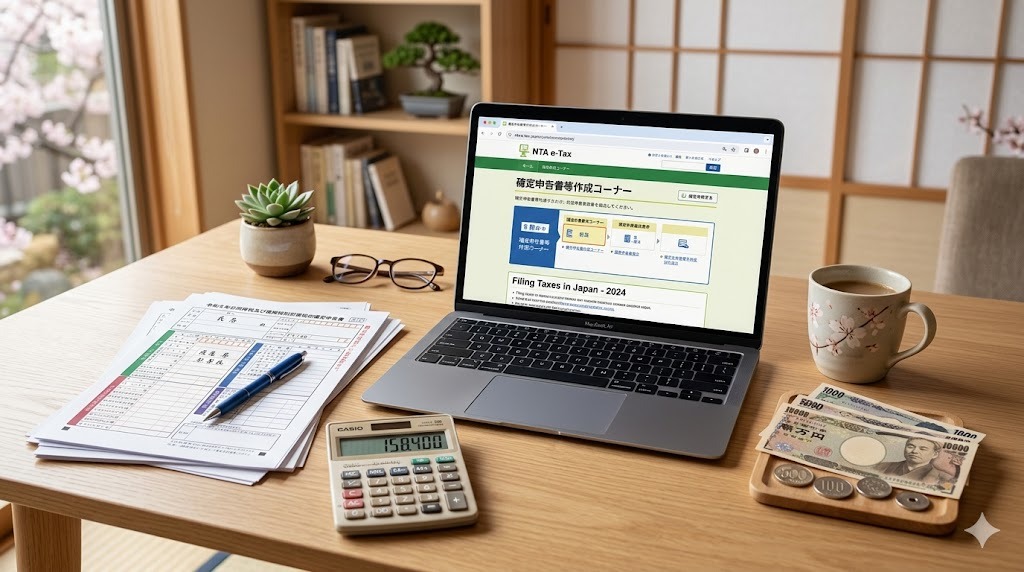
What Is Japan’s Tax System? A Quick Overview for Foreigners
Japan uses a self-assessment tax system called 確定申告 (kakutei shinkoku) — meaning “tax return filing.” If you’re a resident in Japan earning income, you may be required to file a tax return between February 16 and March 15 each year for the previous calendar year.
Japan classifies residents into three categories for tax purposes: Resident (居住者 — lived in Japan for more than 1 year), Non-Permanent Resident (非永住者 — resident for less than 5 of the last 10 years), and Non-Resident (非居住者 — stays under 1 year). Most expats working in Japan fall into the Non-Permanent Resident or Resident category.
The good news: if you work for a Japanese company, your employer typically handles income tax withholding through the year-end adjustment (年末調整), and you may not need to file separately. However, freelancers, self-employed individuals, those with multiple income sources, or anyone earning over ¥20 million per year must file independently.
Do You Need to File a Tax Return in Japan?
You MUST file if you:
- Are self-employed or a freelancer earning over ¥480,000/year
- Have income from two or more employers
- Earn side income over ¥200,000 (beyond your main salary)
- Have capital gains from selling property, stocks, or crypto
- Earn rental income
- Left Japan mid-year but had Japanese-source income
- Want to claim deductions (medical, housing loan, donations, etc.)
You do NOT need to file if you:
- Have only one employer who completed your 年末調整 (year-end adjustment)
- Your total income is below the basic deduction threshold
- You have no additional income sources to declare
Japan Income Tax Rates (2026)
Japan uses a progressive tax system. Here’s how national income tax is calculated:
| Taxable Income | Tax Rate | Deduction |
|---|---|---|
| Up to ¥1,950,000 | 5% | ¥0 |
| ¥1,950,001 – ¥3,300,000 | 10% | ¥97,500 |
| ¥3,300,001 – ¥6,950,000 | 20% | ¥427,500 |
| ¥6,950,001 – ¥9,000,000 | 23% | ¥636,000 |
| ¥9,000,001 – ¥18,000,000 | 33% | ¥1,536,000 |
| ¥18,000,001 – ¥40,000,000 | 40% | ¥2,796,000 |
| Over ¥40,000,000 | 45% | ¥4,796,000 |
Note: In addition to national income tax, you’ll also pay Resident Tax (住民税) of approximately 10%, deducted from your salary the following year. There’s also a Special Reconstruction Income Tax of 2.1% on top of income tax until 2037.
How to File Your Tax Return: Step-by-Step
Step 1: Gather Your Documents
Before filing, collect these essential documents:
- My Number Card (マイナンバーカード) — required for identity verification
- Withholding Tax Slip (源泉徴収票 / gensenchoshuhyo) — provided by your employer
- Bank account details — for tax refunds
- Receipts for deductions — medical bills, insurance payments, donation receipts
- Hanko (seal) or signature — depending on your filing method
Step 2: Choose Your Filing Method
There are three main ways to file:
- e-Tax (online filing) — Fastest and most convenient. Requires My Number Card and a card reader or the My Number Card mobile app. Available at e-tax.nta.go.jp. English guidance is limited but the process is doable.
- Tax Office (税務署 / zeimusho) — Visit in person, bring all documents, and staff can assist you. Some offices have English-speaking staff or interpreters during peak season.
- Paper Filing — Download the forms, fill them out manually, and mail or submit in person. Not recommended for beginners.
Step 3: Calculate Your Deductions
Japan offers numerous deductions that can significantly reduce your tax burden:
- Basic Deduction (基礎控除): ¥480,000 for most taxpayers
- Employment Income Deduction (給与所得控除): Varies by income level
- Medical Expense Deduction (医療費控除): Expenses over ¥100,000 (or 5% of income)
- Social Insurance Deduction (社会保険料控除): NHI and pension payments paid out-of-pocket
- Life Insurance Deduction (生命保険料控除): Up to ¥40,000 for each category
- Housing Loan Deduction (住宅借入金等特別控除): Up to 1% of outstanding mortgage balance
- Furusato Nozei (ふるさと納税): Hometown tax donation scheme — popular among expats
Step 4: Submit and Pay (or Receive a Refund)
After calculating your tax, submit your return by March 15. If you owe additional tax, payment is due on the same date. If you’ve overpaid, your refund will typically arrive within 1–3 months via bank transfer.
Tax Treaties: Japan’s Agreements with Other Countries
Japan has tax treaties with over 80 countries, including the US, UK, Canada, Australia, Germany, France, and South Korea. These treaties prevent double taxation — meaning you won’t be taxed on the same income in both Japan and your home country.
If your country has a tax treaty with Japan, you may be able to claim a tax exemption or reduced rate. Check with a tax professional or your home country’s tax authority to understand how the treaty applies to your situation.
Important for US citizens: The US taxes its citizens on worldwide income regardless of residence. Americans living in Japan must file both Japanese and US tax returns (though foreign tax credits and exclusions like the FEIE can eliminate most double taxation).
Special Situations for Foreigners
Freelancers and Self-Employed
If you’re self-employed or do freelance work in Japan, you’ll need to file a Blue Form (青色申告 / aoiro shinkoku) or White Form (白色申告) return. The Blue Form requires proper bookkeeping but offers a deduction of up to ¥650,000 — making it highly worth it for most self-employed expats.
Working Remotely for a Foreign Company
If you live in Japan but work for a company based overseas, your income may still be taxable in Japan as a resident. Japan taxes residents on worldwide income. You should consult a tax professional to ensure proper compliance and avoid unexpected bills.
Leaving Japan Mid-Year
If you leave Japan during the tax year, you must file a departure return before leaving or appoint a tax representative. You’ll be taxed on your Japanese-source income up to the departure date.
Finding a Tax Accountant (Tax Scrivener) in Japan
For complex tax situations, consider hiring a Zeirishi (税理士) — a licensed tax accountant in Japan. Fees typically range from ¥30,000–¥100,000+ depending on the complexity. Many expat-focused tax firms offer English services:
- Taxlation — English-language tax services for expats in Japan
- Japan Tax Consultants — Specializes in foreign resident taxes
- GaijinPot Jobs Tax Resources — Community recommendations and guides
- Your country’s embassy — Often maintains lists of recommended tax professionals
Useful Links and Resources
- National Tax Agency (NTA) English page
- e-Tax online filing portal
- NTA Tax Treaty Information
- Your local tax office (税務署) — find yours at nta.go.jp
Frequently Asked Questions
Do I pay taxes in Japan on my overseas income?
If you’re a Resident (lived in Japan over 1 year and intend to stay), yes — Japan taxes worldwide income. Non-Permanent Residents (less than 5 of last 10 years) are taxed on Japanese-source income plus overseas income sent to Japan. Always consult a professional for your specific situation.
What happens if I don’t file?
Failing to file when required can result in penalties (加算税) of 15–30% of the owed tax, plus late interest charges. The tax authority can also conduct audits. It’s always better to file, even late, than to not file at all.
Can I file taxes online in English?
e-Tax’s main interface is in Japanese, but the NTA provides English guidance documents and some tax offices have English-speaking staff. Several third-party services offer English-language tax filing assistance for expats.
When is the tax filing deadline?
The standard deadline is March 15 for the previous calendar year. For those seeking refunds only, you have up to 5 years to file. Extensions may be available in exceptional circumstances.
Leave a Reply