This article was created with AI writing assistance (ChatGPT, Claude, etc.). Product selection, specifications, and reviews are verified by the Japan Life Lab editorial team.
This article contains promotional / affiliate links.
Getting around Japan is one of the greatest pleasures of visiting or living in the country. The public transportation network is famously punctual, clean, safe, and extensive — connecting nearly every corner of the country. But with multiple train operators, IC card systems, reserved seating, and regional passes, it can feel overwhelming for newcomers.
Whether you’re a tourist planning a trip or an expat settling into daily life in Japan, this guide covers everything you need to know about Japanese transportation in 2026.
📌 What you will learn
You do not have to read it all — jump to what you need.
- Overview: Japan’s Transportation System
- IC Cards: The Foundation of Japanese Transit
- Shinkansen (新幹線) — Bullet Trains
- Japan Rail Pass (JR Pass) — Is It Worth It?
- Urban Rail: Navigating Tokyo, Osaka & Other Cities
- Buses in Japan
- Taxis in Japan
※ Start wherever fits your situation.
Use the Japan Rail Pass calculator — enter your journeys and it tells you instantly whether the pass beats individual tickets.
Prime members get fast, free delivery on millions of items, Prime Video and members-only deals. Eligible new members can try it free for 30 days.
Start your free 30-day Prime trial →Ages 18–24? See Prime for Young Adults
Paid links. As an Amazon Associate, Japan Life Lab earns from qualifying purchases. Trial eligibility and terms are set by Amazon.
Overview: Japan’s Transportation System
Japan’s transportation ecosystem is layered and multi-modal:
- Shinkansen (新幹線) — High-speed bullet trains connecting major cities
- JR Trains — Japan Railways Group, the primary intercity rail network
- Private Railways — Many urban areas served by private operators (Kintetsu, Tokyu, Odakyu, etc.)
- Subways (地下鉄) — Underground metro networks in major cities
- Buses (バス) — Local, express, and overnight highway buses
- Taxis (タクシー) — Widely available, premium pricing
- Domestic Flights (国内線) — For longer journeys (Tokyo–Okinawa, Hokkaido, etc.)
- Ferries (フェリー) — Connecting islands and coastal cities
IC Cards: The Foundation of Japanese Transit
The most important thing to set up before exploring Japan is an IC card. These rechargeable smart cards let you tap in and out of trains, subways, and buses across Japan — and pay at many convenience stores, vending machines, and shops.
Major IC Cards in Japan
| IC Card | Region | Works Nationwide? | Notes |
|---|---|---|---|
| Suica | Tokyo / JR East | ✅ Yes | Most versatile, works on iPhone/Android |
| PASMO | Tokyo / Private railways | ✅ Yes | Good for Tokyo subway/buses |
| ICOCA | Osaka / JR West | ✅ Yes | Best for Osaka/Kyoto/Kobe area |
| Manaca | Nagoya | ✅ Yes | Nagoya subway/Meitetsu |
| Hayakaken | Fukuoka | ✅ Yes | Fukuoka subway |
All major IC cards are interoperable — a Suica from Tokyo works on Osaka subways and vice versa. Read our complete Suica guide for setup instructions.
Shinkansen (新幹線) — Bullet Trains
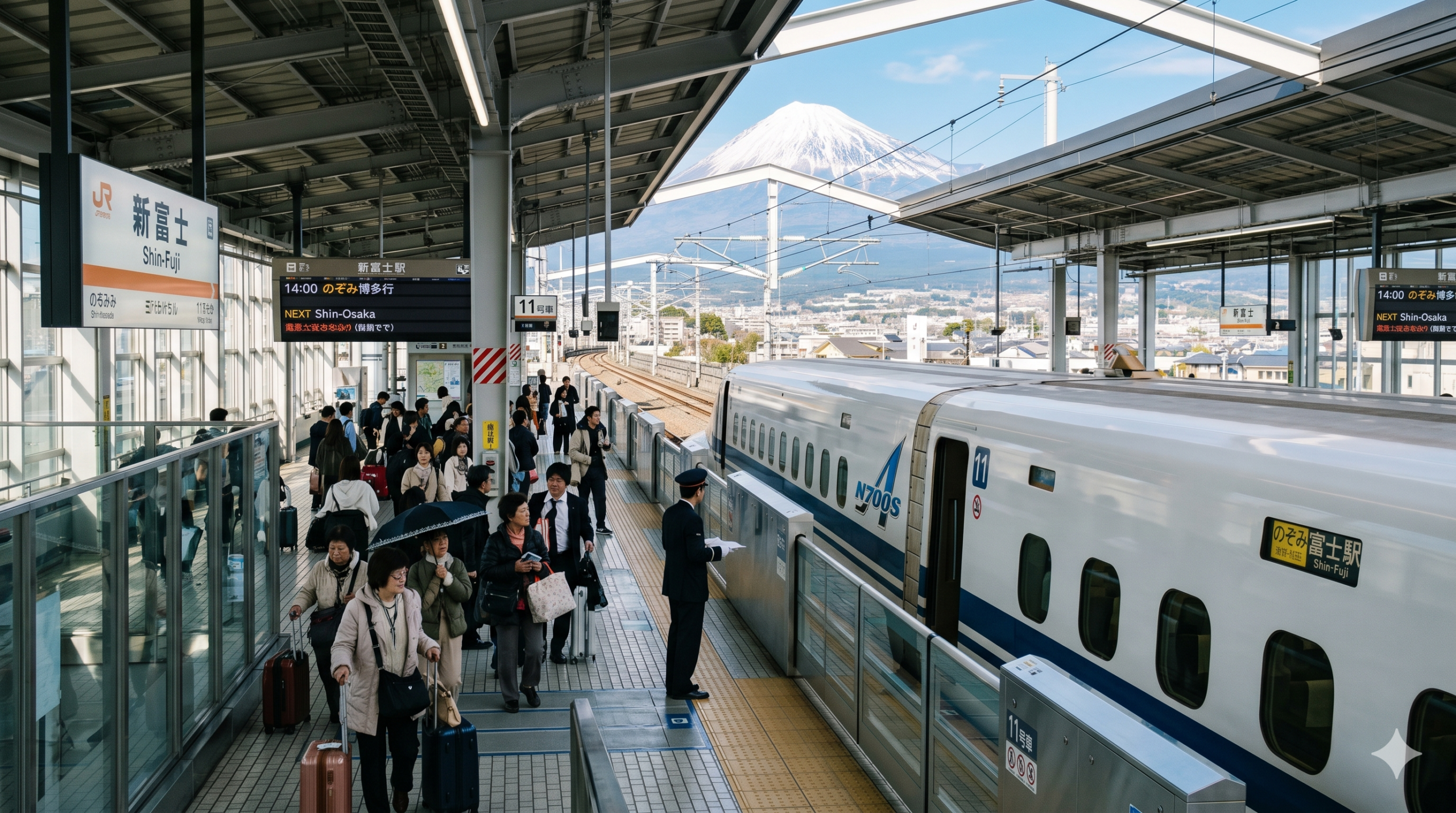
The Shinkansen is Japan’s iconic high-speed rail network, operating at speeds up to 320 km/h. It connects all major cities from Hokkaido (Sapporo) in the north to Kagoshima in the south, making it the backbone of intercity travel.
Main Shinkansen Lines
| Line | Route | Journey Time | One-way Price |
|---|---|---|---|
| Tokaido | Tokyo → Osaka | ~2h 30min (Nozomi) | ~¥14,720 |
| Tokaido | Tokyo → Kyoto | ~2h 15min | ~¥13,940 |
| Sanyo | Osaka → Hiroshima | ~1h 25min | ~¥10,690 |
| Tohoku | Tokyo → Sendai | ~1h 40min | ~¥11,410 |
| Hokuriku | Tokyo → Kanazawa | ~2h 30min | ~¥14,380 |
Booking Shinkansen Tickets
- At the station — Ticket machines (English available) or Green Window (みどりの窓口) counter
- Online — JR-WEST Online Reservation, Shinkansen e-Ticket (JR East)
- IC card — Load Shinkansen tickets onto your Suica/ICOCA for seamless boarding
- JR Pass — Foreign visitors can use the Japan Rail Pass for unlimited Shinkansen rides (Nozomi and Mizuho on the Tokaido/Sanyo lines need an extra special ticket, e.g. ¥4,960 Tokyo–Shin-Osaka)
Japan Rail Pass (JR Pass) — Is It Worth It?
The JR Pass is a special rail pass exclusively available to foreign visitors (tourist visa holders). It provides unlimited rides on most JR trains nationwide, including Shinkansen, for a fixed price over 7, 14, or 21 days. Since 1 October 2026 the prices below apply only on the official JAPAN RAIL PASS online site, which keeps them for a limited time; through overseas agencies the pass now costs ¥53,000 / ¥84,000 / ¥105,000 (Green ¥74,000 / ¥116,000 / ¥147,000).
| Pass Type | Ordinary | Green (First Class) | Best For |
|---|---|---|---|
| 7-Day | ¥50,000 | ¥70,000 | Tokyo–Kyoto–Osaka trip |
| 14-Day | ¥80,000 | ¥110,000 | Multi-city Japan tour |
| 21-Day | ¥100,000 | ¥140,000 | Extended Japan exploration |
A Tokyo → Kyoto → Tokyo round trip alone does not justify the pass (two Nozomi fares = about ¥28,340, versus ¥50,000 for the 7-day pass). Add a trip to Hiroshima or further west and the 7-day pass starts to save money. However, if you’re staying in one city, a local IC card is cheaper.
Urban Rail: Navigating Tokyo, Osaka & Other Cities
Tokyo’s Train Network
Tokyo has the world’s most complex and extensive urban rail network. Key lines include:
- JR Yamanote Line (山手線) — The circular line connecting major stations: Shinjuku, Shibuya, Harajuku, Ueno, Akihabara, Tokyo, Shinagawa
- Tokyo Metro — 9 subway lines covering central Tokyo
- Toei Subway — 4 additional lines operated by Tokyo Metropolitan Government
- Private railways — Tokyu, Odakyu, Keio, Seibu, Tobu for suburbs
Recommended Apps for Navigation
- Google Maps — Best for foreigners; shows exact train lines, platforms, fares, and walking directions
- HyperDia — stopped showing timetables in 2022; use Jorudan or Navitime for detailed schedules instead
- Jorudan — Japanese transit app with English support
- Navitime Japan — Comprehensive navigation including buses and ferries
Buses in Japan
Local Buses
Local city buses use IC cards (tap on, tap off) or cash. In most cities, you board from the rear and exit from the front, paying as you exit. Some rural buses require you to take a numbered ticket on entry and pay based on distance.
Highway Buses (高速バス)
Long-distance highway buses (高速バス/夜行バス) are Japan’s budget travel option. Tokyo–Osaka by overnight bus costs ¥3,000–¥8,000 (vs ¥14,720 for Shinkansen). Popular operators include Willer Express, JR Bus, and Meitetsu Bus. Book online at:
- Willer Express (English available)
- Japan Bus Online
- Kosoku Bus
Taxis in Japan
Japanese taxis are safe, clean, and metered — but expensive. Average fares:
- Flag fall: ¥500–¥750 (first ~1 km)
- Additional: ~¥100 per 300m
- Tokyo airport → central Tokyo: ¥5,000–¥8,000
Taxi Apps
- GO (ゴー) — Japan’s leading taxi app, works across most cities
- S.RIDE — Tokyo taxi booking app
- DiDi — Ride-hailing available in major cities
- Uber — Available in some areas, but uses licensed taxi drivers (not rideshare)
Domestic Flights
For long distances (Tokyo to Okinawa, Hokkaido, or Kyushu), domestic flights are often faster and cheaper than Shinkansen. Japan has excellent low-cost carriers:
| Airline | Type | Key Routes | Booking |
|---|---|---|---|
| ANA | Full service | All major cities | ana.co.jp |
| JAL | Full service | All major cities | jal.co.jp |
| Peach | LCC | Osaka hub, Okinawa, Sapporo | flypeach.com |
| Jetstar Japan | LCC | Tokyo, Nagoya, Osaka | jetstar.com/jp |
| Skymark | Midrange | Tokyo, Kyushu, Okinawa | skymark.co.jp |
Airport Access: Getting To/From Tokyo’s Airports
Narita Airport (NRT) → Tokyo
- Narita Express (N’EX) — ¥3,070 to Shinjuku, ~1h 30min (JR Pass valid)
- Keisei Skyliner — ¥2,570 to Ueno, ~41min (fastest option)
- Keisei Limited Express — ¥1,050 to Ueno, ~1h 20min (budget option)
- Airport Limousine Bus — ¥3,200, convenient for hotels, no transfers
- Taxi — ¥20,000–¥25,000 (avoid for budget travelers)
Haneda Airport (HND) → Tokyo
- Tokyo Monorail — ¥500–¥750 to Hamamatsucho, ~20min
- Keikyu Line — ¥330 to Shinagawa, ~13min
- Airport Limousine Bus — ¥1,000–¥1,500 to major hotels
- Taxi — ¥5,000–¥8,000 to central Tokyo
Renting a Car in Japan
Driving in Japan is surprisingly accessible for foreign visitors. You’ll need an International Driving Permit (IDP) from your home country (available before you leave). Key points:
- Drive on the left side of the road
- Toll roads (有料道路) are common — ETC cards are offered by rental agencies
- Parking is expensive in cities (¥300–¥600/hour) but cars are essential in rural areas
- Car rental: Toyota Rent a Car, Times Car, Nippon Rent-A-Car, Budget
- Gas is ~¥170–¥180/liter (2026 prices)
Frequently Asked Questions About Getting Around Japan
What is the best way to get around Japan as a tourist?
The best combination for most tourists is: Shinkansen for intercity travel + IC card (Suica/PASMO) for city transit + Google Maps for navigation. If you’re visiting 3+ cities in 7 days, the JR Pass often pays for itself.
Can I use credit cards on Japanese trains?
Most train gates in Japan do NOT accept credit cards directly. You need an IC card (Suica, PASMO, etc.) or a physical ticket. However, you can charge your IC card using a credit card at most vending machines, and Apple Pay/Google Pay with Suica linked works for contactless payment.
How do I use the Shinkansen for the first time?
Buy or reserve your ticket at a ticket machine or window. Go to the Shinkansen gate (separate from local trains), insert your ticket or tap your IC card, find your platform based on train name and direction, and board the correct car — car number and seat number are on your ticket. Train staff walk through to check tickets.
Is English signage available on Japanese trains?
Yes — most train stations in Tokyo, Osaka, Kyoto, and major tourist areas have English (and often Chinese/Korean) signage. Station names are displayed in both Japanese and Roman letters. Announcements on Shinkansen and major city trains are made in English. Rural areas may have less English signage, where Google Maps Translate can help.
What is the cheapest way to travel between Tokyo and Osaka?
The cheapest option is an overnight highway bus (¥3,000–¥5,000 one way on services like Willer Express). Budget flights (Peach, Jetstar) can also be cheaper than Shinkansen when booked in advance (¥5,000–¥10,000). The Shinkansen is most expensive but fastest and most convenient.
Quick Reference: Japan Transportation Costs
| Journey | Fastest Option | Budget Option | Time Difference |
|---|---|---|---|
| Tokyo → Osaka | Shinkansen ¥14,720 | Night bus ¥3,000 | 2.5h vs 8h |
| Tokyo → Kyoto | Shinkansen ¥13,940 | Night bus ¥3,000 | 2.2h vs 7h |
| Tokyo → Sapporo | Flight ¥8,000–¥20,000 | Shinkansen ¥24,000 | 1.5h vs 5h+ |
| Tokyo → Okinawa | Flight ¥10,000–¥30,000 | LCC ¥7,000+ | 2.5h (no alternatives) |
Tips for Navigating Japan’s Transit System
- Always keep ¥2,000+ on your IC card — running out mid-journey means using a fare adjustment machine
- Stand on the left on escalators (Osaka: stand on the right) — this is serious etiquette
- No phone calls on trains — set your phone to silent and speak quietly
- Priority seats — give up seats near doors to elderly, pregnant, or disabled passengers
- Large luggage — reserve a luggage space on Shinkansen when bringing large bags
- Last train times — check the last train schedule; missing it means a taxi or waiting until morning
- IC card refund — you can return your Suica/PASMO at JR stations when leaving Japan (¥220 handling fee)
🚆 More Japan Travel Essentials
🔥 Editor’s Picks for Life & Travel in Japan

Japan Expat Starter Kit 2026 PDF guide
Your first 90 days in Japan, step by step: 17 chapters · 24 pages · 100 phrases in Japanese script · 40 kanji · printable checklists. Bank account, My Number, health insurance, apartment, phone, taxes & pension.
$9.99 $4.99 current price
📥 Get the kit →📄 Read 5 pages free: contents + Chapter 2
⚡ Instant PDF download · 🛡️ 30-day money-back guarantee · 🔄 Free 2026 updates
Practical guides for life and travel in Japan — free, about once a week. No spam, unsubscribe anytime.
☕ Enjoying our Japan guides?
If this article helped you, you can support our work with a coffee!
Did this guide help you? 🍵
Japan Life Lab is a small independent blog, and every guide we publish is completely free — no paywalls, ever. If our work saved you time (or a headache), you can support us with a cup of Japanese tea. Every contribution, big or small, goes straight into keeping these guides free, accurate and up to date for everyone.
☕ Support Japan Life Lab
Leave a Reply