This article was created with AI writing assistance (ChatGPT, Claude, etc.). Product selection, specifications, and reviews are verified by the Japan Life Lab editorial team.
This article contains promotional / affiliate links.
📌 What you will learn
You do not have to read it all — jump to what you need.
- Part 1 — Can you legally drive? Three routes, and one that surprises people
- Part 2 — What it actually costs
- Part 3 — Tolls and expressway passes
- Part 4 — The driving rules foreigners get wrong
- Part 5 — Fuel, cards and car sharing
- A realistic five-day budget
- Frequently asked questions
※ Start wherever fits your situation.
Japan is a country you should drive in — once you know the five rules that catch everyone out
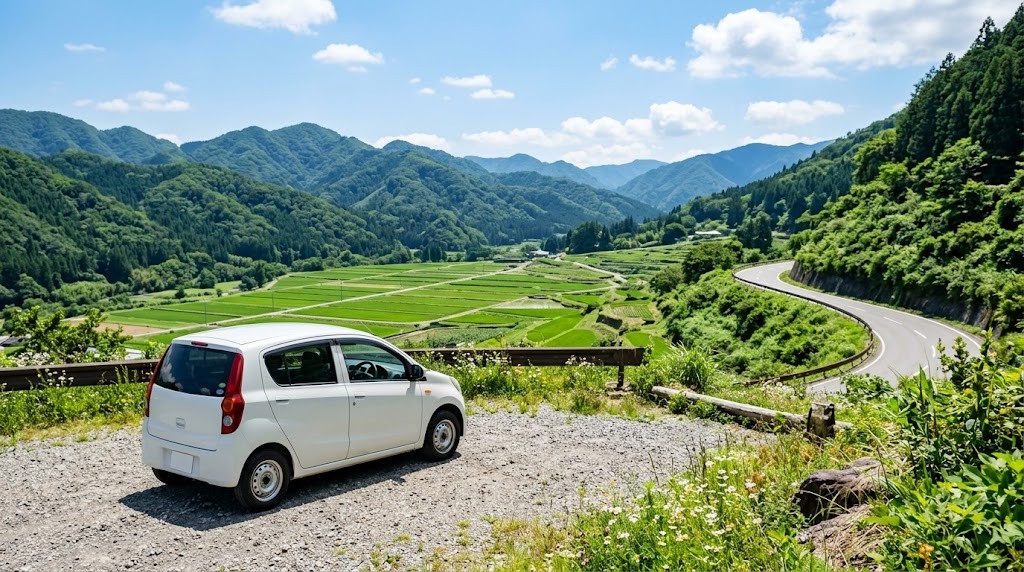
The trains are famously good, which is exactly why most visitors never rent a car. But the moment you want to see the Noto coastline, the farm roads of Hokkaido, a pottery village in Saga, or an onsen with no bus service after 4pm, a car stops being optional. Japanese roads are well maintained, signage is bilingual on major routes, and drivers are calm and predictable.
What trips people up is paperwork and small print. This guide is built entirely on primary sources — the National Police Agency, the Tokyo Metropolitan Police Department, e-Gov statute texts, JAF, the rental companies’ own published rate cards, and METI’s weekly fuel survey — checked in August 2026. Where a figure could not be verified, it says so rather than guessing.
Part 1 — Can you legally drive? Three routes, and one that surprises people
Route A: an International Driving Permit (1949 Geneva Convention)
This is the route for most visitors. But three details matter more than people realise.
| Which treaty | Only IDPs issued under the Convention on Road Traffic signed at Geneva on 19 September 1949. IDPs issued under the 1968 Vienna Convention are not valid in Japan. |
|---|---|
| How long it lasts | One year from the date you land in Japan, or the IDP’s own expiry, whichever is shorter. It is not “one year from the date of issue.” |
| Where to get it | In your home country, before you travel. You cannot obtain an IDP inside Japan. |
| After one year | Once a year has passed since your landing date, your foreign licence and IDP stop being valid in Japan even if the IDP has not expired. You must convert to a Japanese licence. |
⚠️ Watch out
- Fifteen countries are parties to the Geneva Convention but do not issue IDPs in the Geneva format, so their IDPs cannot be used in Japan. These include France, Belgium, Monaco, Albania, Serbia and Russia.
- France, Belgium and Monaco are covered instead by the translation route below.
- Drivers holding Russian, Serbian or Albanian licences have no short-stay route at all — only full conversion to a Japanese licence.
- Verify your own jurisdiction on the Tokyo Metropolitan Police Department list before you book anything.
Route B: an official Japanese translation — exactly six jurisdictions
If your licence was issued in one of the following, you do not need an IDP. You need your licence plus an officially recognised Japanese translation.
| Jurisdiction | Notes |
|---|---|
| Switzerland | Translation route |
| Germany | Translation route (ADAC may also issue) |
| France | Translation route — France does not issue Geneva-format IDPs |
| Belgium | Translation route — same reason |
| Monaco | Translation route — same reason |
| Taiwan | Translation route (Taiwan-Japan Relations Association may also issue) |
⚠️ Watch out
- Slovenia is NOT on this list. Slovenia appears on a different list — the 29 jurisdictions exempt from tests when converting to a Japanese licence — which is where the confusion comes from. Slovenian drivers use an IDP.
- Estonia is on neither list.
- Monaco is on the translation list.
Who can issue the translation: the issuing authority itself; that country’s embassy or consulate in Japan; designated foreign bodies (the Taiwan-Japan Relations Association, ADAC for Germany); and three Japanese organisations — JAF, Ziplus, and the Association for Supporting Inbound Drivers.
| JAF fee | ¥6,600 including 10% consumption tax, effective 1 July 2026 (previously ¥6,000, tax-exempt) |
|---|---|
| How to apply | Online only. JAF no longer accepts counter or postal applications. |
| Processing time | 2–3 business days for the six listed jurisdictions; 5–10 business days otherwise |
| Plan ahead | Apply before you fly. Translations are not something you can sort out at the airport. |
Route C: converting to a Japanese licence (gaimen kirikae) — and what changed in October 2025
If you live in Japan, this is the route you will eventually need. The rules were significantly tightened on 1 October 2025.
| Element | Before 1 Oct 2025 | From 1 Oct 2025 |
|---|---|---|
| Knowledge test questions | 10 | 50 |
| Pass mark | 7 out of 10 (70%) | 45 out of 50 (90%) |
| Illustration questions | Present | Abolished |
| Practical test | — | Crosswalk-transit tasks added; marking criteria made stricter |
| Proof of address | Looser | Residents covered by the Resident Registration Act must produce a residence-record extract showing specified particulars (住民票) |
Other requirements that have not changed: your licence must be currently valid; you must prove a cumulative stay of at least three months in the issuing country after the licence was issued (passport stamps are the usual evidence); minimum age 17 years 6 months for a standard licence; vision 0.7 both eyes / 0.3 each. Tokyo fees are ¥1,600–¥3,900 application depending on class, plus ¥2,350 issuance.
Twenty-nine jurisdictions are exempt from both the knowledge and practical tests: Iceland, Ireland, the USA (only Ohio, Oregon, Colorado, Virginia, Hawaii, Maryland and Washington), the UK, Italy, Australia, Austria, the Netherlands, Canada, South Korea, Greece, Switzerland, Sweden, Spain, Slovenia, the Czech Republic, Denmark, Germany, New Zealand, Norway, Hungary, Finland, France, Belgium, Poland, Portugal, Monaco, Luxembourg and Taiwan. (Indiana is exempt from the practical test only.)
The re-entry trap that catches long-stay residents
This is the most consistently misreported rule in English-language guides, so here it is straight from the National Police Agency’s own diagram.
| Situation | Effect on your one-year clock |
|---|---|
| You leave Japan and return after 3 months or more abroad | The new landing date restarts the one-year clock |
| You leave and return after less than 3 months | The re-entry does not restart the clock. The original landing date still governs |
| More than a year has passed since your original landing, and you take a short trip abroad and come back with a fresh IDP | You still cannot legally drive. The NPA states this explicitly |
Part 2 — What it actually costs
Daily rates: Toyota Rent a Car’s published card (all prices include 10% tax)
Toyota is the only major chain publishing a complete static rate card in English, so it makes the cleanest baseline. “Tokyo” means the 23 wards, Oshima and Narita Airport branches.
| Class | Example models | 6h | 12h | 24h | Tokyo 24h |
|---|---|---|---|---|---|
| C1 compact | Vitz, Passo, Roomy | ¥7,370 | ¥7,920 | ¥10,340 | ¥11,990 |
| C4 mid-size | Camry, Mark X (5 seats, 2,400cc) | ¥13,970 | ¥16,390 | ¥20,790 | ¥22,660 |
| W1 small minivan | Sienta, Isis, Wish (6–7 seats) | ¥9,240 | ¥11,880 | ¥15,840 | ¥17,380 |
| W2 minivan | Voxy, Noah, Esquire (7–8 seats) | ¥15,730 | ¥16,940 | ¥22,990 | ¥26,070 |
| W3 large minivan | Alphard, Vellfire, Estima | ¥18,810 | ¥24,200 | ¥30,250 | ¥33,660 |
Toyota flags regional peak-season surcharges for Hokkaido in summer, Okinawa over holidays, and Tokyo in high season. Nippon Rent-A-Car publishes one comparable example: S-S class (Fit) at the Members Club rate, 6h ¥5,830 / 12h ¥6,490 / 24h ¥8,030, with each extra day ¥6,490 and each extra hour ¥1,100.
Times, Nissan, Budget and Orix route everything through JavaScript booking engines and publish no static rate card, so any figure quoted for them would be a guess. Get a live quote instead.
Insurance, CDW and the NOC that nobody warns you about
This is where visitors get an unpleasant surprise at drop-off. Confirmed at two chains:
| Item | Toyota | Orix |
|---|---|---|
| Bodily injury | Unlimited per person | Unlimited |
| Property damage | Unlimited per accident, ¥50,000 deductible | Unlimited, ¥50,000 deductible |
| Vehicle damage | Actual value, ¥50,000 deductible (¥100,000 large vehicles) | Actual value, ¥50,000–¥100,000 by class |
| Personal injury | Up to ¥30,000,000 per person | Up to ¥30,000,000 |
| CDW (deductible waiver) | ¥1,100 / 24h (¥2,200 large) | ¥1,100–¥2,200 / 24h |
| NOC — car still drivable | ¥20,000 | ¥20,000 |
| NOC — not drivable / not returned | ¥50,000 | ¥50,000 |
| NOC waiver plan | “Double Protection” +¥550 / 24h on top of CDW; also covers tyre and hubcap repair | “RAP” safety pack ¥660 / 24h (¥1,320 premium); waives NOC, covers tyre repair, ¥20,000 late-return grace |
⚠️ Watch out
- NOC (Non-Operation Charge) is not covered by CDW. Orix states this explicitly. CDW waives your damage deductible; NOC is a separate charge for the revenue the company loses while the car is off the road.
- So a minor scrape with CDW purchased still costs you ¥20,000 — or ¥50,000 if the car has to be recovered.
- The waiver is remarkably cheap: ¥550/24h at Toyota, ¥660/24h at Orix. Over a five-day rental that is ¥2,750–¥3,300 to eliminate a ¥50,000 exposure.
- Buy it. This is the single best-value line item on the whole counter menu.
Options, with confirmed prices
| Option | Toyota | Orix |
|---|---|---|
| ETC card rental | ¥550 per rental | ¥550 per rental |
| ETC on-board device | Free (fitted as standard) | Free (fitted as standard) |
| Car navigation | Free | Free |
| Baby / infant seat | ¥1,650 per rental | ¥1,650 per rental |
| Child seat (6mo–4yr) | — | ¥1,650 per rental |
| Junior seat | ¥1,100 per rental | ¥1,100 (4–6yr) |
| Winter / studless tyres | ¥2,200 / 24h cars and vans; ¥3,300 / 24h wagons and SUVs | ¥2,640~ / 24h |
| Tyre chains | Varies by branch | ¥3,300~ per rental |
| 4WD | ¥1,650 / 24h | ¥1,650 / 24h |
| JAF membership certificate | ¥550 per rental | — |
The ETC card question
ETC is Japan’s electronic toll system. Without a card you queue at manned booths and pay cash — workable, but slower and you lose ETC-only discounts.
✅ Good to know
- Rent the card from the rental company: ¥550 per rental at both Toyota and Orix. Tolls are tallied and settled when you drop the car off. This is the answer for visitors.
- The on-board device is fitted as standard and costs nothing.
- You do not need a Japanese bank account or credit card to use the rental route.
⚠️ Watch out
- You cannot obtain your own ETC card with a foreign-issued credit card. ETC credit cards in Japan are issued attached to a Japanese credit card contract.
- The ETC Personal Card exists for people without a Japanese credit card — a security deposit from ¥3,000 and an annual fee of ¥1,257 — but it is designed for residents, not tourists.
- For a trip of any length, the ¥550 rental card is simply the right answer.
Child seats: the law is about age, not height
Article 71-3(3) of the Road Traffic Act prohibits driving with a “young child” not using a child restraint, and Article 14 defines a young child as a person under six years of age.
⚠️ Watch out
- The requirement is age-based: under 6. There is no 140 cm rule in the Road Traffic Act. The 140 cm figure that circulates online is a manufacturer and safety guideline, not a legal threshold.
- Rental seats are ¥1,100–¥1,650 per rental and must be reserved in advance — branches carry limited stock.
- Bringing your own seat is fine, but check it can be installed with a Japanese seatbelt or ISOFIX anchor.
One-way and drop-off fees
Orix publishes a full schedule, which makes it the best reference point:
| Region | Structure |
|---|---|
| Honshu / Shikoku / Kyushu | Under 20 km free; 20–50 km ¥5,500 (¥6,600 luxury, wagon, commercial van); then +¥5,500–¥6,600 per additional 50 km |
| Hokkaido | Eight-block system (Hakodate, Sapporo, Chitose, Asahikawa, Obihiro, Kitami-Memanbetsu, Kushiro, Nakashibetsu): ¥5,500–¥35,200 standard class |
| Okinawa | Eight-zone system: ¥1,100–¥8,800 all classes |
Orix revised its Hokkaido rates on 1 June 2026 and Okinawa on 10 July 2026, so check current figures at booking. One-way rentals are generally unavailable between Hokkaido or Okinawa and other regions, and between islands — Toyota confirms the same restrictions.
Winter tyres in Hokkaido and Tohoku
Every major chain fits winter tyres by default in Hokkaido during the season, and rentals there in winter effectively come with them. Costs are ¥2,200–¥3,300 per 24h at Toyota and ¥2,640~ at Orix — note that Orix began charging separately for studless tyres from October 2024, having previously bundled them.
Part 3 — Tolls and expressway passes
The Japan Expressway Pass: suspended, not confirmed dead
A lot of guides still recommend the JEP. Here is its actual status as of August 2026.
| Status | NEXCO West’s official JEP page still reads: “We stop new reservation for JEP to prevent spread of Coronavirus infection.” It has not been reinstated and the page has not been updated. |
|---|---|
| Launched | 13 October 2017 |
| Historic price | 7 days ¥20,400 / 14 days ¥34,600 (rental car not included) |
| Eligibility (when running) | Non-Japanese passport holder, or Japanese citizen with permanent residence abroad, holding a licence valid in Japan; used via an ETC card at a participating rental company |
| Excluded | Hokkaido expressways, Shuto and Hanshin urban expressways |
| Correct wording for 2026 | Suspended to new bookings since 2020 and not reinstated as of August 2026. No formal discontinuation date has been published. |
The pass that definitely does exist: Kyushu Expressway Pass (KEP)
Operated by NEXCO West. This is the only visitor pass fully verifiable in August 2026.
| Days | Price | Days | Price |
|---|---|---|---|
| 2 | ¥6,200 | 7 | ¥17,200 |
| 3 | ¥8,400 | 8 | ¥19,400 |
| 4 | ¥10,600 | 9 | ¥21,600 |
| 5 | ¥12,800 | 10 | ¥23,800 |
| 6 | ¥15,000 | — | — |
👍 Best for
- Non-Japanese passport holders, or Japanese citizens with permanent residence abroad
- Holders of a licence usable in Japan
- Rental-car customers only — 15 participating operators are listed
- Note: Toyota is currently marked “not accepted” for KEP, so choose your rental chain accordingly
Coverage is unlimited use of the Kyushu Expressway network, excluding urban expressways and certain toll roads.
Do not confuse the Hokkaido passes
The old visitor-facing Hokkaido Expressway Pass URL now returns a 404. What NEXCO East currently sells is HOKKAIDO LOVE! Michi-toku Free Pass, and it is a domestic ETC product, not a visitor product — it requires the customer’s own ETC card and has no foreign-passport eligibility.
| Days | Standard vehicle | Days | Standard vehicle |
|---|---|---|---|
| 2 | ¥8,000 | 5 | ¥11,700 |
| 3 | ¥9,000 | 6 | ¥12,700 |
| 4 | ¥10,700 | 7 | ¥13,700 |
(Period A, 1 April – 6 December 2026. Kei-car rates ¥6,400–¥11,200. Blackout dates apply over Golden Week, Obon and Silver Week.)
Part 4 — The driving rules foreigners get wrong
1. The 30 km/h change on 1 September 2026 — confirmed in the statute
Cabinet Order No. 248 of 2024 amends Article 11 of the Road Traffic Act Enforcement Order with effect from 1 September 2026. The previous text set a flat 60 km/h for cars on general roads; the new text splits it into categories.
| Category | Roads covered | Limit |
|---|---|---|
| Item 1 | Expressway national roads (main carriageway and adjacent acceleration/deceleration lanes excepted); motor-vehicle-only roads; general roads with a centre line or lane markings laid out by road signs or markings; general roads where opposing traffic is separated by road structure or barriers | 60 km/h |
| Item 2 | Every other general road | 30 km/h |
⚠️ Watch out
- The trigger is the presence of a centre line or lane marking — not road width and not a “residential road” designation. Several English write-ups get this wrong.
- If you turn off a marked road into a narrow street with no painted centre line, the default limit is now 30 km/h.
- Posted signed limits still override the statutory default, exactly as before.
- Mopeds remain at 30 km/h, unchanged.
2. Drink driving: the prohibition is absolute, the punishment threshold is not the same thing
Article 65(1) of the Road Traffic Act reads: “No person shall drive a vehicle while carrying alcohol.” That is a zero-tolerance prohibition. The numeric thresholds below are the trigger for criminal punishment, not the point at which driving becomes illegal.
| Breath | 0.15 mg per litre |
|---|---|
| Blood | 0.3 mg per millilitre |
| Offence | Penalty |
|---|---|
| Drunk driving (actually intoxicated state) | Up to 5 years’ imprisonment or a fine up to ¥1,000,000 |
| Providing a vehicle to a person who then drives drunk | Same: up to 5 years / ¥1,000,000 |
| Driving over the threshold | Up to 3 years’ imprisonment or a fine up to ¥500,000 |
| Providing a vehicle | Up to 3 years / ¥500,000 |
| Providing alcohol to, or urging drinking on, someone likely to drive | Up to 3 years / ¥500,000 |
| Riding as a passenger knowing the driver has been drinking | Up to 3 years / ¥500,000 |
3. Seat belts — in every seat, on every road
Article 71-3(2) prohibits driving with any person occupying a seat fitted with a belt without wearing it. The legal obligation is not limited to expressways — that widely repeated claim confuses the duty with the demerit-point regime, which does treat expressways differently. The duty itself applies everywhere.
4. There is no right turn on red
Japan drives on the left, so the “turn across nothing” manoeuvre is a left turn — and on a red light it is prohibited without exception. Article 2 of the Enforcement Order is blunt: at a red signal, “vehicles must not proceed beyond the stop position.” The only allowance is for a vehicle already inside the intersection mid-turn, which may complete the movement.
✅ Good to know
- The green arrow signal (青矢印) is the mechanism you actually need to understand. The statute says a vehicle may proceed in the direction of the arrow regardless of a yellow or red main signal.
- So at a big intersection you will often see a red main light with a green arrow pointing right. That means: right turns go now.
- Visitors routinely sit still at these, blocking the queue, because they read only the red lamp.
- Look at the arrows, not just the circles.
5. Street parking is not a thing
Parking is prohibited by default on most urban roads, vehicle ownership itself requires proof of an off-street space, and civilian parking observers patrol continuously — the Tokyo MPD confirms they cover the entire metropolis. Confirmed Tokyo penalties:
| Violation | Large vehicle | Standard / kei car | Motorcycle |
|---|---|---|---|
| No-stopping-or-parking zone | ¥25,000 | ¥18,000 | ¥10,000 |
| No-parking zone | ¥21,000 | ¥15,000 | ¥9,000 |
⚠️ Watch out
- Add ¥2,000 for violations in senior-driver reserved parking sections.
- When the driver is not identified, the charge falls on the registered owner. For a rental car that means the rental company bills you, usually with an administration fee on top.
- The MPD states explicitly that paying the charge does not erase demerit points.
- Use coin parking (コインパーキング). Every town has it, it is well signposted, and it is vastly cheaper than a ticket.
6. What the law requires after an accident
Article 72(1) imposes three duties, in this order:
- Stop driving immediately.
- Aid anyone injured.
- Take measures to prevent danger on the road (hazard lights, warning triangle, move to safety if possible).
The same paragraph then requires you to report to the police — to an officer at the scene, or otherwise at the nearest police station — stating the time and place, casualties, damage, cargo and the measures you took.
| Police | 110 |
|---|---|
| Ambulance / fire | 119 |
| Is reporting optional? | No. It is a legal obligation. There is no “settle it privately” route. |
| Insurance | Your rental insurance will not respond without a police accident certificate. Reporting protects you. |
Part 5 — Fuel, cards and car sharing
Fuel prices, checked this week
From the Agency for Natural Resources and Energy weekly retail survey, published 13 August 2026 for prices as at Monday 10 August 2026:
| Fuel | National average |
|---|---|
| Regular petrol | ¥170.1 / litre — unchanged for a second consecutive week |
| Diesel | ¥159.5 / litre |
| Kerosene | ¥140.8 / litre (¥2,534 per 18 L) |
This series updates weekly, so treat the figure as a snapshot. A compact car doing 500 km at roughly 18 km/L is about 28 litres, or around ¥4,700 in fuel.
Foreign cards at unmanned pumps: we genuinely do not know
Car sharing (Times Car Share, Careco)
Neither operator publishes eligibility criteria on a page we could verify. The widely repeated claim that membership requires a Japanese licence and a Japanese address is plausible but unverified. In practice these services are built around residents with Japanese payment methods and a registration process conducted in Japanese. If you are visiting, plan on a conventional rental; if you live here, contact the operator directly rather than relying on second-hand claims.
A realistic five-day budget
Compact car, two adults, Tokyo pick-up, roughly 700 km of mixed driving, dropped back in Tokyo.
| Item | Cost | Note |
|---|---|---|
| Car rental, C1 compact, 5 × 24h Tokyo rate | ¥59,950 | ¥11,990 × 5 |
| CDW | ¥5,500 | ¥1,100 × 5 |
| NOC waiver | ¥2,750 | ¥550 × 5 — do not skip this |
| ETC card rental | ¥550 | Per rental, not per day |
| Fuel, roughly 39 L at ¥170.1 | ¥6,634 | 700 km at about 18 km/L |
| Expressway tolls | Check live | Use the official toll search — we will not invent a figure |
| Coin parking, 5 days | ¥5,000–¥15,000 | Highly location-dependent |
| Subtotal before tolls and parking | ¥75,384 |
Split between two people that is roughly ¥7,500 each per day before tolls — competitive with rail once you are outside the Shinkansen corridors, and incomparably better for reaching places trains do not go.
Frequently asked questions
Do I need an International Driving Permit to rent a car in Japan?
Unless your licence was issued in Switzerland, Germany, France, Belgium, Monaco or Taiwan — which use an official Japanese translation instead — yes. It must be issued under the 1949 Geneva Convention; 1968 Vienna Convention permits are not valid in Japan. You cannot obtain an IDP inside Japan, so arrange it before you travel.
How long is my IDP valid in Japan?
One year from the date you land in Japan, or the IDP’s own expiry date, whichever comes first. It is not one year from the date of issue. After that year you must convert to a Japanese licence to keep driving.
Can I leave Japan briefly and come back to reset the one-year clock?
Not if you are registered in Japan’s Basic Resident Register. The National Police Agency states that a re-entry after less than three months abroad does not restart the clock, and that a resident whose original landing was more than a year ago cannot drive even with a fresh IDP. Only an absence of three months or more restarts it.
Is Slovenia on the translation list?
No. The translation list is exactly six jurisdictions: Switzerland, Germany, France, Belgium, Monaco and Taiwan. Slovenia appears on a different list — the 29 jurisdictions exempt from tests when converting to a Japanese licence — which is the usual source of confusion. Slovenian drivers need an IDP.
What is NOC and why did I get charged after a tiny scratch?
NOC (Non-Operation Charge) compensates the rental company for revenue lost while the car is off the road for repair. It is ¥20,000 if the car can still be driven to the shop and ¥50,000 if it cannot. Crucially, CDW does not waive it — Orix states this explicitly. The optional waiver costs ¥550/24h at Toyota or ¥660/24h at Orix and is worth buying every time.
Can tourists get an ETC card?
You can rent one from the rental company for ¥550 per rental at both Toyota and Orix, with tolls settled at drop-off. You cannot obtain a personal ETC card with a foreign-issued credit card, because ETC credit cards in Japan are issued attached to a Japanese credit card contract.
Is the Japan Expressway Pass still available?
No. NEXCO West’s official page still carries the 2020 notice suspending new reservations, and it has not been reinstated as of August 2026. No formal discontinuation date has been published. The Kyushu Expressway Pass, at ¥6,200 for 2 days up to ¥23,800 for 10 days, is confirmed as still operating — though Toyota is currently marked as not accepted for it.
What is the child seat law in Japan?
Article 71-3(3) of the Road Traffic Act prohibits driving with a child not using a child restraint, and Article 14 defines a child as a person under six years of age. The rule is age-based. There is no 140 cm legal threshold — that figure is a manufacturer and safety guideline, not law. Rental seats are ¥1,100–¥1,650 per rental and should be reserved in advance.
What changed on 1 September 2026?
Cabinet Order No. 248 of 2024 lowers the default statutory speed limit on general roads from 60 km/h to 30 km/h, except where the road has a centre line or lane markings laid out by signs or markings, or where opposing traffic is physically separated. The trigger is the presence of a centre line, not road width. Posted limits still override the default.
Can I turn on a red light in Japan?
No. Article 2 of the Enforcement Order requires vehicles not to proceed beyond the stop position at a red signal, with no equivalent of the American right-on-red. What you need to watch for is the green arrow signal, which permits movement in the arrow’s direction regardless of a red or yellow main light — that is how right turns are handled at major intersections.
Is it illegal to ride with a driver who has been drinking?
Yes. Article 65 prohibits riding as a passenger with a driver you know has been drinking if you requested or asked to be carried, and the penalty is up to three years’ imprisonment or a ¥500,000 fine. Providing alcohol to, or urging drinking on, someone likely to drive carries the same penalty.
How much is petrol in Japan?
As at 10 August 2026, the national average for regular petrol was ¥170.1 per litre, per the Agency for Natural Resources and Energy’s weekly survey. Diesel was ¥159.5. The survey updates weekly, so check the current figure before budgeting.
The short version
- Get a 1949 Geneva Convention IDP before you fly — unless your licence is from Switzerland, Germany, France, Belgium, Monaco or Taiwan, in which case get a JAF translation (¥6,600, online only).
- Your IDP runs one year from landing, and a short trip abroad does not reset it.
- Buy the NOC waiver. ¥550–¥660 a day to remove a ¥50,000 exposure that CDW does not cover.
- Rent the ETC card for ¥550. There is no realistic alternative for a visitor.
- Child seats are required under age 6 — age, not height.
- From 1 September 2026, roads without a centre line default to 30 km/h.
- Zero alcohol. Buying a drink for a driver, or riding with one, are criminal offences.
- Watch the green arrows, never turn on red, and never park on the street.
- After any accident: stop, help, secure the scene, call 110. Reporting is a legal duty and your insurance depends on it.
Get those right and Japan becomes one of the most rewarding countries on earth to drive in — quiet mountain roads, immaculate surfaces, roadside stations selling produce picked that morning, and an onsen at the end of the day with a car park instead of a bus timetable.
🔥 Editor’s Picks for Life & Travel in Japan
Japan Expat Starter Kit 2026 PDF guide
Your first 90 days in Japan, step by step: 17 chapters · 24 pages · 100 phrases in Japanese script · 40 kanji · printable checklists. Bank account, My Number, health insurance, apartment, phone, taxes & pension.
$9.99 $4.99 current price
📥 Get the kit →📄 Read 5 pages free: contents + Chapter 2
⚡ Instant PDF download · 🛡️ 30-day money-back guarantee · 🔄 Free 2026 updates
Practical guides for life and travel in Japan — free, about once a week. No spam, unsubscribe anytime.
☕ Enjoying our Japan guides?
If this article helped you, you can support our work with a coffee!
🇯🇵 Travel & Life Essentials for Japan
Hand-picked gear to make your time in Japan easier. Available on Amazon US & Amazon Japan.
🔋 Portable charger
A must for long days of sightseeing and photos.
View on Amazon (US)View on Amazon Japan🔌 Travel plug adapter
Japan uses Type A outlets. Bring the right adapter.
View on Amazon (US)View on Amazon Japan🎧 Translation earbuds
Real-time translation to talk without barriers.
View on Amazon (US)View on Amazon JapanAs an Amazon Associate, Japan Life Lab earns from qualifying purchases.
Did this guide help you? 🍵
Japan Life Lab is a small independent blog, and every guide we publish is completely free — no paywalls, ever. If our work saved you time (or a headache), you can support us with a cup of Japanese tea. Every contribution, big or small, goes straight into keeping these guides free, accurate and up to date for everyone.
☕ Support Japan Life Lab
Leave a Reply