This article was created with AI writing assistance (ChatGPT, Claude, etc.). Product selection, specifications, and reviews are verified by the Japan Life Lab editorial team.
This article contains promotional / affiliate links.
📌 What you will learn
You do not have to read it all — jump to what you need.
- 1. How Japanese over-the-counter medicine is classified
- 2. The May 2026 restriction: eight ingredients, one box each
- 3. What is genuinely worth buying — and still unrestricted
- 4. Where to shop and how prices differ
- 5. Tax-free shopping changes completely on 1 November 2026
- 6. Practical phrases and label reading
- Frequently asked questions
※ Start wherever fits your situation.
Prime members get fast, free delivery on millions of items, Prime Video and members-only deals. Eligible new members can try it free for 30 days.
Start your free 30-day Prime trial →Ages 18–24? See Prime for Young Adults
Paid links. As an Amazon Associate, Japan Life Lab earns from qualifying purchases. Trial eligibility and terms are set by Amazon.
The rules changed in May 2026: you can no longer stock up on Japanese cold medicine
For years, the standard advice for visitors to Japan was simple: walk into a Matsumoto Kiyoshi, grab five boxes of the cough medicine your friends asked for, and pay at the counter.
That advice is now out of date. Since 1 May 2026, Japan has enforced a new category called 指定濫用防止医薬品 (designated abuse-prevention medicines). Eight active ingredients are now restricted, and products containing them are subject to a one-box-per-purchase limit, age verification, and in many stores physical removal from the open shelf.
The ingredients affected are the ones in the most popular products: cough suppressants, decongestants and sleep aids. If you have shopped for medicine in Japan before, this will change how you shop.
This guide covers what you can still buy freely, what is now restricted, how Japan’s drug classification system works, and how the tax-free rules change again on 1 November 2026.
1. How Japanese over-the-counter medicine is classified
Japan sorts non-prescription medicine into four tiers. The tier determines who can sell it to you and whether it sits on an open shelf.
| Class | Japanese | Who can sell it | What this means for you |
|---|---|---|---|
| Guidance-required | 要指導医薬品 | Pharmacist only, in person | Behind the counter. Cannot be bought online. Written explanation required |
| Class 1 | 第1類医薬品 | Pharmacist only | Behind the counter. You will be asked questions before purchase |
| Class 2 | 第2類医薬品 | Pharmacist or 登録販売者 | Usually on the shelf. Most cold, pain and stomach medicines sit here |
| Class 3 | 第3類医薬品 | Pharmacist or 登録販売者 | Freely on the shelf. Vitamins, mild digestive aids |
The person titled 登録販売者 (registered seller) is not a pharmacist but holds a national qualification to sell Class 2 and 3 medicines. Most drugstores are staffed by these, with a pharmacist present only during certain hours. If a shelf is empty and marked with a card, it usually means the pharmacist is off duty.
⚠️ Watch out
- A store labelled ドラッグストア is not necessarily a pharmacy. Many sell cosmetics, snacks and household goods with a small medicine section
- Look for 薬局 (pharmacy) or the sign 調剤 (dispensing) if you need prescription medicine filled
- Prescription medicine from your home country cannot be bought over the counter here. Bring your own supply with documentation
2. The May 2026 restriction: eight ingredients, one box each
The change was driven by a domestic problem — overdose among young people using freely available cough and sleep medicines. The response was to designate eight ingredients and tighten how products containing them are sold.
The eight designated ingredients
| Ingredient | Typically found in |
|---|---|
| Codeine / コデイン | Cough syrup, combination cold medicine |
| Dihydrocodeine / ジヒドロコデイン | Cough suppressants |
| Ephedrine / エフェドリン | Bronchodilators, cold medicine |
| Pseudoephedrine / プソイドエフェドリン | Nasal decongestants |
| Methylephedrine / メチルエフェドリン | Cough and cold combinations |
| Bromovaleryl urea / ブロムワレリル尿素 | Sedatives, some headache powders |
| Dextromethorphan / デキストロメトルファン | Cough suppressants — newly added |
| Diphenhydramine / ジフェンヒドラミン | Sleep aids, antihistamines — newly added |
What actually happens at the till
✅ Key points
- One box per purchase. This applies to everyone, regardless of age
- Age verification. Staff will assess your apparent age and may ask for ID
- Under 18: purchase is still allowed but name and age must be recorded in writing, and a pharmacist or registered seller must handle the sale
- You may be asked what you need it for and whether you bought the same product recently
- Stock is often not on the shelf. Stores may use locked cases, behind-counter placement, or empty display boxes
If you find an empty box on a shelf with a card attached, that is not out-of-stock. Take the card to the counter and staff will bring the real product.
⚠️ Watch out
- Buying multiple boxes by going through separate tills or returning later is exactly what the rule is designed to prevent. Do not try it
- Online purchase of these products now requires real-time age verification by video call, not a checkbox
- Bringing large quantities of medicine out of Japan may also hit your own country’s import limits. Codeine in particular is controlled or banned in several countries — check before you buy
3. What is genuinely worth buying — and still unrestricted
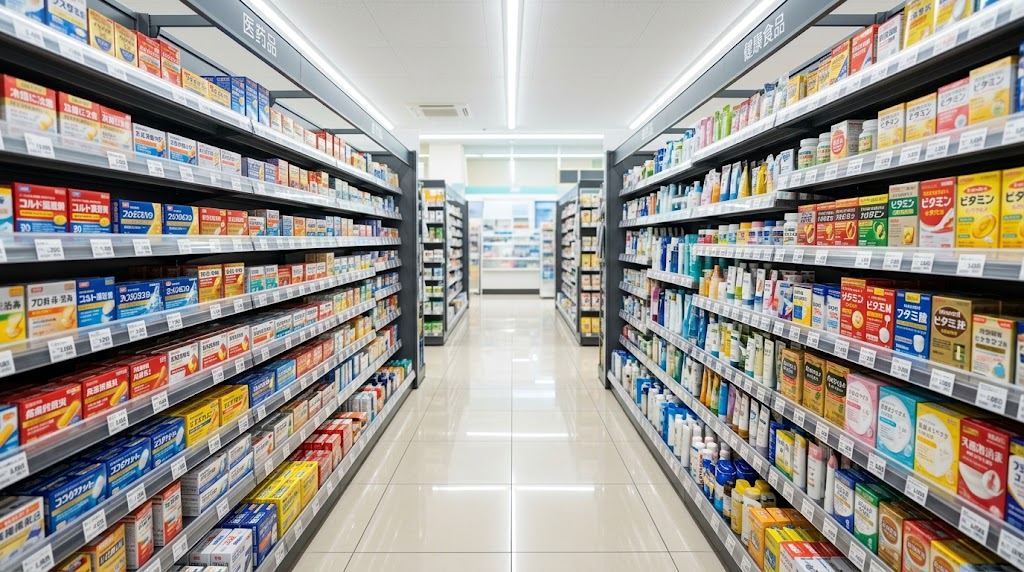
The restriction covers a narrow set of ingredients. The majority of what makes Japanese drugstores worth visiting is untouched.
Cooling patches (冷却シート)
Gel sheets applied to the forehead, marketed for fever. The active mechanism is evaporative cooling rather than medication, so these are classified as quasi-drugs and sold freely. Japanese households treat them as standard, and travellers often find them more effective than a cold flannel.
Pain relief patches (湿布 / シップ)
Adhesive patches containing anti-inflammatory compounds, applied to the shoulder, back or knee. These come in cooling and warming types. Japan uses them at a scale that surprises most visitors, and the adhesive quality is genuinely better than most equivalents abroad.
| 冷感 (cooling) | For acute pain, recent injury, inflammation |
|---|---|
| 温感 (warming) | For chronic stiffness, cold-weather aches |
| Common brands | Salonpas, Feitas, Harikkusu |
| Class | Usually Class 2 or 3 — freely available |
Eye drops (目薬)
Japan’s eye drop market is unusually developed, with products aimed at screen fatigue, dryness, and contact lens wearers. Some contain a cooling agent that produces a strong menthol sensation — the packaging usually indicates intensity on a scale.
⚠️ Watch out
- Products containing vasoconstrictors reduce redness but can cause rebound redness with heavy use
- If you wear contact lenses, look for コンタクト on the box. Not all formulations are compatible
- Preservative-free single-use vials exist and are worth the extra cost for daily use
Stomach medicine (胃腸薬)
A category Japan takes seriously. Powders and granules designed for overeating, stomach heaviness and hangovers. Ohta Isan and Kampo-based formulations are the classics. These are generally Class 2 or 3 and remain freely available.
Hydration and vitamin drinks
Small brown bottles near the till containing vitamins, taurine and caffeine. These are classified variously as quasi-drugs or Class 3 medicines. For summer travel, oral rehydration products such as OS-1 are a more useful purchase and are usually found in the beverage section rather than the medicine aisle.
👍 Practical tips
- Kampo (漢方) formulations are traditional herbal medicines regulated as pharmaceuticals in Japan. Kakkonto (葛根湯) for early cold symptoms is the best known
- Foot care — cooling sheets for tired legs are a Japan speciality and worth a try after a day of walking
- Hand and lip care — Japanese lip balms and hand creams are inexpensive and generally excellent
- Motion sickness tablets are widely available and useful for winding mountain roads and ferries
4. Where to shop and how prices differ
| Chain | Character | Notes |
|---|---|---|
| Matsumoto Kiyoshi | The default. Yellow and blue signage | Widest tourist-area coverage. Multilingual signage common |
| Sundrug | Competitive pricing | Often cheaper than Matsukiyo on the same product |
| Welcia | Large stores, wide range | Frequently open late, some 24h |
| Cosmos | Discount focus | Cheaper but fewer tax-free counters |
| Tsuruha / Kokumin | Regional strength | Kokumin common in stations and airports |
| Don Quijote | Not a drugstore, but stocks medicine | Open very late. Prices vary; check per item |
Prices for identical products vary meaningfully between chains — differences of 20–30% on the same box are common. If you are buying several items, it is worth checking two stores. Airport pharmacies charge a premium; buy in the city.
5. Tax-free shopping changes completely on 1 November 2026
If you are visiting after this date, the mechanism you may have read about no longer applies.
| Until 31 October 2026 | From 1 November 2026 | |
|---|---|---|
| How you pay | Tax-excluded price at the till | Tax-included price at the till |
| When you get the tax back | Immediately (never charged) | Refunded after customs confirms export at departure |
| General goods vs consumables | Separate categories with separate rules | Distinction abolished |
| Sealed packaging for consumables | Required — could not be opened in Japan | Abolished |
| ¥500,000 daily cap per store | Applied to consumables | Abolished |
The practical consequences for a medicine shopper are mixed.
✅ Key points
- Good: the sealed-bag rule disappears. You will be able to use what you bought while still in Japan
- Good: the ¥500,000 per-store daily cap disappears
- Less good: you pay the full tax-inclusive price up front and wait for a refund
- Important: you must physically present the goods at the airport for customs confirmation, so allow extra time before your flight
- Note: the separate posting/shipping option (別送) was abolished on 31 March 2025
6. Practical phrases and label reading
| 風邪薬 (kaze-gusuri) | Cold medicine |
|---|---|
| 解熱鎮痛剤 (genetsu-chintsuzai) | Fever reducer / painkiller |
| 咳止め (seki-dome) | Cough suppressant |
| 鼻炎薬 (bien-yaku) | Rhinitis / allergy medicine |
| 胃腸薬 (ichouyaku) | Stomach medicine |
| 目薬 (megusuri) | Eye drops |
| 湿布 (shippu) | Pain relief patch |
| 酔い止め (yoi-dome) | Motion sickness tablets |
| 虫刺され (mushi-sasare) | Insect bite |
| 妊娠中 (ninshin-chuu) | Pregnant — say this to staff before buying anything |
A useful sentence to show staff on your phone: 「英語の説明はありますか?」 (Do you have an English explanation?). Many major products now include an English insert, and staff at tourist-area branches are used to the question.
👍 Practical tips
- Photograph the box of any medicine you take at home, including the ingredient list, before you travel. Staff can match ingredients even without a shared language
- Google Lens handles Japanese medicine packaging surprisingly well — point it at the ingredient panel
- Dosages in Japan are often calculated for a smaller average body weight. Read the adult dosage carefully rather than assuming
- Bring your prescription medicine with the prescription or a doctor’s letter. Some common Western medications are controlled in Japan
Frequently asked questions
Can I still buy Japanese cold medicine as a souvenir in 2026?
Yes, but if the product contains one of the eight designated ingredients — including dextromethorphan and diphenhydramine — you are limited to one box per purchase and may be asked for ID. Products without those ingredients are unaffected.
Which medicines are now behind the counter in Japan?
Products containing codeine, dihydrocodeine, ephedrine, pseudoephedrine, methylephedrine, bromovaleryl urea, dextromethorphan or diphenhydramine. Stores must either lock them away, keep them behind the counter, display empty boxes, or supervise the area.
Do I need a prescription for medicine in Japan as a tourist?
Not for over-the-counter products. For prescription medicine you need to see a doctor in Japan; a foreign prescription cannot normally be filled at a Japanese pharmacy.
Is tax-free shopping for medicine still possible after November 2026?
Yes, but the mechanism changes. From 1 November 2026 you pay the tax-inclusive price and receive a refund after customs confirms the goods are leaving Japan. The sealed-packaging requirement and the ¥500,000 per-store daily cap are abolished.
Which drugstore chain is cheapest in Japan?
It varies by product. Sundrug and Cosmos are generally competitive; Matsumoto Kiyoshi has the widest tourist coverage but is not always the cheapest. Differences of 20–30% on identical items are common, so it is worth comparing two stores.
Can I bring Japanese medicine back to my own country?
That depends on your country’s import rules, not Japan’s. Codeine-containing products in particular are restricted or prohibited in several countries. Check your destination’s customs rules before buying in quantity.
Summary
| Changed 1 May 2026 | Eight ingredients restricted — one box per purchase, age verification |
|---|---|
| Newly added ingredients | Dextromethorphan and diphenhydramine (cough syrup and sleep aids) |
| Still freely available | Cooling sheets, pain patches, eye drops, stomach medicine, Kampo, vitamins |
| Changing 1 November 2026 | Tax-free becomes a refund at departure, not an exemption at the till |
| Abolished from 1 Nov 2026 | Sealed packaging requirement and the ¥500,000 per-store daily cap |
| Cheapest chains | Sundrug, Cosmos — but compare, differences reach 20–30% |
Japanese drugstores are still one of the most rewarding places to shop in the country. The change is not that you can no longer buy medicine — it is that you can no longer buy it in bulk without questions. Plan for one box of anything containing the restricted ingredients, and buy the rest freely.
🔥 Editor’s Picks for Life & Travel in Japan
Japan Expat Starter Kit 2026 PDF guide
Your first 90 days in Japan, step by step: 17 chapters · 24 pages · 100 phrases in Japanese script · 40 kanji · printable checklists. Bank account, My Number, health insurance, apartment, phone, taxes & pension.
$9.99 $4.99 current price
📥 Get the kit →📄 Read 5 pages free: contents + Chapter 2
⚡ Instant PDF download · 🛡️ 30-day money-back guarantee · 🔄 Free 2026 updates
Practical guides for life and travel in Japan — free, about once a week. No spam, unsubscribe anytime.
☕ Enjoying our Japan guides?
If this article helped you, you can support our work with a coffee!
Did this guide help you? 🍵
Japan Life Lab is a small independent blog, and every guide we publish is completely free — no paywalls, ever. If our work saved you time (or a headache), you can support us with a cup of Japanese tea. Every contribution, big or small, goes straight into keeping these guides free, accurate and up to date for everyone.
☕ Support Japan Life Lab
Leave a Reply