This article was created with AI writing assistance (ChatGPT, Claude, etc.). Product selection, specifications, and reviews are verified by the Japan Life Lab editorial team.
This article contains promotional / affiliate links.
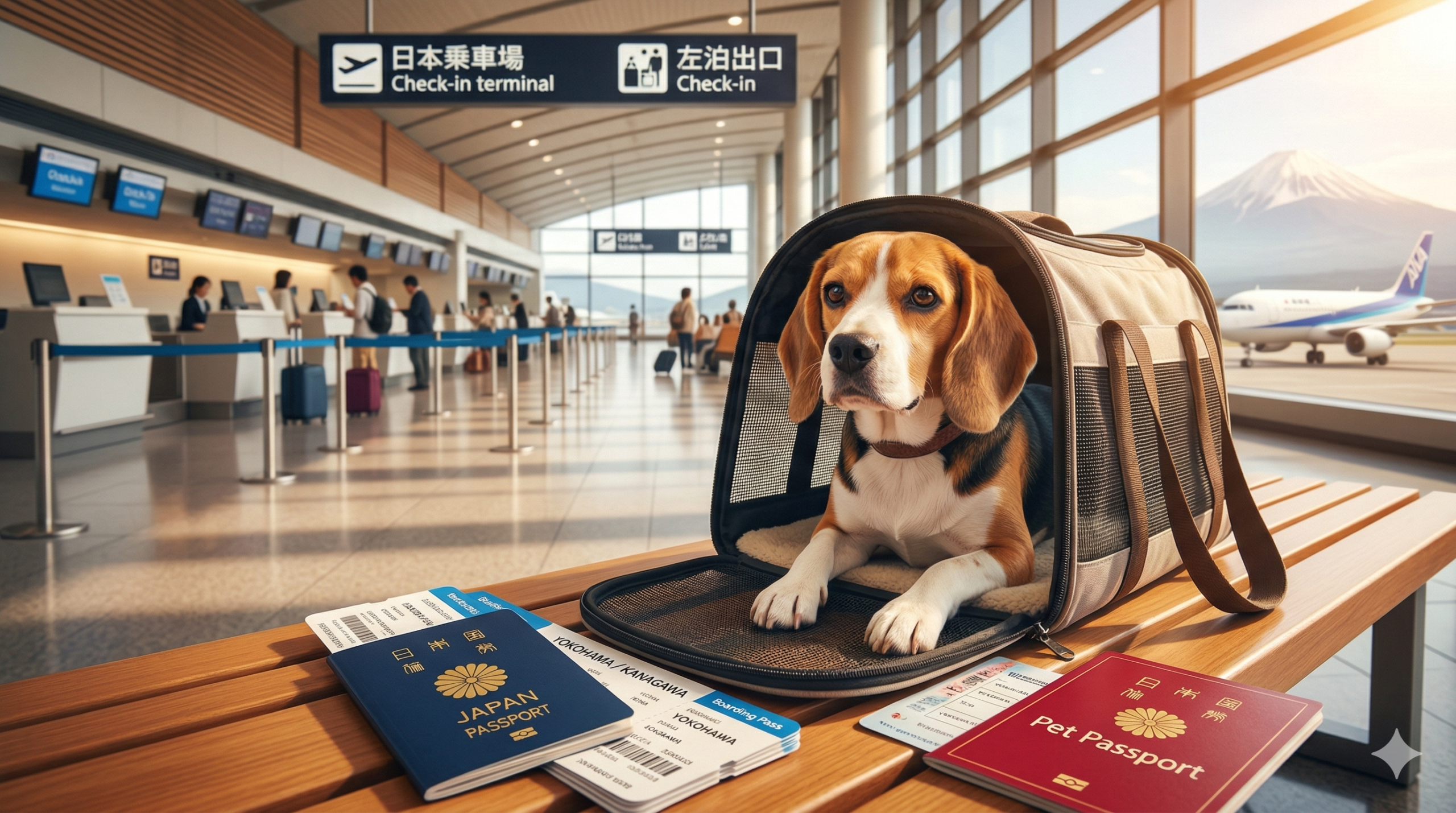
Bringing a pet to Japan is one of the most complex international pet relocations in the world. Japan has some of the strictest animal import regulations globally, designed to maintain its rabies-free status. However, with proper planning and the right documentation, thousands of pet owners successfully bring their cats and dogs to Japan every year — including thousands of expats, international company employees, and military families.
This complete guide covers everything you need to know about bringing a pet to Japan in 2026 — from quarantine rules and rabies titer tests to microchipping requirements and what to expect at Japan’s ports of entry. We’ll also cover tips for finding pet-friendly housing and adjusting your pet to Japanese life.
📌 What you will learn
You do not have to read it all — jump to what you need.
- Can You Bring Pets to Japan?
- Step-by-Step: Bringing Your Cat or Dog to Japan
- Costs: Bringing a Pet to Japan
- What Happens at Japan Quarantine?
- Finding Veterinary Care in Japan
- Pet Insurance in Japan
- Registering Your Dog in Japan
※ Start wherever fits your situation.
Can You Bring Pets to Japan?
Yes — cats and dogs can be brought to Japan, but the process varies significantly depending on your country of origin. Japan uses a risk category system based on each country’s rabies status:
- Category 1 (Designated Rabies-Free Countries): Australia, New Zealand, Hawaii, Iceland, Fiji. Shortest quarantine (may be 0–12 hours).
- Category 2 (Countries with Proof of Rabies-Free History): UK, Ireland, Sweden, Norway. Requires documentation but shorter quarantine.
- Category 3 (All Other Countries): USA, Canada, most of Europe, most of Asia. Requires full protocol including 2 rabies vaccinations, titer test, and 180-day waiting period. This is the most common scenario for expats.
Important: Birds, rabbits, hamsters, reptiles, and other exotic pets have completely different (often stricter) import regulations. This guide focuses on cats and dogs.
Step-by-Step: Bringing Your Cat or Dog to Japan
Step 1: Microchip Your Pet (ISO Standard)
Your pet must have a microchip that meets ISO Standard 11784/11785 (15-digit FDXB chip). This is mandatory — no microchip, no entry. Most modern veterinarians use ISO-standard chips. If your pet has an older, non-ISO chip, you’ll need to add a second compliant one. The chip must be implanted before the first rabies vaccination counts toward Japan’s requirements.
Step 2: Two Rabies Vaccinations
Japan requires two rabies vaccinations given at least 30 days apart. The first vaccination must be given after microchipping (the chip must be confirmed scannable at the time of vaccination). Both vaccinations must use an inactivated (killed) rabies vaccine. Keep all vaccination records with lot numbers and dates — you’ll need them for documentation.
Step 3: Rabies Antibody Titer Test
This is the critical and often most time-consuming step. You must have a rabies neutralizing antibody titer test performed at a Japan-approved laboratory. The test must show a result of 0.5 IU/mL or higher. The blood sample must be taken at least 30 days after the second rabies vaccination.
Approved laboratories include: Kansas State University Rabies Lab (USA), APHA Weybridge (UK), BioResearch Laboratory (USA), and others listed on the Ministry of Agriculture, Forestry and Fisheries (MAFF) Japan website. Results typically take 2–4 weeks. Keep the original test certificate — you’ll need it for the import declaration.
Step 4: 180-Day Waiting Period
After the blood draw for the titer test (not after receiving results), you must wait 180 days before your pet can enter Japan with no quarantine. This is the rule that surprises most pet owners. If you move to Japan before the 180 days pass, your pet will spend the remaining days in quarantine at an Animal Quarantine Service (AQS) facility in Japan — at your expense (typically ¥8,000–¥12,000/day).
Plan ahead: Start the process at least 8–9 months before your planned Japan arrival date to avoid quarantine costs.
Step 5: Health Certificate (AHEV or Equivalent)
Within 10 days of departure, have a government-accredited veterinarian complete and sign a health certificate. In the USA, this means a USDA-accredited vet and then USDA APHIS endorsement. In the UK, it requires an Official Veterinarian (OV) and APHA endorsement. The certificate must match Japan’s required format exactly — your vet should use Japan’s official health certificate form from the MAFF website.
Step 6: Book a Direct Flight When Possible
Japan requires pets to arrive on the same flight as their owner (or within a specific timeframe). Japan’s three main international airports that accept pets are: Narita (NRT), Haneda (HND), and Kansai International (KIX). Not all airports have AQS inspection facilities — confirm with Japan’s Animal Quarantine Service before booking.
Most major carriers (ANA, JAL, United, Delta, Lufthansa, British Airways) accept pets in the cabin (cats, small dogs) or as cargo. Cabin rules: generally under 8kg total (pet + carrier). Cargo is required for larger dogs. Note that some airlines have breed restrictions (brachycephalic breeds like Pugs, Bulldogs, and Persian cats may be refused).
Step 7: Japan Airport Inspection
Upon arrival in Japan, proceed to the Animal Quarantine Service inspection counter before going through customs. AQS officers will verify:
- Microchip scan (matches all documents)
- Vaccination records (timing, lot numbers)
- Titer test certificate (approved lab, ≥0.5 IU/mL)
- 180-day wait calculation from blood draw date
- Health certificate (within 10 days of travel, government endorsed)
Costs: Bringing a Pet to Japan
| Microchip (if not already implanted) | ¥3,000–¥8,000 ($20–$60 USD) |
|---|---|
| Rabies vaccinations (×2) | ¥3,000–¥10,000 each |
| Rabies titer test | ¥15,000–¥30,000 ($100–$200 USD) |
| Health certificate + government endorsement | ¥10,000–¥30,000 ($70–$200 USD) |
| Airline pet fees (in-cabin) | ¥10,000–¥30,000 per flight |
| Japan AQS inspection fee | ¥400–¥1,000 per pet |
| Japan quarantine (if needed) | ¥8,000–¥12,000/day |
Total expected cost (no quarantine, Category 3 country): Approximately ¥60,000–¥120,000 ($400–$800 USD) depending on country, veterinary rates, and airline fees.
What Happens at Japan Quarantine?
If your pet is detained at quarantine (due to incomplete documents, failed titer test, or not completing the 180-day wait), they’ll be housed at an Animal Quarantine Service facility until the required period completes. AQS facilities are professional and humane, but they can be stressful for pets. You can visit your pet daily during quarantine hours. The cost is billed to the pet owner and paid before release.
For this reason, working with a professional pet relocation specialist (like PetRelocation.com, Asia Pacific Pet Relocation, or Japan-based services) is highly recommended for complex situations. They handle all documentation and coordination — fees typically run $500–$1,500 USD but can save significantly on quarantine costs and stress.
Finding Veterinary Care in Japan
Japan has excellent veterinary care, including many English-speaking vets in major cities. Key resources:
- Tokyo: Nishi Azabu Animal Hospital (English), Azabu Animal Medical Center, Tokyo Midtown Veterinary Clinic
- Osaka: Umeda Animal Hospital (English-friendly), Shinsaibashi Veterinary Clinic
- Nationwide: Japan Animal Referral Medical Center (ARM), Pet ER Japan (emergency care)
Japan does not have a standardized system for international vaccine records, so your Japanese vet will start fresh records. Bring all original vaccination history from your home country — many Japanese vets appreciate this for context even if they can’t formally use it in Japan’s system.
Pet Insurance in Japan
Japan has a well-developed pet insurance industry. Major providers include:
- Anicom Insurance (アニコム損保): Japan’s largest pet insurer. Japanese-language only.
- Ipet Insurance (アイペット損保): Second largest. Japanese-language focus.
- Trupanion Japan: International-friendly, English customer service available.
Pet insurance in Japan typically covers 50–70% of veterinary fees up to annual limits. Monthly premiums range from ¥2,000–¥8,000 depending on species, breed, age, and coverage level. Enrollment must usually be done within 6 months of arriving in Japan or within a set age limit (often under 8–10 years old). Highly recommended given Japan’s relatively high veterinary costs.
Registering Your Dog in Japan
Japan legally requires all dogs to be registered with the local municipal government (市区町村) within 30 days of arrival. Registration is done at your local city/ward office or health center. You’ll receive a rabies vaccination certificate that must be renewed annually. Annual rabies vaccination (注射) is legally required for all dogs in Japan. Failure to register can result in a fine up to ¥200,000.
Cats are not currently required to be registered by national law, though some municipalities are introducing cat registration programs. However, microchipping cats became legally required for newly born kittens in Japan from June 2022 — imported cats should ensure their ISO microchip is properly documented.
Adjusting Your Pet to Life in Japan
Japan’s urban environment can be quite different for pets used to suburban or rural settings. Key adjustment tips:
- Compact apartments: Most Tokyo apartments are small (1K/1LDK). Create vertical space with cat trees and wall shelves. Dogs need structured walks.
- Hot and humid summers: Japan’s summer (July–September) is extremely hot and humid. Never leave pets in cars. Keep air conditioning running during heat waves.
- Typhoon season: June–October brings typhoons. Keep emergency pet supplies (food, water, medication) ready. Know your local pet-friendly evacuation shelter.
- Pet etiquette: Dogs must be on leash in public. Most parks prohibit off-leash dogs. Train your dog to be quiet — loud barking in close-proximity Japanese apartments causes neighbor complaints.
- Pet-friendly spaces: Japan has excellent pet cafés, pet-friendly restaurants (outdoor seating), pet hotels (ペットホテル), and pet-friendly accommodation options. Many shopping centers like IKEA Japan and some department stores allow leashed pets in outdoor areas.
Resources for Pet Owners in Japan
- Ministry of Agriculture, Forestry and Fisheries (MAFF) Japan: Official import requirements
- Animal Quarantine Service (AQS): Direct inquiry service available in English
- Facebook: Expat Pet Owners in Japan (large community with real-world advice)
- Reddit: r/japanlife (active thread community for expat pet questions)
- Japan Pet Supplies: Amazon Japan (amazon.co.jp), Rakuten Pet, Aeon Pet, Cainz Home
Final Thoughts
Bringing a pet to Japan requires patience and meticulous documentation, but it’s absolutely achievable. The most important rules: start early (8–9 months minimum for Category 3 countries), get the ISO microchip first, complete two rabies vaccinations, get the titer test, and wait 180 days from the blood draw. With everything in order, Japan’s AQS inspection is smooth and your pet can join you in your new life in Japan without quarantine.
Japan is actually a wonderful country for pet owners once you’re here — excellent veterinary care, a huge pet product market, pet-friendly cafés and parks, and a culture that deeply loves animals. Welcome to Japan, and welcome to your pet’s new adventure! 🐾
Essential Products for Bringing Your Pet to Japan
These items are must-haves for your pet’s journey to Japan and for settling in once you arrive:
IATA-Approved Pet Travel Carrier (Cabin/Cargo)
IATA-compliant carriers are required for most international airlines. Look for rigid carriers for cargo holds and soft-sided for cabin travel.
Pet Travel Documents Organizer
Keep your pet’s vaccination records, health certificates, and MAFF documents organized in a waterproof travel document holder.
Portable Water Bowl & Food Container for Travel
Keep your pet hydrated during the long journey with a collapsible water bowl and spill-proof food container.
Tax-free shopping in Japan changes on 1 November 2026
Until 31 October you show your passport at the till and simply pay without the 10% consumption tax. From 1 November you pay the full tax-included price in the shop and claim the tax back at the airport — at a customs kiosk or through Visit Japan Web — before you check in.
- The ¥5,000 minimum per shop, per day stays the same.
- The general-goods / consumables split is abolished, and so is the ¥500,000 cap on consumables.
- Sealed packaging is abolished — but consumables still have to leave Japan unused.
- Everything on the receipt has to be with you at departure. Customs can ask to see it.
Shopping before 1 November? Nothing changes for you yet.
🔥 Editor’s Picks for Life & Travel in Japan
📘 The Japan Expat Starter Kit 2026
Banking, housing, My Number, taxes, 100 phrases and a 40-kanji cheat sheet — everything from this site in one 17-chapter PDF field manual. Free lifetime 2026 updates.
Reader price: $9.99 $6.99 with code JLL30 at checkout
30-day money-back guarantee · Instant download · PR
Practical guides for life and travel in Japan — free, about once a week. No spam, unsubscribe anytime.
☕ Enjoying our Japan guides?
If this article helped you, you can support our work with a coffee!
Did this guide help you? 🍵
Japan Life Lab is a small independent blog, and every guide we publish is completely free — no paywalls, ever. If our work saved you time (or a headache), you can support us with a cup of Japanese tea. Every contribution, big or small, goes straight into keeping these guides free, accurate and up to date for everyone.
☕ Support Japan Life Lab
Leave a Reply