This article was created with AI writing assistance (ChatGPT, Claude, etc.). Product selection, specifications, and reviews are verified by the Japan Life Lab editorial team.
This article contains promotional / affiliate links.
Tax-free shopping in Japan changes on 1 November 2026
Until 31 October you show your passport at the till and simply pay without the 10% consumption tax. From 1 November you pay the full tax-included price in the shop and claim the tax back at the airport — at a customs kiosk or through Visit Japan Web — before you check in.
- The ¥5,000 minimum per shop, per day stays the same.
- The general-goods / consumables split is abolished, and so is the ¥500,000 cap on consumables.
- Sealed packaging is abolished — but consumables still have to leave Japan unused.
- Everything on the receipt has to be with you at departure. Customs can ask to see it.
Shopping before 1 November? Nothing changes for you yet.
📱 PayPay 2026 Update — Check App for Current Promotions
PayPay campaigns change frequently. Welcome bonuses and cashback rates are updated regularly — always check the PayPay app’s Campaigns tab after registering for the latest offers. Regional cashback campaigns (typically 10–30% back at local merchants) are often more valuable than signup bonuses and are available throughout Japan.
📌 What you will learn
You do not have to read it all — jump to what you need.
- 💳 Japan’s Cashless Revolution: A Foreigner’s Survival Guide
- 🏆 The Big 4 Payment Methods in Japan (Ranked)
- 📱 PayPay: Japan’s #1 QR Code Payment
- 🚃 IC Cards (Suica / PASMO): The Essential Payment
- 💳 Credit Cards: What Works in Japan
- 💴 Cash: Still King in Some Places
- 📊 Payment Method by Situation
※ Start wherever fits your situation.
💳 Japan’s Cashless Revolution: A Foreigner’s Survival Guide
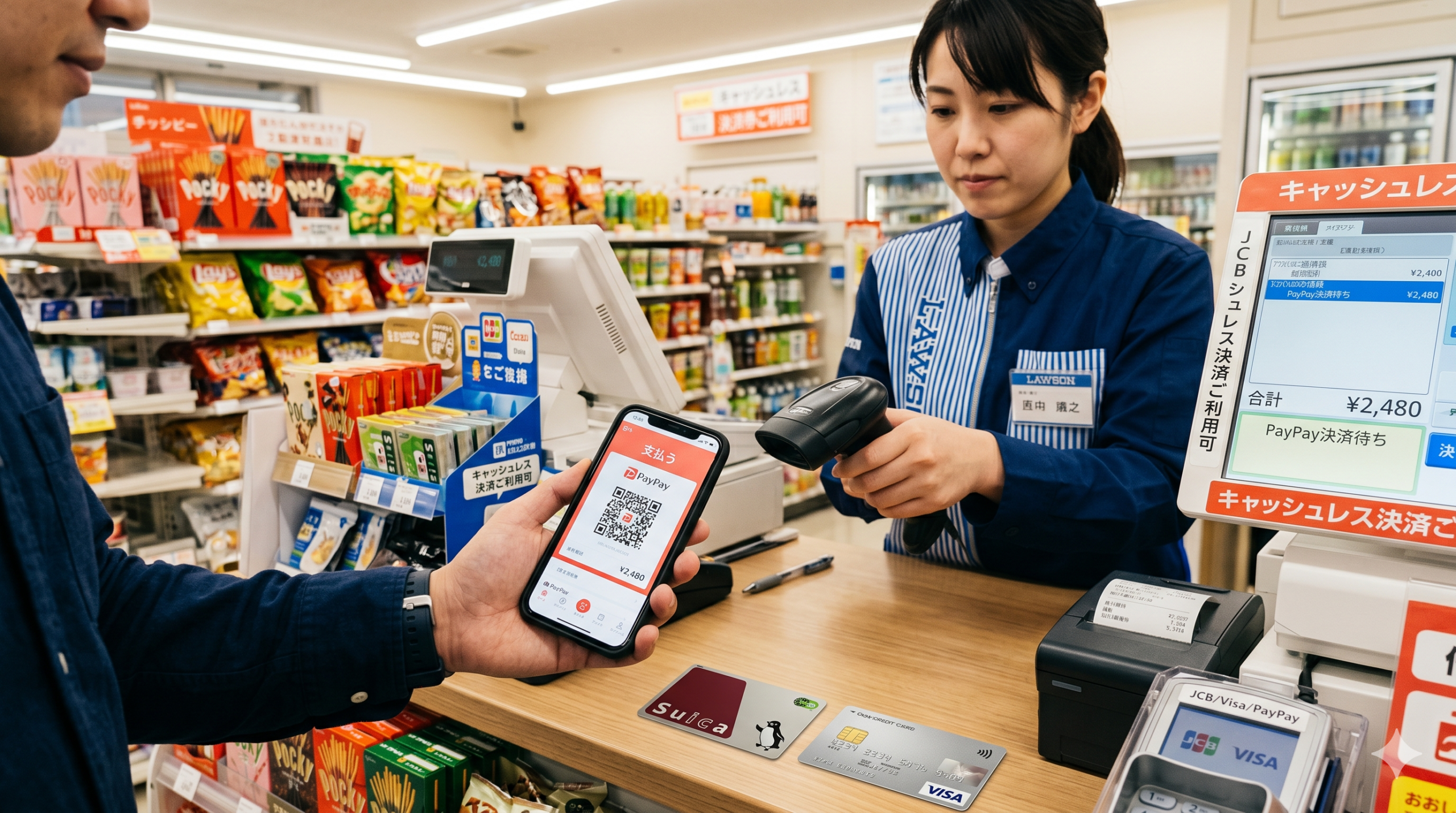
Japan in 2026 is a cashless puzzle. PayPay QR codes everywhere, IC card readers at every station, credit card terminals that sometimes work and sometimes don’t, and some ramen shops that STILL only take cash. Confusing? Absolutely.
This guide cuts through the noise. After researching every major payment method across Tokyo, Osaka, and rural Japan, here’s exactly which payment to use where — so you never get stuck at a register again.
🏆 The Big 4 Payment Methods in Japan (Ranked)
| Rank | Method | Acceptance Rate | Best For | Setup Difficulty |
|---|---|---|---|---|
| 🥇 | Cash (JPY) | 100% | Small shops, temples, rural areas | None |
| 🥈 | IC Card (Suica/PASMO) | ~85% | Trains, convenience stores, vending machines | Easy |
| 🥉 | Credit/Debit Card | ~70% | Department stores, hotels, electronics shops | Already have one |
| 4️⃣ | PayPay (QR code) | ~60% | Restaurants, izakaya, local shops | Moderate |
📱 PayPay: Japan’s #1 QR Code Payment
What is PayPay?
PayPay is Japan’s most popular mobile payment app with 60+ million users. Think of it like Venmo or Alipay, but Japanese. You scan a QR code at the shop (or they scan yours), and money is deducted from your PayPay balance.
Why foreigners should care
- 💡 Many small restaurants and izakaya accept PayPay but NOT credit cards
- 💡 Regular cashback campaigns (sometimes 10-30% back!)
- 💡 Free ¥1,000 welcome bonus (promotional — verify in PayPay app) for new users (limited time)
- 💡 Split bills easily with friends who also use PayPay
How to set up PayPay as a foreigner
- Download the PayPay app (iOS/Android)
- Register with your phone number (Japanese number required)
- Verify your identity with passport or residence card
- Add money via bank account, convenience store ATM, or credit card
- Start scanning QR codes!
⚠️ Tourist limitation: PayPay requires a Japanese phone number for registration. Tourists with eSIM/data-only SIM cannot use PayPay. It’s mainly for residents and long-term visitors.
🚃 IC Cards (Suica / PASMO): The Essential Payment
IC cards are the single most useful payment method for anyone in Japan. They work for trains AND shopping, and you can set them up before landing.
Key advantages
- 🚃 Tap-and-go at every train gate in Japan
- 🏪 Works at 7-Eleven, FamilyMart, Lawson, and most chain stores
- 🤖 Vending machines, coin lockers, some taxis
- 📱 Set up on iPhone/Android — no physical card needed
👉 Read our detailed guide: PASMO vs Suica: Which IC Card Should You Get?
💳 Credit Cards: What Works in Japan
Acceptance by brand (best to worst)
- Visa — Best overall acceptance (~70%)
- Mastercard — Very close to Visa (~65%)
- JCB — Japan’s domestic brand, great at Japanese shops but poor overseas
- American Express — Limited to hotels, department stores, large chains (~40%)
- Discover/Diners — Very limited (~20%)
Pro tips for credit card users
- 💡 Always carry cash as backup — Many restaurants still don’t take cards
- 💡 Choose “Without conversion” when the terminal asks — This avoids DCC (Dynamic Currency Conversion) fees
- 💡 Contactless (tap-to-pay) is growing but not universal yet
- 💡 Wise or Revolut cards give the best exchange rates for foreigners
👉 Read our guide: Best Credit Cards for Foreigners in Japan
💴 Cash: Still King in Some Places
Despite Japan’s cashless push, you’ll still need cash for:
- 🏯 Temples and shrines (admission fees, omamori charms)
- 🍜 Small ramen shops and street food stalls
- 🏔️ Rural areas (especially onsen towns)
- 🅿️ Some parking lots and laundromats
- 🏥 Clinics and small hospitals
Where to get Japanese yen
- 7-Eleven ATMs (7Bank) — Accept international cards, English UI, 24/7
- Japan Post ATMs — Good for Visa/Mastercard withdrawals
- Wise card — Withdraw JPY at interbank rates
- Airport exchange — Convenient but worst rates (avoid if possible)
📊 Payment Method by Situation
| Situation | Best Payment | Why |
|---|---|---|
| Taking the train | 🟢 Suica/PASMO | Only IC cards work at train gates |
| Convenience store | 🟢 Suica/PASMO | Fastest checkout, no signature needed |
| Department store | 💳 Credit card | Tax-free processing + high amounts |
| Izakaya / local restaurant | 📱 PayPay or 💴 Cash | Many don’t take credit cards |
| Electronics (Yodobashi, BIC) | 💳 Credit card | Tax-free + point cards stack |
| Temple / shrine | 💴 Cash | Electronic payments not accepted |
| Splitting dinner bill | 📱 PayPay | Send money instantly to friends |
| Don Quijote | 💳 Credit card + coupon | Tax-free + 15% off coupon stacks |
🎯 The Perfect Setup for Living in Japan
Here’s what we recommend for expats and long-term residents:
- Mobile Suica on your iPhone/Android — for daily transit and quick purchases
- Wise or Revolut card — for credit card payments with zero forex fees
- PayPay — for restaurants and local shops that only take QR
- ¥10,000-20,000 cash — always have some on hand for emergencies
With this combo, you’re covered for 99% of payment situations in Japan.
💸 The smart way to handle money in Japan
A Wise account gives you a multi-currency debit card with the real exchange rate and low fees — perfect for cashless payments, paying bills, and withdrawing cash in Japan as a foreigner.
Open a free Wise account →🔗 Related Guides
🗾 More Japan Life Guides
🔥 Editor’s Picks for Life & Travel in Japan
📘 The Japan Expat Starter Kit 2026
Banking, housing, My Number, taxes, 100 phrases and a 40-kanji cheat sheet — everything from this site in one 17-chapter PDF field manual. Free lifetime 2026 updates.
Reader price: $9.99 $6.99 with code JLL30 at checkout
30-day money-back guarantee · Instant download · PR
Practical guides for life and travel in Japan — free, about once a week. No spam, unsubscribe anytime.
☕ Enjoying our Japan guides?
If this article helped you, you can support our work with a coffee!
🇯🇵 Travel & Life Essentials for Japan
Hand-picked gear to make your time in Japan easier. Available on Amazon US & Amazon Japan.
🔋 Portable charger
A must for long days of sightseeing and photos.
View on Amazon (US)View on Amazon Japan🔌 Travel plug adapter
Japan uses Type A outlets. Bring the right adapter.
View on Amazon (US)View on Amazon Japan🎧 Translation earbuds
Real-time translation to talk without barriers.
View on Amazon (US)View on Amazon JapanAs an Amazon Associate, Japan Life Lab earns from qualifying purchases.
Did this guide help you? 🍵
Japan Life Lab is a small independent blog, and every guide we publish is completely free — no paywalls, ever. If our work saved you time (or a headache), you can support us with a cup of Japanese tea. Every contribution, big or small, goes straight into keeping these guides free, accurate and up to date for everyone.
☕ Support Japan Life Lab
Leave a Reply