This article was created with AI writing assistance (ChatGPT, Claude, etc.). Product selection, specifications, and reviews are verified by the Japan Life Lab editorial team.
Nobody warns you. Japan’s summer is a different species of heat — not just hot, but overwhelmingly, suffocatingly humid. When you step outside in Tokyo or Osaka between June and September, the air feels like a warm, wet towel pressed to your face. The humidity regularly exceeds 80%, and temperatures hover around 35°C (95°F) — sometimes spiking higher.
Every year, tens of thousands of people are hospitalized for heat-related illness (熱中症 – necchusho) in Japan. Many are tourists who didn’t know what to expect. This guide covers everything you need to survive Japan’s summer safely and comfortably.
What to Actually Expect: Japan Summer by Month
| Month | Avg Temp (Tokyo) | Humidity | What to Expect |
|---|---|---|---|
| June | 21–26°C | 75–80% | Rainy season (梅雨). Overcast, sticky. |
| July | 26–31°C | 80–85% | Hot, humid. Rainy season ends mid-July. Festivals begin. |
| August | 28–35°C | 80–90% | Peak summer. Brutal heat. Obon holidays. Fireworks festivals. |
| September | 24–30°C | 75–80% | Still hot. Typhoon season. Cooling late September. |
The 10 Commandments of Japan Summer Survival
1. Carry a Cooling Towel or Neck Fan at All Times
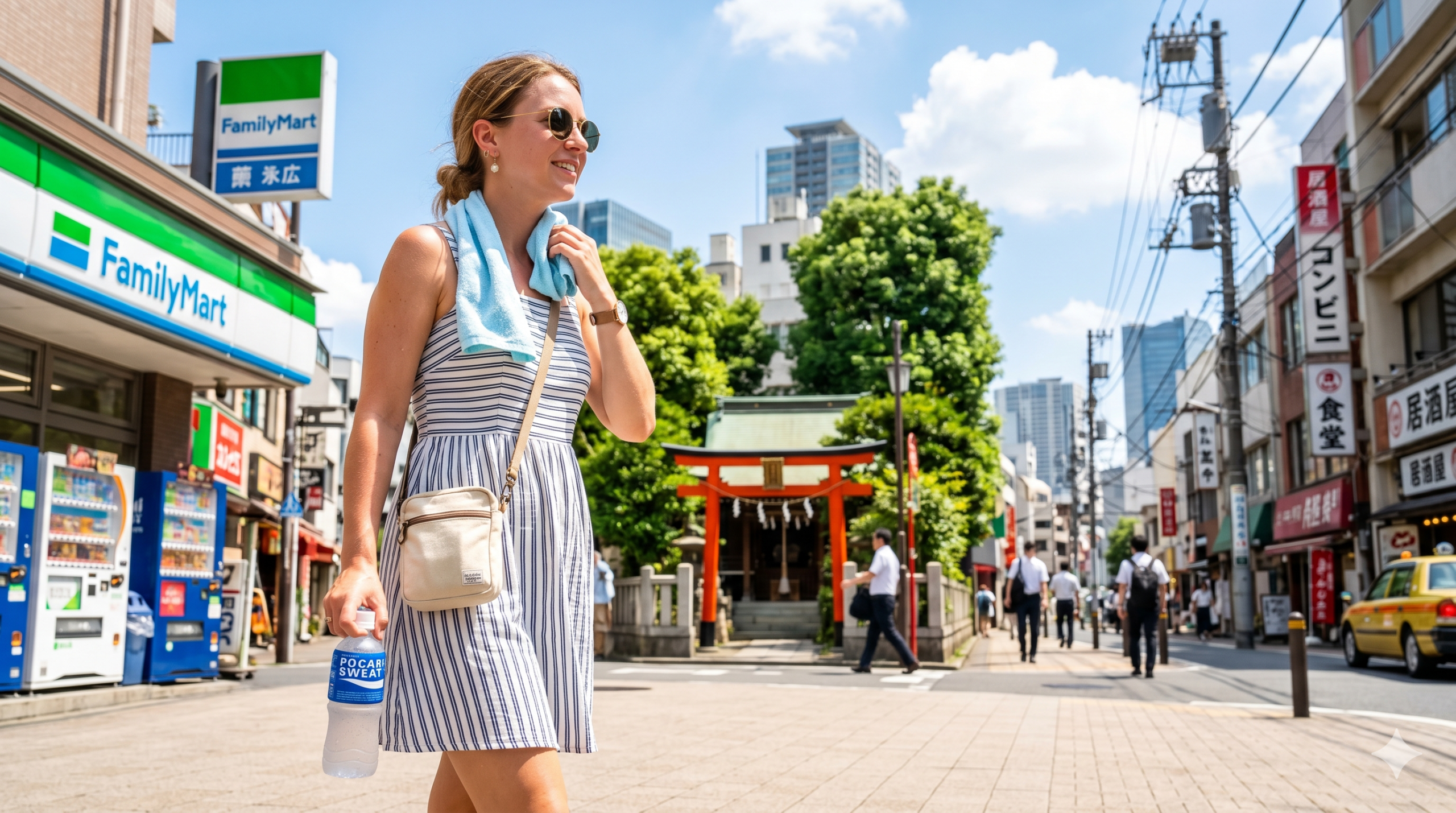
Japanese people are experts at personal cooling. You’ll see everyone with cooling accessories — neck fans (ネッククーラー), cooling towels soaked in water, and handheld fans. These aren’t tourist gimmicks; they’re essential survival gear. Daiso (¥100 shop) sells excellent cooling towels for ¥100–¥220. A neck fan from Anker or Sharp costs ¥3,000–¥8,000 and is worth every yen for outdoor sightseeing.
2. Hydrate with Electrolytes, Not Just Water
In Japan’s heat, you sweat so much that plain water alone isn’t enough — you lose essential electrolytes that cause cramps and dizziness. Drink Pocari Sweat (ポカリスエット) or Aquarius — Japan’s isotonic drinks that balance electrolytes perfectly. Available at every convenience store for about ¥150. A packet of Pocari Sweat powder is even better for all-day hydration.
3. Master the Art of Konbini Hopping
Japan has a convenience store every few hundred meters in cities. Each one is air-conditioned to refreshing coldness. Locals habitually duck in to cool down, use the bathroom, buy cold drinks or ice cream, and escape the sun. A ¥150 drink purchase buys you legitimately staying inside as long as you need.
4. Wear UV-Protective Clothing and Sunscreen
Japan’s UV index peaks at 8–11 in summer (extreme). Japanese fashion includes UV-blocking parasols (日傘), UV arm covers (アームカバー), and face-covering hats — serious sun protection, not fashion statements. Pick up UV arm covers at any ¥100 shop for ¥100–¥330. Japanese sunscreen brands like Anessa and Biore UV are world-class and very affordable.
5. Time Outdoor Activities Strategically
The heat index in Tokyo in August often exceeds 40°C. Plan outdoor sightseeing before 10 AM and after 5 PM. Hours of 11 AM – 4 PM are brutal — use this time for museums, air-conditioned malls, or temple interiors. Early morning visits to Fushimi Inari or Shibuya Crossing have the added benefit of smaller crowds.
6. Know the Signs of Heat Stroke
Heat stroke (熱中症 – necchusho) is life-threatening. Warning signs: dizziness, confusion, no longer sweating (dangerous — means your cooling system failed), rapid heartbeat, nausea. If someone shows severe symptoms, call 119 immediately. If mild, move to air conditioning, give sports drinks, apply cool towels to neck, wrists, and armpits.
7. Use Tokyo’s Underground Cities
Train stations and underground shopping centers (地下街 – chikagai) are entirely air-conditioned. Tokyo’s underground complexes under Shinjuku, Shibuya, and Ginza are essentially air-conditioned villages. Osaka’s Namba Walk and Umeda underground are even more extensive. Spend midday exploring these instead of streets.
8. Use Japanese Air Conditioning Correctly
Japanese AC remotes use Japanese-only controls. Key buttons: 冷房 (reibou) = cooling, 暖房 (danbou) = heating, 除湿 (joshitsu) = dehumidify only (useful on rainy days). Set temperature to 26–28°C for energy savings or lower for comfort.
9. Eat Japanese Summer Foods
Japan’s summer food is designed to cool you down. Must-try: hiyashi chuka (冷やし中華) — cold ramen; kakigori (かき氷) — shaved ice; zaru soba (ざる蕎麦) — cold buckwheat noodles; edamame (枝豆) — salted soybeans at any beer garden; watermelon (すいか) everywhere in summer.
10. Japan’s Summer Events Are Worth Braving the Heat
Japan’s summer has unbeatable experiences: hanabi (花火) fireworks festivals — some of the world’s most spectacular; Obon (お盆) ancestor festivals with Bon Odori dancing; summer beer gardens on department store rooftops; matsuri (祭り) neighborhood festivals with taiko drumming. Beat the heat with a strategy and these events become magical.
Best Cooling Products to Buy in Japan
| Product | Where to Buy | Price |
|---|---|---|
| Cooling towel (冷感タオル) | Daiso, drug stores | ¥100–¥330 |
| UV arm sleeves (アームカバー) | Daiso, Uniqlo | ¥100–¥1,500 |
| Neck fan (ネッククーラー) | Electronics stores, Amazon Japan | ¥3,000–¥8,000 |
| Pocari Sweat powder (10 pack) | Drug stores, Amazon Japan | ¥500 |
| UV parasol (日傘) | Drug stores, department stores | ¥1,000–¥5,000 |
What NOT to Do in Japan Summer
- Don’t skip sunscreen — Japan’s UV is extreme. A single day unprotected causes serious burns.
- Don’t drink only alcohol — Beer garden nights are fun but dehydrating. Match every beer with water.
- Don’t wear heavy jeans or dark colors — Black fabric in Japanese sun feels like wearing a furnace.
- Don’t push through exhaustion outdoors — When dizzy or flushed, go inside immediately.
- Don’t ignore the humidity — 35°C with 85% humidity feels like 45°C. Plan accordingly.
Japan Summer Packing Checklist
- ✅ Lightweight, breathable fabrics (linen, moisture-wicking)
- ✅ Wide-brim hat or cap
- ✅ Sunscreen SPF50+
- ✅ Portable fan or neck fan
- ✅ Reusable water bottle
- ✅ Cooling towel
- ✅ Light rain jacket (for sudden showers and typhoon season)
- ✅ Travel insurance (essential for summer in Japan)
⛺ Escape the heat: book a glamping getaway
Beat the city heat with a weekend in the mountains or by the sea. Japan now has hundreds of stylish glamping sites — air-conditioned domes, BBQ, onsen nearby — and you can compare and reserve them online.
Emergency Information
Emergency: 119 (ambulance in Japan). English available. Say “heat stroke” or “necchusho.” Japan Tourism Agency hotline: 050-3816-2787 (English, 24/7).
🗾 More Japan Life Guides
🔥 Editor’s Picks for Life & Travel in Japan
🇯🇵 Travel & Life Essentials for Japan
Hand-picked gear to make your time in Japan easier. Available on Amazon US & Amazon Japan.
🔋 Portable charger
A must for long days of sightseeing and photos.
View on Amazon (US)View on Amazon Japan🔌 Travel plug adapter
Japan uses Type A outlets. Bring the right adapter.
View on Amazon (US)View on Amazon Japan🎧 Translation earbuds
Real-time translation to talk without barriers.
View on Amazon (US)View on Amazon JapanAs an Amazon Associate, Japan Life Lab earns from qualifying purchases.
Leave a Reply