This article was created with AI writing assistance (ChatGPT, Claude, etc.). Product selection, specifications, and reviews are verified by the Japan Life Lab editorial team.
This article contains promotional / affiliate links.
📌 What you will learn
You do not have to read it all — jump to what you need.
- Japan Internet Options in 2026: WiFi, eSIM, or SIM Card?
- Japan Internet Options Compared: Quick Summary
- Option 1: Pocket WiFi Rental — Best for Groups & Multiple Devices
- Option 2: eSIM — Best for Solo Travelers & Maximum Convenience
- Option 3: Tourist SIM Card — Best for Budget Travelers
- Option 4: Monthly SIM Plan — Best for Expats & Long-Term Visitors
- Option 5: Home Fiber (Hikari) — Best for Expats Settling In
※ Start wherever fits your situation.
Japan Internet Options in 2026: WiFi, eSIM, or SIM Card?
Staying connected in Japan is easier than ever in 2026, but choosing the right option can be confusing. Should you rent a Pocket WiFi, buy an eSIM before your trip, or get a local SIM card at the airport? This guide breaks down every option with real costs, pros, cons, and step-by-step setup instructions.
Whether you’re a tourist visiting for a week or an expat settling down for months, we’ve tested every option so you don’t have to. Here’s everything you need to know about internet access in Japan.
Japan Internet Options Compared: Quick Summary
| Option | Best For | Cost | Setup |
|---|---|---|---|
| Pocket WiFi | Groups, multi-device | ¥400–800/day | Pick up at airport |
| eSIM | Solo travelers, convenience | $10–30/week | Buy online before trip |
| Tourist SIM | Budget travelers | ¥1,000–3,000 | Buy at airport/konbini |
| Expat SIM (Monthly) | Long-term residents | ¥1,500–4,000/mo | Online or store |
Option 1: Pocket WiFi Rental — Best for Groups & Multiple Devices
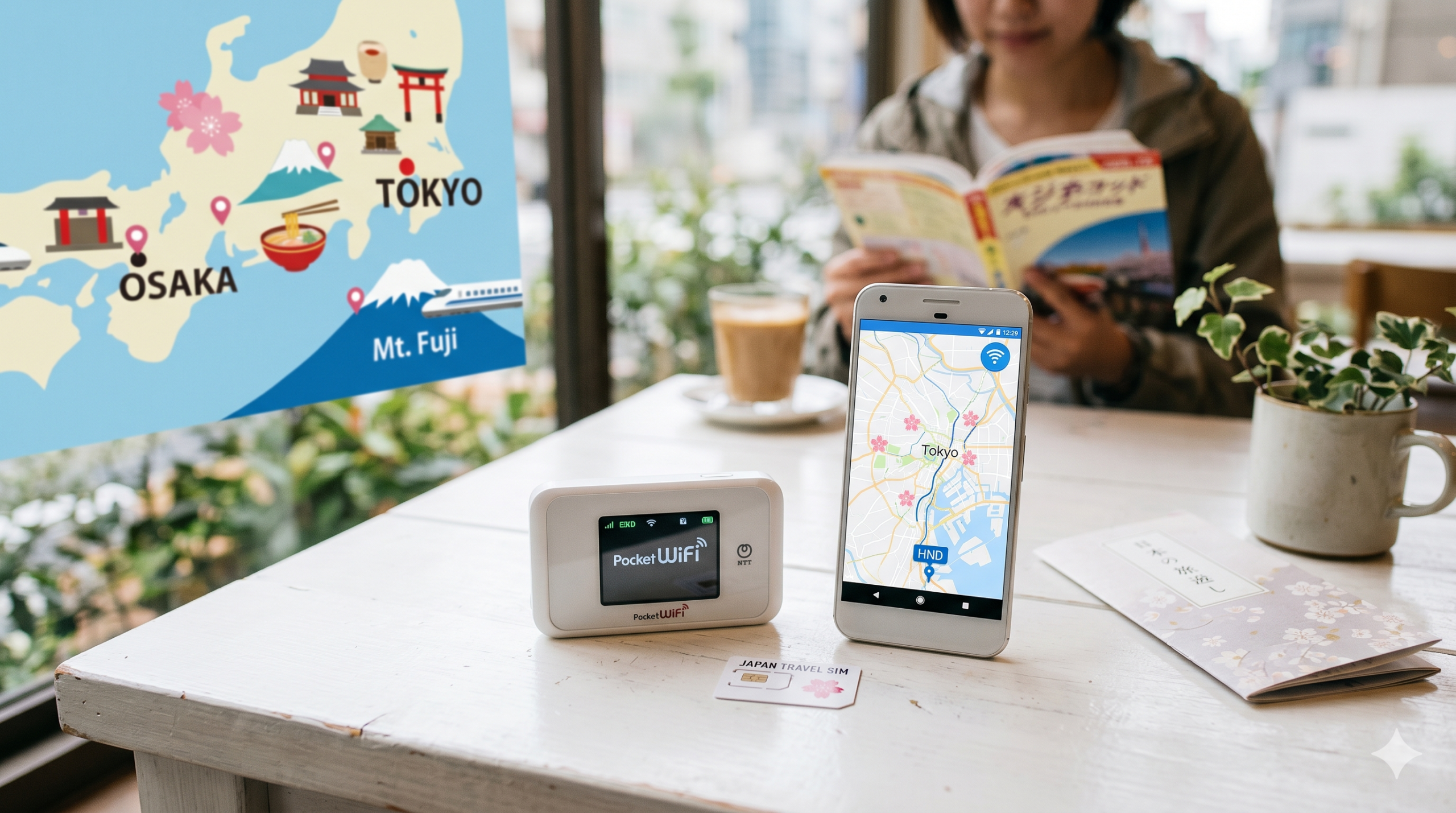
Pocket WiFi (portable WiFi router) lets you connect multiple devices simultaneously — perfect if you’re traveling with family or need your laptop, phone, and tablet all connected. In 2026, most Pocket WiFi devices support 4G LTE with download speeds of 50–150 Mbps, more than enough for video calls, streaming, and maps.
How to get one: Pre-book online and pick up at the airport counter on arrival (Narita, Haneda, Kansai, Chubu). You can also have it delivered to your hotel. Return it in a pre-paid envelope at the airport before departing.
Best Pocket WiFi providers in 2026: IIJmio WiFi (most reliable coverage), SoftBank WiFi Rental (fastest speeds), PUPURU (best English support). Prices range from ¥400–800/day with unlimited data plans.
Important: Some “unlimited” plans throttle speeds after 10GB/day. Always check the fine print. For 4+ people sharing one device, performance may degrade during peak usage.
Option 2: eSIM — Best for Solo Travelers & Maximum Convenience
eSIM has become a very popular option for tourists. You buy a digital SIM card online before your trip, scan a QR code, and you’re connected the moment your plane lands — no waiting at the airport counter, no physical SIM to lose.
Best eSIM providers for Japan 2026:
- Airalo Japan — Most popular, 1GB for $4.50 to 20GB for $28. Instant activation. Works on any eSIM-compatible phone.
- Holafly Japan — Unlimited data from $9.99/5 days. Best for data-heavy users (hotspot included).
- Ubigi Japan — Good prices, fast activation, works in 190+ countries if you’re multi-destination.
- IIJmio eSIM — Japanese carrier quality, from ¥220/day. Requires Japanese address for monthly plans.
Is your phone compatible? Most iPhones from XR (2018) onward and recent Android phones support eSIM. Check in Settings → Cellular → Add Cellular Plan. If you see this option, you’re compatible.
Step-by-step setup: (1) Buy eSIM online → (2) Receive QR code by email → (3) On your phone, go to Settings → Cellular → Add eSIM → (4) Scan QR code → (5) Activate. The whole process takes under 5 minutes.
Option 3: Tourist SIM Card — Best for Budget Travelers
Physical SIM cards from Japanese carriers are available at airport vending machines, major electronics stores (Yodobashi, BIC Camera), and some convenience stores. These are typically data-only SIMs (no calling) designed for tourists.
Best tourist SIM cards in 2026:
- IIJmio Tourist SIM — 15GB for ¥2,200 (15 days). Excellent coverage on docomo network.
- BIC SIM — 10GB for ¥1,980. Available at BIC Camera stores nationwide.
- JAPAN TRAVELER SIM (IIJ) — 5GB for ¥1,800 or 15GB for ¥3,000. Available online and at airports.
- Softbank Tourist SIM — 21-day unlimited data plan for ¥3,000. Best for heavy users.
Important note: These SIMs require your passport for registration in some cases. Data-only means no calls — use LINE, WhatsApp, or Facetime for calls. For most tourists, 10–15GB is more than sufficient for a 1–2 week trip.
Option 4: Monthly SIM Plan — Best for Expats & Long-Term Visitors
If you’re living in Japan or staying for 1+ months, a monthly SIM contract makes the most financial sense. Japan’s MVNO (virtual network operators) offer excellent plans at a fraction of major carrier prices.
Best monthly SIM plans 2026:
- Rakuten Mobile — ¥0 up to 1GB, ¥1,078 up to 3GB, ¥2,178 unlimited. Best value, fast speeds. No contract required.
- IIJmio — ¥850/2GB to ¥2,000/15GB. Reliable docomo/au network. eSIM option available.
- ahamo (docomo) — ¥2,970 for 30GB. Best for heavy data users on Japan’s strongest network.
- Y!mobile — ¥2,178/4GB to ¥3,278/15GB. SoftBank network, good for rural coverage.
Requirements for expats: Most monthly plans require a Japanese address and residence card (在留カード). Rakuten Mobile and IIJmio are most foreigner-friendly for setup. Many accept My Number card as ID.
Option 5: Home Fiber (Hikari) — Best for Expats Settling In
If you’re living in Japan long-term, a home fiber line (called hikari) gives you the fastest, most stable, and cheapest-per-GB internet — far better value than pocket WiFi or a SIM for everyday home use. The main hurdle for foreigners is that most providers’ sign-up pages are in Japanese.
One of the easiest options is ahamo光. If you (or a family member) already use docomo’s ahamo mobile plan, you get a monthly bundle discount, and new sign-ups can earn up to 20,000 dPoints. Speeds run up to 1–10 Gbps with no complicated long-term contract traps — a solid choice once you’ve settled into an apartment.
🏠 Setting up a home in Japan?
ahamo光 offers stable home fiber with ahamo mobile discounts and up to 20,000 dPoints for new sign-ups. (Sign-up page is in Japanese — a translation tool helps.)
Check ahamo光 Fiber Plans →Free WiFi in Japan: Where to Find It
Free WiFi has expanded dramatically in Japan by 2026. Here’s where you’ll find reliable free connections:
- 7-Eleven, FamilyMart, Lawson — Free WiFi at virtually all locations (30-minute sessions, unlimited reconnect)
- Major train stations — JR stations, Tokyo Metro stations offer free WiFi (registration required first time)
- Starbucks Japan — Free unlimited WiFi at all locations
- McDonald’s Japan — Free WiFi, 3 sessions/day per device
- Japan Free Wi-Fi app — Aggregates all free hotspot networks, auto-connects at 200,000+ spots
- Major airports & shopping malls — Unlimited free WiFi
Free WiFi is fine for light browsing, but for navigation, streaming, and secure connections, we strongly recommend having your own data connection.
Internet Speed in Japan: What to Expect
Japan has some of the fastest internet speeds in the world. In 2026, 5G coverage has expanded to cover most major cities, with 4G LTE available virtually everywhere else. Here’s what to expect:
- 5G (major cities): 100–1,000 Mbps download
- 4G LTE (nationwide): 20–150 Mbps download
- 3G (rural areas, rare): 1–10 Mbps download
- Free WiFi (varies): 5–50 Mbps typically
For context: streaming Netflix HD requires 5 Mbps, 4K requires 25 Mbps, video calling requires 1–3 Mbps. Any 4G LTE connection in Japan will handle all of these easily.
🧮 Related tool: Japan Travel Data Calculator 2026
Enter your trip length and daily hours of maps, social media, streaming and video calls to see how many GB you need and which plan size to buy.
Which Option Should You Choose? Quick Decision Guide
- Arriving with eSIM-compatible phone + solo trip → eSIM (Airalo or Holafly) — easiest and most convenient
- Group travel (2+ people) → Pocket WiFi rental — share costs, everyone connects
- Budget travel, short trip (1 week) → Tourist SIM card at airport — ¥1,000–2,000 total
- Living in Japan 1+ months → Monthly SIM (Rakuten Mobile is best value)
- Laptop-heavy trip, need stable connection → Pocket WiFi (dedicated device, battery backup included)
📶 A reliable eSIM for Japan
Want hassle-free mobile data the moment you land? Voye Global offers Japan eSIMs with nationwide 4G/5G, QR activation in minutes and 24/7 multilingual support — delivered instantly by email, no physical SIM. A solid backup if your pocket WiFi or other eSIM fails.
See Voye eSIM Plans →Japan Internet FAQ
Can I use my home carrier’s roaming plan? Yes, but it’s typically very expensive (¥50–200 per MB without a roaming package, or $10–15/day for packages). We don’t recommend this unless it’s very short-term.
Can I use VPN in Japan? Yes, VPNs are legal in Japan. Using a VPN is recommended for secure connections on public WiFi. Many expats use NordVPN or ExpressVPN.
Does Japan have 5G? Yes, 5G coverage has expanded significantly by 2026. Docomo, SoftBank, au (KDDI), and Rakuten Mobile all offer 5G in major cities. Rural areas still rely mainly on 4G.
How do I connect to free WiFi at 7-Eleven? Look for “7SPOT” network → Register with email (one-time) → Connect. Session limit is 30 minutes but you can reconnect immediately.
📥 Japan Expat Starter Kit 2026
60+ page PDF: Banking, Housing, Suica, Taxes & daily life in Japan
Get the Guide — $9.99 →More Japan Tech Guides
🇯🇵 Travel & Life Essentials for Japan
Hand-picked gear to make your time in Japan easier. Available on Amazon US & Amazon Japan.
🔋 Portable charger
A must for long days of sightseeing and photos.
View on Amazon (US)View on Amazon Japan🔌 Travel plug adapter
Japan uses Type A outlets. Bring the right adapter.
View on Amazon (US)View on Amazon Japan🎧 Translation earbuds
Real-time translation to talk without barriers.
View on Amazon (US)View on Amazon JapanAs an Amazon Associate, Japan Life Lab earns from qualifying purchases.
📶 Going abroad from Japan? Rent a pocket WiFi
Heading overseas on a trip from Japan? Rent an unlimited pocket WiFi router and stay connected in 130+ countries — pick up at the airport, return by drop-off.
Check overseas WiFi rental →Practical guides for life and travel in Japan — free, about once a week. No spam, unsubscribe anytime.
☕ Enjoying our Japan guides?
If this article helped you, you can support our work with a coffee!
Did this guide help you? 🍵
Japan Life Lab is a small independent blog, and every guide we publish is completely free — no paywalls, ever. If our work saved you time (or a headache), you can support us with a cup of Japanese tea. Every contribution, big or small, goes straight into keeping these guides free, accurate and up to date for everyone.
☕ Support Japan Life Lab
Leave a Reply