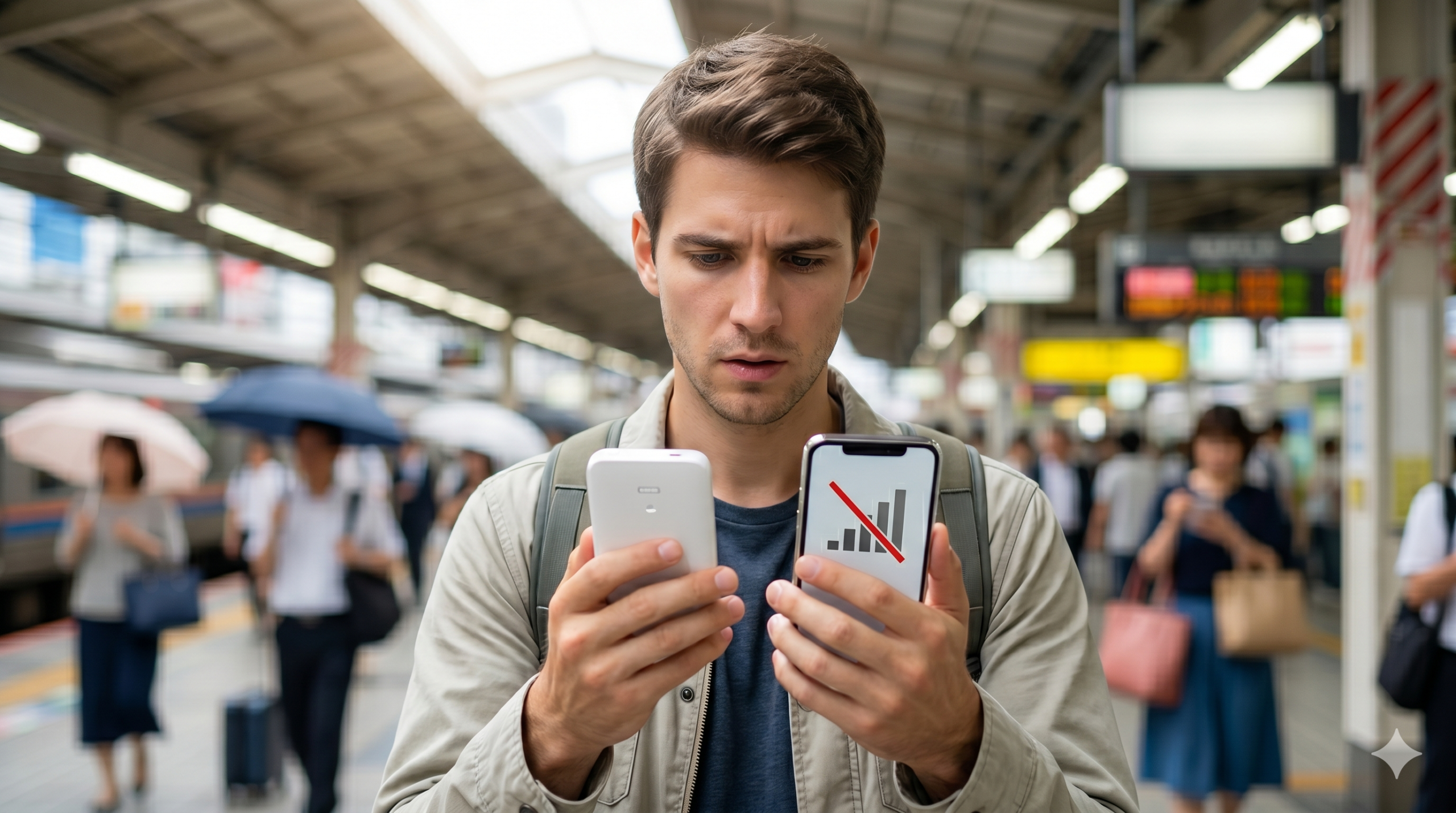
Why Your Phone Might Not Work in Japan (Even With a “Good” Plan)
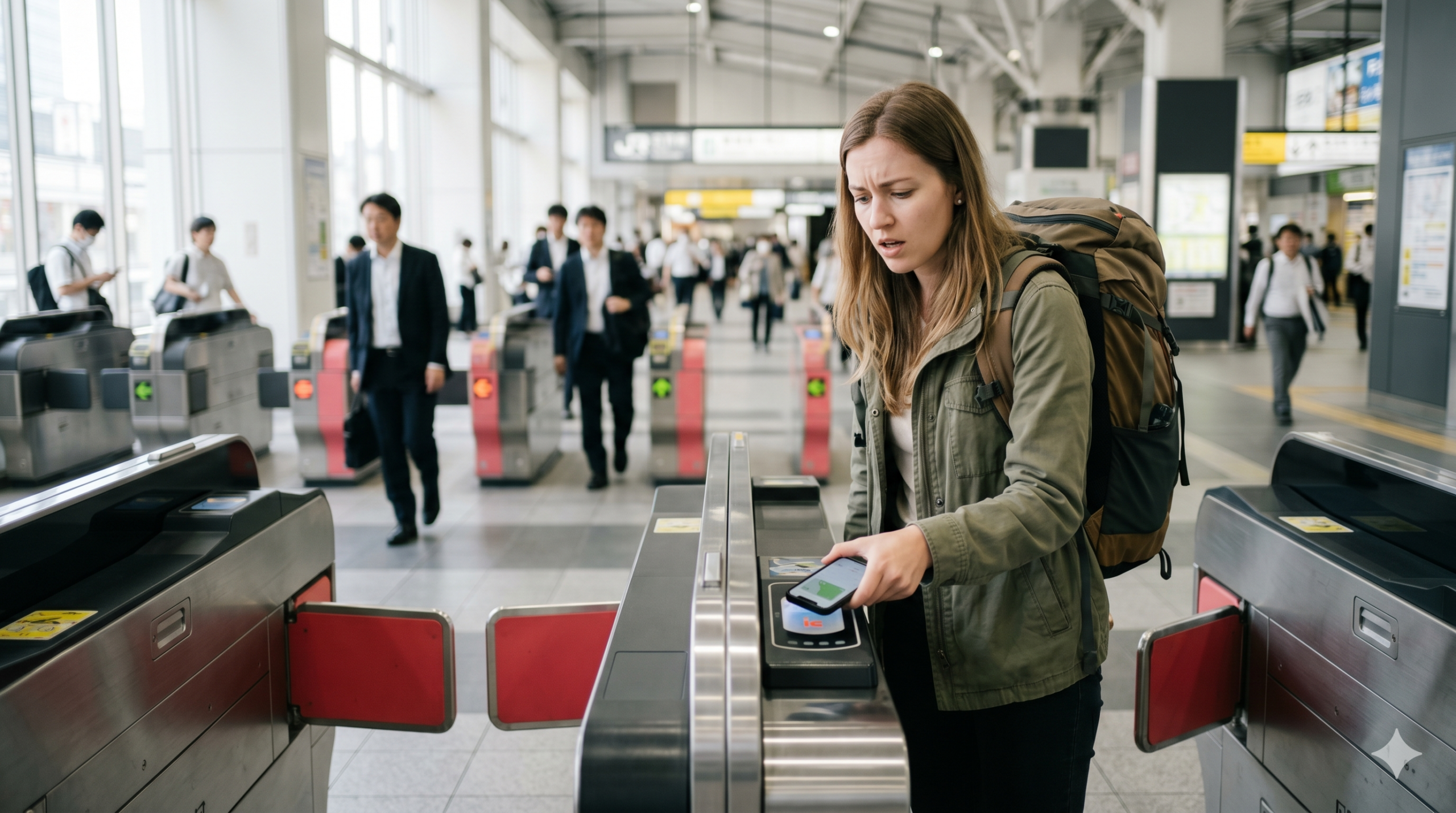
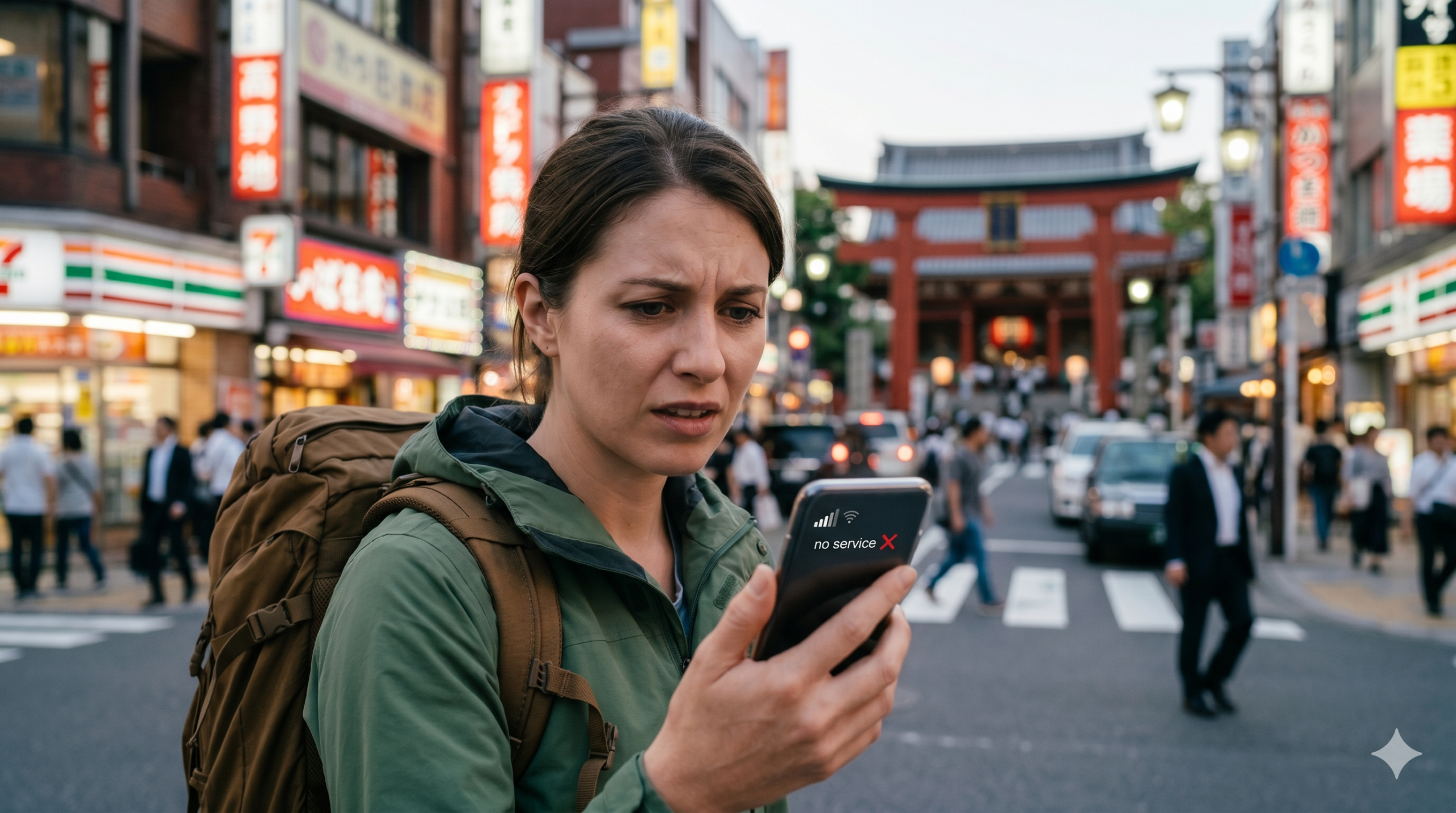
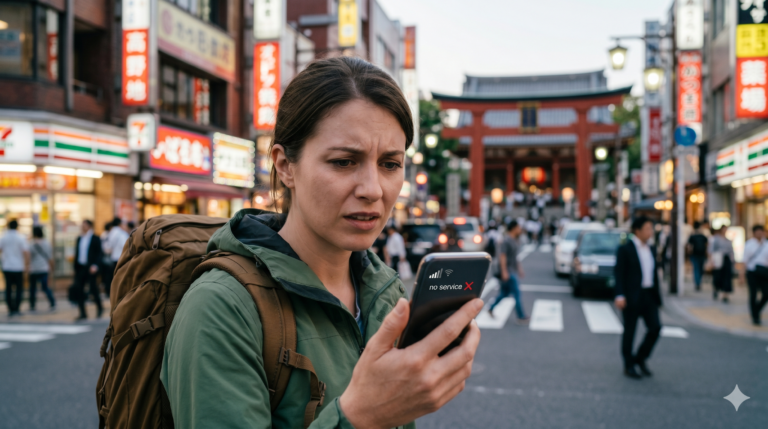
You land at Narita or Haneda, turn on your phone, andโฆ nothing. Or worse โ you have signal bars but no actual internet. Or your roaming charges are sky-high. Japan’s mobile network situation is excellent for locals but confusing for foreigners. This guide walks through every scenario, every fix, and the cheapest setup for 2026.
The 4 Ways to Get Internet in Japan
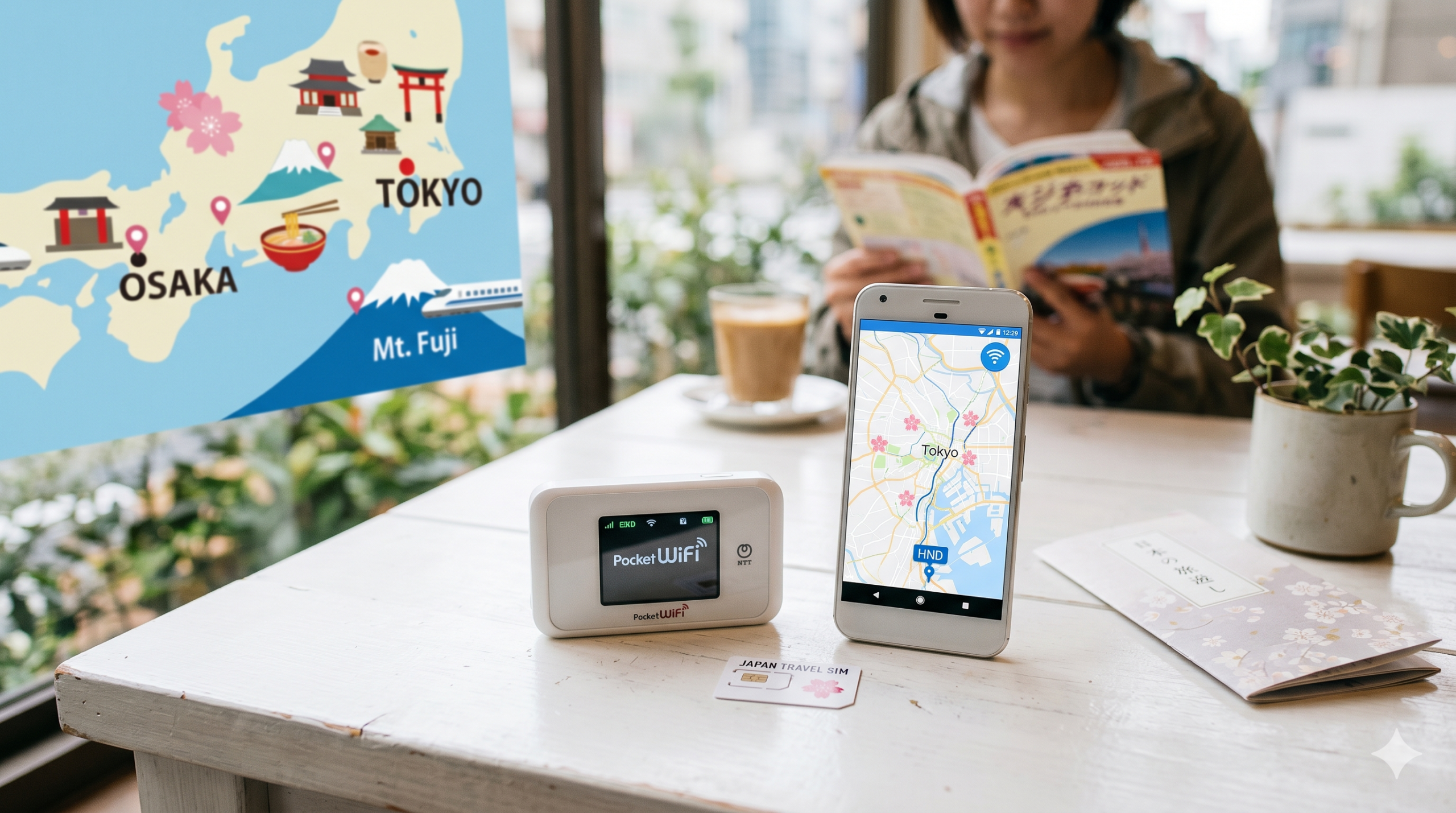
Before troubleshooting, it helps to know your options. There are four main ways tourists and expats get internet in Japan:
Option 1: International Roaming (Your Home Plan)
Simply using your existing phone plan in Japan. Most major carriers offer international day passes ($5โ$15/day) or global plans. Pros: no setup needed. Cons: can be expensive for longer stays, sometimes throttled to 2G speeds after a data limit.
Option 2: eSIM (Best for Tourists)
Buy a Japan eSIM before you travel. Download it to your phone, activate it on arrival. Pros: fast, cheap (from ยฅ1,000 for 7 days), keep your home SIM active for calls. Cons: requires a compatible eSIM phone (iPhone XS or later, most modern Android flagships). Top providers: Airalo, Holafly, IIJmio.
Option 3: Physical SIM Card
Buy a Japan SIM at the airport or online. Insert and go. Pros: works on any unlocked phone. Cons: need to eject your home SIM (can’t receive calls on your normal number while in Japan unless you have two SIM slots).
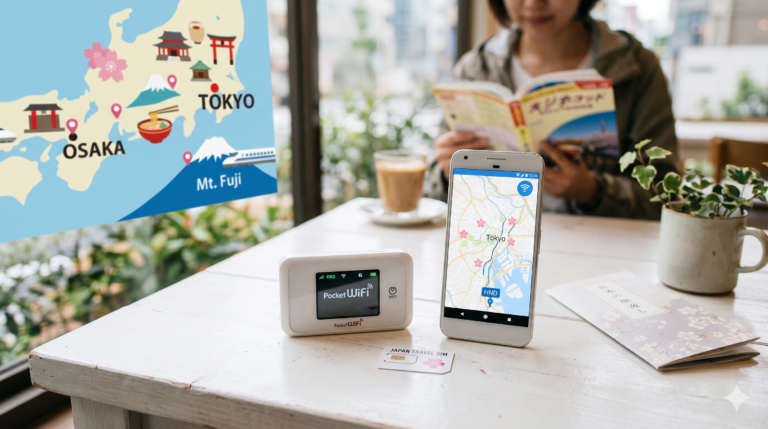
Option 4: Pocket WiFi Device
A portable WiFi hotspot you rent. Pros: connect multiple devices, no phone compatibility issues. Cons: extra device to carry and charge, need to pick up/return at airport.
Troubleshooting: My Phone Has No Internet in Japan
Problem 1: Roaming Isn’t Enabled
The most common fix. Many phones have data roaming disabled by default to prevent bill shock.
iPhone fix: Settings โ Mobile Data โ Mobile Data Options โ Data Roaming โ ON
Android fix: Settings โ Connections โ Mobile Networks โ Data Roaming โ ON
Also check: Settings โ Mobile Data โ make sure mobile data is ON, not just WiFi.
Problem 2: Your Phone is Carrier-Locked
If you bought your phone directly from a carrier (AT&T, Verizon, EE, etc.) rather than unlocked, it may only work with their SIM cards. Japan’s networks (NTT Docomo, SoftBank, au) use different carrier agreements.
Fix: Contact your carrier to unlock your phone before traveling. Most carriers unlock for free after your contract period. Once unlocked, Japanese SIMs and eSIMs will work.
Quick check: Try inserting a different SIM (even a friend’s) and see if it connects. If it doesn’t, your phone is locked.
Problem 3: Wrong APN Settings
If you have a Japan SIM card but no internet, the issue is usually APN (Access Point Name) settings โ the configuration your phone needs to connect to the carrier’s data network.
Fix for iPhone: Many Japan SIMs install the APN profile automatically when you insert the card. If not, go to the carrier’s website and download their APN profile. Usually at: [carrier name] + “APN settings iPhone”.
Fix for Android: Settings โ Connections โ Mobile Networks โ Access Point Names โ Add new APN โ Enter the APN details from your carrier’s website.
Common Japan SIM APN settings (IIJmio example):
Name: IIJmio
APN: iijmio.jp
Username: mio@iij
Password: iij
Authentication: CHAP
Problem 4: eSIM Not Activating
You purchased an eSIM but it’s not connecting. Common causes and fixes:
- QR code not scanned correctly: Settings โ Mobile Data โ Add eSIM โ Use QR Code. Make sure you’re using a different device to display the QR (you can’t scan and display on the same phone).
- Not yet in Japan: Some eSIMs only activate once you’re in Japan and your device registers on the Japanese network. Give it 10โ15 minutes after landing.
- APN not set: Same as above โ check if an APN profile needs to be installed.
- Phone too old: eSIM requires iPhone XS (2018) or later, or Android phones with eSIM support. Check your phone’s specs.
- eSIM already used: Most travel eSIMs are single-use. If you’ve activated this eSIM before, it won’t activate again on a new phone. Contact the provider for a new QR code.
Problem 5: Connected to WiFi But No Internet
Your phone shows full WiFi bars but pages won’t load. This is usually a captive portal (login page) issue.
Fix: Open your browser and try to navigate to any HTTP page (like http://neverssl.com). This should trigger the hotel/cafรฉ/airport login portal. Complete the login and you’ll get access.
If still nothing: Forget the network and reconnect. Check if the WiFi requires a voucher code from the front desk (common in hotels and ryokan).
Problem 6: SIM Card Not Recognized
Phone shows “No SIM” or “Invalid SIM” after inserting Japan SIM.
Fix:
- Power off completely, remove SIM, reinsert, power on
- Check you have the right SIM size (nano/micro/standard) โ Japan SIMs usually come with an adapter
- Make sure SIM is seated correctly โ the gold contacts facing down on iPhone, facing up on most Android
- Try a different SIM tray orientation if there are multiple slots
- If still failing, try your home SIM โ if that’s also not recognized, the SIM tray or reader may be damaged
Problem 7: Very Slow Internet Despite Good Signal
You have signal and data is technically working, but speeds are painful (like 0.5 Mbps). Causes:
- Fair Use Throttling: Your Japan SIM or roaming plan has hit its high-speed data cap. Data continues at 200 kbps or lower. Check your plan’s data limit.
- Network congestion: Happens at major events, busy stations (Shinjuku, Shibuya), and peak hours. Move a bit or wait a few minutes.
- Wrong network band: Rarely, your phone might not support the 5G/4G LTE bands used by the Japanese carrier. Check your phone’s supported bands vs Japan’s carrier bands (Docomo uses B3, B19, B28; SoftBank uses B3, B8, B28; au uses B3, B18/B26).
Fix: If throttled, buy more data or switch to a different plan. If band incompatibility, try a different SIM carrier.
Public WiFi in Japan: What Works and What Doesn’t
Free WiFi Hotspots That Work Well
- 7SPOT (7-Eleven WiFi): Free, available in all 7-Eleven stores. Register once with email. 60 minutes per session, unlimited sessions.
- Docomo WiFi / au WiFi / SoftBank WiFi: Available at major stations, malls, and tourist spots. Speed varies widely.
- JR East Train WiFi: Shinkansen and many express trains now have onboard WiFi. Speed is usable for email/maps but not streaming.
- Airport WiFi: Narita and Haneda have excellent free WiFi. Use it to set up your eSIM/SIM before leaving the airport.
- Starbucks Japan WiFi: Reliable, fast enough for video calls. Works nationwide.
WiFi That’s More Trouble Than It’s Worth
- Japan Connected-free WiFi app: Requires registration. Works at some spots but inconsistent.
- FREESPOT: Highly variable quality. Many require a Japanese-language registration process.
- Hotel room WiFi: Often fine for browsing but may struggle with video calls. Use the hotel lobby if in-room is slow.
The Best Internet Solutions for Japan by Trip Type
Short-Term Tourist (1โ2 weeks)
Best option: eSIM. Get Airalo or IIJmio eSIM before you travel. 10GB for ยฅ3,000โยฅ5,000 is plenty for 2 weeks of maps, messaging, and light browsing. Keep your home SIM active for calls and 2FA messages.
Long-Term Expat or Remote Worker
Best option: Local SIM from IIJmio, Rakuten Mobile, or LINEMO. Monthly plans from ยฅ880โยฅ3,300 for unlimited or large data. Rakuten Mobile offers unlimited data for ยฅ3,278/month on their own network (note: rural coverage gaps).
Traveling as a Group
Best option: Pocket WiFi rental. Share one device among 3โ5 people. Rent from Japan Wireless or Ninja WiFi at the airport. Around ยฅ300โยฅ600 per day for unlimited data. Return at the airport.
No Smartphone (or Older Phone Without eSIM)
Best option: Pocket WiFi, or a physical SIM from the airport (IIJmio, b-mobile, Docomo Data SIM). Bring a SIM tool to open the tray.
Japan’s 5G Coverage Map (2026)
Japan has excellent 4G LTE coverage essentially everywhere that people live or travel. 5G coverage as of 2026:
- NTT Docomo: Best overall coverage including rural areas. 5G expanding rapidly.
- SoftBank: Strong in cities, weaker in rural areas.
- au (KDDI): Good city coverage, solid rural LTE.
- Rakuten Mobile: 5G and 4G in urban areas, uses au network roaming in rural areas (data throttled on roaming).
For most tourists visiting Tokyo, Osaka, Kyoto, and the main tourist trail, any provider works fine. If you’re doing rural hiking or visiting remote onsen, Docomo-based SIMs give the best coverage.
Quick Fix Checklist: No Internet in Japan
Run through this in order:
- โ Data roaming enabled? (Settings โ Mobile Data โ Data Roaming โ ON)
- โ Mobile data enabled? (not just WiFi)
- โ Phone unlocked for international use?
- โ APN settings installed? (for physical SIM users)
- โ eSIM properly scanned and activated?
- โ Have you hit your data limit? (check carrier app)
- โ Try airplane mode ON for 30 seconds, then OFF
- โ Full phone restart (power off, wait 30 seconds, power on)
- โ Forget WiFi network and reconnect
- โ Try a different WiFi network (7-Eleven hotspot as backup)
๐พ More Japan Life Guides
๐ JAPAN EXPAT STARTER KIT
Stop Googling Everything.
Get the Complete Guide.
Banking ยท Health Insurance ยท Housing ยท Suica ยท Taxes ยท PayPay ยท Amazon Japan
โ all in one PDF, updated for 2026.
30-day money-back guarantee ยท Instant PDF download
๐พ More Japan Travel Guides
๐ฏ๐ต Travel & Life Essentials for Japan
Hand-picked gear to make your time in Japan easier. Available on Amazon US & Amazon Japan.
๐ Portable charger
A must for long days of sightseeing and photos.
View on Amazon (US)View on Amazon Japan๐ Travel plug adapter
Japan uses Type A outlets. Bring the right adapter.
View on Amazon (US)View on Amazon Japan๐ง Translation earbuds
Real-time translation to talk without barriers.
View on Amazon (US)View on Amazon JapanAs an Amazon Associate, Japan Life Lab earns from qualifying purchases.