This article was created with AI writing assistance (ChatGPT, Claude, etc.). Product selection, specifications, and reviews are verified by the Japan Life Lab editorial team.
This article contains promotional / affiliate links.
Tax-free shopping in Japan changes on 1 November 2026
Until 31 October you show your passport at the till and simply pay without the 10% consumption tax. From 1 November you pay the full tax-included price in the shop and claim the tax back at the airport — at a customs kiosk or through Visit Japan Web — before you check in.
- The ¥5,000 minimum per shop, per day stays the same.
- The general-goods / consumables split is abolished, and so is the ¥500,000 cap on consumables.
- Sealed packaging is abolished — but consumables still have to leave Japan unused.
- Everything on the receipt has to be with you at departure. Customs can ask to see it.
Shopping before 1 November? Nothing changes for you yet.
Ask any foreigner who has lived in Japan what they miss most, and a surprising number will say the same thing: the 100-yen shop. Not the temples. Not the sushi. The shop where everything costs about 70 cents.
Daiso, Seria and Can Do are not “cheap junk stores.” They are where Japan quietly puts its obsession with small, well-made objects. This guide covers what is genuinely worth buying, what to skip, and how the three chains differ — so you do not waste a suitcase corner on the wrong things.
📌 What you will learn
You do not have to read it all — jump to what you need.
- First: the three chains are not the same
- Prices: “100 yen” is not always 100 yen
- What is actually worth buying
- What to skip
- Practical notes for visitors
- For expats: this is your first stop, not your last resort
- Can you buy this stuff from abroad?
※ Start wherever fits your situation.
Prime members get fast, free delivery on millions of items, Prime Video and members-only deals. Eligible new members can try it free for 30 days.
Start your free 30-day Prime trial →Ages 18–24? See Prime for Young Adults
Paid links. As an Amazon Associate, Japan Life Lab earns from qualifying purchases. Trial eligibility and terms are set by Amazon.
First: the three chains are not the same
Foreign visitors often treat “100-yen shop” as one thing. Locals do not. Each chain has a personality, and knowing it saves you a lot of walking.
| Chain | Character | Go here for |
|---|---|---|
| Daiso | The biggest. Widest range, largest stores | Everything. Start here if you only visit one |
| Seria | Design-focused. Muted colours, no loud packaging | Kitchenware, storage, anything you will actually display at home |
| Can Do | Smaller, often in stations and malls | Quick stops, character goods |
If you care how things look on your shelf, go to Seria. Daiso sells more, but Seria curates. This single tip changes most people’s experience.
Prices: “100 yen” is not always 100 yen
Two things surprise visitors.
1. Tax is added at the register. The shelf says ¥100, you pay ¥110. Japan quotes prices before consumption tax in these stores, so budget accordingly.
2. Not everything is ¥100. Daiso in particular now sells ¥200, ¥300 and ¥500 items mixed in with the rest. They are labelled, but easy to miss. Check the tag on anything that looks too good to be ¥100 — because it probably is.
What is actually worth buying
1. Kitchen tools — the category Japan takes too seriously
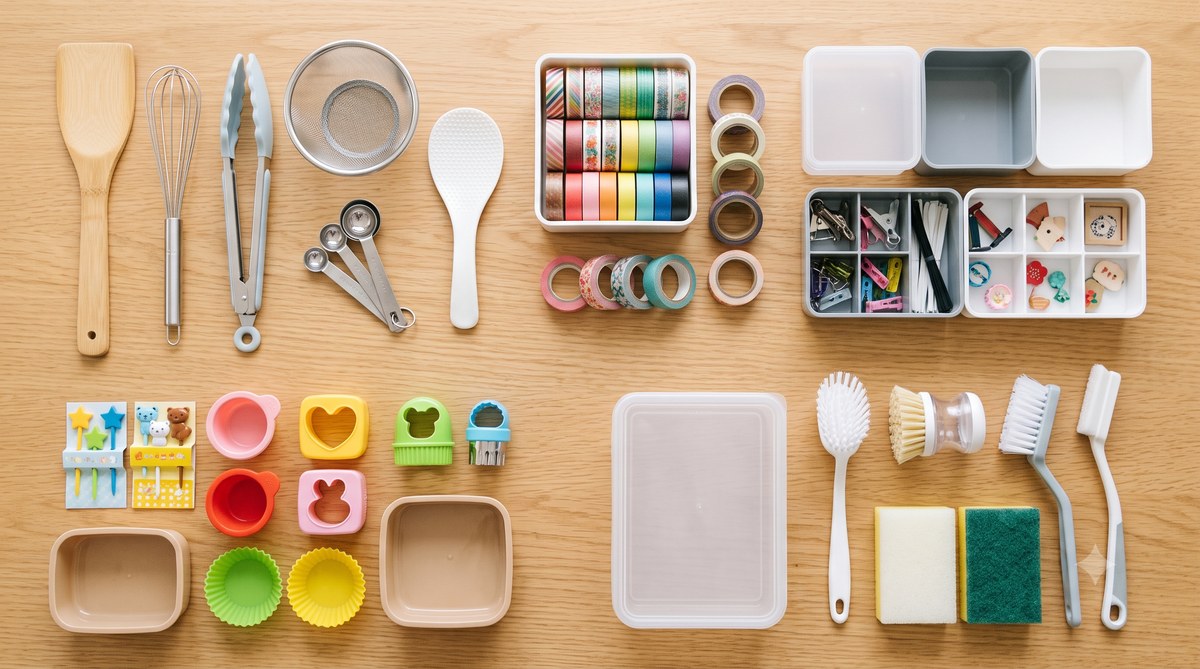
This is where the 100-yen shop stops making sense to outsiders. Vegetable peelers that genuinely work. Ginger graters. Egg separators. Rice paddles with dimples so the rice does not stick. These are designed by people who cook, sold for ¥110.
The reason is cultural: Japanese kitchens are small, so tools are single-purpose and compact rather than bulky multi-tools. If you buy one category, make it this one.
2. Storage and organisation
Small apartments created an entire industry. Drawer dividers, cable ties, under-shelf baskets, boxes sized to fit each other. Seria’s storage boxes are modular — they stack and line up because they share dimensions. That is not an accident.
A word of warning: it is very easy to buy storage for storage’s sake. Measure your drawer first.
3. Stationery
Japan’s stationery reputation is earned at the high end, but a lot of it trickles down. Notebooks with decent paper, masking tape, pens that do not smear. Masking tape (washi tape) is the classic souvenir: light, flat, cheap, and genuinely nice.
4. Bento and lunch goods
Bento boxes, silicone dividers, sauce bottles shaped like fish, tiny picks. Even if you never make a bento, these are the most “Japan” objects in the shop and they cost almost nothing.
5. Seasonal items
In summer: hand fans, cooling sheets, sun-protection sleeves. In winter: heat packs (kairo). These rotate with the calendar, so what you find in July is gone by November. If you see it and want it, buy it then — the shelf will be different next month.
What to skip
- Electronics and batteries — cables, chargers, earphones. The savings are not worth the failure rate. Buy these properly.
- Knives and anything that must hold an edge — Japan makes extraordinary knives. These are not those.
- Anything you will rely on — if it failing would ruin your day, do not buy it here.
- Bulky items if you are flying — the cost is not the money, it is the suitcase space.
The honest rule: 100-yen shops are excellent at simple objects and unreliable at complex ones. A peeler has no failure mode. A charging cable has several.
Practical notes for visitors
Tax-free does not really apply here
Tax-free shopping in Japan generally requires a minimum purchase (¥5,000+) at participating stores. Most 100-yen shops do not offer it, and reaching the threshold means buying 45+ items. Just pay the tax.
Bring your own bag
Plastic bags cost extra in Japan since 2020. It is a few yen, but you will be asked, and knowing the question is coming helps.
The big Daiso stores are worth the detour
Flagship locations (Harajuku, Ginza and other major districts) carry several floors of stock. A small neighbourhood Daiso carries a fraction of the range. If you are shopping seriously, find a large one.
For expats: this is your first stop, not your last resort
If you have just moved to Japan and your apartment is empty, the 100-yen shop is how you get to “livable” in one afternoon. Plates, cutlery, a drying rack, hangers, cleaning supplies, a bucket, storage boxes. You can furnish a kitchen for under ¥3,000.
The strategy most long-term residents settle on: buy it at the 100-yen shop first, and replace only the things you end up using every day. You will discover you use the cheap peeler forever and the cheap frying pan for two months.
Can you buy this stuff from abroad?
Not from Daiso directly in most countries — their international stores carry different (and pricier) stock. If you are outside Japan and want the real thing, the practical routes are:
- Amazon Japan — many Japanese kitchen and stationery goods ship internationally
- Proxy services (Buyee etc.) — for items only sold domestically
- Ask a friend visiting Japan — genuinely the cheapest option for light items
Be realistic though: shipping a ¥110 item overseas costs more than the item. These make sense as a bulk order or a suitcase filler, not a single purchase.
FAQ
Is Daiso cheaper in Japan than in my country?
Almost certainly yes. Overseas Daiso locations price higher to cover import and local costs, and carry a narrower range. The ¥110 price point is essentially a Japan-only phenomenon.
Are the products made in China? Does that matter?
Many are, yes. But they are designed to Japanese specifications and that is what you are actually buying — the thinking behind the object, not the factory. A ¥110 Japanese-designed grater outperforms a $8 generic one.
What is the single best thing to buy?
Ask ten residents and you get ten answers, but the recurring ones are: kitchen tools, masking tape, and storage boxes from Seria. All three are light, cheap, and hard to find equivalents for outside Japan.
Bottom line
The 100-yen shop is not a tourist attraction, which is exactly why it is worth visiting. It is where Japan’s design culture shows up in ordinary objects that ordinary people use.
- Seria for anything you will look at daily
- Daiso (a large branch) for range
- Buy: kitchen tools, stationery, storage, bento goods, seasonal items
- Skip: electronics, knives, anything you depend on
- Remember: ¥100 becomes ¥110 at the register
You May Also Like
🔥 Editor’s Picks for Life & Travel in Japan
Japan Expat Starter Kit 2026 PDF guide
Your first 90 days in Japan, step by step: 17 chapters · 24 pages · 100 phrases in Japanese script · 40 kanji · printable checklists. Bank account, My Number, health insurance, apartment, phone, taxes & pension.
$9.99 $4.99 current price
📥 Get the kit →📄 Read 5 pages free: contents + Chapter 2
⚡ Instant PDF download · 🛡️ 30-day money-back guarantee · 🔄 Free 2026 updates
Practical guides for life and travel in Japan — free, about once a week. No spam, unsubscribe anytime.
☕ Enjoying our Japan guides?
If this article helped you, you can support our work with a coffee!
Did this guide help you? 🍵
Japan Life Lab is a small independent blog, and every guide we publish is completely free — no paywalls, ever. If our work saved you time (or a headache), you can support us with a cup of Japanese tea. Every contribution, big or small, goes straight into keeping these guides free, accurate and up to date for everyone.
☕ Support Japan Life Lab
Leave a Reply