This article was created with AI writing assistance (ChatGPT, Claude, etc.). Product selection, specifications, and reviews are verified by the Japan Life Lab editorial team.
This article contains promotional / affiliate links.
Japan is more popular than ever — but it’s also more regulated than ever. In 2024 and 2025, cities across Japan rolled out sweeping new rules targeting overtourism, reckless behavior, and disrespectful conduct. By 2026, those rules have teeth: fines, access bans, and in some cases, permanent blacklisting from popular sites.
Whether it’s the ¥4,000 fee to climb Mount Fuji, the photography ban in Kyoto’s Gion district, or drone restrictions at national parks, this guide covers everything you need to know to stay on the right side of Japan’s new tourist rules — and avoid ruining your trip with an avoidable fine.
- Mount Fuji: ¥4,000 trail fee + 4,000 daily hiker cap
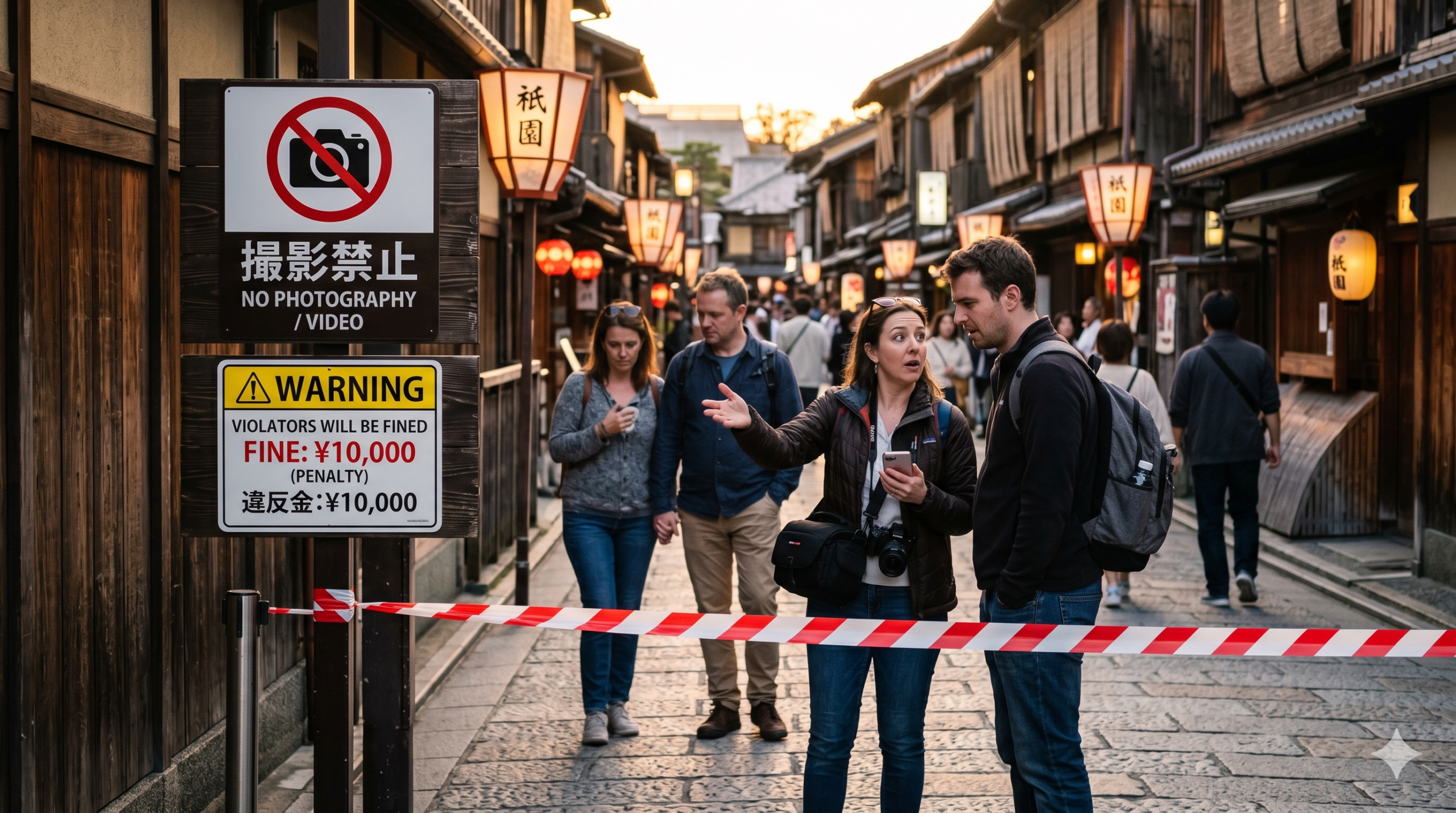
- Kyoto Gion: no photos on private streets (¥10,000 penalty set by locals)
- Departure tax tripled to ¥3,000, plus local hotel taxes
- Drone bans at most national parks and UNESCO sites
- Street-drinking ban around Shibuya Station; check local signs in Osaka & Kyoto
- Private alleys in Gion closed to tourists
📌 What you will learn
You do not have to read it all — jump to what you need.
- ⛰️ 1. Mount Fuji: Fees, Hiker Caps & Gate Closures
- 📸 2. Kyoto’s Gion District: No Photos of Geisha (¥10,000 Fine)
- 🖤 3. The Fujikawaguchiko Black Screen Saga — And What It Means for You
- 🚁 4. Drone Bans: Most Popular Sites Are Off-Limits
- 🍺 5. Alcohol Bans in Public Spaces
- 💰 6. Overtourism Taxes: What You’ll Be Charged
- 🦌 7. Nara Deer: Don’t Feed Them the Wrong Food (Serious Fine)
※ Start wherever fits your situation.
⛰️ 1. Mount Fuji: Fees, Hiker Caps & Gate Closures
Mount Fuji’s iconic Yoshida Trail now charges a ¥4,000 climbing fee per person — and that’s just to use the trail. Combined with a hard cap of 4,000 hikers per day, popular climbing windows fill up fast. Book your slot in advance at the official Fuji Climbing website or risk being turned away at the gate.
The trail gate closes at 2:00 PM and reopens at 3:00 AM (climbers with a mountain-hut booking are exempt) during the official climbing season (July 1–September 10). This was introduced to stop the dangerous practice of “Bullet Climbing” — attempting to summit overnight without proper equipment or acclimatization. If you arrive at the gate during closure hours, you will be turned away. No exceptions.
| Detail | Info |
|---|---|
| Trail Fee (Yoshida) | ¥4,000 per person |
| Daily Hiker Cap | 4,000 people |
| Gate Closed | 2:00 PM – 3:00 AM (hut guests exempt) |
| Climbing Season | July 1 – September 10 |
| Arriving during closure | Turned back unless you have a mountain-hut reservation |
Pro tip: Book your climbing slot at least 2–3 weeks in advance during July and August. The Subashiri, Gotemba, and Fujinomiya trails (Shizuoka side) charge the same ¥4,000 fee, apply the same 2:00 PM–3:00 AM entry restriction and require an online pre-learning module.
📸 2. Kyoto’s Gion District: No Photos of Geisha (¥10,000 Fine)
This is the one that catches tourists off guard most often. In Kyoto’s Gion district — Japan’s most famous geisha neighborhood — photographing maiko and geiko (geisha) without consent is not allowed on Gion’s private streets, where signs put up by the local residents’ association warn of a ¥10,000 penalty (a local rule since 2019, not a legal fine). The rule applies to streets, alleys, and tea house entrances.
The ban came after years of harassment: tourists chasing women in kimono through narrow alleys, blocking paths for photos, and refusing to respect clear “no photography” signs. Compliance officers now patrol the area, especially in the evenings when geisha are most active.
🖤 3. The Fujikawaguchiko Black Screen Saga — And What It Means for You
In 2024, the town of Fujikawaguchiko (home to the famous “Mount Fuji convenience store” photo spot) erected a large black screen to block the view — after tourists ignored barriers, trespassed on private property, and caused traffic hazards for the perfect Instagram shot.
The screen became international news, but the underlying message is clear: Japan’s local communities are willing to permanently block access to iconic views rather than tolerate disrespectful behavior. Several other photo spots around Japan have followed suit, erecting barriers or blocking views entirely.
The rule: Always stay on designated viewing areas. Crossing barriers, trespassing on private property, or standing in traffic for a photo can result in fines of ¥20,000 or higher — and permanent access bans for the local community.
🚁 4. Drone Bans: Most Popular Sites Are Off-Limits
As of 2022 (enforced more strictly from 2025), Japan’s Civil Aeronautics Act requires drone operators to obtain permits from the Japan Civil Aviation Bureau (JCAB) before flying in most populated or sensitive areas. In practice, this means virtually every tourist destination is a no-fly zone for casual visitors.
- All national parks (Fuji-Hakone-Izu, Nikko, Yoshino-Kumano, etc.)
- UNESCO World Heritage Sites (Hiroshima Peace Memorial, Nara’s Todai-ji, etc.)
- Within 150m of airports (Tokyo, Osaka, Sapporo)
- Nara Park (to protect the deer)
- Above crowds at any festival or public event
- All imperial palace grounds
Fines for unauthorized drone use start at ¥500,000 and can include criminal charges under the Aviation Act. Leave your drone at home unless you’ve secured permits weeks in advance — the process is extensive and not designed for casual tourist use.
🍺 5. Alcohol Bans in Public Spaces
Japan has traditionally been lenient about public drinking — buying a beer from a convenience store and enjoying it while walking or in a park was completely normal. But that’s changed in several areas due to overtourism and disorder.
Areas with alcohol restrictions (2026):
- Shibuya Station area (Tokyo): Drinking on streets and in parks is banned from 6 pm to 5 am all year (since October 2024)
- Kyoto’s Gion district: We found no official drinking ban, but private alleys are closed to tourists and drinking while walking is frowned upon
- Nara Park: No alcohol near the deer (it harms them)
- Mount Fuji climbing trails: Not part of the official 2026 climbing rules, but avoid alcohol — it worsens altitude sickness
💰 6. Overtourism Taxes: What You’ll Be Charged
Japan’s national departure tax is ¥3,000 per person (it was ¥1,000 until 30 June 2026) and is automatically included in your airfare. But many destinations now layer their own tourist taxes on top:
| Location | Tax Amount | Notes |
|---|---|---|
| Kyoto (accommodation) | ¥200–¥10,000/night | Scales with room price |
| Tokyo (accommodation) | Tokyo ¥100–¥200 / Osaka ¥200–¥500 per night | Based on room rate |
| Osaka (accommodation) | Tokyo ¥100–¥200 / Osaka ¥200–¥500 per night | Per person |
| Mount Fuji (Yoshida Trail) | ¥4,000/person | Trail conservation fee |
| National departure tax | ¥3,000/person (since 1 July 2026) | All international departures |
🦌 7. Nara Deer: Don’t Feed Them the Wrong Food (Serious Fine)
Nara’s famous deer are technically wild animals under Japanese law, protected as national treasures. Feeding them is allowed — but only with official “shika senbei” (deer crackers) sold by licensed vendors. Feeding them human food, snacks, or anything else is illegal and carries fines.
Tourists have been gored by deer after teasing them with food they couldn’t deliver, or after being surrounded by aggressive bucks during rutting season (September–November). During this period, approach the deer with extra caution and keep children close.
🚶 8. Queuing & Line-Cutting: Japan Takes This Seriously
Japan’s queue culture is sacred. Cutting in line — even at a busy tourist site — can result in being asked to leave by staff or security. At popular attractions, advance timed-entry tickets are now required at some attractions, meaning you can’t just walk in whenever you like.
Sites with mandatory advance tickets (2026):
- TeamLab Borderless & Planets (Tokyo & Osaka)
- (Not needed: Fushimi Inari in Kyoto is free and open 24 hours — go early to beat the crowds)
- (Arashiyama Bamboo Grove: no official timed-entry system has been announced — just go early)
- Popular timed-ticket attractions also include some museums and observation decks
- Hiroshima Peace Memorial Museum
- Shibuya Sky observation deck
⛩️ 9. Temple & Shrine Etiquette: What Can Get You Removed
Japan’s temples and shrines are actively monitored for disrespectful behavior. Staff and volunteer guides now have authority to remove visitors for the following:
- Climbing on or touching sacred statues and structures
- Entering “no entry” areas marked with rope or signs
- Flash photography inside buildings (or photography at all in some areas)
- Loud behavior during prayer times
- Entering sacred areas without appropriate footwear
- Using “quiet hours” areas with speakers or music
Some shrines now ban photography entirely inside their main halls. Always check signage before raising your camera. Violations can result in being asked to leave and, at some sites, a formal ban from re-entry.
📱 10. Using Your Phone While Cycling (New Fine)
As of November 2024, Japan revised its Road Traffic Act to impose strict penalties on cyclists using smartphones while riding. This affects tourists who rent bikes at popular cycling destinations like Kyoto, Shimanami Kaido, and Nara.
✅ How to Stay on the Right Side of Japan’s Rules
The bottom line: Japan’s new tourist rules aren’t designed to punish visitors — they’re designed to preserve the destinations that make Japan worth visiting. Follow these principles and you’ll have no problems:
- Always book major attractions in advance (Mount Fuji, popular museums, etc.)
- Never photograph people in traditional dress without asking first
- Stay on marked paths and behind barriers at scenic spots
- Leave drones at home (or get permits weeks in advance)
- Respect “no photography” and “quiet hours” signage
- Pay all local tourist taxes — they’re usually collected automatically at hotels
- Don’t feed animals anything except approved food from official vendors
- Keep off your phone while cycling
🗾 Frequently Asked Questions
Can I still visit Kyoto’s Gion district as a tourist?
Yes, absolutely. The Gion district is open to tourists — you just can’t photograph geisha or maiko on the streets without their consent. Walking through, shopping, and dining are all completely fine. The ¥10,000 fine only applies to harassing or photographing working geisha.
Is the Mount Fuji ¥4,000 fee per trip or per day?
The ¥4,000 fee is per person, per climb on the Yoshida Trail. It includes a conservation contribution. The Subashiri, Gotemba and Fujinomiya trails charge the same ¥4,000. The fee does not include lodging at mountain huts, which costs an additional ¥7,000–¥9,000 per night.
Can I bring my drone to Japan?
You can bring a drone to Japan, but flying it legally requires registration with the JCAB (Japan Civil Aviation Bureau), a Remote Pilot Certificate, and specific permits for each flight location. Most tourist sites are restricted areas. The process takes weeks — not suitable for short-term tourists.
What is the “overtourism tax” and do I have to pay it?
Yes. Most accommodation taxes in Japan (Kyoto, Tokyo, Osaka) are automatically added to your hotel bill. The national departure tax (¥3,000 since 1 July 2026) is built into your flight ticket price. Site-specific fees like the Fuji trail fee must be paid at the gate or in advance online.

Japan Expat Starter Kit 2026 PDF guide
Your first 90 days in Japan, step by step: 17 chapters · 24 pages · 100 phrases in Japanese script · 40 kanji · printable checklists. Bank account, My Number, health insurance, apartment, phone, taxes & pension.
$9.99 $4.99 current price
📥 Get the kit →📄 Read 5 pages free: contents + Chapter 2
⚡ Instant PDF download · 🛡️ 30-day money-back guarantee · 🔄 Free 2026 updates
🗾 More Japan Travel & Life Guides
🇯🇵 Travel & Life Essentials for Japan
Hand-picked gear to make your time in Japan easier. Available on Amazon US & Amazon Japan.
🔋 Portable charger
A must for long days of sightseeing and photos.
View on Amazon (US)View on Amazon Japan🔌 Travel plug adapter
Japan uses Type A outlets. Bring the right adapter.
View on Amazon (US)View on Amazon Japan🎧 Translation earbuds
Real-time translation to talk without barriers.
View on Amazon (US)View on Amazon JapanAs an Amazon Associate, Japan Life Lab earns from qualifying purchases.
🔥 Editor’s Picks for Life & Travel in Japan
Practical guides for life and travel in Japan — free, about once a week. No spam, unsubscribe anytime.
☕ Enjoying our Japan guides?
If this article helped you, you can support our work with a coffee!
Did this guide help you? 🍵
Japan Life Lab is a small independent blog, and every guide we publish is completely free — no paywalls, ever. If our work saved you time (or a headache), you can support us with a cup of Japanese tea. Every contribution, big or small, goes straight into keeping these guides free, accurate and up to date for everyone.
☕ Support Japan Life Lab
Leave a Reply