This article was created with AI writing assistance (ChatGPT, Claude, etc.). Product selection, specifications, and reviews are verified by the Japan Life Lab editorial team.
This article contains promotional / affiliate links.
Japan is famous for being polite, clean, and incredibly organized — but scratch the surface and you’ll find a complex web of unwritten social rules that no guidebook fully explains. Breaking these invisible codes won’t get you arrested, but it will earn you silent stares and quiet judgment from Japanese people around you.
We asked expats, cultural consultants, and long-term Japan residents: what are the social rules that took you longest to figure out? Here are the 15 most important ones — and why they matter.

Japan Expat Starter Kit 2026 PDF guide
Your first 90 days in Japan, step by step: 17 chapters · 24 pages · 100 phrases in Japanese script · 40 kanji · printable checklists. Bank account, My Number, health insurance, apartment, phone, taxes & pension.
$9.99 $4.99 current price
📄 Read 5 pages free: contents + Chapter 2
⚡ Instant PDF download · 🛡️ 30-day money-back guarantee · 🔄 Free 2026 updates
📌 What you will learn
You do not have to read it all — jump to what you need.
- 1. Never Eat or Drink While Walking
- 2. Queue Culture Is Sacred
- 3. Talking Loudly on the Phone Is Taboo on Public Transit
- 4. Cash Is Still King (But This Is Changing Fast)
- 5. Remove Your Shoes — Always
- 6. Gift-Giving Has Complex Rules
- 7. The “Quiet Car” Culture Extends Everywhere
※ Start wherever fits your situation.
1. Never Eat or Drink While Walking
This one surprises almost every visitor. In Japan, eating while walking is considered rude and messy. You’ll notice Japanese people stop completely at a food stall, eat, then continue walking. The exception: festival food at matsuri events, where eating while walking is acceptable because everyone is doing it. Drinks from vending machines? Find a spot to stand still.
2. Queue Culture Is Sacred
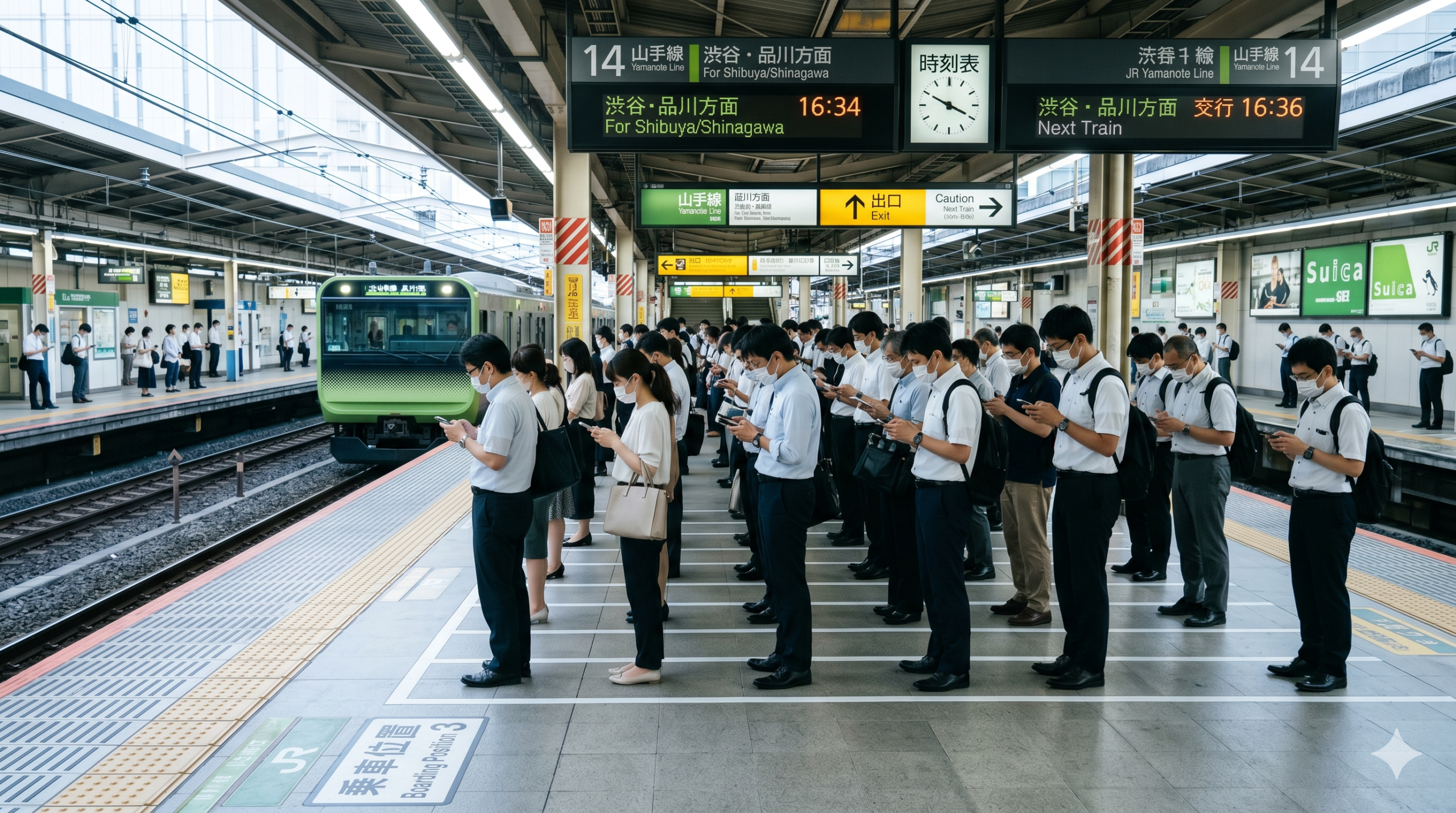
The Japanese queue for everything — trains, escalators, ramen shops, ATMs — and they do it with near-military precision. Never cut in line, even if the queue looks informal. On escalators, stand on the left (except in Osaka, where locals stand on the right). On train platforms, the boarding lines painted on the floor are followed religiously.
3. Talking Loudly on the Phone Is Taboo on Public Transit
Train cars in Japan are remarkably quiet. Phone calls are actively discouraged — you’ll see signs everywhere. If your phone rings, step into the space between carriages or wait until you exit. Texting and messaging are fine. Even among groups, conversations are kept low-volume. This is one rule that shocks visitors from louder cultures the most.
4. Cash Is Still King (But This Is Changing Fast)
Despite being a tech-forward country, Japan remained cash-heavy longer than most developed nations. Many small restaurants, temples, and local shops are cash-only. Always carry ¥5,000–¥10,000 in cash, especially outside major cities. PayPay and IC cards (Suica/Pasmo) are now widely accepted, but don’t assume cards work everywhere.
5. Remove Your Shoes — Always
Before entering any Japanese home, many traditional restaurants (zashiki seating), some traditional inns (ryokan), and even some offices, you remove your shoes. The key signal: a step up (tataki/genkan) and slippers at the entrance. If you see this, remove your shoes. Place them neatly pointing toward the exit. Never step on the tataki with outdoor shoes.
6. Gift-Giving Has Complex Rules
Giving gifts is common and important in Japan, but the rules are nuanced. Never give gifts in sets of 4 (the number 4 sounds like “death” in Japanese). Gifts are typically not opened immediately in front of the giver to avoid showing disappointment. When giving or receiving, use both hands. The wrapping matters as much as the gift itself — messy wrapping is disrespectful.
7. The “Quiet Car” Culture Extends Everywhere
Japanese public spaces operate at a much lower volume than Western equivalents. Museums, elevators, convenience stores — even in busy areas, people maintain a hushed baseline. This isn’t unfriendliness; it’s cultural courtesy. Laughing loudly, speaking at a high volume in restaurants, or playing music without earphones will attract uncomfortable stares.
8. Business Cards Are Sacred Objects
If you’re in a business context in Japan, the meishi (business card) exchange is a ritual, not a formality. Present your card with both hands, Japanese side up if bilingual. Receive cards with both hands and read it carefully. Never write on it, stuff it in your pocket, or put it on a table carelessly. Business card holders are standard equipment for professionals.
9. “Yes” Doesn’t Always Mean Yes
Direct refusal is considered impolite in Japanese culture. “Muzukashii desu ne” (that’s difficult…) often means no. A sharp intake of breath through the teeth (“saa…”) means the answer is no. If someone says “I’ll think about it” or doesn’t follow up, the answer is usually no. Learning to read these indirect signals saves enormous misunderstanding.
10. Don’t Tip — Ever
Tipping in Japan is not just unnecessary — it can actually be considered rude, as if implying the service provider is underpaid or needs charity. Service quality in Japan is consistently high because it’s considered a professional standard, not something earned through tips. This applies to restaurants, taxis, hotels, and hairdressers.
11. Garbage Rules Are Extremely Strict
Japan has one of the most complex garbage separation systems in the world. Rules vary by municipality, but typically: burnable garbage, non-burnable, plastic, cardboard, and glass are all separate streams with specific collection days. Putting garbage out on the wrong day or in the wrong bag is a neighborhood offense — your bag may be tagged and returned to you. Read our Japan Garbage Guide for Foreigners for full details.
12. Pointing Is Rude
In Japanese culture, pointing at people or things directly with a single finger is considered rude. Instead, Japanese people use an open hand with all fingers extended to indicate direction or objects. This is a subtle one that most foreigners don’t notice until someone points it out.
13. The Onsen Rules Are Non-Negotiable
Hot spring baths (onsen) require complete nudity — swimwear is not allowed in traditional baths. Wash and rinse thoroughly before entering the communal bath. Keep your towel out of the water (fold it on your head). Don’t let the towel touch the water. Tattoos are still banned in most onsen, though this is slowly changing in tourist areas.
14. Expressing Gratitude Constantly
Japanese social interaction involves constant expressions of gratitude that can seem excessive to outsiders. “Itadakimasu” before eating, “Gochisousama” after, “Osewani narimashita” (thank you for your support) to anyone who helped you — these aren’t just pleasantries, they’re expected social glue. Skipping them marks you as ungrateful.
15. Personal Space in Crowds vs. Quiet Trains
Japan seems to contradict itself: trains can be packed beyond Western imagination, yet personal space is fiercely respected in other contexts. The key is context. In rush-hour trains, physical proximity is unavoidable and accepted. But in parks, restaurants, and public areas, deliberately sitting directly next to a stranger when other seats are available is strange and uncomfortable for both parties.
The Bottom Line
Understanding Japan’s unwritten rules transforms your experience from tourist to insider. You don’t need to follow every rule perfectly — Japanese people are generally forgiving of foreigners — but showing awareness and effort goes a long way. The goal isn’t perfection: it’s respect.
📖 Recommended reading: Our Japan Convenience Store Guide and Suica Complete Guide cover more Japan essentials for expats and visitors.
🗾 More Japan Life Guides
🔥 Editor’s Picks for Life & Travel in Japan
Practical guides for life and travel in Japan — free, about once a week. No spam, unsubscribe anytime.
☕ Enjoying our Japan guides?
If this article helped you, you can support our work with a coffee!
🇯🇵 Travel & Life Essentials for Japan
Hand-picked gear to make your time in Japan easier. Available on Amazon US & Amazon Japan.
🔋 Portable charger
A must for long days of sightseeing and photos.
View on Amazon (US)View on Amazon Japan🔌 Travel plug adapter
Japan uses Type A outlets. Bring the right adapter.
View on Amazon (US)View on Amazon Japan🎧 Translation earbuds
Real-time translation to talk without barriers.
View on Amazon (US)View on Amazon JapanAs an Amazon Associate, Japan Life Lab earns from qualifying purchases.
Did this guide help you? 🍵
Japan Life Lab is a small independent blog, and every guide we publish is completely free — no paywalls, ever. If our work saved you time (or a headache), you can support us with a cup of Japanese tea. Every contribution, big or small, goes straight into keeping these guides free, accurate and up to date for everyone.
☕ Support Japan Life Lab
Leave a Reply