This article was created with AI writing assistance (ChatGPT, Claude, etc.). Product selection, specifications, and reviews are verified by the Japan Life Lab editorial team.
Moving to Japan is exciting — but Japan’s garbage system can feel like learning a second language. Miss the wrong pickup day, use the wrong bag, or forget to rinse a bottle, and your trash gets left behind with a stern red sticker. This comprehensive guide covers everything you need to know to sort your garbage correctly in Japan, from basic categories to city-specific rules and common expat mistakes.
Why Japan’s Garbage System Is So Strict
Japan generates around 40 million tons of household waste per year, yet its landfills are remarkably small by international standards. The secret is an incredibly efficient recycling and incineration system built on strict source separation. When residents properly sort their trash, municipalities can:
- Incinerate combustible waste at high temperatures to generate electricity
- Recycle plastics, glass, cans, and paper at near-100% capture rates
- Minimize landfill use (Japan’s landfills have only ~20 years of remaining capacity)
- Keep cities clean and reduce odors from improper disposal
For foreigners, the system can feel overwhelming at first. Many expats report that garbage sorting was one of the biggest adjustment challenges when moving to Japan. But once you understand the logic behind it, it becomes second nature within a few weeks.
The 4 Main Garbage Categories
While exact rules differ by municipality, almost every city in Japan uses some version of these four core categories:
| Category | Japanese | Typical Collection | Bag Required |
|---|---|---|---|
| Burnable (Combustible) | 可燃ごみ | 2–3× per week | Usually required |
| Non-Burnable (Incombustible) | 不燃ごみ | 1–2× per month | Usually required |
| Recyclables | 資源ごみ | 1–2× per week | Varies by item |
| Oversized (Bulky) | 粗大ごみ | By appointment | No bag — sticker needed |
🔥 Burnable Garbage (可燃ごみ / Moeru Gomi)
This is the most frequently collected category — usually 2 to 3 times per week. If in doubt about whether something is burnable, a good rule of thumb is: if it can catch fire and isn’t recyclable, it’s probably burnable.
What Goes in Burnable Trash
- All food scraps and leftovers
- Vegetable peels and cores
- Meat bones (small ones)
- Eggshells
- Coffee grounds, tea bags
- Used cooking oil (absorbed in paper)
- Disposable chopsticks and wooden utensils
- Paper plates and paper cups
- Dirty pizza boxes (if contaminated)
- Used napkins and paper towels
- Wax paper and baking parchment
- Paper bags (without plastic handles)
- Tissues and facial wipes
- Receipts and thermal paper
- Stickers and adhesive labels
- Photographs and film negatives
- Carbon paper
- Paper cartons that cannot be recycled (contaminated)
- Envelope windows (composite material)
- Shredded paper (often too small to recycle)
- Old clothes (not recyclable grade)
- Underwear and socks
- Worn-out shoes (rubber soles go to non-burnable)
- Stuffed animals and soft toys
- Pillows and cushions
- Curtains (under 50cm)
- Rope and twine (natural fibers)
- Rubber gloves and aprons
- Plastic wrap (if not marked as recyclable)
- Plastic bags without recycling mark
- Styrofoam food trays (soiled)
- Composite packaging
- Used disposable razors
- Plastic toothbrushes
- Vinyl items
⚠️ Some cities (like Yokohama) separate plastics from burnable. Check local rules.
🪨 Non-Burnable Garbage (不燃ごみ / Moenai Gomi)
Non-burnable garbage is collected less frequently — usually once or twice a month. These are items that can’t be safely incinerated. Many contain materials that release toxic fumes at high temperatures.
What Goes in Non-Burnable Trash
- Ceramics, pottery, and porcelain
- Glass items (not bottles — see recyclables)
- Mirrors
- Light bulbs (wrap in newspaper)
- Fluorescent tubes (separate in some cities)
- Candles (wax)
- Thermometers (non-mercury)
- Magnets
- Clocks and watches (without batteries)
- Hangers (metal and plastic)
- Umbrellas under 50cm
- Frying pans and pots (metal)
- Knives and scissors (wrap securely)
- Nails, screws, and bolts
- Metal wire and chains
- Padlocks and keys
- Metal caps and lids (small)
- Spray can nozzles
- Staples and paper clips
- Razor blades (wrap carefully)
- Hair dryers and curling irons
- Electric shavers
- Small kitchen appliances (hand mixers etc.)
- Remote controls (remove batteries first)
- Calculators
- Landline phones (small)
- Radio and portable speakers (small)
⚠️ Larger appliances follow the Home Appliance Recycling Law. See section below.
- Sharp items — wrap in thick paper, label 危険 (Danger)
- Broken glass — double bag and label 危険 or ガラス
- Used light bulbs — wrap in original box or newspaper
- Spray cans — must be completely empty (depressurize first)
♻️ Recyclables (資源ごみ / Shigen Gomi)
Recyclables are the most complex category because they’re further divided into subcategories — and the rules for preparation (rinsing, removing caps, flattening) are strictly enforced. When in doubt, clean it out.
Paper Recyclables (紙類)
Tie these in bundles with string — do not put them in plastic bags (unless your municipality specifically allows it). Keep them dry.
- Newspapers (新聞紙): Bundle separately from magazines. Remove any plastic wrappers.
- Cardboard boxes (ダンボール): Break down flat. Remove tape and staples if possible. Keep dry.
- Magazines and catalogs (雑誌): Bundle separately from newspapers.
- Office paper and envelopes (雑紙): Anything that’s clean paper — envelopes (remove plastic windows), printouts, wrapping paper without foil coating.
- Milk cartons and juice cartons (牛乳パック): Rinse thoroughly, open flat, dry completely. Many supermarkets have dedicated collection boxes.
Cans (缶類)
- Aluminum cans (アルミ缶): Rinse, crush if local rules allow.
- Steel/tin cans (スチール缶): Rinse thoroughly. Remove paper labels if possible.
- Aerosol cans (スプレー缶): Must be completely empty — use outdoors to depressurize. Pierce the can ONLY if your municipality requires it (many no longer recommend this).
Bottles and Glass (びん類)
- Glass bottles (ガラスびん): Rinse thoroughly. Remove caps (metal caps go to non-burnable; plastic caps go to plastic recyclables or burnable depending on your city).
- Beer bottles, sake bottles, soy sauce bottles: Rinse and separate by color in some cities (clear, brown, other).
- Broken glass: Goes to non-burnable, NOT recyclables.
PET Bottles (ペットボトル)
- Remove the cap (separate category or burnable).
- Remove the label (separate category or burnable).
- Rinse thoroughly — even a small amount of liquid can contaminate a whole batch.
- Crush flat and put the lid back on for transport (or as instructed locally).
- Only bottles marked with the PET bottle symbol (ペットボトル) qualify. Other plastic containers do not.
Plastic Containers and Packaging (プラスチック製容器包装)
Look for the plastic recycling mark (プラ) on the package. These must be rinsed clean.
- Styrofoam trays (clean only)
- Plastic wrapping from food products
- Plastic bags and zip-lock bags
- Shampoo bottles and soap pumps (rinse thoroughly)
- Plastic cups, lids, and containers
- Blister packaging (from medicine, electronics)
Important: If a plastic container is too dirty to clean (e.g., an oil container with residue), it goes to burnable garbage.
1. Rinse everything — contaminated recyclables go to landfill, defeating the purpose
2. Remove caps from bottles — different material = different recycling stream
3. Flatten cardboard — reduces collection truck trips
4. Keep paper dry — wet paper cannot be recycled
5. Never put food-contaminated items in recycling — when in doubt, throw it out
🏙️ City-by-City Garbage Rules
Japan has over 1,700 municipalities, each with its own rules. Here’s a detailed breakdown for the cities most expats live in.
🗼 Tokyo (東京)
Tokyo is divided into 23 special wards (特別区) plus cities and towns in the western suburbs. Each ward manages its own garbage collection independently, which means the rules in Shinjuku differ from those in Shibuya or Minato.
Basic Categories for Most Tokyo Wards
- Combustible garbage (可燃ごみ): 2–3 times per week (varies by ward)
- Non-combustible garbage (不燃ごみ): 1–2 times per month
- Recyclables — Cans, Bottles, PET Bottles: Once per week, often separated
- Paper recyclables: Once per week (ward-specific pickup day)
- Plastic containers (プラスチック製容器包装): Once per week in most wards
Tokyo Ward-Specific Notes
| Ward | Combustible Days | Special Notes |
|---|---|---|
| Shinjuku (新宿区) | Tue, Fri + 1 other | Dedicated small metal day (小金属) once/month |
| Shibuya (渋谷区) | Mon, Thu | Paper recyclables on specific Tuesday |
| Minato (港区) | Tue, Fri | Resource collection twice/week (Tue and Fri) |
| Setagaya (世田谷区) | Mon, Thu or Tue, Fri | Depends on your exact address within the ward |
| Sumida (墨田区) | Wed, Sat | Soft plastics on alternate weeks |
| Bunkyo (文京区) | Varies by address | Mixed cans/bottles/PET same day |
Garbage bags in Tokyo: Most wards do not require official colored bags — any transparent or semi-transparent bag is usually fine. However, a few wards (like Suginami) have moved to official municipal bags. Always confirm with your ward office.
Tokyo Garbage Stations (ゴミ捨て場)
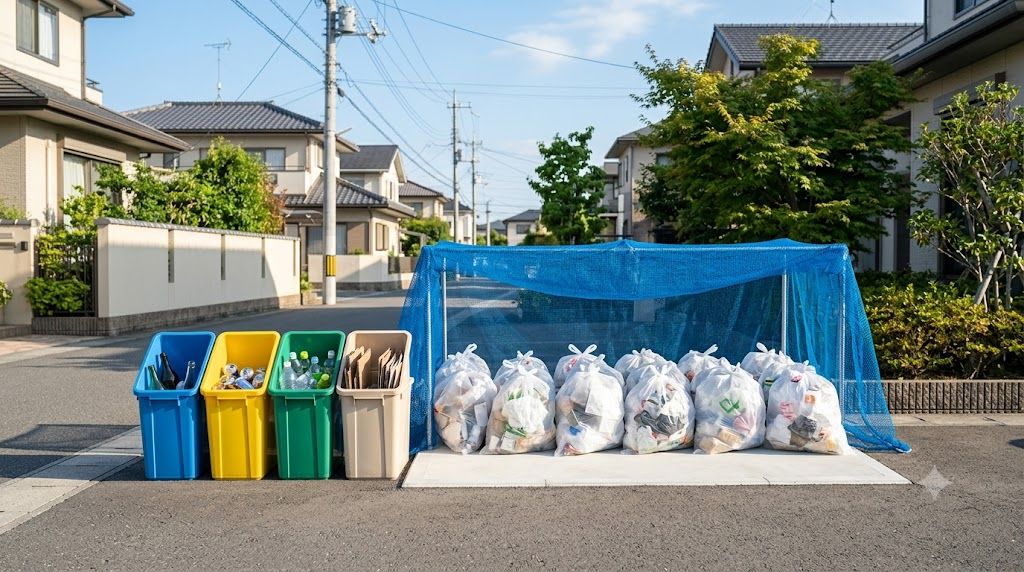
In Tokyo, most residential neighborhoods use communal garbage stations (ゴミ置き場) rather than individual curbside pickup. These are shared spots — usually a small fenced area or a designated pavement section — where residents put out their trash on collection morning. Rules for garbage stations:
- Only put garbage out on the designated collection morning (not the night before in most wards)
- Cover the pile with a net (provided by the neighborhood association) to deter crows
- Keep the area clean after collection — pick up any stray items
- Larger apartment buildings usually have their own garbage room (ゴミ置き場) with separate bins
🌸 Yokohama (横浜市)
Yokohama has one of the most complex garbage systems in Japan — 10 separate categories. It famously reduced waste by 30% in the early 2000s by introducing this rigorous system. Many expats moving to Yokohama are initially overwhelmed, but the city provides excellent multilingual materials.
Yokohama’s 10 Garbage Categories
- Burnable garbage (燃やすごみ) — food scraps, paper, textiles, dirty plastic packaging [Twice per week]
- Non-burnable garbage (燃えないごみ) — ceramics, glass, small metals [Twice per month]
- Plastic containers and packaging (プラスチック製容器包装) — rinsed, with プラ mark [Once per week]
- Bottles (びん) — rinsed glass bottles, separated by color [Twice per month]
- Cans (缶) — aluminum and steel cans, rinsed [Twice per month]
- PET bottles (ペットボトル) — cap and label removed, rinsed, crushed [Once per week]
- Newspaper (新聞) — bundled with string [Once per week]
- Cardboard (ダンボール) — flattened, bundled with string [Once per week]
- Paper packaging (紙製容器包装) — milk cartons, paper bags, paper cups [Once per week]
- Mixed paper (雑誌・雑紙) — magazines, envelopes, small boxes [Once per week]
🌺 Osaka (大阪市)
Osaka City uses a simpler 3+1 system compared to Yokohama:
- Burnable garbage (普通ごみ) — Twice per week. Must use designated light-blue semi-transparent bags (45L: ¥320, 30L: ¥230, 20L: ¥160). Available at convenience stores and supermarkets.
- Non-burnable garbage (不燃ごみ) — Once per month. Must use Osaka City official beige bags.
- Resource garbage (資源ごみ) — Once per week. Glass bottles, PET bottles, cans, paper, and cardboard all go out on the same day. Boxes and paper must be bundled with string, not put in bags.
- Oversized garbage (粗大ごみ) — By appointment. Call 0120-79-0053 or apply online. Fee: ¥200–2,400 depending on item size.
Key Osaka rule: The garbage station (ゴミ置き場) opens at 8:00 AM on collection days. Do not put garbage out the night before — it’s against the rules and risks warning from your neighborhood association.
🌊 Fukuoka (福岡市)
Fukuoka uses a color-coded bag system. Every category requires a specific color:
- Burnable garbage (燃えるごみ) — Black bags [Mon, Thu, or Tue, Fri depending on district]
- Non-burnable garbage (燃えないごみ) — Blue bags [First and third Wednesday of each month]
- PET bottles — Clear bags [Every Wednesday]
- Cans and glass bottles — Clear bags [Every Wednesday with PET bottles]
- Cardboard and paper — Bundle with string, no bag needed [Every Wednesday]
Fukuoka’s colored bag system makes it easy to see at a glance if something is in the wrong bag. Bags are sold at supermarkets and drug stores in packs — the city does not provide them free of charge.
🌸 Kyoto (京都市)
Kyoto has a 4-category system that’s relatively straightforward for foreigners:
- Burnable waste (可燃ごみ) — 2× per week
- Non-burnable / small metal (不燃・小型金属ごみ) — 1× per month (small metals included)
- Recyclables (資源ごみ) — Cans, PET, glass, paper — varies by district
- Oversized waste (粗大ごみ) — By appointment
Kyoto is known for its historic machiya townhouse neighborhoods where narrow alleys make garbage collection challenging. If you live in central Kyoto, you may have a specific collection point designated by your machiya landlord.
🌻 Nagoya (名古屋市)
Nagoya has a 5-category system with some unique rules:
- Burnable garbage (可燃ごみ) — 2× per week (Mon/Thu or Tue/Fri)
- Non-burnable garbage (不燃ごみ) — 1× per month
- Empty cans (空き缶) — 1× per week
- Empty bottles and empty PET (空きびん・空きペット) — 1× per week
- Paper and other resource garbage (古紙等資源ごみ) — 1× per week
Nagoya requires the use of official Nagoya garbage bags (名古屋市指定ごみ袋) for burnable and non-burnable garbage. These must be purchased and are available in sizes 15L, 30L, and 45L at supermarkets and drug stores. The bags are yellow/cream colored and clearly marked.
🛋️ Oversized Garbage (粗大ごみ / Sodai Gomi)
Items larger than about 30–50cm in any direction are classified as oversized (bulky) garbage and cannot be put out with regular trash. You must schedule a pickup appointment and pay a fee.
How to Dispose of Oversized Garbage
- Determine your fee. Look up the item on your city’s oversized garbage fee schedule online. Fees vary by item type and size.
- Purchase a garbage sticker (粗大ごみシール). Buy this at a convenience store (コンビニ), post office, or the city hall. Write your name and date on the sticker.
- Schedule a pickup. Call your city’s oversized garbage center or apply online. You’ll be given a specific date.
- Put it out on the pickup day. Place the item in front of your building or at the designated spot on the morning of collection. Attach the sticker prominently.
Oversized Garbage Fees by City
| Item | Tokyo (avg) | Osaka | Yokohama | Fukuoka |
|---|---|---|---|---|
| Single bed mattress | ¥1,200–2,000 | ¥1,200 | ¥1,600 | ¥1,500 |
| Sofa (2-seater) | ¥2,000–4,000 | ¥2,000 | ¥2,400 | ¥2,000 |
| Bicycle | ¥1,000–2,000 | ¥1,200 | ¥1,600 | ¥1,000 |
| Dining table | ¥1,200–3,000 | ¥1,200 | ¥2,400 | ¥1,500 |
| Wardrobe (large) | ¥2,000–5,000 | ¥2,400 | ¥4,000 | ¥2,500 |
| Tatami mat (per mat) | ¥1,000–1,500 | ¥1,200 | ¥1,200 | ¥1,000 |
Alternatives to Oversized Garbage Pickup
Rather than paying city fees, consider these options for large items in good condition:
- Mercari / Junk Mail: Japan’s most popular second-hand apps. Easy to list furniture; buyers often arrange their own transport.
- Jimoty (ジモティー): Free listing site for giveaways. You can give away furniture for free, and many people will come to pick it up.
- IKEA/Nitori take-back: IKEA Japan has a buy-back service. Nitori accepts some furniture returns.
- Recycle shops (リサイクルショップ): Shops like Hard Off, Book Off, and Second Street buy used furniture and electronics.
- Private waste collection companies: For large volumes (e.g., clearing an entire apartment), private companies will haul everything away for a flat fee — typically ¥10,000–50,000.
📺 Home Appliance Recycling Law (家電リサイクル法)
Japan’s Home Appliance Recycling Law (家電リサイクル法, Kaden Risaikuru Ho) covers four specific categories of large electronics. These cannot be disposed of as regular oversized garbage — they require specialized recycling.
The 4 Covered Categories
| Item | Typical Recycling Fee | How to Dispose |
|---|---|---|
| Air conditioners (エアコン) | ¥990–2,000+ | Retailer/manufacturer collection |
| TVs (テレビ) — CRT & flat panel | ¥1,320–2,916 | Retailer/manufacturer collection |
| Refrigerators (冷蔵庫) | ¥3,740–4,730 | Retailer/manufacturer collection |
| Washing machines (洗濯機) | ¥2,530–3,300 | Retailer/manufacturer collection |
How to use the recycling law:
- Contact the retailer where you bought the appliance (or any appliance retailer like Yamada Denki, Bic Camera, or Yodobashi Camera). They are legally required to accept old appliances.
- Alternatively, contact the manufacturer directly.
- You can also drop items off at a designated recycling collection point — your city hall website lists locations.
- Pay the recycling fee (リサイクル料金) — this is separate from any transport fee the retailer may charge.
PC Recycling (パソコン)
PCs are covered by a separate law. Manufacturers marked with the PC recycling mark (PCリサイクルマーク) will collect their own products for free. For older machines without this mark, you’ll pay ¥3,000–5,000 for disposal. Alternatively, many municipalities have designated PC collection days, and some 100-yen shops and electronics retailers accept small electronics for recycling.
🔋 Batteries, Medicines, and Hazardous Items
These require special handling and cannot go in regular garbage:
Batteries (電池)
- Single-use batteries (乾電池): Do NOT put in burnable or non-burnable garbage (risk of fire in collection trucks). Most supermarkets, drug stores, and electronics shops have free collection boxes. Some wards collect them with non-burnable garbage on specific days — check locally.
- Rechargeable batteries and lithium batteries: Bring to electronics stores (Yodobashi, Bic Camera) or to JBRC collection points. These must never go in garbage or oversized collection — lithium batteries have caused fires in garbage trucks.
- Car batteries: Return to the store where you buy a new one, or take to a gas station.
Medicines (薬)
- Unused/expired medicines: Do NOT flush down the toilet (water pollution risk). Bring to a pharmacy (薬局) — many accept returns. Some cities have medicine collection at city hall or designated collection points.
- Liquid medicines should be solidified (absorbent material) before disposal in burnable garbage if no collection point is available.
Other Hazardous Items
- Mercury thermometers and fluorescent lights: These contain mercury — bring to a collection point. Most cities have special collection events (特別回収) a few times a year.
- Paint, chemicals, pesticides: Never pour down the drain. Many cities have specific collection events — check your ward’s calendar. Some hardware stores accept unused paint.
- Gas cylinders (ガス缶/カセットボンベ): Must be completely empty before disposal. Puncture the cap to release remaining gas, then put in non-burnable or small metal garbage (city-specific).
- Fire extinguishers: Not regular garbage. Contact a certified disposal company or the fire extinguisher manufacturer.
🏠 Move-In & Move-Out Garbage Guide
Moving is one of the most garbage-intensive events in daily life, and Japan has specific rules for disposal when you’re relocating.
When Moving In
- Register with your ward office first. You cannot legally use the local garbage station until you’ve registered as a resident (住民登録). This usually happens within 14 days of moving in.
- Get your garbage schedule. Your ward office or building manager will give you a garbage calendar (ゴミ収集カレンダー) — a colored chart showing what category is collected on which day. This is your bible for the next few years.
- Get official bags if required. Some cities (Nagoya, Fukuoka, etc.) require official bags. Buy these before your first garbage day.
- Locate your garbage station. Ask your building manager or landlord where the nearest communal garbage spot is. In apartments, it’s often in the basement or car park.
- Cardboard from moving boxes: Break down and bundle with string for paper recycling. Don’t put it all out at once — it may not all fit, or the collection schedule may not align. Ask your landlord if the building has a cardboard disposal area.
When Moving Out (引っ越し時のごみ処理)
- Clear out before the move. Ideally, start reducing garbage 2–3 weeks before the move date so you’re not stuck with a mountain of trash on moving day.
- Large furniture and appliances: Schedule oversized garbage pickup (粗大ごみ) at least 2–3 weeks in advance — appointment slots can be scarce. Or sell on Mercari/Jimoty.
- Do NOT put garbage out after you’ve unregistered. Once you’ve completed your move-out registration (転出届), you’re technically no longer a resident of that ward and cannot use the local garbage collection. The timing can be tricky — coordinate with your landlord.
- Clean the apartment. Japan expects apartments to be returned in pristine condition. Don’t leave ANY garbage behind — your landlord can charge you for removal fees.
- Ask about extra collection. Some wards offer a special “moving garbage” collection or allow you to bring extra bags during a defined period. Call your ward office to ask.
🏘️ Neighborhood Associations and Garbage Stations
In most Japanese residential areas, garbage collection is managed through a community system centered around the neighborhood association (町内会, chōnaikai). Understanding how this works will save you from awkward encounters with your neighbors.
What is the Chōnaikai?
The chōnaikai is a voluntary neighborhood organization that handles community tasks like cleaning, festival organization, and — critically — garbage station management. As a resident (including foreigners), you may be expected to:
- Join the chōnaikai and pay a small monthly fee (typically ¥200–500/month)
- Take turns on “garbage station duty” (ゴミ当番) — usually once every few months, meaning you arrive early on collection morning, open the net over the garbage pile, oversee the pickup, and clean up afterward
- Help maintain the garbage station area (sweeping, washing)
Joining is technically voluntary, but refusing can lead to social friction. Most chōnaikai are welcoming to foreign residents and will explain the rules in simple Japanese (and sometimes English).
The Crow Problem (カラス対策)
Jungle crows (ハシブトガラス) are intelligent, resourceful, and a major urban pest in Japan. They tear open garbage bags looking for food scraps. To counter this:
- Garbage stations are covered with nets (防鳥ネット) that are spread over the pile before collection and removed afterward
- Never put food-containing bags on top of the pile — tuck them underneath
- Some neighborhoods use yellow mesh bags that crows reportedly find harder to see through
- Do not leave garbage out the night before — crows are active at dawn
High-Rise Apartments (マンション)
In larger condominium buildings, garbage collection is typically managed by the building management company (管理会社). Usually there’s a dedicated garbage room (ゴミ置き場) on the ground floor or basement. Rules:
- You can deposit garbage 24/7 (or during designated hours — check your building rules)
- Separate bins are provided for each category
- Some buildings have automated garbage collection systems (ゴミ圧縮装置)
- You don’t need to join a chōnaikai in most condominiums
🚫 Top 10 Mistakes Foreigners Make with Japanese Garbage
These are the most common errors that lead to garbage being rejected (left behind with a red sticker) or triggering neighbor complaints:
Japan runs a very tight collection schedule. Burnable garbage day doesn’t mean you can put out non-burnable items “just this once.” Collections happen fast, and rejected bags sit until the next collection day.
Food residue in recyclables contaminates entire batches. A bottle with soy sauce residue can cause a whole bin of glass to go to incineration instead of recycling. Rinse everything.
In many neighborhoods, putting garbage out the night before is prohibited. Not only do crows ravage the bags, but it’s considered antisocial. Put garbage out on collection morning, before 8:00–8:30 AM.
Many municipalities require semi-transparent bags so collectors can verify the contents. Using an opaque black trash bag (common in Western countries) will likely result in your garbage being rejected.
This is actually a fire hazard. Lithium batteries and even regular alkaline batteries can cause fires in garbage collection trucks and processing facilities. Use dedicated battery collection boxes.
The cap must be removed (it’s a different type of plastic). The label must also be peeled off. Many collection points will reject PET bottles that still have caps or labels.
Cardboard must be broken down flat and bundled with string (not put in a bag). Un-flattened boxes take up too much space and won’t be collected.
Refrigerators, washing machines, TVs, and air conditioners are covered by the Home Appliance Recycling Law and cannot be put out as regular or oversized garbage. Many people abandon appliances on the street — this is illegal and you can be fined.
Garbage stations are for use by residents of that specific neighborhood. Using a random station because it’s more convenient is considered improper and can trigger complaints.
Knives, razor blades, and broken glass must be wrapped in thick paper and labeled 危険 (kiken, “danger”) or ガラス (garasu, “glass”) for the safety of collection workers.
📱 Apps and Resources to Help
These tools make navigating Japan’s garbage rules much easier, especially when you’re starting out:
City-Specific Official Apps
- Tokyo Gomi (東京ごみ) — Available from each Tokyo ward. Look for your ward’s name in the App Store (e.g., “新宿区ごみ分別”). Shows collection calendars, item category search, and pickup schedule reminders.
- Yokohama Gomi Navi (横浜市ごみ・資源物の分け方・出し方) — Yokohama City’s official app. Has a search function where you type in any item and it tells you which of the 10 categories it belongs to, and when it’s collected.
- Osaka City Gomi App — Available as “大阪市ごみ分別なび.” Features include: collection day reminders by district, item categorization, and a multilingual FAQ.
- Fukuoka City Gomi Calendar — Search “福岡市ごみ分別” for the city’s official app and web resources.
National Resources
- 5374.jp — A universal garbage schedule site that works for many municipalities across Japan. Enter your postal code and get your schedule. Interface is in Japanese but highly intuitive.
- Sayonara Gomi (さようならゴミ) — Crowd-sourced app available for some cities. Useful for understanding local nuances.
- Your local city hall website — Look for the 生活・環境 (lifestyle/environment) section. Many larger cities now offer garbage guides in English, Chinese, Korean, and other languages.
- The Japan Garbage Disposal Guide (多言語生活情報) — Published by CLAIR (Council of Local Authorities for International Relations). A multilingual guide covering garbage basics across all of Japan.
Useful Japanese Vocabulary for Garbage
| Japanese | Romaji | Meaning |
|---|---|---|
| ゴミ / ごみ | Gomi | Garbage / trash |
| 可燃ごみ | Kanen gomi | Burnable garbage |
| 不燃ごみ | Funen gomi | Non-burnable garbage |
| 資源ごみ | Shigen gomi | Recyclable resources |
| 粗大ごみ | Sodai gomi | Oversized/bulky garbage |
| 燃えるごみ | Moeru gomi | Burnable garbage (alt. term) |
| ペットボトル | PET bottoru | PET plastic bottles |
| ダンボール | Danbōru | Cardboard |
| 収集日 | Shūshū bi | Collection day |
| 指定袋 | Shitei fukuro | Official designated garbage bag |
| ゴミ置き場 | Gomi okiba | Garbage station/spot |
| 危険 | Kiken | Danger (label for sharp items) |
❓ Frequently Asked Questions
Here are the questions expats ask most about Japan’s garbage system:
Q: My garbage was rejected with a red sticker. What do I do?
Take the bag home. Check what was wrong — the sticker usually has a checkbox indicating the problem (wrong day, wrong bag, incorrect sorting, etc.). Re-sort the items correctly. Most buildings have a notice board explaining common mistakes. If the sticker is in Japanese and you can’t read it, ask your building manager to translate.
Q: Can I get garbage information in English?
Yes. Many city halls provide multilingual garbage guides. Tokyo Metropolitan Government, Yokohama City, and Osaka City all have English-language garbage information on their websites and at the ward office. Also check with your local International Exchange Center (国際交流センター) — they often provide translated garbage calendars for foreigners.
Q: Is there a fine for improper garbage disposal?
Yes, technically. Under Japan’s Waste Disposal and Public Cleansing Act, illegal dumping (不法投棄) can result in fines up to ¥1 billion for businesses and ¥5 million for individuals, plus imprisonment. In practice, most enforcement for residential violations is handled through community pressure rather than formal fines — your garbage is left behind and neighbors will talk. However, for major violations like abandoning appliances, surveillance cameras are now common and actual fines have been issued.
Q: What if I’m not sure which category an item belongs to?
Use your city’s garbage categorization tool — most city websites and apps have a search function where you type in the item name and it tells you the category. If the item isn’t in the database, default to burnable garbage (for items that can catch fire) or non-burnable (for items that can’t). When truly unsure, contact your ward office — they have garbage hotlines and are genuinely helpful.
Q: Do I have to buy official garbage bags?
It depends on your city. Nagoya, Fukuoka, and some wards of other cities require official designated bags (指定袋). Tokyo wards, Osaka (for most categories), and many other cities accept any semi-transparent or transparent bag. Check your local rules — the garbage calendar from your ward office will specify. Official bags are sold at supermarkets, convenience stores, and drug stores.
Q: What do I do with used cooking oil?
Never pour cooking oil down the drain — it clogs pipes and pollutes waterways. Options: (1) Let it solidify and dispose as burnable garbage — either use a solidifying agent (凝固剤, available at 100-yen shops) or absorb with newspaper/cardboard. (2) Many supermarkets and convenience stores have cooking oil collection boxes for recycling into biodiesel fuel — look for the yellow drop-off containers, especially at AEON stores. (3) Cooking oil can be taken to some city-designated collection points.
Q: How do I dispose of a microwave or small appliance?
Small kitchen appliances (microwaves, toasters, electric kettles) are typically oversized garbage (粗大ごみ) if larger than 30–50cm. Contact your city’s oversized garbage center to schedule pickup. If the appliance is in working condition, you can donate it to a recycle shop (リサイクルショップ), sell it on Mercari, or give it away on Jimoty.
Q: Can I throw away medicine down the toilet?
No — flushing medicine pollutes waterways and has been linked to antibiotic-resistant bacteria in rivers. Bring unused or expired medicines to a pharmacy (薬局). Many pharmacies and some city halls have medicine collection boxes. In a pinch, you can mix liquid medicines with coffee grounds or sawdust to deactivate them, then dispose as burnable garbage — but please use a collection point whenever possible.
Q: What happens to Japan’s incinerated garbage?
Japan’s modern incinerators are remarkably clean — equipped with advanced exhaust filters and emission controls. The heat generated is used to produce electricity and hot water for nearby buildings. The residual ash is used in construction materials (road base, land reclamation). Tokyo’s landfill in Tokyo Bay (夢の島) was created this way. This is why Japan can maintain much smaller landfills than most developed countries.
Q: Are there collection points for clothes and textiles?
Yes! Rather than putting old clothes in burnable garbage, consider: (1) Clothing donation boxes — many supermarkets, shopping centers, and city halls have drop-off boxes for used clothes. (2) Recycle shops — shops like 2nd Street, Book Off, and Treasure Factory buy good-condition clothes. (3) Clothing swaps — many expat communities organize regular clothing swaps. (4) H&M and Uniqlo both have in-store clothing recycling programs in Japan. Only dispose of truly worn-out textiles as burnable garbage.
🌿 Conclusion: Garbage is a Window into Japanese Culture
Japan’s meticulous garbage sorting system can be frustrating at first — but it reflects something deeper about Japanese culture: a commitment to collective responsibility, environmental sustainability, and consideration for others. Once you understand the why behind the rules, the how becomes much easier to follow.
With this guide, you have everything you need to navigate Japan’s garbage system confidently. The key steps:
- Get your garbage calendar from your ward office or building manager
- Download your city’s official garbage app
- Buy official bags if required (Nagoya, Fukuoka, etc.)
- Rinse all recyclables before disposal
- Never put batteries, large appliances, or hazardous items in regular garbage
- When in doubt, ask your neighbors or call the ward office
And remember — even long-term residents sometimes get things wrong. Nobody will judge you for asking questions. Good luck with your sorting! ♻️
🗾 More Japan Life Guides
📥 Japan Expat Starter Kit 2026
Everything you need to know about living in Japan — banking, healthcare, housing, Suica, taxes & more. 60+ pages of practical guides in one PDF.
📥 Get the Guide — $19
Leave a Reply