This article was created with AI writing assistance (ChatGPT, Claude, etc.). Product selection, specifications, and reviews are verified by the Japan Life Lab editorial team.
This article contains promotional / affiliate links.
Japanese summers are hot, humid, and full of mosquitoes. From late May to October, any evening near a river, a park, a shrine, or a garden means bites — and Japanese mosquito bites tend to swell more than visitors expect.
The good news is that Japan takes mosquitoes extremely seriously and has spent a century engineering products for them. Some of these products simply do not exist outside Japan, and one of them — a room spray that works for 12 hours from a single push — genuinely surprises people the first time they use it.
Here are the seven mosquito products Japanese households actually buy, what each one is for, and where to get them.
Quick answer
Visiting Japan? Buy Skin Vape mist and a tube of Muhi at any drugstore on day one. Living in Japan? Set up a plug-in vaporiser in June, keep a one-push room spray by the door, and use KINCHO coils on the balcony.
Prime members get fast, free delivery on millions of items, Prime Video and members-only deals. Eligible new members can try it free for 30 days.
Start your free 30-day Prime trial →Ages 18–24? See Prime for Young Adults
Paid links. As an Amazon Associate, Japan Life Lab earns from qualifying purchases. Trial eligibility and terms are set by Amazon.
Why Japanese mosquito products are different
Three things set them apart. First, formats: Japan has invented delivery methods (one-push room sprays, hanging boundary repellents, clip-on fan units) that most countries never adopted. Second, availability: every konbini and drugstore stocks the full range from May onward, so you are never far from a solution. Third, the after-bite category is taken as seriously as prevention — Muhi is a household name in a way no anti-itch cream is in most countries.
The practical consequence for you: do not import repellent into Japan. Buy it here, on arrival, for less money and better results.
The 7 best Japanese mosquito products in 2026
1. KINCHO Katori Senko (mosquito coil)
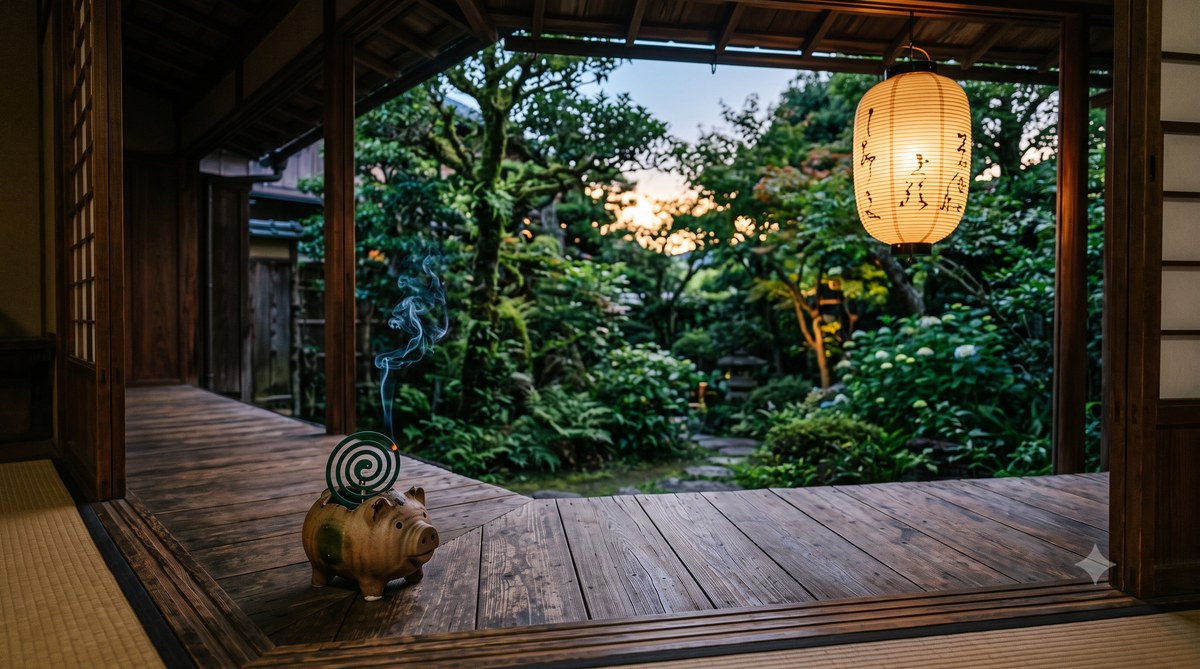
The green spiral coil is the single most iconic summer object in Japan. KINCHO has been making them since 1902, and the smell of a burning coil is, for most Japanese people, the smell of summer itself.
Coils work by slowly smouldering and releasing pyrethroid vapour. They are cheap (a box of 30 costs a few hundred yen), require no electricity, and cover an outdoor area better than almost anything else. This is what you want on a balcony, at a barbecue, at a campsite, or in a garden — anywhere air moves and plug-in devices are useless.
Indoors they work too, but the smoke is noticeable. Most households use coils outside and switch to a spray or plug-in device inside.
| Details | |
|---|---|
| Type | Smouldering coil (pyrethroid) |
| Burn time | About 7 hours per coil |
| Power | None needed |
| Best for | Balconies, camping, gardens, BBQ |
| Note | Use the ceramic pig-shaped holder (kayari-buta) — it is the classic look |
Buy on Amazon.comBuy on Amazon Japan
2. Skin Vape mist (Fumakilla)
If you buy one thing before a summer trip to Japan, make it this. Skin Vape is the standard body repellent sold in every drugstore and konbini, and it comes in a mist that goes on dry rather than sticky.
Look at the label: the strength is written as a percentage of the active ingredient. The higher-strength versions last longer between applications, which matters if you are hiking, walking through parks, or visiting temples with a lot of greenery around them.
There is also a version made for children and one that is unscented. Japanese mosquitoes are aggressive around dusk near water, greenery and shrines — the exact places tourists go — so keep a small bottle in your bag rather than in your hotel room.
| Details | |
|---|---|
| Type | Body mist repellent |
| Feel | Dry, non-sticky finish |
| Where to buy | Any drugstore, konbini, Don Quijote |
| Best for | Sightseeing, hiking, festivals |
| Note | Kids and unscented versions available |
Buy on Amazon.comBuy on Amazon Japan
3. KINCHO One-Push Room Spray (Ka ga Inaku Naru Spray)
This is the product foreigners never believe until they try it. One single push into the air of a room, and mosquitoes in that room are dealt with for roughly 12 hours. No coil, no smoke, no plug, no repeated spraying.
It works by dispersing a fine mist that settles on walls and surfaces, so mosquitoes that land there are affected. You spray once when you come home, once before bed, and forget about it.
For anyone living in a Japanese apartment with a small bedroom, this is the most convenient anti-mosquito product on the market. It is also the easiest thing to bring home as a souvenir — it is compact and there is genuinely nothing quite like it outside Japan.
| Details | |
|---|---|
| Type | One-push room spray |
| Duration | About 12 hours per push |
| Coverage | One room |
| Best for | Bedrooms, apartments, offices |
| Note | Ventilate before sleeping if you are sensitive |
Buy on Amazon.comBuy on Amazon Japan
4. Muhi S / Muhi Alpha EX (itch relief cream)
Prevention fails eventually. When it does, Muhi is what Japan reaches for. It is the standard anti-itch cream, sold in every drugstore, and the difference against generic hydrocortisone is how fast it stops the itch — usually within seconds thanks to a cooling component.
Muhi S is the everyday version and is mild enough for children. Muhi Alpha EX is stronger, containing an anti-inflammatory ingredient for bites that swell badly. Japanese mosquito bites tend to swell more than many visitors expect, particularly for people who have never been exposed to the local species.
Buy it on day one, not on the day you get bitten at 11pm and the drugstore is closed.
| Details | |
|---|---|
| Type | Anti-itch cream |
| Muhi S | Mild, suitable for children |
| Muhi Alpha EX | Stronger, for swelling |
| Best for | After-bite relief |
| Note | Sold in every drugstore; a classic souvenir |
Buy on Amazon.comBuy on Amazon Japan
5. Earth No-Mat plug-in liquid vaporiser (アースノーマット)
For indoor use over a whole season, the plug-in liquid vaporiser is what most Japanese homes actually rely on. A bottle of liquid slots into a small unit, you plug it into the wall, and it quietly protects a room for 30, 60, 90 or 120 days depending on the refill (rated at 12 hours a day).
Unlike coils there is no smoke and no smell to speak of, and unlike sprays there is nothing to remember to do. It just runs. If you are living in Japan rather than visiting, this is the baseline you set up in June and forget about until September.
Refills are cheap and sold everywhere, and units are typically a few hundred to a couple of thousand yen.
| Details | |
|---|---|
| Type | Plug-in liquid vaporiser |
| Duration | 30 / 60 / 90 / 120-day refills (12 h a day) |
| Smoke | None |
| Best for | Living rooms, bedrooms, long stays |
| Note | Buy the unit once, then buy the same brand’s refills (Earth warns that other bottles may not work safely and can be a fire risk) |
Buy on Amazon.comBuy on Amazon Japan
6. Outdoor portable repellent (Earth Dokodemo Tsukaeru No-Mat)
A small battery-powered fan unit spreads repellent from a cartridge, so you get protection without smoke, flame, heat or a power socket. Earth’s Dokodemo Tsukaeru No-Mat (どこでもつかえるアースノーマット) is sold in Japan as a quasi-drug for mosquitoes (防除用医薬部外品), and Earth lists it for killing mosquitoes, keeping them out and repelling them outdoors. The maker suggests it for balconies, entrances, barbecues and tents as well as kids’ rooms.
The standard set runs for about 90 days at 8 hours a day (roughly 720 hours) on two AA batteries, and there is also a 180-day version. With alkaline batteries you will need one battery change partway through, and an LED meter shows when the batteries or the cartridge need replacing. It is odourless and the fan is quiet.
Like any area repellent it works less well in wind, and it is not a substitute for skin repellent in dense greenery. One warning about similar gadgets: several wearable clip-on fan units in Japanese shops are labelled 不快害虫用 (for nuisance insects) and list midges and drain flies, not mosquitoes, as their targets. If you want mosquito protection, check that the pack says 蚊 (mosquito).
| Details | |
|---|---|
| Type | Battery-powered portable mosquito repeller |
| Power | 2 × AA batteries (included) |
| Duration | About 90 days at 8 h a day (180-day version available) |
| Best for | Balconies, barbecues, tents, entrances, kids’ rooms |
| Note | Less effective in strong wind |
Buy on Amazon.comBuy on Amazon Japan
7. Window / veranda hanging repellent (Mushi Konazu)
Hang one from the veranda ceiling, near the entrance, or by the window, and it discourages insects from coming in through the gap. It does nothing for mosquitoes already inside, and it will not save you if you leave the window wide open with the light on — but as a first line of defence at the boundary of your home, it is cheap and effortless.
Japanese apartments frequently have no window screens on the balcony door, or screens with small gaps. Combining a hanging repellent at the boundary with a one-push spray inside covers both directions.
| Details | |
|---|---|
| Type | Hanging repellent |
| Duration | Typically 180–366 days |
| Placement | Veranda, entrance, window |
| Best for | Preventing entry |
| Note | Combine with an indoor product — it is a boundary defence, not a room treatment |
Buy on Amazon.comBuy on Amazon Japan
Which one do you actually need?
| Situation | What to buy |
|---|---|
| Tourist, 1–2 weeks | Skin Vape mist + Muhi |
| Living in Japan, apartment | Plug-in vaporiser + one-push room spray |
| Balcony, BBQ, garden | KINCHO coil + ceramic holder |
| Camping / hiking | Skin Vape + battery-powered portable repeller |
| Small children | Kids-formula Skin Vape + Muhi S |
| Already bitten | Muhi Alpha EX |
Five habits that matter more than any product
1. Empty standing water. Mosquitoes breed in a bottle cap of water. Plant saucers on a balcony are the single most common source of the mosquitoes in your own apartment.
2. Close the window before turning the light on. In Japan this is basic etiquette and basic self-defence — the light pulls insects straight through the gap.
3. Shower after sweating. Mosquitoes are attracted to lactic acid and body heat. A quick rinse after coming home measurably reduces bites.
4. Wear light colours. Dark clothing attracts more mosquitoes. This is why summer yukata are so often pale.
5. Watch dusk. The Asian tiger mosquito, common in Japan, bites hardest at dawn and dusk rather than deep night. Plan your repellent around those two windows.
FAQ
Can I bring repellent into Japan from my country?
You can, but there is little reason to. Japanese products are cheap, widely available, and formulated for the local species. Note that aerosol cans have airline restrictions — buying on arrival avoids the issue entirely.
Are mosquito coils safe indoors?
They are used indoors in Japan, but they do produce smoke. Ventilate, and if anyone in the household has asthma, use a plug-in vaporiser or one-push spray instead.
Do the one-push sprays really last 12 hours?
In a closed room, yes — that is the design. In a room with the window open and air moving through, the effect is shorter. Use it in a room you can keep closed.
What about dengue or other diseases?
Japan has had isolated dengue cases, most notably a small 2014 outbreak in Tokyo. The everyday risk is low, but mosquito protection is still worth taking seriously, especially if you spend evenings outdoors.
Final word
Mosquitoes are the one thing that can quietly ruin a Japanese summer evening — and the fix costs less than a coffee. Buy Skin Vape and Muhi on your first drugstore trip. If you live here, add a plug-in vaporiser and a one-push spray. That combination handles almost everything Japan can throw at you between June and September.
Related guides
- Japan Summer Survival Guide 2026
- Best Japanese Rainy Season Gadgets
- Best Portable Fans in Japan
- Best Japanese Folding Fans (Sensu)
🔥 Editor’s Picks for Life & Travel in Japan

Japan Expat Starter Kit 2026 PDF guide
Your first 90 days in Japan, step by step: 17 chapters · 24 pages · 100 phrases in Japanese script · 40 kanji · printable checklists. Bank account, My Number, health insurance, apartment, phone, taxes & pension.
$9.99 $4.99 current price
📥 Get the kit →📄 Read 5 pages free: contents + Chapter 2
⚡ Instant PDF download · 🛡️ 30-day money-back guarantee · 🔄 Free 2026 updates
🛒 Ready to Buy? Shop These in Japan!
Get fast delivery across Japan — including same-day in major cities
Practical guides for life and travel in Japan — free, about once a week. No spam, unsubscribe anytime.
☕ Enjoying our Japan guides?
If this article helped you, you can support our work with a coffee!
Leave a Reply