This article was created with AI writing assistance (ChatGPT, Claude, etc.). Product selection, specifications, and reviews are verified by the Japan Life Lab editorial team.
This article contains promotional / affiliate links.
Obon is the week when Japan quietly turns inside out. Millions of people travel back to their hometowns to honour their ancestors, the shinkansen sells out, expressways jam for 40 kilometres, and your favourite little ramen shop is suddenly closed with a handwritten note on the door.
In 2026, Obon ran from Thursday 13 August to Sunday 16 August. If you are visiting Japan in that window — or living here and wondering why the city feels strange — this guide explains what actually closes, when travel is worst, and how to turn the week into one of the best experiences of the year rather than a logistical disaster.
Quick answer
Dates: 13–16 Aug 2026 (Tokyo and parts of the north observe it in mid-July instead).
Worst travel days: 8 and 11–13 Aug leaving the cities; 15–16 Aug returning.
What closes: small family-run restaurants, ryokan, independent shops, some clinics.
What stays open: shinkansen, airports, subways, convenience stores, department stores, major chains.
What is Obon, actually?
Obon is a Buddhist observance in which the spirits of ancestors are believed to return to the family home. Families clean graves, light lanterns to guide the spirits back, offer food at the household altar, and then — at the end of the week — send the spirits off again with fires and floating lanterns.
It is not a public holiday in the legal sense: banks and government offices technically stay open. But in practice, a huge share of the country takes the week off, which is why the roads and trains are so brutal.
Obon 2026 dates and crowds
| Date | What happens |
|---|---|
| 8 Aug (Sat) | First wave of departures from Tokyo/Osaka. Expressways jam from early morning. |
| 11–13 Aug | Peak outbound travel. Shinkansen reserved seats sold out; unreserved cars standing-room only. |
| 13 Aug | Mukaebi — welcoming fires. Obon officially begins. |
| 14–15 Aug | Bon Odori dances peak across the country. Many small businesses closed. |
| 15 Aug | Okuribi begins — send-off fires and lantern floating. |
| 15–16 Aug | Peak return travel. Inbound expressways and trains at their worst. |
| 16 Aug | Gozan no Okuribi in Kyoto — giant kanji-shaped bonfires lit on the mountains. |
What actually closes (and what does not)
| Closed or reduced | Open as normal |
|---|---|
| Small family-run restaurants and izakaya | Convenience stores (24/7, always) |
| Independent shops and workshops | Department stores and shopping malls |
| Family-run ryokan and minshuku | Chain restaurants and cafés |
| Some clinics and dentists | Hospitals (emergency departments) |
| Some museums and small galleries | Shinkansen, subways, airports |
| Many small factories and offices | Major tourist attractions (busier than usual) |
The headline is simple: Japan does not shut down. You will never go hungry or be unable to travel. What you lose is the small, personal, family-run layer of the country — precisely the layer many travellers came for.
How to travel during Obon without suffering
Book the shinkansen the moment reservations open. Reserved seats for the Obon window disappear quickly, and by late June your options narrow sharply. If you are already in Japan and have not booked, be prepared to stand for hours in the unreserved cars.
Travel against the flow. The crowds move out of the big cities early in the week and back at the end. So do the opposite: leave Tokyo on 14–15 August, return on 17–18. Empty trains, cheaper hotels.
Or simply stay in Tokyo. This is the counter-intuitive move: because everyone leaves, central Tokyo becomes unusually quiet and pleasant. Restaurants that normally require a month of planning suddenly have space. It is one of the best weeks of the year to be in the city.
Book accommodation early. Prices in tourist regions surge and availability collapses. Kyoto around 16 August (Gozan no Okuribi) is close to impossible without booking well ahead.
What to actually do during Obon
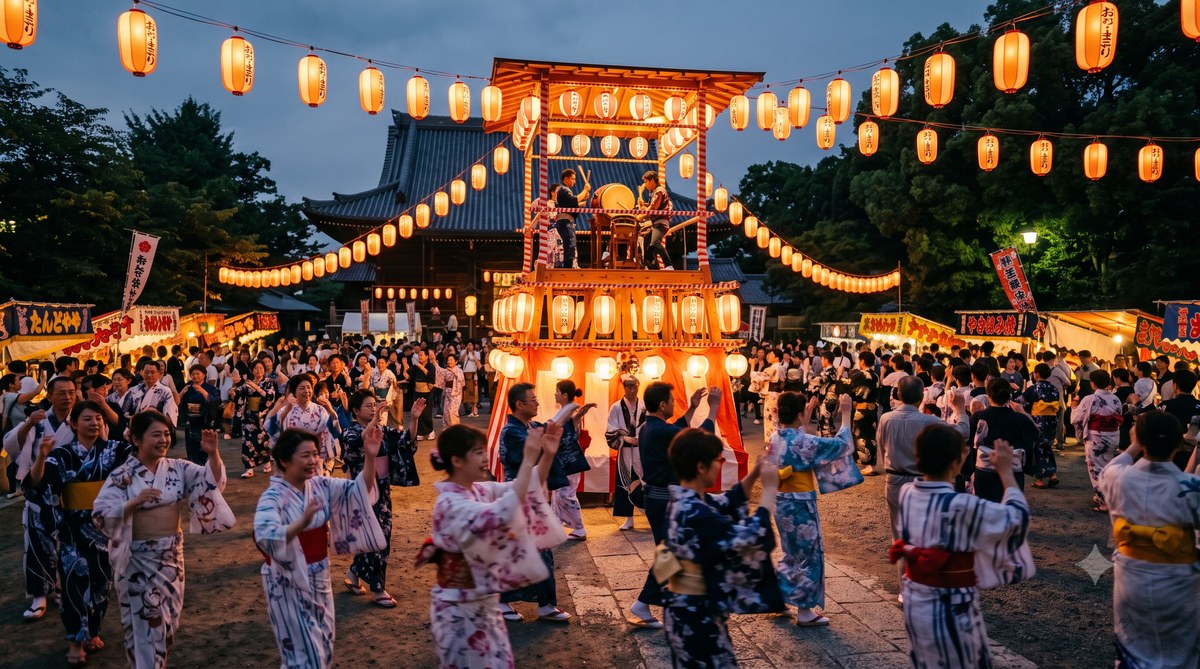
Bon Odori. Community dances held in parks, temple grounds and shrines, around a wooden tower (yagura) with taiko drums. Anyone can join — the steps are repetitive and simple, locals will show you, and nobody minds if you are bad at it. This is one of the most welcoming experiences in Japanese culture and it costs nothing.
Gozan no Okuribi (Kyoto, 16 August). Five giant fires shaped like kanji and symbols are lit on the mountains surrounding Kyoto to send the spirits home. It is genuinely moving, and genuinely crowded.
Toro Nagashi. Paper lanterns floated down rivers at dusk to guide the spirits back. Held in many towns; quiet, beautiful and far less crowded than the big fires.
Awa Odori (Tokushima, 12–15 August). The most famous Obon dance festival in Japan — tens of thousands of dancers, over a million spectators. Book accommodation months in advance or day-trip from a nearby city.
Etiquette worth knowing
- If invited to a family altar (butsudan), a small bow and a moment of silence is enough. You are not expected to know the prayers.
- Do not treat graveyards as photo spots during Obon — families are there for a reason.
- Wearing a yukata to Bon Odori is welcomed, not mocked. Rentals are available in most tourist cities.
- Small gifts (fruit, sweets) are appropriate if visiting a Japanese family during Obon.
If you live in Japan
Expect your local shops to close without much notice — buy what you need before the 13th. Rubbish collection schedules often change. Clinics close, so refill prescriptions in advance. And if your Japanese colleagues take the week off, do not expect emails to be answered.
If you have Japanese in-laws, this is the week you may be invited to visit graves and clean them together. Say yes. It is one of the more quietly meaningful things you will be asked to do here.
FAQ
Is Obon a public holiday?
Not officially. Banks and government offices remain open, but most private companies give employees the week off, which is why travel is so congested.
Why does Tokyo celebrate in July?
When Japan switched to the Gregorian calendar, some regions — including much of Tokyo and parts of the north — kept Obon on the old date, which now falls in mid-July.
Should I avoid visiting Japan during Obon?
No — but plan for it. Book transport and hotels early, avoid intercity travel on the peak days, and stay put in one place. If you can be flexible, staying in Tokyo while everyone else leaves is the smartest move.
Final word
Obon is not a tourist event, which is exactly why it is worth experiencing. It is the one week where the whole country stops and turns toward its dead — with dancing, lanterns, fires and family. Get the logistics right, and you will see a side of Japan that no itinerary can manufacture.
Related guides
- Best Japanese Summer Festivals
- Best Japanese Yukata
- Best Japanese Mosquito Repellents
- Japan Summer Survival Guide
🔥 Editor’s Picks for Life & Travel in Japan

Japan Expat Starter Kit 2026 PDF guide
Your first 90 days in Japan, step by step: 17 chapters · 24 pages · 100 phrases in Japanese script · 40 kanji · printable checklists. Bank account, My Number, health insurance, apartment, phone, taxes & pension.
$9.99 $4.99 current price
📥 Get the kit →📄 Read 5 pages free: contents + Chapter 2
⚡ Instant PDF download · 🛡️ 30-day money-back guarantee · 🔄 Free 2026 updates
Practical guides for life and travel in Japan — free, about once a week. No spam, unsubscribe anytime.
☕ Enjoying our Japan guides?
If this article helped you, you can support our work with a coffee!
🇯🇵 Travel & Life Essentials for Japan
Hand-picked gear to make your time in Japan easier. Available on Amazon US & Amazon Japan.
🔋 Portable charger
A must for long days of sightseeing and photos.
View on Amazon (US)View on Amazon Japan🔌 Travel plug adapter
Japan uses Type A outlets. Bring the right adapter.
View on Amazon (US)View on Amazon Japan🎧 Translation earbuds
Real-time translation to talk without barriers.
View on Amazon (US)View on Amazon JapanAs an Amazon Associate, Japan Life Lab earns from qualifying purchases.
Did this guide help you? 🍵
Japan Life Lab is a small independent blog, and every guide we publish is completely free — no paywalls, ever. If our work saved you time (or a headache), you can support us with a cup of Japanese tea. Every contribution, big or small, goes straight into keeping these guides free, accurate and up to date for everyone.
☕ Support Japan Life Lab
Leave a Reply