
This article was created with AI writing assistance (ChatGPT, Claude, etc.). Product selection, specifications, and reviews are verified by the Japan Life Lab editorial team.
This article contains promotional / affiliate links.
Tax-free shopping in Japan changes on 1 November 2026
Until 31 October you show your passport at the till and simply pay without the 10% consumption tax. From 1 November you pay the full tax-included price in the shop and claim the tax back at the airport — at a customs kiosk or through Visit Japan Web — before you check in.
- The ¥5,000 minimum per shop, per day stays the same.
- The general-goods / consumables split is abolished, and so is the ¥500,000 cap on consumables.
- Sealed packaging is abolished — but consumables still have to leave Japan unused.
- Everything on the receipt has to be with you at departure. Customs can ask to see it.
Shopping before 1 November? Nothing changes for you yet.
📌 What you will learn
You do not have to read it all — jump to what you need.
- Part 1: What JESTA actually is
- Part 2: What you will have to submit
- Part 3: JESTA vs Visit Japan Web — the confusion everyone has
- Part 4: What has already changed in 2026
- Part 5: Should you change your travel plans?
- Part 6: How to avoid the fake JESTA sites
- Frequently asked questions
※ Start wherever fits your situation.
Japan is adding a US-style ESTA — and most travellers still have not heard about it
For decades, the deal with Japan was refreshingly simple: if your country was on the visa-exemption list, you booked a flight, landed, got a stamp, and walked out. No forms filed in advance, no fee, no approval to wait for.
That is ending. Japan has formally decided to introduce JESTA — the Japan Electronic System for Travel Authorization — a mandatory online pre-screening that visa-exempt travellers will have to complete before boarding their flight. The plan was approved by cabinet in March 2026, and the target for going live is fiscal year 2028 (April 2028 onward); the amended Immigration Control Act that creates JESTA passed the Diet in May 2026.
It sounds far away. It is not, for two reasons. First, the departure tax already tripled on 1 July 2026, and the two changes are part of the same policy package — so the cost of entering and leaving Japan is moving now, not in 2028. Second, if you are the kind of traveller who books flights nine to twelve months out, your 2028 trip is already inside the planning window.
This guide explains exactly what JESTA is, who will need it, what it will likely cost, what is already in force in 2026, and how it differs from Visit Japan Web — which is the single biggest point of confusion right now.
Part 1: What JESTA actually is
JESTA follows a template that already exists elsewhere: the US ESTA, the UK ETA, and the EU’s planned ETIAS. The logic is the same in all of them. Visa-free entry was designed in an era when the only screening point was the immigration desk at the border. Governments now want to move that screening before departure, so that someone who will be refused entry never boards the plane at all.
| Official name | Japan Electronic System for Travel Authorization (JESTA) |
|---|---|
| Run by | Immigration Services Agency of Japan, with the Ministry of Foreign Affairs |
| Status | Cabinet-approved March 2026; target launch fiscal year 2028 (from April 2028), law enacted May 2026 |
| Who it applies to | Nationals of the roughly 74 countries and regions that currently have visa exemption with Japan |
| Who it does not apply to | Anyone who already needs a visa; residents of Japan holding a residence card |
| Purpose of stay covered | Tourism, short-term business, transit, cruise-ship landing |
| Expected fee | Roughly ¥2,000–¥3,000 — not officially confirmed |
| Expected validity | Likely around two years, or until your passport expires, with multiple entries |
| Where you apply | Online only — no embassy visit, no interview |
Two details in that table matter more than the rest. The authorization is expected to be tied to your passport number — which means renewing your passport means reapplying, exactly as with the US ESTA. And it applies to transit, so travellers who are only changing planes in Japan may be caught by it too.
Which countries are affected
Japan currently grants visa exemption to about 74 countries and regions. If you are from any of them, you are in scope. That includes:
| Region | Examples of visa-exempt nationalities affected |
|---|---|
| North America | United States, Canada, Mexico |
| Europe | UK, Ireland, France, Germany, Spain, Italy, Netherlands, Poland, Portugal and most other EU/EEA states |
| Asia | South Korea, Taiwan, Hong Kong, Singapore, Malaysia, Thailand, Brunei |
| Oceania | Australia, New Zealand |
| Middle East | United Arab Emirates, Qatar, Turkey, Israel |
| Latin America | Brazil, Argentina, Chile, Costa Rica, Uruguay |
⚠️ Watch out
- If your nationality already requires a visa for Japan — India, China, the Philippines, Vietnam, Nepal, Russia and many others — JESTA changes nothing for you. You will continue to apply for a visa as before.
- The list of visa-exempt countries is not frozen. Japan has adjusted it before, and could adjust it again before 2028.
- Being from a visa-exempt country has never guaranteed entry. Immigration officers have always had the final say at the border, and that will not change under JESTA.
Part 2: What you will have to submit
Nothing here is unusual if you have done a US ESTA or UK ETA. Based on the announced design, expect to provide:
✅ Key points
- Personal details — full name as printed in your passport, date of birth, nationality, contact email.
- Passport data — number, issuing country, issue and expiry dates.
- Purpose of travel — tourism, business, transit, and so on.
- Where you are staying — at minimum the first night’s accommodation, with address.
- Intended dates and length of stay.
- Background questions — previous criminal convictions, previous immigration refusals or deportations, and similar eligibility declarations.
Approval is expected to be near-instant in most cases, with some applications flagged for manual review and taking up to around 72 hours. The practical advice that comes out of every other ETA system in the world applies here too: do not leave it to the airport. Apply as soon as your flight is booked.
Part 3: JESTA vs Visit Japan Web — the confusion everyone has
This is the single most misunderstood point online right now, so it is worth being blunt: they are completely different things and one does not replace the other.
| Visit Japan Web | JESTA | |
|---|---|---|
| Status | Live now | Not yet live — target fiscal 2028 |
| Mandatory? | No, optional (but strongly recommended) | Yes, mandatory for visa-exempt travellers |
| Cost | Free | Expected ¥2,000–¥3,000 |
| When you use it | Any time before arrival — even at the airport | Before boarding; airlines will check it |
| What it is for | Speeding up the immigration and customs desks with QR codes | Approving whether you may travel to Japan at all |
| If you skip it | You fill in paper forms on the plane — slower, but you still enter | You are not allowed to board |
| Approval involved? | None. It is just a form | Yes — it can be refused |
In other words, Visit Japan Web is a convenience tool. JESTA is a gate. Once JESTA launches, you will most likely be doing both: JESTA to be allowed on the plane, Visit Japan Web to get through the airport quickly.
What Visit Japan Web does for you today
Since you will keep using it either way, here is where it stands in 2026. Registration takes about fifteen minutes and covers three procedures: the immigration arrival card, the customs declaration, and tax-free shopping registration. One account can hold up to ten people, which is why families should register together rather than individually.
👍 What to do now
- Register before you fly, not on the plane. Airport and in-flight Wi-Fi are exactly where the system fails you.
- Screenshot your QR codes. Connectivity right after landing is unreliable and the codes are what you actually need at the desk.
- Expect separate codes for immigration and for customs — you present them at two different points.
- At Haneda, Narita and Kansai, joint kiosks scan your QR code and passport together in a single step. At Sapporo, Fukuoka, Nagoya and Naha, expect the older two-step flow.
- It stays free. Any site charging you for Visit Japan Web registration is not the official service.
Part 4: What has already changed in 2026
JESTA is the headline, but it is the part that has not happened yet. The change that is already hitting your wallet is the departure tax.
| What changed | The International Tourist Tax (出国税) tripled |
|---|---|
| From | ¥1,000 |
| To | ¥3,000 |
| Effective | 1 July 2026 |
| Who pays | Everyone leaving Japan by air or sea — Japanese nationals and foreign visitors alike, in every cabin class |
| How it is collected | Built into your ticket price. There is nothing to pay at the airport |
| Exempt | Children under 2, and transit passengers who leave Japan within 24 hours |
| Grandfathering | Tickets issued on or before 30 June 2026 keep the old ¥1,000 rate, even for a departure after 1 July |
| Revenue impact | From roughly ¥49 billion a year to about ¥130 billion — earmarked for overtourism measures and border infrastructure |
For a family of four that is ¥12,000 instead of ¥4,000 — annoying, but hidden inside the fare, so most people will never notice it as a line item. The reason to understand it is the grandfathering rule: if you already held a ticket bought in June 2026, you paid the old rate, and you should not be charged a top-up.
⚠️ Watch out
- Nobody will ask you for ¥3,000 at the airport. If someone does — a website, an email, a person at a counter — it is a scam. The tax is inside the ticket.
- The exemption for transit is 24 hours. A long layover that tips over that line makes you liable.
- The tax applies to departures, not arrivals. Residents of Japan flying home for a holiday pay it too.
Part 5: Should you change your travel plans?
Short answer: no, but adjust two habits.
✅ Key points
- For trips in 2026 and 2027: nothing to do. JESTA does not exist yet. Register on Visit Japan Web, and know that the departure tax is already inside your fare.
- For trips from April 2028 onward: budget an extra ¥2,000–¥3,000 per person, and add “apply for JESTA” to your checklist at the moment you book, not the week you fly.
- If you renew your passport between applying and travelling, plan to reapply. Authorizations of this type are tied to the passport, not the person.
- If you have any past immigration or criminal history, this is the change that affects you most. Pre-screening moves the decision earlier, so a problem that might once have surfaced at the border will now surface before you have paid for anything.
There is a reasonable argument that JESTA will make arrivals better for most people. The stated plan pairs it with walk-through gates for pre-approved travellers — the same trade the US and UK made, where you accept a form and a fee in exchange for a shorter queue. Whether that materialises is another question, but it is the intent.
Part 6: How to avoid the fake JESTA sites
This is worth saying two years early, because it is entirely predictable. Every ETA system on earth has spawned an ecosystem of look-alike sites that charge three to five times the official fee for “assistance” with a form you could fill in yourself in ten minutes. Some are technically legal middlemen. Some simply take your passport data and your money.
👍 What to do now
- Wait for the official portal. JESTA will be operated by the Immigration Services Agency of Japan. Until that portal is announced, no site can legitimately sell you a JESTA.
- Any site taking JESTA applications right now is not real. The system does not launch until fiscal 2028 at the earliest.
- Check the domain. Japanese government services sit on
.go.jpdomains. A.comselling government approvals is a reseller at best. - Never pay for Visit Japan Web. It is free, permanently.
- Be sceptical of urgency. “Apply now before the rules change” is the oldest hook in travel-document fraud.
Frequently asked questions
Do I need JESTA for my trip this year?
No. JESTA is not yet in operation. It is targeted at fiscal year 2028, from April 2028 onward, and the law creating it was passed in May 2026 (fee and details still to be set). For any trip before then, the existing visa-exemption rules apply and you only need Visit Japan Web, which is optional and free.
Is JESTA a visa?
No. It is a pre-travel authorization for people who are already visa-exempt. It does not give you the right to work or stay long term, and it does not replace a visa for nationalities that need one.
How much will JESTA cost?
The fee has not been officially confirmed. Reporting points to roughly ¥2,000 to ¥3,000, in line with the US ESTA and UK ETA.
Does JESTA replace Visit Japan Web?
No. They are separate systems with different jobs. JESTA decides whether you may board; Visit Japan Web speeds you through immigration and customs after you land. Expect to use both.
Do residents of Japan need JESTA?
No. JESTA is aimed at short-term visitors entering visa-free. If you hold a residence card, you re-enter Japan on that, not on visa exemption.
Do I need JESTA if I am only transiting through Japan?
Based on the announced scope, yes — transit and cruise-ship landing by visa-exempt nationals are included. Confirm the final rules closer to launch.
Has the departure tax already gone up?
Yes. The International Tourist Tax rose from ¥1,000 to ¥3,000 on 1 July 2026. It is collected inside your ticket price, so there is nothing to pay at the airport. Children under 2 and transit passengers leaving within 24 hours are exempt.
I bought my ticket before July 2026 — do I owe the extra ¥2,000?
No. Tickets issued on or before 30 June 2026 keep the old ¥1,000 rate even if you depart after 1 July 2026.
Will JESTA make immigration queues longer?
The stated intent is the opposite: pre-approved travellers are meant to use walk-through gates, shortening waits on arrival. Whether that is delivered in practice remains to be seen.
Can JESTA be refused?
Yes — that is the point of it. Unlike Visit Japan Web, which is just a form, JESTA involves a screening decision that can come back negative.
🔥 Editor’s Picks for Life & Travel in Japan
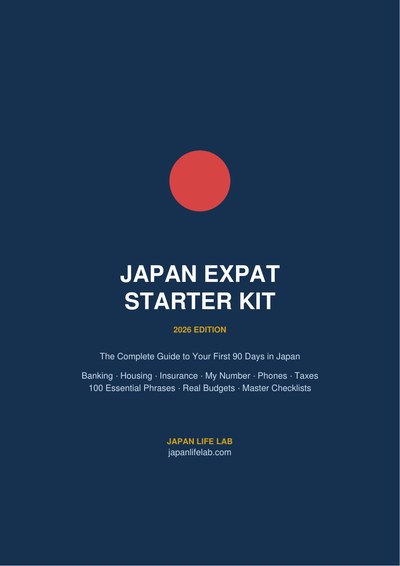
Japan Expat Starter Kit 2026 PDF guide
Your first 90 days in Japan, step by step: 17 chapters · 24 pages · 100 phrases in Japanese script · 40 kanji · printable checklists. Bank account, My Number, health insurance, apartment, phone, taxes & pension.
$9.99 $4.99 current price
📥 Get the kit →📄 Read 5 pages free: contents + Chapter 2
⚡ Instant PDF download · 🛡️ 30-day money-back guarantee · 🔄 Free 2026 updates
Practical guides for life and travel in Japan — free, about once a week. No spam, unsubscribe anytime.
☕ Enjoying our Japan guides?
If this article helped you, you can support our work with a coffee!
🇯🇵 Travel & Life Essentials for Japan
Hand-picked gear to make your time in Japan easier. Available on Amazon US & Amazon Japan.
🔋 Portable charger
A must for long days of sightseeing and photos.
View on Amazon (US)View on Amazon Japan🔌 Travel plug adapter
Japan uses Type A outlets. Bring the right adapter.
View on Amazon (US)View on Amazon Japan🎧 Translation earbuds
Real-time translation to talk without barriers.
View on Amazon (US)View on Amazon JapanAs an Amazon Associate, Japan Life Lab earns from qualifying purchases.
Did this guide help you? 🍵
Japan Life Lab is a small independent blog, and every guide we publish is completely free — no paywalls, ever. If our work saved you time (or a headache), you can support us with a cup of Japanese tea. Every contribution, big or small, goes straight into keeping these guides free, accurate and up to date for everyone.
☕ Support Japan Life Lab
Leave a Reply