This article was created with AI writing assistance (ChatGPT, Claude, etc.). Product selection, specifications, and reviews are verified by the Japan Life Lab editorial team.
This article contains promotional / affiliate links.
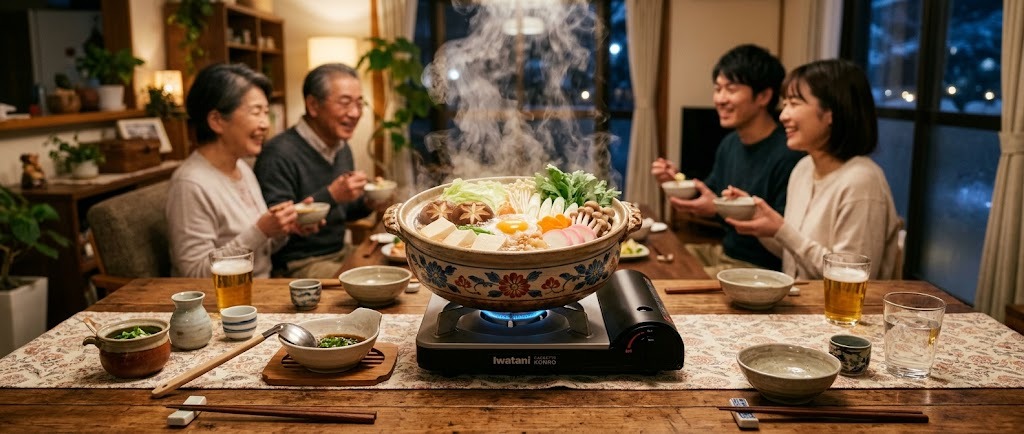
If there is one piece of Japanese cookware that changes how you eat in winter, it is the donabe — the traditional clay pot that sits at the center of every Japanese hot pot (nabe) dinner. Donabe hold heat like nothing else in your kitchen: the thick clay walls warm up slowly, distribute heat evenly, and keep your broth bubbling gently long after you turn down the flame.
In Japan, nabe season is a social institution. From October to March, families and friends gather around a steaming pot of dashi, vegetables, tofu and thinly sliced meat, cooking at the table and eating straight from the pot. The good news: you do not need to live in Japan to join in. Authentic donabe from famous Japanese kilns ship internationally via Amazon.com, and Japan residents can find the full range on Amazon Japan.
This guide covers how to choose a donabe, how to care for it, and the five pieces of gear — from a 1,300-year-old Iga kiln’s rice cooker to the portable stove that makes tabletop nabe possible — that build a complete Japanese hot pot setup.
⏱ The short answer (30 seconds)
In a hurry? The full reasons and prices are right below.
- Nagatani-en Kamado-santhe legendary Iga clay rice cooker
- Ginpo Hana Mishima donabethe classic Banko ware hot pot
- Hario Gohangamathe glass rice pot for the curious
- Iwatani portable butane stovethe engine of tabletop nabe
- Zojirushi Gourmet d’Expert electric skilletnabe for flame-free homes
※ If in doubt, go with #1. Budget picks are further down the page.
Prime members get fast, free delivery on millions of items, Prime Video and members-only deals. Eligible new members can try it free for 30 days.
Start your free 30-day Prime trial →Ages 18–24? See Prime for Young Adults
Paid links. As an Amazon Associate, Japan Life Lab earns from qualifying purchases. Trial eligibility and terms are set by Amazon.
How to choose a donabe
Size: Donabe are sized in “gō” for rice or by diameter for hot pot. A 7-gō (about 21cm) pot suits 1–2 people; a 9-gō (27cm) pot feeds 3–4. When in doubt, go bigger — leftovers reheat beautifully.
Clay type: Iga ware (Iga-yaki) is prized for its porous, heat-retaining clay; Banko ware (Banko-yaki) from Yokkaichi is petalite-rich and extremely resistant to thermal shock — about 80% of donabe in Japan are Banko ware.
Heat source: Traditional donabe are for open flame (gas). If your kitchen is induction-only, look for IH-compatible models or use a portable butane stove — which you will want anyway for cooking at the table.
Care basics: Before first use, cook a small batch of rice porridge (okayu) in the pot — this “medome” seals the porous clay. Never put a hot donabe on a cold wet surface, and let it dry fully before storing to prevent mold.
The 5 best donabe & hot pot essentials for 2026
1. Nagatani-en Kamado-san — the legendary Iga clay rice cooker
The Kamado-san from Nagatani-en, an Iga ware kiln founded in 1832, is arguably the most famous donabe in the world. Designed specifically for rice, its double-lid system and thick Iga clay walls produce rice with a texture no electric cooker can match — plump, glossy grains with a faint sweetness and, if you leave it a minute longer, the prized crispy okoge crust at the bottom.
It is genuinely foolproof: medium flame, wait for the steam whistle, turn off, rest 20 minutes. No electronics, nothing to break, and it doubles as a stunning serving vessel at the table. The 3-cup (CT-03) size suits couples; the 5-cup CT-50 feeds a family. Expect to pay around $110–180 depending on size — an heirloom price for an heirloom pot.
2. Ginpo Hana Mishima donabe — the classic Banko ware hot pot
Walk into any Japanese home and the nabe pot on the table is very likely a Ginpo. Made from petalite-rich Banko clay in Yokkaichi, Ginpo’s Hana Mishima series — with its instantly recognizable stamped flower pattern — has been Japan’s standard hot pot for decades. The clay shrugs off thermal shock, so it moves from stovetop to table night after night, winter after winter.
Sizes run from a personal 6-gō pot to a party-ready 10-gō. For most households the 9-gō (27cm, serves 3–4) is the sweet spot. Prices are refreshingly reasonable — usually $40–80 — for a pot that will genuinely last decades.
3. Hario Gohangama — the glass rice pot for the curious
Tokyo glassmaker Hario’s Gohangama cooks rice the traditional way — but in heatproof glass, so you can actually watch the grains dance in the boil. The glass lid’s whistle tells you exactly when to cut the heat, making it the easiest entry into stovetop rice for donabe beginners nervous about clay care (no medome sealing, dishwasher-friendly, no mold worries).
Purists will still prefer clay for the final texture, but as a low-maintenance daily driver around $50–70, the Gohangama is a brilliant gateway into Japanese stovetop rice.
4. Iwatani portable butane stove — the engine of tabletop nabe
The secret to a real nabe dinner is that the pot never leaves the table. That is the job of a cassette konro — a portable butane stove — and Iwatani is the undisputed king of the category. Compact, wind-shielded, pushing out serious heat from a single click-in butane canister, an Iwatani stove keeps the broth simmering while everyone cooks and eats at their own pace.
It earns its keep beyond nabe season too: yakiniku at the table, camping, and emergency preparedness (a cassette stove is standard disaster-kit gear in Japan). At roughly $30–60 it is the cheapest ticket to the full Japanese hot pot experience — and one of Amazon’s most-loved Japanese products, period.
5. Zojirushi Gourmet d’Expert electric skillet — nabe for flame-free homes
If open flame at the table is not an option — dorm rules, kids, induction-only kitchens — Zojirushi’s Gourmet d’Expert electric skillet (EP series) delivers the tabletop hot pot experience with a plug instead of a burner. The deep nonstick pan handles nabe, sukiyaki and shabu-shabu, with precise temperature control from a gentle simmer to a hard sear.
It is the practical, safety-first path to nabe night, and doubles as a party skillet for okonomiyaki or yakisoba. Around $130–180 on Amazon.com, with strong reviews from American nabe converts.
Quick comparison
| Pick | Best for | Price range |
|---|---|---|
| Nagatani-en Kamado-san | The ultimate stovetop rice | $110–180 |
| Ginpo Hana Mishima | Classic family hot pot | $40–80 |
| Hario Gohangama | Easy-care glass rice pot | $50–70 |
| Iwatani butane stove | Cooking at the table | $30–60 |
| Zojirushi electric skillet | Flame-free tabletop nabe | $130–180 |
Final thoughts
A donabe is one of those rare purchases that changes a season. Start with a Ginpo hot pot and an Iwatani stove for the full nabe-night experience, or go straight to the Kamado-san if rice is your religion. Either way, your winter table will never be the same.
Living in Japan? Every pick above is cheaper and faster to get on Amazon Japan. Overseas readers can order via Amazon.com, or use a proxy service like Buyee for kiln-direct models that do not ship internationally.
🔥 Editor’s Picks for Life & Travel in Japan

Japan Expat Starter Kit 2026 PDF guide
Your first 90 days in Japan, step by step: 17 chapters · 24 pages · 100 phrases in Japanese script · 40 kanji · printable checklists. Bank account, My Number, health insurance, apartment, phone, taxes & pension.
$9.99 $4.99 current price
📥 Get the kit →📄 Read 5 pages free: contents + Chapter 2
⚡ Instant PDF download · 🛡️ 30-day money-back guarantee · 🔄 Free 2026 updates
🛒 Ready to Buy? Shop These in Japan!
Get fast delivery across Japan — including same-day in major cities
Practical guides for life and travel in Japan — free, about once a week. No spam, unsubscribe anytime.
☕ Enjoying our Japan guides?
If this article helped you, you can support our work with a coffee!
Leave a Reply