This article was created with AI writing assistance (ChatGPT, Claude, etc.). Product selection, specifications, and reviews are verified by the Japan Life Lab editorial team.
This article contains promotional / affiliate links.
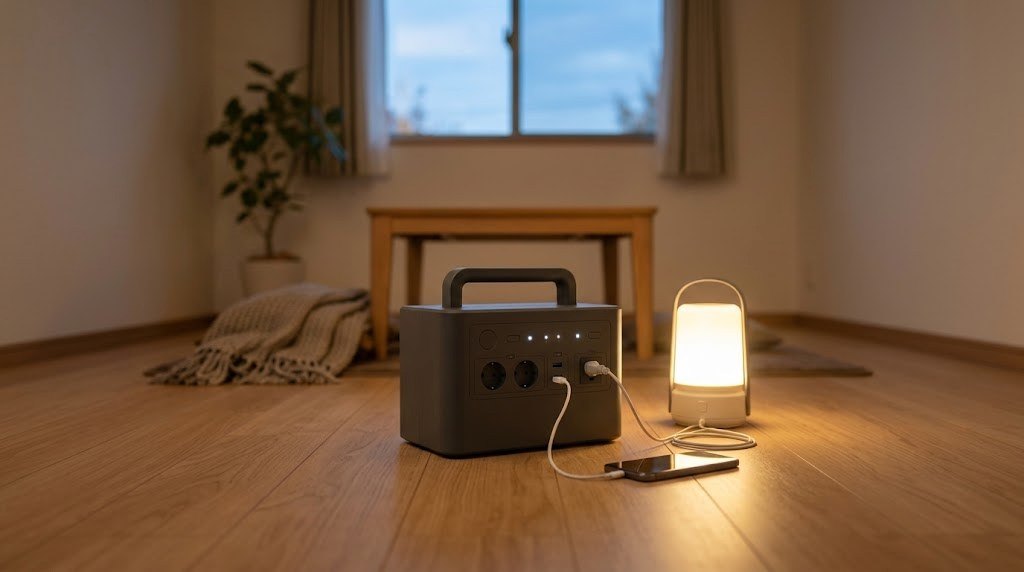
Japan has earthquakes, typhoons and, in snowy areas, winter blackouts. For a renter, a portable power station (ポータブル電源, pootaburu dengen) is the simplest way to keep phones, lights and an electric blanket going when the grid fails: no fuel, no fumes, and it lives in a cupboard. The catch is the footnotes on the spec sheet.
We compare five Japan-market models with an Amazon Japan listing, from ¥19,800 to about ¥70,000, from Anker, DJI and Jackery. Specs come from the makers’ pages and Jackery’s manual; prices from kakaku.com on 13 October 2026. For the rest of your kit, see our earthquake survival guide.
📌 What you will learn
You do not have to read it all — jump to what you need.
- How to choose: Wh, watts, charging, UPS, warranty
- The 5 best power stations, from ¥19,800
- Comparison table
- Safety, storage, disposal and when to buy
- Frequently asked questions
- The short version
※ Start wherever fits your situation.
Prime members get fast, free delivery on millions of items, Prime Video and members-only deals. Eligible new members can try it free for 30 days.
Start your free 30-day Prime trial →Ages 18–24? See Prime for Young Adults
Paid links. As an Amazon Associate, Japan Life Lab earns from qualifying purchases. Trial eligibility and terms are set by Amazon.
How to choose a portable power station in Japan
1. Capacity (Wh): how long things really run
Capacity is given in watt-hours (Wh). Dividing it by a device’s watts gives a theoretical maximum; real run times are shorter because of conversion losses. Jackery’s own estimates for its 1,070 Wh 1000 New show the gap: about 12 hours for a 55 W electric blanket (simple division says about 19), about 35 hours for a 10 W LED light, and 1.7 to 38 hours for a fridge drawing 15 to 520 W. Our rule of thumb: 288 Wh for phones, laptops and lights; the 1 kWh class for a blanket through the night, a fridge or a kettle.
2. AC output (W): rated and start-up power
Rated output is what the outlets supply continuously: 300 W for the Anker C300, 800 W for DJI’s Mini (up to 1,000 W maximum on its spec page), 1,500 W for the Jackery and 1,550 W for the Anker C1000 Gen 2. Add up everything you plug in at once. Some appliances need more at start-up: Jackery names fridges, air conditioners, heaters and hair dryers, and DJI says motor-driven devices such as compressors and air conditioners may not work for that reason.
3. Charging: wall, sun and car
The 1 kWh class now refills from the wall in about an hour, usually in a special fast mode: Anker quotes 54 minutes in its app’s super-fast mode (about 60 in normal mode), Jackery about 60 minutes in its app’s emergency mode, which its manual says to use only when needed, and DJI 75 minutes in fast-charge mode. From the wall, the C300 DC charges only over USB-C, with chargers you buy separately. Solar input: 100 W on the two C300s, 400 W on the DJI and the Jackery, 600 W on the C1000 Gen 2.
4. Battery, cycles and weight
All five use lithium iron phosphate (LiFePO4, or LFP) cells, rated for 3,000 cycles on the two C300s and 4,000 on the others. For those 4,000 cycles, Anker’s C1000 Gen 2 and DJI’s Mini keep 80% of their capacity, Jackery’s 1000 New 70%, by the makers’ figures. Weight: 2.8 and 4.1 kg for the small Ankers, 10.8 to 11.5 kg for the 1 kWh class.
5. UPS: does it take over when the power cuts?
The four AC models can sit between the wall and a device and take over in an outage, within about 10 to 20 ms by the makers’ figures. Jackery’s manual adds that this is not a zero-millisecond UPS: do not rely on it for servers or workstations, and connect only one device in UPS mode.
6. Warranty depends on the seller
Jackery’s warranty covers only units bought from its official stores (its own site and its official Amazon, Rakuten and Yahoo stores); the full 5 years (3 + 2) is an own-site perk. Anker extends 18 months to 5 years when you register as a member (3 years for the C300 DC). DJI says its repair service in Japan covers products bought from its official store and authorised sellers. On Amazon Japan, check the seller’s name before you pay.
The 5 best portable power stations to buy in Japan in 2026
Prices include tax. Buttons go to Amazon Japan only, as these are Japan-market models.
1. Anker SOLIX C300 DC — best budget pick (USB only)
Anker’s C300 DC is a 288 Wh battery box with no AC outlet: four USB-C ports (two up to 140 W), two USB-A ports and a car-style socket, 300 W in total, plus an LED light on top. It weighs about 2.8 kg.
It charges from USB-C chargers you supply, solar panels or a car socket. The lowest price on kakaku.com on 13 October 2026 was ¥19,800 for dark grey; Anker’s Amazon store charged ¥24,990 for either colour.
| Capacity / battery | 288 Wh, lithium iron phosphate; 3,000 cycles |
|---|---|
| Outputs | No AC. USB-C ×2 (140 W), ×1 (100 W), ×1 (15 W); USB-A ×2; car socket; 300 W total |
| Charging | USB-C about 1.5 h with two 140 W chargers, about 2.3 h with one (not included); solar 100 W; car |
| Size / weight | 12.4 × 12.0 × 20.0 cm; about 2.8 kg |
| Warranty | 18 months, plus 18 months after registering with Anker |
✅ Pros
- Under ¥25,000 for 288 Wh
- Light at 2.8 kg, LED light
- Four USB-C ports
⚠️ Cons
- No AC outlet: no blanket, no fridge
- USB-C chargers not included
👍 Best for
- Students and one-room flats
- A light box to grab when you evacuate
2. Anker SOLIX C300 — best small pick with AC outlets
The C300 puts 288 Wh in a 4.1 kg box with three AC outlets (300 W rated, 600 W peak), three USB-C ports (two at 140 W), a USB-A port, a car socket and a large LED light on the front. Anker names TVs and electric blankets as blackout uses.
It refills from the wall in about 68 minutes and switches over in about 10 ms when the power cuts, per Anker’s table; the car charging cable is sold separately. Lowest price on kakaku.com: ¥29,800 for dark grey; Anker’s Amazon store: ¥34,990.
| Capacity / battery | 288 Wh, lithium iron phosphate; 3,000 cycles |
|---|---|
| AC output | 3 outlets; 300 W rated (50/60 Hz), 600 W peak |
| Other ports | USB-C ×2 (140 W), ×1 (15 W); USB-A ×1; car socket |
| Charging | AC about 68 min (330 W); USB-C 140 W; solar 100 W; car (cable sold separately) |
| Size / weight | 16.4 × 16.1 × 24.0 cm; about 4.1 kg |
| Warranty | 18 months, plus 42 months after registering with Anker |
✅ Pros
- AC outlets in a 4.1 kg box
- Full in about 68 minutes
- About 10 ms switch-over
⚠️ Cons
- 300 W limit: no kettle, no heater
- 288 Wh is one night of light use
👍 Best for
- Singles and couples in a 1K or 1LDK
- Laptop work through a blackout
3. DJI Power 1000 Mini — best value per watt-hour
DJI’s Power 1000 Mini (released on 10 February 2026, per kakaku.com) holds 1,008 Wh and weighs about 11.5 kg. The Japanese version has four AC outlets with up to 1,000 W (800 W continuous on DJI’s spec page); a retractable 100 W USB-C cable is built in.
In fast-charge mode it refills from the wall in 75 minutes (58 minutes to 80%) in DJI’s 25 °C lab test, and DJI says it takes over within 0.01 seconds in a blackout. Amazon Japan sold the black version for ¥50,589, the lowest price on kakaku.com, or about ¥50 per watt-hour.
| Capacity / battery | 1,008 Wh, LFP; over 80% after 4,000 cycles (DJI test) |
|---|---|
| AC output | 4 outlets (Japan version); up to 1,000 W, 800 W continuous |
| Other ports | Retractable USB-C cable 100 W, USB-C 100 W (150 W total with both), USB-A ×2 (12 W), SDC |
| Charging | AC 75 min in fast mode (25 °C lab); solar 400 W and car 400 W with cables sold separately |
| Size / weight | 31.4 × 21.2 × 21.6 cm; about 11.5 kg |
| Warranty | 5 years; some accessories, such as the retractable cable module, excluded |
✅ Pros
- Lowest price per Wh of our picks
- Built-in retractable USB-C cable
- Four AC outlets
⚠️ Cons
- 1,000 W max: no big heaters
- Heaviest 1 kWh pick at 11.5 kg
- Car and solar cables extra
👍 Best for
- Families who want 1 kWh on a budget
- Camping and car trips
4. Jackery 1000 New (JE-1000D) — easiest to own for years
Jackery’s 1000 New (released on 10 July 2024, per kakaku.com) holds 1,070 Wh and, at about 10.8 kg, is the lightest of our three 1 kWh picks. Three 100 V AC outlets share 1,500 W (3,000 W peak); Jackery estimates about one hour for an 850 W kettle.
Emergency charge mode, set in the app, refills it in about 60 minutes. Jackery takes back its power stations sold in Japan free of charge (you pay the shipping). Amazon Japan charged ¥69,483, the lowest price on kakaku.com. Jackery also sells a 1000 New V3 (JE-1000G, ¥82,350), not compared here.
| Capacity / battery | 1,070 Wh, LiFePO4; 70% left after 4,000 cycles (Jackery) |
|---|---|
| AC output | 3 outlets, 100 V 50/60 Hz; 1,500 W total, 3,000 W peak |
| Other ports | USB-C 100 W and 30 W, USB-A 18 W, car socket 12 V 10 A |
| Charging | AC about 60 min in emergency mode (app); solar up to 400 W; car (cable sold separately) |
| Size / weight | 32.7 × 22.4 × 24.7 cm; about 10.8 kg |
| UPS / warranty | Switches within 20 ms; warranty only via official stores, 3 + 2 years on Jackery’s own site |
✅ Pros
- Lightest 1 kWh pick at 10.8 kg
- Free maker take-back (you pay shipping)
- 1,500 W: runs an 850 W kettle
⚠️ Cons
- Fast charge only in emergency mode
- Warranty tied to official stores
👍 Best for
- Families preparing for earthquakes
- Anyone who wants a clear disposal route
5. Anker SOLIX C1000 Gen 2 — fastest charging, most outlets
Anker’s SOLIX C1000 Gen 2 (on sale since October 2025, per Anker) stores 1,024 Wh, weighs about 11.3 kg and has the most outlets here: five AC (1,550 W rated, 2,300 W peak), three USB-C, a USB-A port and a car socket.
It refills from the wall in 54 minutes in the app’s super-fast mode (Anker test at 20 °C), or about 60 minutes in normal mode, which Anker recommends for battery life when you are not in a hurry. Anker says it switches over in about 0.01 seconds in an outage. Lowest price on kakaku.com: ¥69,290 for off-white (¥71,800 dark grey); Anker’s own store charged ¥69,990, and its product page links to Anker’s Amazon store.
| Capacity / battery | 1,024 Wh, LFP; 4,000 cycles to 80% |
|---|---|
| AC output | 5 outlets; 1,550 W rated (50/60 Hz), 2,300 W peak |
| Other ports | USB-C 100 W ×2 and 15 W ×1, USB-A 12 W, car socket 90 W |
| Charging | AC 54 min (super-fast mode), about 60 min normal; solar up to 600 W; car cable included |
| Size / weight | 38.4 × 20.8 × 24.4 cm; about 11.3 kg |
| Warranty | 18 months, plus 42 months after registering with Anker |
✅ Pros
- Fastest wall charge here: 54 minutes
- Five AC outlets, 1,550 W
- Car charging cable included
⚠️ Cons
- Super-fast mode needs the app
- Widest body at 38.4 cm
👍 Best for
- Homes with frequent outages
- A kettle or fridge in a blackout
Comparison table
| Model | Best for | Capacity | AC output (rated) | AC outlets | Weight | Fastest wall charge | Price, 13 Oct 2026* |
|---|---|---|---|---|---|---|---|
| Anker C300 DC | Budget, USB only | 288 Wh | None | 0 | 2.8 kg | USB-C only, about 1.5 h | ¥19,800 lowest; Amazon ¥24,990 |
| Anker C300 | Small with AC | 288 Wh | 300 W | 3 | 4.1 kg | About 68 min | ¥29,800 lowest; Amazon ¥34,990 |
| DJI Power 1000 Mini | Value per Wh | 1,008 Wh | 800 W continuous (up to 1,000 W) | 4 | 11.5 kg | 75 min (fast mode) | ¥50,589 (Amazon, lowest) |
| Jackery 1000 New | Long-term owners | 1,070 Wh | 1,500 W | 3 | 10.8 kg | About 60 min (emergency mode) | ¥69,483 (Amazon, lowest) |
| Anker C1000 Gen 2 | Fast charge, most outlets | 1,024 Wh | 1,550 W | 5 | 11.3 kg | 54 min (super-fast mode) | ¥69,290 lowest; Anker store ¥69,990 |
* Incl. tax. “Lowest” = lowest shop on kakaku.com (C300s: dark grey; C1000 Gen 2: off-white); “Amazon” = Amazon.co.jp or AnkerDirect Amazon offer on kakaku.com.
Using a power station in Japan: safety, storage, disposal, timing
Safety rules from the manuals
Your own manual comes first. Anker (C300, C300 DC, C1000 Gen 2): do not use or store the unit anywhere hot, such as a car in the sun or direct sunlight; keep it out of rain and humid places; avoid uses such as data servers and medical devices, where a failure could endanger life or property. Jackery’s JE-1000D manual: do not use or leave it at 45 °C or more, near fire or heaters; never block its vents, and leave at least 5 cm of space on every side; when charging from the wall, do not share the socket with other appliances through a power strip; people with a pacemaker should not use it; if it smokes or catches fire, douse it with plenty of water until no smoke is visible. DJI advises against using its Mini in the rain for more than 3 minutes.
Storage: the makers disagree
Anker’s C300 pages say to store the unit fully charged at 0 to 40 °C and check it about every three months. Jackery’s manual recommends 60 to 80% for long storage, also with a check every three months, and warns that storing it empty for three to six months can damage the battery. Follow your model’s manual.
Throwing a power station away
Japan’s Ministry of the Environment warns that lithium-ion batteries can catch fire and have caused fires at waste plants, and says to follow your municipality’s rules. Jackery takes back its power stations sold in Japan free of charge (you pay the shipping; solar panels and accessories excluded). Anker collects its own power stations if you send them prepaid, labelled リチウムイオン電池 (lithium-ion battery), but asks you to use your municipality if it accepts them. For DJI, ask DJI’s support. Our garbage sorting guide explains how to find your city’s rules.
When to buy
Amazon.co.jp’s Prime Kanshasai (プライム感謝祭) is holding a pre-sale from 13 to 15 October, followed by the main sale from 16 to 19 October 2026, for Prime members only. Its point-up campaign requires an entry: spend ¥10,000 or more in total from 13 to 19 October and you get extra points, depending on the conditions you meet. We do not know which power stations will be discounted, so compare prices (see our sale calendar).
Frequently asked questions
How big a power station do I need for a blackout?
Add up the watts and hours you need. Phones, a laptop and LED lights fit the 288 Wh class. For an electric blanket through the night, a fridge or a kettle, choose the 1 kWh class: Jackery estimates about 12 hours for a 55 W blanket on its 1,070 Wh 1000 New.
Can I use a Japanese power station abroad?
Check your model’s manual. Jackery’s JE-1000D manual is marked for use only in Japan (国内専用), and its AC outlets supply 100 V. Do not assume a Japanese model suits another country’s sockets or voltage.
How do I dispose of an old power station in Japan?
Follow your municipality’s rules and the maker’s service. Jackery takes back its power stations sold in Japan free of charge (you pay the shipping); Anker collects its own if you send them prepaid, but asks you to use your municipality if it accepts them. For DJI, ask DJI’s support.
The short version
Phones and laptops only: Anker SOLIX C300 DC. A small box with AC outlets: Anker SOLIX C300. Most capacity for the money: DJI Power 1000 Mini. A light 1 kWh unit with free take-back: Jackery 1000 New. Fastest refill and five outlets: Anker SOLIX C1000 Gen 2. Size it in watt-hours, check the watts, and buy from an official seller.
🔥 Editor’s Picks for Life & Travel in Japan

Japan Expat Starter Kit 2026 PDF guide
Your first 90 days in Japan, step by step: 17 chapters · 24 pages · 100 phrases in Japanese script · 40 kanji · printable checklists. Bank account, My Number, health insurance, apartment, phone, taxes & pension.
$9.99 $4.99 current price
📥 Get the kit →📄 Read 5 pages free: contents + Chapter 2
⚡ Instant PDF download · 🛡️ 30-day money-back guarantee · 🔄 Free 2026 updates
🛒 Ready to Buy? Shop These in Japan!
Get fast delivery across Japan — including same-day in major cities
Practical guides for life and travel in Japan — free, about once a week. No spam, unsubscribe anytime.
☕ Enjoying our Japan guides?
If this article helped you, you can support our work with a coffee!
Leave a Reply