This article was created with AI writing assistance (ChatGPT, Claude, etc.). Product selection, specifications, and reviews are verified by the Japan Life Lab editorial team.
This article contains promotional / affiliate links.
Ask any foreigner living in Japan what confused them most in their first month, and garbage sorting will be near the top of the list. Not the language. Not the trains. The garbage.
It sounds trivial until you are standing in front of six different bins at 7am, holding a plastic bottle, wondering whether the cap goes in the same bag. Then your bag gets left behind with a bright orange sticker on it, and your neighbour gives you a look you will not forget.
Here is the thing nobody tells you: there is no national rule. Japan has over 1,700 municipalities and each one sets its own system. What is burnable in Yokohama may be non-burnable in Osaka. This guide gives you the framework that applies almost everywhere, then shows you how to find your own city’s exact rules in about five minutes.
⚠️ The single most important rule
Your city’s rules override everything in this article. Always check your local guide — most city offices publish one in English, Chinese, Korean, Portuguese and Vietnamese. We show you how to find it below.
📌 What you will learn
You do not have to read it all — jump to what you need.
- The categories you will meet almost everywhere
- The PET bottle ritual (three steps, every time)
- How to read the symbols on packaging
- Items that trip people up
- Oversized waste (粗大ゴミ): the paid system
- Four appliances that are illegal to throw away
- The rules that are not about sorting
※ Start wherever fits your situation.
The categories you will meet almost everywhere
| Japanese | Reading | English | Typical items |
|---|---|---|---|
| 燃えるゴミ / 可燃ゴミ | moeru gomi | Burnable | Food scraps, tissues, paper waste, small wood |
| 燃えないゴミ / 不燃ゴミ | moenai gomi | Non-burnable | Ceramics, glass, small metal, umbrellas |
| プラスチック / プラ | purasuchikku | Plastic packaging | Wrappers, trays, containers with the ♳ プラ mark |
| ペットボトル | petto botoru | PET bottles | Drink bottles only, marked PET |
| ビン・カン | bin / kan | Glass & cans | Bottles and metal cans |
| 資源ゴミ / 古紙 | shigen gomi | Recyclables / paper | Newspapers, cardboard, magazines |
| 粗大ゴミ | sodai gomi | Oversized waste | Furniture, bicycles, anything over ~30cm |
The critical distinction for newcomers is between プラ (plastic packaging) and ペットボトル (PET bottles). They are not the same category. A plastic yoghurt tub and a plastic drink bottle usually go in different bags.
The PET bottle ritual (three steps, every time)
PET bottles are the one item where nearly every municipality agrees, and where nearly every newcomer gets it wrong.
- Remove the cap — the cap is a different plastic. It goes with プラ, or in a dedicated cap collection box
- Peel off the label — also プラ. Most labels have a perforated line to make this easy
- Rinse the bottle and crush it flat if your city asks for it
Yes, it feels excessive. But this is why Japan’s PET recycling rate is among the highest in the world — the material arrives at the plant already clean and separated.
How to read the symbols on packaging
Japanese packaging is labelled, and once you can read four marks you can sort almost anything.
| Mark | Meaning | Where it goes |
|---|---|---|
| プラ (in a triangle-ish box) | Plastic packaging | Plastic bag |
| PET (in an arrow triangle) | PET bottle | PET bottle collection |
| 紙 | Paper packaging | Paper recycling or burnable |
| アルミ / スチール | Aluminium / steel | Cans |
When packaging has no mark at all, it usually goes in burnable — but check your city guide, because this is exactly where local rules diverge.
Items that trip people up
| Item | Usually goes | Why people get it wrong |
|---|---|---|
| Bottle caps | Plastic (プラ) | Assumed to go with the bottle |
| Pizza boxes with grease | Burnable | Cardboard, but contaminated so not recyclable |
| Umbrellas | Non-burnable | Mixed materials confuse people |
| Batteries | Special collection | Never in household waste |
| Spray cans | Special / non-burnable | Must be fully empty — explosion risk |
| Broken glass | Non-burnable, wrapped in paper | Injury risk to collectors — mark it 危険 (kiken) |
| Clothes and fabric | Varies widely | Some cities recycle, some burn |
| Cooking oil | Solidify or soak in paper | Never pour down the drain |
Oversized waste (粗大ゴミ): the paid system
Anything roughly over 30cm — furniture, suitcases, bicycles, futons — cannot go out with normal rubbish. It requires a booking and a fee.
- Call or book online with your city’s 粗大ゴミ centre. Many now accept online applications
- You are told a price and a collection date, typically ¥300–¥2,000 per item
- Buy a 粗大ゴミ処理券 (sticker) at a convenience store for that amount
- Write your name or reference number on the sticker and attach it to the item
- Put it out at the specified place by the specified morning
📌 Booking can take 1–3 weeks in busy periods, especially March when everyone moves house. If you are leaving Japan, start this process a month before your flight.
Four appliances that are illegal to throw away
Under Japan’s Home Appliance Recycling Law, four categories cannot be disposed of as oversized waste at all:
- Air conditioners
- Televisions
- Refrigerators and freezers
- Washing machines and clothes dryers
These must go back through a retailer or a designated collection point, and you pay a recycling fee plus transport. If you bought the item in Japan, the shop that sold it is obliged to take it back. Leaving one on the street is illegal dumping and carries serious penalties.
The rules that are not about sorting
Sorting correctly is only half of it. These are the unwritten rules that actually cause friction with neighbours.
Put it out on the morning, not the night before
Most collection points want rubbish out by 8:00am on the day, not the evening before. Putting it out at night invites crows and cats, and in many buildings it is explicitly forbidden. This is the single most common complaint against foreign residents.
Use the designated bag
Many cities require specific coloured or printed bags, sold at supermarkets and convenience stores. In those cities, a normal shopping bag will simply be refused. Check whether your city uses 指定袋 (shitei bukuro).
Use the net
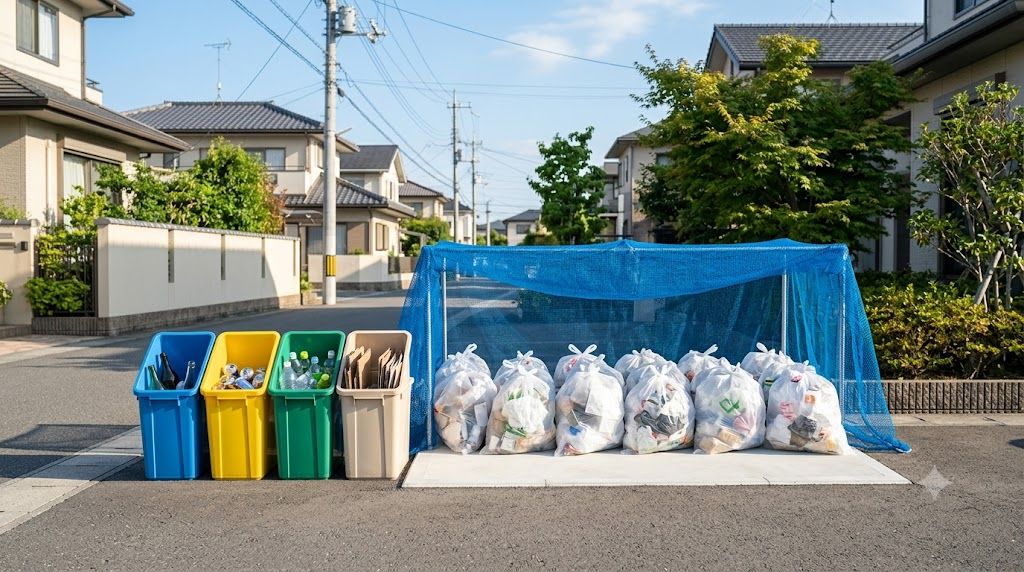
Collection points usually have a yellow or blue net. Put your bag under it. It exists to stop crows, and crows in Japan are formidable. A torn bag spread across the pavement becomes your responsibility.
If your bag is rejected
A sticker on your bag means it was not collected. Take it back inside, fix the problem, and put it out on the next correct day. Leaving it there is what turns a small mistake into a neighbourhood dispute.
How to find your own city’s rules in five minutes
- Search “[your city name] ゴミ 分別 外国語” or “[city name] garbage guide English”
- Look for the 市役所 / 区役所 official site — most publish a PDF guide in 5+ languages
- Download the collection calendar for your district. Days differ street by street
- Check whether your city has an app — many now offer one with notifications and a searchable item database
- Ask at your building. Many apartments post the rules by the bins in Japanese and English
If you cannot find anything, go to your city hall in person and ask for the ゴミ分別ガイド. Staff at the residents’ counter deal with this constantly and will hand you a booklet.
A practical setup for your home
The system only works if sorting is easier than not sorting. What works for most people:
- Three bins minimum in the kitchen: burnable, plastic, PET/cans
- A bag on a hook for plastic packaging — it is bulky but light
- A box by the door for paper and cardboard
- The calendar on the fridge, with collection days circled
- Rinse as you go — a container washed immediately takes 5 seconds, one left for three days takes five minutes
Final thoughts
Japanese garbage sorting looks obsessive from the outside. Living with it for a while, most people come to see the logic: the burden is shifted to the household so that the recycling stream stays clean, and the result is one of the highest material recovery rates in the world.
You will get it wrong at first. Everyone does, including Japanese people who move between cities. Learn your local calendar, put things out in the morning, use the net — and the rest sorts itself out.
🗾 More Japan Life Guides
🔥 Editor’s Picks for Life & Travel in Japan
📘 The Japan Expat Starter Kit 2026
Banking, housing, My Number, taxes, 100 phrases and a 40-kanji cheat sheet — everything from this site in one 17-chapter PDF field manual. Free lifetime 2026 updates.
Reader price: $9.99 $6.99 with code JLL30 at checkout
30-day money-back guarantee · Instant download · PR
Practical guides for life and travel in Japan — free, about once a week. No spam, unsubscribe anytime.
☕ Enjoying our Japan guides?
If this article helped you, you can support our work with a coffee!
🇯🇵 Travel & Life Essentials for Japan
Hand-picked gear to make your time in Japan easier. Available on Amazon US & Amazon Japan.
🔋 Portable charger
A must for long days of sightseeing and photos.
View on Amazon (US)View on Amazon Japan🔌 Travel plug adapter
Japan uses Type A outlets. Bring the right adapter.
View on Amazon (US)View on Amazon Japan🎧 Translation earbuds
Real-time translation to talk without barriers.
View on Amazon (US)View on Amazon JapanAs an Amazon Associate, Japan Life Lab earns from qualifying purchases.
Did this guide help you? 🍵
Japan Life Lab is a small independent blog, and every guide we publish is completely free — no paywalls, ever. If our work saved you time (or a headache), you can support us with a cup of Japanese tea. Every contribution, big or small, goes straight into keeping these guides free, accurate and up to date for everyone.
☕ Support Japan Life Lab
Leave a Reply