This article was created with AI writing assistance (ChatGPT, Claude, etc.). Product selection, specifications, and reviews are verified by the Japan Life Lab editorial team.
This article contains promotional / affiliate links.
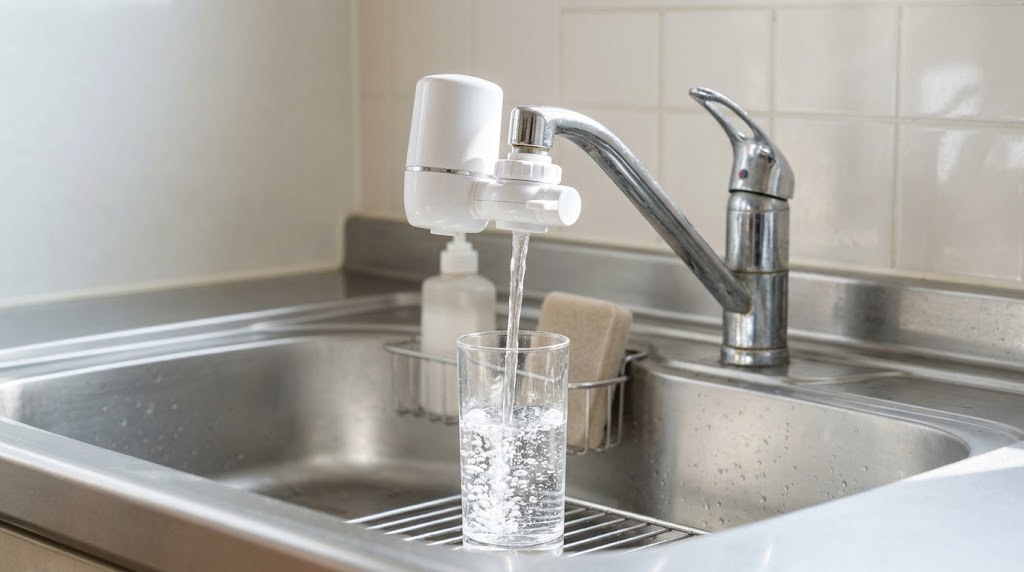
In Japan a water filter is a 浄水器 (jōsuiki). Renters usually pick one of two kinds: a small unit that clips onto the kitchen faucet (蛇口直結型), or a jug with a cartridge inside (ポット型) that needs no fitting.
We compare five filters with an in-stock Amazon Japan listing, from ¥2,844 to ¥9,350 at the lowest in-stock shop on kakaku.com: two from Panasonic, one from Toray’s Torayvino brand and two from Mitsubishi Chemical Cleansui. All five list PFOS and PFOA among the substances they remove. Specs come from the makers’ own pages and manuals; prices from kakaku.com on 21 October 2026. Just moved in? Our guide to renting an apartment in Japan covers the rest of the set-up.
📌 What you will learn
You do not have to read it all — jump to what you need.
- Tap water, PFAS and how to choose a filter
- The 5 best water filters, from ¥2,844
- Comparison table and running costs
- Using a filter safely
- Frequently asked questions
- The short version
※ Start wherever fits your situation.
Prime members get fast, free delivery on millions of items, Prime Video and members-only deals. Eligible new members can try it free for 30 days.
Start your free 30-day Prime trial →Ages 18–24? See Prime for Young Adults
Paid links. As an Amazon Associate, Japan Life Lab earns from qualifying purchases. Trial eligibility and terms are set by Amazon.
How to choose a water filter in Japan
1. Do you need one? Tap water and the 2026 PFAS standard
Tap water from Japanese water utilities has to meet national water-quality standards. On 1 April 2026 PFOS and PFOA, two PFAS chemicals, became one of those standards: the Ministry of the Environment amended the Ordinance on Water Quality Standards (水質基準に関する省令) to set 0.00005 mg/L, that is 50 ng/L, for the two combined, and the Water Supply Act Enforcement Regulations now require utilities to test for them, as a rule at least about once every three months. Niigata Prefecture counts 52 standards in total from that date and points residents to their local utility, which publishes its test results.
So in our reading a filter is not a requirement. People buy one for the taste and smell of chlorine, カルキ in Japanese, or to reduce the other substances it lists. Toray and Cleansui both say to use their filters only with water that meets the tap-water standards.
2. Faucet-mounted or pitcher
A faucet-mounted filter gives filtered water on demand at 1.6 to 3.0 litres a minute on our picks, plus unfiltered spray and stream settings for washing up. A pitcher filters slowly (0.10 L a minute on the Cleansui CP508) but needs no compatible faucet and no tools, which suits sensor taps or a landlord who does not want anything attached.
3. Read the box: the substances and the 80% rule
Japan’s Consumer Affairs Agency rules say each substance on the box comes with a total filtered volume: the amount of water the cartridge has filtered by the time removal of that substance falls to 80% in the JIS S 3201 test. PFOS and PFOA are not in the JIS list: they are tested by the Japan Water Purifier Association’s JWPAS B method, also to 80% removal. Torayvino and Cleansui label such models PFOS/PFOA除去試験済 (“PFOS/PFOA removal tested”); Panasonic lists them among its 19 substances. Check the substances you care about, not just the count.
4. Cartridge life and running cost
The replacement guide assumes a daily volume: 10 litres a day for the faucet units here, 2 litres for the Cleansui pitcher. All three makers add that it varies with your water, use and pressure. To compare running costs, divide the cartridge price by its rated volume; our table does this for the three faucet picks.
5. Will it fit your faucet?
Faucet units fit only certain spouts, and each maker has its own list. Cleansui’s CB026 manual rules out sensor and shower faucets, square or oval spouts, and straight spouts under 13 mm or 24 mm and over in diameter or with under 10 mm of straight section; parts for common round and threaded spouts are in the box, some others free on request. Toray’s MK207SLX manual rules out sensor and shower faucets, square or oval tips, spouts under 13 mm or 25 mm and over, tips that drop 15 mm or less and aerator threads other than 22 mm. Panasonic says faucets other than the shapes shown on its TK-CJ pages cannot be fitted. Check yours against the maker’s list, and keep the original parts for moving out.
6. Words you will see
| On the box | Reading | Meaning |
|---|---|---|
| 浄水器 | jōsuiki | Water filter |
| 蛇口直結型 | jaguchi chokketsu-gata | Faucet-mounted |
| ポット型 | potto-gata | Pitcher (jug) type |
| 除去対象物質 | jokyo taishō busshitsu | Substances removed |
| 総ろ過水量 | sō roka suiryō | Total volume filtered (rating) |
| ろ過流量 | roka ryūryō | Flow rate (litres per minute) |
| 交換目安 | kōkan meyasu | Replacement guide |
| 浄水 / 原水 | jōsui / gensui | Filtered / unfiltered water |
The 5 best water filters to buy in Japan in 2026
Prices include tax; buttons go to Amazon Japan.
1. Panasonic TK-CJ14 — 19 substances, one cartridge a year
Panasonic’s TK-CJ14 clips onto the faucet and lists 19 substances: 16 from the JIS S 3201 test plus three set by the JWPAS B standard, PFOS and PFOA among them. Its TK-CJ24C1 cartridge is rated at 4,000 litres for most items (2,000 litres for chloroform and 1,2-DCE). Panasonic’s guide is about one year at 10 litres a day, or six months if removing chloroform and 1,2-DCE is your aim.
A replacement cartridge was ¥4,555 at Amazon Japan, the lowest in-stock price on kakaku.com. The unit itself was ¥5,771 at the lowest in-stock shop and ¥5,864 at Amazon Japan.
| Type | Faucet-mounted |
|---|---|
| Substances | 19 (16 JIS + 3 JWPAS B, incl. PFOS/PFOA) |
| Cartridge | TK-CJ24C1: 4,000 L (2,000 L for chloroform, 1,2-DCE) |
| Replacement guide | About 1 year at 10 L/day (6 months for chloroform, 1,2-DCE) |
| Flow rate | 1.8 L/min at 100 kPa |
| Size, weight | 7.5 × 12.5 × 11 cm; about 310 g (450 g full) |
| Hot water | Filtered side under 35 °C; unfiltered/spray under 80 °C |
✅ Pros
- Longest replacement guide here: about a year at 10 L/day
- Lowest cartridge cost per rated litre of our three faucet picks
- PFOS/PFOA listed
⚠️ Cons
- No display: you track the date yourself
- Chloroform and 1,2-DCE rated at half the volume
👍 Best for
- Anyone who wants to change a cartridge only once a year
- Households using about 10 litres a day
2. Panasonic TK-CJ24 — the same filter with a litres-left display
The TK-CJ24 uses the same TK-CJ24C1 cartridge, the same 19 substances and the same 1.8 litres a minute. What it adds is an LCD that shows the litres left in the cartridge and blinks once 150 litres or fewer remain; Panasonic’s spec table lists that display, and a coin battery in the box, for the TK-CJ24 only.
The lowest in-stock shop on kakaku.com asked ¥9,350; Amazon Japan asked ¥9,900, so the display costs about ¥3,600 more at the lowest prices.
| Type | Faucet-mounted, with LCD |
|---|---|
| Substances | 19 (16 JIS + 3 JWPAS B, incl. PFOS/PFOA) |
| Cartridge | TK-CJ24C1: 4,000 L (2,000 L for chloroform, 1,2-DCE) |
| Replacement guide | About 1 year at 10 L/day (6 months for chloroform, 1,2-DCE) |
| Flow rate | 1.8 L/min at 100 kPa |
| Size, weight | 7.5 × 13.5 × 12 cm; about 350 g (490 g full) |
| Display | Litres left; blinks at 150 L or less |
✅ Pros
- Shows the litres left as a number
- Same long-life cartridge as the TK-CJ14
⚠️ Cons
- Most expensive pick here
- Larger and heavier than the TK-CJ14
👍 Best for
- Households whose daily use varies a lot
- Anyone who never remembers when they last changed it
3. Torayvino Cassetty MK207SLX — fastest flow, made in Japan
Toray’s Cassetty MK207SLX filters 3.0 litres a minute, the fastest of our picks, which helps when you fill a pot. It lists 18 substances, PFOS and PFOA included, each rated at 1,500 litres, and a digital sign counts down the litres left. Toray gives five months at 10 litres a day, or three months at 15, and says it is made in Japan.
The unfiltered spray has 0.4 mm holes that Toray says cut splashing and use 30% less water than its previous models. The MKC.SLX cartridge was ¥6,400 at Amazon Japan, the lowest in-stock price on kakaku.com and the priciest per rated litre of our three faucet picks. The unit was ¥8,481 at four shops and ¥8,482 at Amazon Japan.
| Type | Faucet-mounted, with digital sign |
|---|---|
| Substances | 18, incl. PFOS/PFOA |
| Cartridge | MKC.SLX: 1,500 L |
| Replacement guide | 5 months at 10 L/day; 3 months at 15 L/day |
| Flow rate | 3.0 L/min |
| Size, weight | H 102 × W 157 × D 100 mm; 452 g full |
| Hot water | Filtered: avoid 35 °C and above; unfiltered: not 50 °C and above |
| Made in | Japan; battery CR2032 |
✅ Pros
- Fastest flow here: 3.0 L/min
- Litres-left display
- Made in Japan
⚠️ Cons
- Highest cartridge cost per litre of our faucet picks
- Cartridge lasts 5 months at 10 L/day
👍 Best for
- Cooks who fill pots with filtered water
- Anyone who wants a made-in-Japan unit
4. Cleansui CB026 — the budget faucet filter
Cleansui’s CB026 is the lightest and cheapest faucet unit here: 205 g, with a cartridge rated at 1,800 litres and six months at 10 litres a day. It lists 11+3 substances, including PFOS and PFOA, and switches between filtered water, unfiltered spray and an unfiltered stream.
The lowest in-stock shops asked ¥2,898 plus ¥550 delivery; Amazon Japan asked ¥2,927, with delivery from ¥460. A CBC06 cartridge was ¥2,151 at the lowest in-stock shops plus delivery. The newer CB096 (November 2025) adds a monthly countdown bar; Cleansui says its battery cannot be replaced, and we found no Amazon Japan listing for it on kakaku.com.
| Type | Faucet-mounted |
|---|---|
| Substances | 11 + 3, incl. PFOS/PFOA |
| Cartridge | CBC06: 1,800 L |
| Replacement guide | 6 months at 10 L/day |
| Flow rate | 1.6 L/min |
| Size, weight | 131 × 100 × 59 mm; 205 g (315 g full) |
| Hot water | Filtered: not 35 °C and above; unfiltered/spray: not 60 °C and above |
| Warranty | 1 year |
✅ Pros
- Lowest-priced faucet unit here
- Lightest faucet unit here: 205 g
- Cartridge rated 1,800 L
⚠️ Cons
- Fewest listed substances here
- Slowest faucet flow here: 1.6 L/min
- Delivery fee at the lowest-priced shops
👍 Best for
- A first filter on a small budget
- Anyone who wants the lightest unit on the tap
5. Cleansui CP508 — a 2.2-litre pitcher, no fitting needed
Cleansui’s CP508 holds 2.2 litres of filtered water (3.6 litres in all), lists 17+3 substances including PFOS and PFOA, and its cartridge is rated at 200 litres, about three months at 2 litres a day. Cleansui says you can pour while it is still filtering, once the water is below the reservoir line.
It filters 0.10 litres a minute, so fill it ahead of time. It is big: 128 × 257 × 281 mm and 3,060 g when full, and Cleansui asks you to hold it with both hands. Cleansui lists the CPC5W two-pack as its cartridge. The lowest in-stock shops asked ¥2,844 plus ¥550 delivery; Amazon Japan asked ¥2,873, delivery from ¥460. The smaller CP405 (1.4 litres filtered, 105 mm wide, also 200 L) was ¥2,809 at Amazon Japan plus delivery.
| Type | Pitcher |
|---|---|
| Capacity | 2.2 L filtered; 3.6 L in all |
| Substances | 17 + 3, incl. PFOS/PFOA |
| Cartridge | 200 L; 2-pack CPC5W |
| Replacement guide | 3 months at 2 L/day |
| Flow rate | 0.10 L/min |
| Size, weight | 128 × 257 × 281 mm; 860 g (3,060 g full) |
| Warranty | 1 year |
✅ Pros
- No faucet fitting needed
- Lowest price here
- Pour while it filters, below the reservoir line
⚠️ Cons
- Slow: 0.10 L/min
- Heavy when full
- Cartridge every 3 months at 2 L/day
👍 Best for
- Sensor or oval faucets
- Renters who cannot attach anything
Comparison table
| Model | Type | Substances | Cartridge rating | Guide | Flow | Price, 21 Oct 2026* |
|---|---|---|---|---|---|---|
| Panasonic TK-CJ14 | Faucet | 19 (PFOS/PFOA) | 4,000 L | About 1 year at 10 L/day | 1.8 L/min | ¥5,771 lowest; Amazon ¥5,864 |
| Panasonic TK-CJ24 | Faucet + LCD | 19 (PFOS/PFOA) | 4,000 L | About 1 year at 10 L/day | 1.8 L/min | ¥9,350 lowest; Amazon ¥9,900 |
| Torayvino MK207SLX | Faucet + display | 18 (PFOS/PFOA) | 1,500 L | 5 months at 10 L/day | 3.0 L/min | ¥8,481 lowest; Amazon ¥8,482 |
| Cleansui CB026 | Faucet | 11 + 3 (PFOS/PFOA) | 1,800 L | 6 months at 10 L/day | 1.6 L/min | ¥2,898 + delivery lowest; Amazon ¥2,927 |
| Cleansui CP508 | Pitcher, 2.2 L | 17 + 3 (PFOS/PFOA) | 200 L | 3 months at 2 L/day | 0.10 L/min | ¥2,844 + delivery lowest; Amazon ¥2,873 |
* Incl. tax, on kakaku.com. “Lowest” = lowest in-stock shop; “Amazon” = Amazon.co.jp row. Ratings are the makers’ figures to 80% removal (chloroform and 1,2-DCE: 2,000 L on the Panasonic cartridge).
Cartridge cost per litre (faucet picks)
| Cartridge | Lowest in-stock price* | Rated volume | Per litre |
|---|---|---|---|
| Panasonic TK-CJ24C1 (TK-CJ14, TK-CJ24) | ¥4,555 | 4,000 L | About ¥1.1 |
| Cleansui CBC06 (CB026) | ¥2,151 + delivery | 1,800 L | About ¥1.2 |
| Torayvino MKC.SLX (MK207SLX) | ¥6,400 | 1,500 L | About ¥4.3 |
* kakaku.com, 21 October 2026. Per litre = price ÷ rated volume, before delivery. Cleansui’s own example for the CB026 is about ¥500 a month, at ¥3,000 a cartridge over 180 days.
Using a filter safely
Keep hot water out of the cartridge
All three makers set a limit for the filtered side: under 35 °C on Panasonic’s spec sheet; Toray asks you to avoid 35 °C and above; Cleansui says not to run water of 35 °C or more through the cartridge, warning that it weakens the activated carbon, which can release what it has caught. The unfiltered side has its own limits: under 80 °C on the Panasonic units, not 50 °C and above on the Torayvino and not 60 °C and above on the Cleansui CB026. Switch to unfiltered before you run hot water for the dishes.
Run it first, use it fresh
Toray asks you to run the MK207SLX for about 10 seconds at the start of each day and about 60 seconds after a long break, and not to store filtered water but use it soon. Cleansui’s CB026 manual adds: keep stored water in a clean lidded container in the fridge. Cleansui says not to leave filtered water from the CP508 at room temperature for long, never to put tea bags, juice or milk in it, and not to put it in the freezer or the chilled compartment.
Freezing, pressure and other appliances
Do not let a filter freeze (Toray, Cleansui). Toray gives the MK207SLX’s pressure resistance as 350 kPa, and Cleansui asks you to turn the tap down where water pressure is high. Toray also notes that on a mixer tap a water heater may rarely light poorly, and that running a dishwasher at the same time may rarely cause it trouble. Cleansui says not to connect the CB026 to an outlet-controlled (元止め式) instant water heater or electric water heater.
Throwing away old cartridges
Cleansui’s CB026 manual says to dispose of used cartridges as plastic items, and used units, under your local rules. Rules differ by city, so check your ward’s list; our Japan garbage sorting guide explains how to read it.
Frequently asked questions
Is tap water in Japan safe to drink?
Water from Japanese utilities must meet the national standards, which from 1 April 2026 include PFOS and PFOA at 50 ng/L combined, tested as a rule at least about once every three months. Your local utility publishes its results. In our view people buy a filter mainly for taste and to reduce the substances it lists.
Do Japanese water filters remove PFAS?
These five list PFOS and PFOA, tested by the JWPAS B method with 80% removal as the yardstick. Panasonic rates its cartridge at 4,000 L for them, Toray at 1,500 L, and Cleansui at 1,800 L on the CB026 and 200 L on the CP508. Other PFAS are not in these makers’ lists.
Faucet filter or pitcher?
A faucet filter is faster, 1.6 to 3.0 L a minute here, and has spray settings for washing up. A pitcher, at 0.10 L a minute on the CP508, needs no fitting, so it suits sensor, shower or oval faucets that Cleansui lists as unsuitable for its faucet unit.
How often should I change the cartridge?
At 10 litres a day: about a year for Panasonic (six months for chloroform and 1,2-DCE), five months for Torayvino and six months for the Cleansui CB026. The CP508 pitcher cartridge lasts about three months at 2 litres a day. Cleansui says to change it when the flow drops.
Can I take a Japanese faucet filter home?
We would not count on it. Cleansui’s CB026 and CP508 manuals say: “This product is designed for use in Japan only. The warranty is void outside Japan.” These units are made for Japanese faucets and tap water, so this guide links to Amazon Japan only.
The short version
One cartridge a year and PFOS/PFOA listed: Panasonic TK-CJ14, or the TK-CJ24 if you want a litres-left display. The fastest flow for cooking: Torayvino Cassetty MK207SLX. The cheapest faucet filter: Cleansui CB026. A faucet that will not take a filter: the Cleansui CP508 pitcher. Check that your faucet fits, keep hot water out of the cartridge, and note the date you change it. Working out your monthly budget? See our Japan cost of living guide.
🔥 Editor’s Picks for Life & Travel in Japan
Japan Expat Starter Kit 2026 PDF guide
Your first 90 days in Japan, step by step: 17 chapters · 24 pages · 100 phrases in Japanese script · 40 kanji · printable checklists. Bank account, My Number, health insurance, apartment, phone, taxes & pension.
$9.99 $4.99 current price
📥 Get the kit →📄 Read 5 pages free: contents + Chapter 2
⚡ Instant PDF download · 🛡️ 30-day money-back guarantee · 🔄 Free 2026 updates
🛒 Ready to Buy? Shop These in Japan!
Get fast delivery across Japan — including same-day in major cities
Practical guides for life and travel in Japan — free, about once a week. No spam, unsubscribe anytime.
☕ Enjoying our Japan guides?
If this article helped you, you can support our work with a coffee!
Leave a Reply