This article was created with AI writing assistance (ChatGPT, Claude, etc.). Product selection, specifications, and reviews are verified by the Japan Life Lab editorial team.
This article contains promotional / affiliate links.
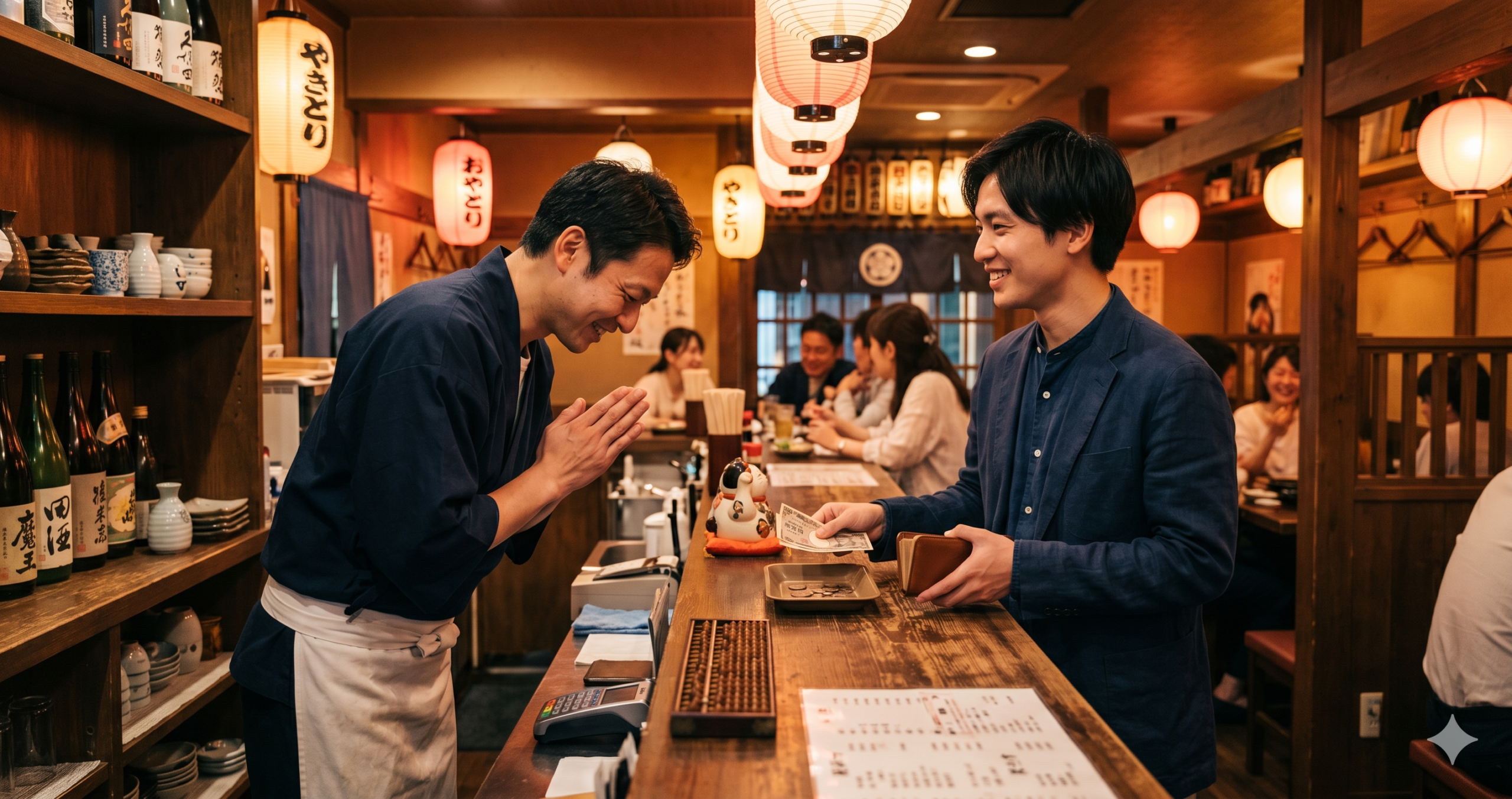
Short answer: No. Never. Japan is one of the only countries in the world where tipping is not just unnecessary — it can actually be considered rude. This surprises most Western visitors, but understanding why will help you navigate Japan like a local.
• Restaurants, cafes, bars: Never tip
• Hotels (standard): Never tip
• Taxis: Never tip
• Luxury ryokan (inn): ¥1,000–¥3,000 in an envelope, for exceptional personal service only
• Private tour guides: Optional, ¥5,000–¥10,000 for a full day
• What to do instead: Say “Gochisousama deshita” (ごちそうさまでした)
Why Tipping Is Considered Rude in Japan
✅ Updated for July 2026 — prices and product information refreshed.
In Japan, excellent service isn’t something extra — it’s expected. The concept of omotenashi (おもてなし), or wholehearted hospitality, means that service workers take pride in doing their job perfectly, regardless of financial incentive. Tipping implies that the service was somehow above and beyond what was deserved — which can feel insulting to someone who considers top-quality service a professional standard.
There’s also a practical reason: Japanese service workers receive fair wages and benefits. Unlike the US, where tipped workers can be paid less than minimum wage, Japanese staff don’t rely on tips to survive. Offering one can make them uncomfortable, as many are company-policy prohibited from accepting them — meaning they’d have to refuse, creating an awkward situation for everyone involved.
What Happens If You Try to Tip in Japan
If you leave cash on the table at a restaurant, a server will often chase you down the street to return it, assuming you forgot your change. Taxi drivers have been known to exit their vehicle to hand back “extra” money. It’s not stubbornness — it’s genuine, deeply cultural behavior.
Workers who accept tips risk getting in trouble with management. So when they politely but firmly return your money, accept it gracefully. Don’t insist.
Service Charges: When You Do Pay Extra
Japan does have service charges — but they’re set by the establishment, not optional.
| Venue Type | Service Charge | Notes |
|---|---|---|
| Casual restaurants, ramen, izakaya | None | Pay exactly what’s on the bill |
| Upscale restaurants | 10–15% added automatically | Listed on menu before you order |
| Business hotels | None | Room rate is all-inclusive |
| Luxury hotels & ryokan | 10–15% added automatically | Clearly stated at booking |
| Taxis | None | Pay the exact meter fare |
If a service charge applies, it will be clearly displayed on the menu or at the entrance — you’ll never be surprised by a hidden fee.
Tipping Guide by Venue
🍜 Restaurants & Cafes
Tip: No. Whether you’re at a conveyor belt sushi counter, a standing ramen bar, or a multi-course kaiseki dinner, no tip is expected. Pay the bill as shown. At the end of the meal, say “Gochisousama deshita” (ごちそうさまでした) — “Thank you for the meal.” This single phrase means more to Japanese service staff than any tip ever could.
🏨 Hotels
Tip: No. Hotel staff — bellhops, concierge, housekeeping — are not tipped in Japan. Many are explicitly prohibited by company policy from accepting gratuities. A smile, a thank-you in Japanese, or a positive online review mentioning their name is far more meaningful.
🏯 Ryokan (Traditional Japanese Inns)
Tip: Rarely, and only if personal service was exceptional. The one genuine exception to Japan’s no-tipping rule is the high-end ryokan, where a nakai-san (personal attendant) serves your meals and cares for your room throughout your stay.
If you’d like to show appreciation, the Japanese custom is kokorozuke (心付け) — literally “a gift from the heart.” Put ¥1,000–¥3,000 in a small envelope or folded paper, and present it to your nakai-san at the start of your stay (not the end), using both hands. Never hand over loose cash.
🚕 Taxis
Tip: No. Pay the exact meter fare. If you hand over ¥1,000 for a ¥850 ride and say “keep the change,” the driver will likely refuse and hand back your ¥150. This is normal. Just make sure you have small bills and coins ready.
🗺️ Tour Guides
Tip: Optional, and more accepted here than anywhere else. Private and group tour guides in Japan have more exposure to Western customs and generally won’t refuse a tip. For a full-day private tour, ¥5,000–¥10,000 per group (not per person) is a generous gesture. For organized tours (Trafalgar, etc.), roughly USD $5–$10 per person per day for tour managers.
Present any tip in an envelope or folded paper, privately, before you part ways.
💇 Hairdressers & Spas
Tip: No. Pay the posted price. Like restaurants, Japanese beauty and wellness professionals consider excellent service their baseline standard, not something deserving extra payment.
How to Show Appreciation in Japan (No Money Required)
Japan has its own rich vocabulary of gratitude that means far more than tipping:
- Gochisousama deshita (ごちそうさまでした) — After any meal. Essential.
- Arigatou gozaimashita (ありがとうございました) — Formal thank you for service received.
- Oishikatta desu (おいしかったです) — “That was delicious.” Use at restaurants.
- Totemo tasukatte moraimashita (とても助かってもらいました) — “You really helped me out.” Use when someone went out of their way for you.
Other genuine ways to show appreciation:
- Write a positive online review mentioning specific staff — hotels and restaurants genuinely value this
- Bring a small souvenir or local candy from your home country for ryokan or hotel staff
- Make the effort to try Japanese phrases — even broken Japanese is deeply appreciated
- Send a handwritten thank-you note for exceptional stays at a ryokan or boutique hotel
USA vs. Europe vs. Japan: Tipping Culture Compared
| Aspect | 🇺🇸 USA | 🇪🇺 Europe | 🇯🇵 Japan |
|---|---|---|---|
| Standard restaurant tip | 15–20% | 0–10%, varies | 0% — never tip |
| Taxi tip | 10–15% | Round up | Exact fare only |
| If you don’t tip | Considered rude | Usually fine | Completely normal |
| Culture view of tipping | Shows appreciation | Supplement wages | Potentially insulting |
The Bottom Line
Visiting Japan is a rare chance to experience a service culture where excellence is simply the standard — no financial coercion required. The freedom from tip math, the confidence that your server isn’t silently judging your 18% vs. 22%, and the knowledge that the cleaner who tidied your hotel room is paid fairly — it’s genuinely refreshing.
So put away the extra bills. Learn a few Japanese phrases instead. Say “gochisousama deshita” after your meals. Leave a detailed positive review. Those gestures will be remembered long after any bank note.
🗾 More Japan Life Guides
🇯🇵 Travel & Life Essentials for Japan
Hand-picked gear to make your time in Japan easier. Available on Amazon US & Amazon Japan.
🔋 Portable charger
A must for long days of sightseeing and photos.
View on Amazon (US)View on Amazon Japan🔌 Travel plug adapter
Japan uses Type A outlets. Bring the right adapter.
View on Amazon (US)View on Amazon Japan🎧 Translation earbuds
Real-time translation to talk without barriers.
View on Amazon (US)View on Amazon JapanAs an Amazon Associate, Japan Life Lab earns from qualifying purchases.
🔥 Editor’s Picks for Life & Travel in Japan
📘 The Japan Expat Starter Kit 2026
Banking, housing, My Number, taxes, 100 phrases and a 40-kanji cheat sheet — everything from this site in one 17-chapter PDF field manual. Free lifetime 2026 updates.
Reader price: $9.99 $6.99 with code JLL30 at checkout
30-day money-back guarantee · Instant download · PR
Practical guides for life and travel in Japan — free, about once a week. No spam, unsubscribe anytime.
☕ Enjoying our Japan guides?
If this article helped you, you can support our work with a coffee!
Did this guide help you? 🍵
Japan Life Lab is a small independent blog, and every guide we publish is completely free — no paywalls, ever. If our work saved you time (or a headache), you can support us with a cup of Japanese tea. Every contribution, big or small, goes straight into keeping these guides free, accurate and up to date for everyone.
☕ Support Japan Life Lab
Leave a Reply