This article was created with AI writing assistance (ChatGPT, Claude, etc.). Product selection, specifications, and reviews are verified by the Japan Life Lab editorial team.
This article contains promotional / affiliate links.
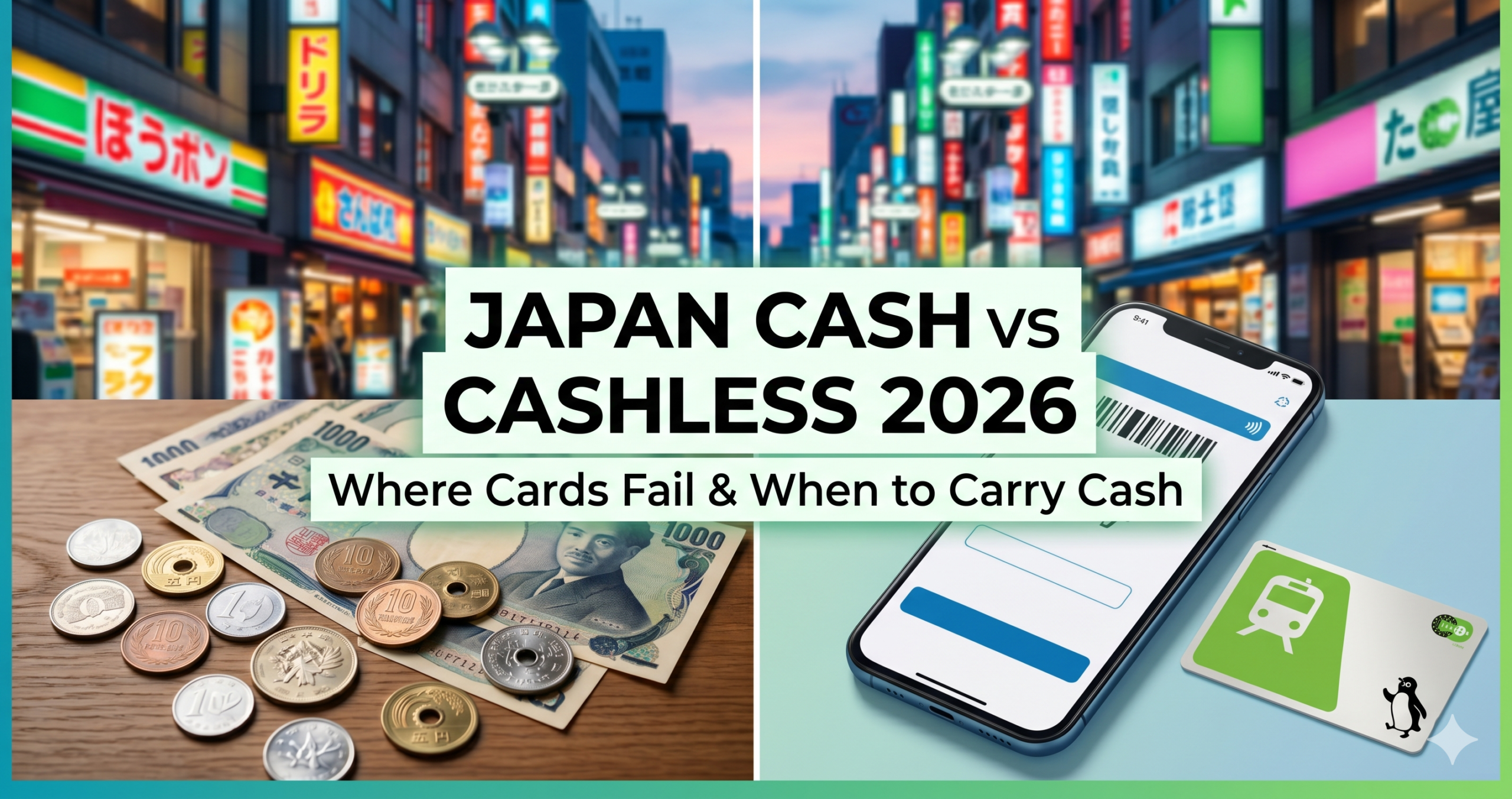
Japan is still a cash country — but only kind of. The truth is more complicated than every travel blog tells you, and getting it wrong means standing at a shrine entrance with no cash and a dying credit card machine blinking at you.
Here’s the honest answer: Japan was 42.8% cashless in 2024, and the government wants to hit 80% by 2030. That means roughly 30–40% of places you’ll visit still only take cash — especially the ones tourists love most.
• 42.8% of consumer spending was cashless in 2024 (METI official data)
• Government target: 80% cashless by 2030
• Credit cards: 82.9% of all cashless transactions
• ~30-40% of small businesses in Tokyo remain cash-only
• 20,000+ 7-Eleven ATMs open 24/7 across Japan
⏱ The short answer (30 seconds)
In a hurry? The full reasons and prices are right below.
- Welcome Suica / TOURIST PASMO (Best for Tourists)
- Credit Cards (Visa or Mastercard)
- Apple Pay / Google Pay
- PayPay (For Residents, Not Tourists)
※ If in doubt, go with #1. Budget picks are further down the page.
Where You Still Need Cash in Japan 2026
These are the places that will catch you off guard:
Temples, Shrines & Historic Sites
This is the #1 cash trap for tourists. Almost every famous temple and shrine in Japan charges cash-only admission (¥300–1,000). The goshuin stamp you want? ¥300–500, cash only. The omamori charm at Fushimi Inari? Coins. The offering box at Meiji Shrine? Coins.
Rule: Assume every temple and shrine is cash-only. Carry at least ¥5,000 when sightseeing.
Small Restaurants & Local Izakayas
That atmospheric little ramen shop down the alley with hand-written menus and no website? Cash only. Family-run izakayas, neighborhood soba restaurants, and local lunch spots frequently don’t accept cards. Even in Tokyo, about 30% of independent restaurants remain cash-only.
Coin Lockers at Stations
Storing your luggage? Station coin lockers cost ¥400–700 and accept coins only (some newer ones accept IC cards). Always carry ¥500–¥1,000 in coins for this.
Gashapon Machines
Those capsule toy machines tourists love? Strict coin-only, ¥100–500 each. Zero modernization planned.
Public Bathhouses (Sento)
Entry: ¥150–400 cash only. Locker coins required.
Rural Japan
Small-town taxis, traditional ryokan in the countryside, local pharmacies, and mountain hut accommodations are frequently cash-only. If you’re leaving major cities, carry ¥20,000–30,000 minimum.
Best Cashless Payment Methods for Foreigners
1. Welcome Suica / TOURIST PASMO (Best for Tourists)
This is your best friend in Japan. The Welcome Suica card has no deposit or card fee — you buy it loaded with ¥1,000–¥10,000 — and it is valid for 28 days (unused balance is not refunded). Load money onto it and use it for:
- All trains and subway lines across Japan
- Every convenience store (7-Eleven, FamilyMart, Lawson)
- Vending machines
- Many restaurants and supermarkets
- Taxis in major cities
No bank account required. No Japanese phone number. Available at airports and major stations. This single card eliminates most of your payment friction.
2. Credit Cards (Visa or Mastercard)
Both work equally well across Japan. American Express is limited to major urban venues (~30–40% fewer merchants). Discover and Diners Club are rarely accepted.
Most important feature to look for: Zero foreign transaction fees. A 2–3% fee on every purchase adds up fast. Cards like Chase Sapphire Preferred, Capital One Venture, or Wise card eliminate this fee entirely.
3. Apple Pay / Google Pay
If your card is registered and contactless, tap-to-pay works at most modern retailers, convenience stores, and increasingly at restaurants. Over 50% of new cards issued in Japan are contactless-enabled as of 2026. This is growing fast.
4. PayPay (For Residents, Not Tourists)
PayPay has 65 million+ users in Japan and is accepted at small restaurants that don’t take cards. But it requires a Japanese phone number and Japanese bank account or credit card. Useful for long-term residents, not practical for most tourists.
ATMs: Where to Get Cash in Japan
7-Eleven ATMs (Best Option)
Available at all 20,000+ 7-Eleven stores nationwide, open 24/7, with English interface. Accepts Visa, Mastercard, Maestro, Cirrus, JCB, UnionPay, and Discover. Fee: ¥110–220 per transaction. Withdrawal limit: ¥50,000–100,000 per transaction.
First stop after landing: 7-Eleven ATM in the airport arrivals area. Withdraw ¥30,000–40,000 for your first few days.
Japan Post Bank ATMs (Second Option)
Found in post offices and major train stations. Also accepts foreign cards with similar fees. Limited hours (closed evenings and weekends).
Regular Bank ATMs — Avoid
Standard Japanese bank ATMs (MUFG, SMBC, etc.) often reject foreign cards. Don’t waste time trying them.
Currency Exchange: Where to Get the Best Rate
| Location | Rate Quality | Notes |
|---|---|---|
| 7-Eleven ATM withdrawal | ⭐⭐⭐⭐⭐ Best | Very close to mid-market rate |
| City exchange shops | ⭐⭐⭐⭐ Good | 2–4% above mid-market |
| Airport exchange | ⭐⭐ Poor | 5–8% markup. Avoid except for small emergency amount |
| Hotel exchange | ⭐ Worst | 5–10% markup. Never use if avoidable |
Check the mid-market rate on Google before exchanging anywhere: search “[your currency] to JPY.”
How Much Cash to Carry?
| Traveler Type | Recommended Daily Cash |
|---|---|
| Budget traveler | ¥5,000–8,000/day |
| Mid-range traveler | ¥10,000–15,000/day |
| Comfortable traveler | ¥15,000–25,000/day |
Keep ¥10,000–20,000 on you at all times as a backup. Even if you plan to pay cashless, Japan’s cashless infrastructure occasionally fails at the worst times.
💸 The smart way to handle money in Japan
A Wise account gives you a multi-currency debit card with the real exchange rate and low fees — perfect for cashless payments, paying bills, and withdrawing cash in Japan as a foreigner.
The Smart Japan Money Strategy
- Arrive with ¥30,000–50,000 (or withdraw immediately from 7-Eleven ATM at airport)
- Buy a Welcome Suica card (no deposit) loaded with ¥5,000–10,000
- Use Suica for trains, convenience stores, and everyday purchases
- Use a zero-fee credit card (Visa/Mastercard) for hotels, large restaurants, and shopping malls
- Keep ¥10,000 cash in your wallet at all times for temples, small restaurants, and emergencies
- Withdraw cash every 2–3 days at 7-Eleven if needed
This approach covers 95%+ of payment situations you’ll encounter. You’ll look like a local — or at least, a well-prepared tourist.
🗾 More Japan Travel & Life Guides
🔥 Editor’s Picks for Life & Travel in Japan
Japan Expat Starter Kit 2026 PDF guide
Your first 90 days in Japan, step by step: 17 chapters · 24 pages · 100 phrases in Japanese script · 40 kanji · printable checklists. Bank account, My Number, health insurance, apartment, phone, taxes & pension.
$9.99 $4.99 current price
📥 Get the kit →📄 Read 5 pages free: contents + Chapter 2
⚡ Instant PDF download · 🛡️ 30-day money-back guarantee · 🔄 Free 2026 updates
Practical guides for life and travel in Japan — free, about once a week. No spam, unsubscribe anytime.
☕ Enjoying our Japan guides?
If this article helped you, you can support our work with a coffee!
🇯🇵 Travel & Life Essentials for Japan
Hand-picked gear to make your time in Japan easier. Available on Amazon US & Amazon Japan.
🔋 Portable charger
A must for long days of sightseeing and photos.
View on Amazon (US)View on Amazon Japan🔌 Travel plug adapter
Japan uses Type A outlets. Bring the right adapter.
View on Amazon (US)View on Amazon Japan🎧 Translation earbuds
Real-time translation to talk without barriers.
View on Amazon (US)View on Amazon JapanAs an Amazon Associate, Japan Life Lab earns from qualifying purchases.
Did this guide help you? 🍵
Japan Life Lab is a small independent blog, and every guide we publish is completely free — no paywalls, ever. If our work saved you time (or a headache), you can support us with a cup of Japanese tea. Every contribution, big or small, goes straight into keeping these guides free, accurate and up to date for everyone.
☕ Support Japan Life Lab
Leave a Reply