This article was created with AI writing assistance (ChatGPT, Claude, etc.). Product selection, specifications, and reviews are verified by the Japan Life Lab editorial team.
This article contains promotional / affiliate links.
Tax-free shopping in Japan changes on 1 November 2026
Until 31 October you show your passport at the till and simply pay without the 10% consumption tax. From 1 November you pay the full tax-included price in the shop and claim the tax back at the airport — at a customs kiosk or through Visit Japan Web — before you check in.
- The ¥5,000 minimum per shop, per day stays the same.
- The general-goods / consumables split is abolished, and so is the ¥500,000 cap on consumables.
- Sealed packaging is abolished — but consumables still have to leave Japan unused.
- Everything on the receipt has to be with you at departure. Customs can ask to see it.
Shopping before 1 November? Nothing changes for you yet.
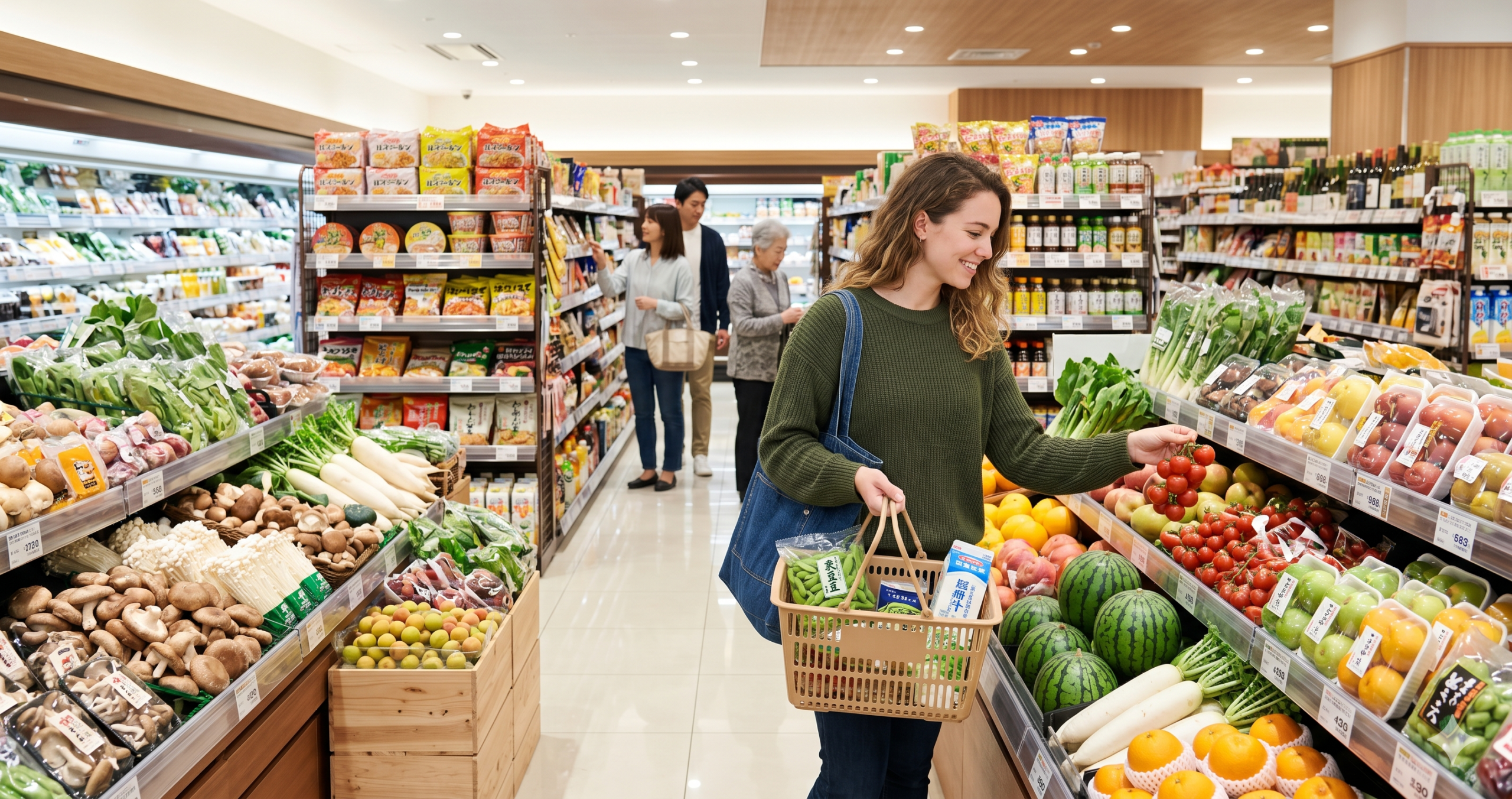
Grocery shopping in Japan as a foreigner can be either wonderfully easy or quietly baffling — depending on where you go. The good news: once you know which stores serve your needs best, it becomes one of the genuine pleasures of living in or visiting Japan.
Here’s the honest breakdown of Japan’s best supermarkets for non-Japanese speakers in 2026.
• Cheapest overall: OK Store or Gyomu Super
• Best international food selection: Seijo Ishii or National Azabu
• Most convenient nationwide: AEON
• Best for bulk + imports: Costco Japan
• Best specialty/import finds: Kaldi Coffee Farm
⏱ The short answer (30 seconds)
In a hurry? The full reasons and prices are right below.
- AEON (イオン)Best All-Rounder
- OK Store (オーケー)Tokyo’s Cheapest Option
- Gyomu Super (業務スーパー)Wholesale Prices for Everyone
- Seijo Ishii (成城石井)Premium Imported Foods
- Costco JapanFor the Bulk Buyers
- National AzabuTokyo’s Iconic Expat Store
- Kaldi Coffee Farm (カルディコーヒーファーム)
※ If in doubt, go with #1. Budget picks are further down the page.
The Best Supermarkets in Japan for Foreigners (2026)
1. AEON (イオン) — Best All-Rounder
Japan’s largest supermarket chain with 350+ stores nationwide, AEON is the default recommendation for foreigners for good reason: it has everything. You’ll find it near major train stations, airports, and shopping malls across the country.
AEON offers an excellent imported food section, tax-free shopping for non-residents (bring your passport), and ATMs that accept foreign cards. The house brand “TopValu” produces quality products at competitive prices. On the 20th and 30th of each month, AEON cardholders get 5% off — worth knowing if you’re staying longer term.
- Price: Mid-range
- International selection: Excellent
- English support: Good (multilingual signage in major locations)
- Best for: One-stop shopping with reliable quality
2. OK Store (オーケー) — Tokyo’s Cheapest Option
If you’re in the Tokyo, Kanagawa, Chiba, or Saitama area and prioritizing budget, OK Store is your answer. Prices here are consistently 20–30% lower than competitors — we’re talking lettuce for ¥200, grapefruit for ¥88, and weekly specials that are genuinely hard to beat.
The trade-off: OK Store’s English support is minimal, and the international food selection is limited compared to AEON or Seijo Ishii. But for everyday staples — rice, vegetables, tofu, eggs, dairy — it’s unbeatable on price.
- Price: Cheapest in Tokyo area
- International selection: Limited
- English support: Minimal
- Best for: Budget shopping for daily essentials
3. Gyomu Super (業務スーパー) — Wholesale Prices for Everyone
Gyomu Super (“gyomu” means “business/commercial”) passes wholesale pricing to regular customers through bulk purchasing — and it works. With 1,000+ locations nationwide, it’s one of Japan’s fastest-growing chains.
The international food section is surprisingly strong: French and Italian imported products, Southeast Asian ingredients, and over 100 halal-certified items. If you’re looking for large quantities of frozen food or imported staples at very low prices, this is your store. Just be prepared to buy a 1kg block of cheese, not a small wedge.
- Price: Very cheap
- International selection: Excellent (especially Asian and European imports)
- Halal options: 100+ certified products
- Best for: Budget shopping + international food lovers
4. Seijo Ishii (成城石井) — Premium Imported Foods
Seijo Ishii is Japan’s answer to a specialty import grocery store. Located in major train stations and upscale neighborhoods across Kanto and Kansai, it stocks European cheeses, specialty wines, imported chocolates, global condiments, and ingredients that are simply impossible to find elsewhere in Japan.
Yes, it’s expensive — but when you need quality mozzarella, a specific Spanish olive oil, or a bottle of wine that isn’t “Japanese domestic,” Seijo Ishii delivers. It also has a solid prepared food section (their sandwiches and salads are genuinely good).
- Price: Premium
- International selection: Exceptional (European focus)
- Best for: Quality imports, wine, specialty ingredients
5. Costco Japan — For the Bulk Buyers
Costco operates 30+ warehouse locations in Japan (major ones near Tokyo: Makuhari and Kawasaki). The membership system is the same as worldwide:
- Gold Star: ¥5,280/year (individual)
- Gold Star Executive: ¥10,560/year (extra benefits, usable globally)
The selection skews heavily toward American and European imports — giant blocks of cheese, quality beef, imported snacks, and American-sized portions of everything. If you miss big Western portions and shopping in English, Costco feels like a brief return to home. The rotisserie chicken is legendary among Tokyo expats.
- Price: Mid-high (membership required)
- International selection: Excellent (US/European focus)
- Best for: Households with storage space, expat comfort foods
6. National Azabu — Tokyo’s Iconic Expat Store
Located in Hiroo (near the embassy district), National Azabu has been serving Tokyo’s international community since 1962. It stocks the largest organic section in Tokyo and an extensive range of international products — but it’s expensive, and the location limits it to Tokyo residents.
Worth knowing: National Azabu has a custom nut butter station where you can grind your own almond or peanut butter fresh. A small detail that expats tend to love disproportionately.
7. Kaldi Coffee Farm (カルディコーヒーファーム)
Not a traditional supermarket, but found in most major shopping malls nationwide. Kaldi specializes in imported specialty items: pasta, European sauces, Middle Eastern spices, Southeast Asian ingredients, plus their famous rotating import selection. The coffee range is particularly good. Check it when you need a specific international ingredient and can’t find it elsewhere.
Key Japanese Supermarket Concepts for Foreigners
Two Types of Expiration Dates (Critical)
Understanding these two labels will save you from throwing away perfectly good food — or eating something you shouldn’t:
- 賞味期限 (Shoumikigen) — Best-Before Date: Used on shelf-stable items (snacks, sauces, instant noodles, frozen food). The product is at its best quality before this date, but is often still safe and edible after it. You’ll see this on most packaged goods.
- 消費期限 (Shouhikigen) — Use-By Date: Used on highly perishable items (fresh meat, fish, prepared bento, dairy, raw seafood). Do not eat after this date. This is the safety cutoff.
Stores often mark down items approaching their Shoumikigen date — these are perfectly fine to buy.
The Bagging System
One thing that surprises most foreign visitors: in Japan, the cashier scans your items and takes payment, but you bag your own groceries at a separate packing table (袋詰め台, fukurozumeidai) near the exit. Don’t try to bag at the checkout counter — it slows everything down and creates confusion.
Bring Your Own Bag
Since 2020, plastic bags are charged at ¥3–¥10 each. Bring a reusable bag (エコバッグ, eco bag). If you need one, say “Rejibukuro, hitotsu kudasai” (レジ袋、一つください) — “One shopping bag, please.”
Point Cards Worth Getting
Japan’s point card culture is real and worth engaging with:
- WAON Card (AEON): Used across AEON, Mini Stop, and affiliated stores. Points valid 2 years. 5% discount on 20th/30th at AEON supermarkets.
- Ponta / dPoint: Accepted at multiple chains, linked to Lawson, various apps.
- Most stores have their own app-based point system — worth downloading for regular stores.
Discount Hours for Prepared Food
Japanese supermarkets mark down prepared food (bento, sushi, deli items) heavily in the evenings — typically from 7–9 PM. If you’re comfortable eating supermarket meals, shopping in the evening gets you 30–50% off perfectly good food.
Quick Comparison: Which Store Is Right for You?
| Store | Price | International | English | Best For |
|---|---|---|---|---|
| AEON | Mid | Excellent | Good | All-around shopping |
| OK Store | Cheapest | Limited | Minimal | Budget daily shopping |
| Gyomu Super | Very cheap | Excellent | Minimal | Budget + international |
| Seijo Ishii | Premium | Exceptional | Good | Quality European imports |
| Costco Japan | Mid-High | Excellent | Good | Bulk US/EU products |
| National Azabu | Premium | Excellent | Excellent | Organic + premium |
| Kaldi | Mid-High | Excellent | Good | Specialty finds |
🗾 More Japan Living Guides
🇯🇵 Travel & Life Essentials for Japan
Hand-picked gear to make your time in Japan easier. Available on Amazon US & Amazon Japan.
🔋 Portable charger
A must for long days of sightseeing and photos.
View on Amazon (US)View on Amazon Japan🔌 Travel plug adapter
Japan uses Type A outlets. Bring the right adapter.
View on Amazon (US)View on Amazon Japan🎧 Translation earbuds
Real-time translation to talk without barriers.
View on Amazon (US)View on Amazon JapanAs an Amazon Associate, Japan Life Lab earns from qualifying purchases.
🔥 Editor’s Picks for Life & Travel in Japan
📘 The Japan Expat Starter Kit 2026
Banking, housing, My Number, taxes, 100 phrases and a 40-kanji cheat sheet — everything from this site in one 17-chapter PDF field manual. Free lifetime 2026 updates.
Reader price: $9.99 $6.99 with code JLL30 at checkout
30-day money-back guarantee · Instant download · PR
🛒 Ready to Buy? Shop These in Japan!
Get fast delivery across Japan — including same-day in major cities
Practical guides for life and travel in Japan — free, about once a week. No spam, unsubscribe anytime.
☕ Enjoying our Japan guides?
If this article helped you, you can support our work with a coffee!
Leave a Reply