Author: Miyabi

  • ElevenLabs Review 2026: Best AI Voice Generator? (We Tested Every Plan)

    ElevenLabs Review 2026: Best AI Voice Generator? (We Tested Every Plan)

    🤖 AI Tool Review — Pricing Verified May 2026

    AI tool pricing and features change frequently. This review was verified in May 2026. Always check the official website for current pricing before subscribing — many AI tools offer free tiers or discounts not available when this review was written.

    🎙️ LIMITED OFFER: Get ElevenLabs Creator Plan at 50% OFF — First month just $11 (usually $22)!
    → Claim your discount here

    If you’ve ever needed a realistic voiceover, a podcast intro, or a dubbed video — you know how expensive and slow it can be to hire voice actors. ElevenLabs changes all of that. It’s the world’s most advanced AI voice generator, used by over 1 million creators, publishers, and studios worldwide.

    In this review, we cover everything you need to know: how ElevenLabs works, its key features, honest pros and cons, real pricing breakdown, and whether it’s worth subscribing in 2026.

    ⚡ TL;DR — Is ElevenLabs Worth It?
    Yes — if you need high-quality AI voiceovers, ElevenLabs is the clear industry leader. The Creator plan ($22/mo) is the sweet spot for most users: 100,000 credits/month, commercial rights, and access to 3,000+ voices. Start with the free plan to test, then upgrade when you’re ready.

    What is ElevenLabs?

    ElevenLabs is an AI audio platform founded in 2022 that uses deep learning to generate human-quality speech. Unlike older text-to-speech tools that sound robotic, ElevenLabs captures natural intonation, emotion, and pacing. It’s become the go-to choice for:

    • YouTubers and content creators needing professional voiceovers
    • Publishers creating audiobooks and podcasts
    • Businesses adding voice to apps and websites
    • Video creators dubbing content into multiple languages
    • Developers building voice-enabled AI applications

    Key Features

    🎙️ 1. Ultra-Realistic Voice Generation

    ElevenLabs’ core feature is its text-to-speech engine, which produces voices so natural they’re nearly indistinguishable from real humans. You get access to a library of 3,000+ pre-made voices across 32 languages, with control over:

    • Stability (consistency of voice)
    • Similarity boost (how closely the AI matches the source)
    • Style exaggeration (emotion intensity)
    • Speaker boost (clarity enhancement)

    The voices range from warm and friendly to authoritative and dramatic — perfect for any content type.

    Best for: Podcasters, YouTubers, e-learning creators, and anyone needing professional narration without hiring voice actors.

    🧬 2. Voice Cloning (Instant & Professional)

    One of ElevenLabs’ most powerful features is voice cloning. Upload just 1 minute of audio and ElevenLabs creates a digital clone of any voice. There are two types:

    • Instant Voice Cloning — Available from the Starter plan. Upload a sample, get a clone in seconds. Great for consistent branding across videos.
    • Professional Voice Cloning — Available on Creator plan+. Uses 30+ minutes of studio audio for near-perfect replication. Used by major publishers for audiobooks.

    Clone your own voice to scale content production, or create a consistent brand voice across all your media.

    Best for: Brands, influencers, and audiobook publishers who need consistent voice identity at scale.

    🌍 3. AI Dubbing — Translate Videos in 32 Languages

    ElevenLabs’ AI Dubbing feature lets you translate and dub video content into 32 languages while preserving the original speaker’s voice and emotional tone. This is a game-changer for:

    • YouTubers expanding to international audiences
    • Businesses localizing marketing videos
    • Course creators making multilingual e-learning
    • News publishers distributing content globally

    Unlike traditional dubbing (which costs thousands of dollars), ElevenLabs does it in minutes, maintaining the original speaker’s voice characteristics across languages.

    Best for: Content creators going global, international marketers, and multilingual educators.

    🔊 4. AI Sound Effects Generator

    New in 2025, ElevenLabs added a text-to-sound-effect generator. Simply describe a sound and it generates it instantly. Examples:

    • “Heavy rain on a tin roof with distant thunder” → generates the exact sound
    • “Sci-fi laser blaster powering up” → instant game-ready SFX
    • “Coffee shop background ambiance with gentle chatter” → perfect background audio

    This eliminates the need for expensive sound libraries. Creators can generate unlimited custom SFX directly from text descriptions.

    Best for: Game developers, video editors, podcasters, and filmmakers needing custom sound design.

    🤖 5. Conversational AI & Voice Agents

    ElevenLabs now offers Conversational AI — the ability to build voice-enabled AI agents that can talk with users in real-time. This opens up use cases like:

    • AI customer support with natural voice interaction
    • Interactive voice assistants for apps
    • Educational tutors that speak to students
    • Accessible interfaces for visually impaired users

    Developers can use the ElevenLabs API to integrate conversational voice AI into any product with low latency and high naturalness.

    Best for: SaaS developers, app builders, and businesses wanting to add voice AI to their products.

    ElevenLabs Pricing (2026)

    🎉 Special Offer: Creator Plan 50% OFF for the First Month — Pay $11 instead of $22!
    Claim this deal →
    Plan Price Credits/Month Key Features
    Free $0 10,000 10 voices, basic voice generation, watermark-free for personal use
    Starter $5/mo 30,000 Instant voice cloning, 30 voices, commercial license
    Creator ⭐ BEST VALUE
    First month 50% OFF = $11!
    $22
    $11 first month!
    100,000 Professional voice cloning, 3,000+ voices, audio dubbing, sound effects, commercial license
    Pro $99/mo 500,000 High-volume production, priority support, advanced analytics
    Scale $330/mo 2,000,000 3 team seats, enterprise features, priority queue
    Business $1,320/mo 11,000,000 Volume discounts, dedicated support, custom agreements, unlimited seats

    Note: 1 credit ≈ 1 character of text. The Creator plan’s 100,000 credits equals roughly 70,000–80,000 words of narration — more than enough for most content creators.

    Which Plan Should You Choose?

    • 🆓 Free — Testing the platform, personal projects only (no commercial use)
    • 💼 Starter ($5) — Occasional voiceovers for social media, YouTube intros, small projects with commercial rights
    • Creator ($22 → $11 first month!)Most popular. Full-time content creators, podcasters, YouTubers who need high-quality voice regularly
    • 🚀 Pro ($99) — Agencies, studios, heavy-volume users producing multiple videos/podcasts per week
    • 🏢 Scale/Business — Enterprise teams, SaaS companies, publishers with massive content operations

    ElevenLabs Pros and Cons

    ✅ Pros

    • Most natural-sounding AI voices available
    • 3,000+ voice library in 32 languages
    • Voice cloning from just 1 minute of audio
    • AI Dubbing preserves original voice
    • Sound effects generator from text
    • API access for developers
    • Commercial license from Starter plan
    • Free plan available to test first

    ❌ Cons

    • Credit-based system can deplete quickly for heavy users
    • Professional voice cloning needs 30+ min of audio
    • Pro plan ($99) is a big jump from Creator
    • Some voices can sound slightly unnatural on complex text
    • Dubbing quality varies by language

    What Real Users Say

    “I used to spend $300/month on voice actors. With ElevenLabs Creator plan at $22, I produce the same quality content. The ROI is insane.”

    — Alex M., YouTube Content Creator (250K subscribers)

    “The voice cloning feature is unbelievable. I uploaded 2 minutes of my own voice and now I can produce entire audiobooks in my voice without recording a word.”

    — Sarah K., Self-Published Author

    “We use ElevenLabs API to power our customer service voice bot. Response latency is under 500ms and callers genuinely can’t tell it’s AI.”

    — David L., SaaS Startup CTO

    🌟 Trusted by 1 Million+ Creators & Enterprises Worldwide

    Partners include major publishers, gaming studios, global news networks, and Fortune 500 companies

    Is ElevenLabs Worth It in 2026?

    Absolutely yes — for anyone who needs consistent, professional-quality voice content. The free plan is a genuine starting point (no credit card required), and the Creator plan at $22/month (or just $11 for your first month with the current promotion) delivers exceptional value compared to hiring voice actors.

    Whether you’re a solo YouTuber, a podcast producer, an e-learning creator, or a developer building voice apps, ElevenLabs is the clear leader in AI voice technology. The combination of natural-sounding voices, voice cloning, multilingual dubbing, and sound effects in one platform is unmatched.

    🎙️ Ready to Start with ElevenLabs?

    Start free (no credit card needed), or grab the Creator plan at 50% OFF for your first month!

    🆓 Try ElevenLabs Free ⚡ Get Creator 50% OFF →

    ElevenLabs FAQ

    Q: Is ElevenLabs free to use?
    Yes! The free plan includes 10,000 credits per month with access to basic voices. No credit card required. It’s enough for short voiceovers and testing the platform.
    Q: How many words does 10,000 credits cover?
    Since 1 credit ≈ 1 character, 10,000 credits covers approximately 7,000–8,000 words. The Creator plan’s 100,000 credits gives you roughly 70,000–80,000 words — about the length of a novel.
    Q: Can I use ElevenLabs voice for commercial projects?
    Yes, all paid plans (Starter and above) include a commercial license, meaning you can monetize content created with ElevenLabs voices on YouTube, podcasts, and other platforms.
    Q: How accurate is the voice cloning?
    Instant Voice Cloning (from 1 min of audio) is impressive for most use cases. Professional Voice Cloning (30+ min of high-quality audio) achieves near-perfect replication used in audiobook production.
    Q: Does ElevenLabs support Japanese?
    Yes! ElevenLabs supports Japanese among its 32 languages. This makes it excellent for creators in Japan or those targeting Japanese-speaking audiences.
  • Synthesia Review 2026: Create AI Avatar Videos Without a Camera (Honest Test)

    Synthesia Review 2026: Create AI Avatar Videos Without a Camera (Honest Test)

    Looking for an honest Synthesia review? I’ve tested dozens of AI video tools — here’s what you need to know before buying.

    ⚡ Quick Verdict: Synthesia is the #1 AI avatar video generator for businesses. Text-to-video in minutes, 125+ avatars, 120+ languages. Try Synthesia Free →

    What Is Synthesia?

    Synthesia is a cloud-based AI video platform that converts text scripts into professional videos with realistic AI avatars. Founded in London in 2017, it’s used by 50,000+ companies including IBM and BBC. Write a script, pick an avatar, and get a polished video in minutes — no camera, microphone, or editing needed.

    For Japan-based users and expats, Synthesia’s 120+ language support is especially powerful for multilingual training videos and marketing content without hiring voice actors.

    Key Features

    125+ AI Avatars

    Choose from 125+ diverse avatars covering ages, ethnicities, and professional styles. Enterprise users can create custom avatars with their own face.

    FeatureDetails
    Standard Avatars125+ included
    Languages120+
    Custom AvatarEnterprise only
    Voice CloningEnterprise only

    Text-to-Video in Minutes

    Paste your script, select an avatar and template, hit generate. Most videos are ready in 2–5 minutes. 200+ professional templates available, all customizable with your brand colors and logo.

    120+ Language Support

    Create one video and instantly produce versions in English, Japanese, Spanish, French, and 116+ more languages. Ideal for global companies targeting Japanese or international markets.

    Pricing

    PlanPriceVideos/Month
    Free$03 (watermark)
    PersonalFrom $29/mo10
    BusinessFrom $89/moUnlimited
    EnterpriseCustomUnlimited

    Pros & Cons

    ✅ Pros❌ Cons
    No camera or mic neededFree plan has watermark + 3 video limit
    125+ diverse avatarsCustom avatars only on Enterprise
    120+ languagesUSD pricing only
    No credit card for free trialTeam features need Business plan+

    Comparison

    ToolAvatarsLanguagesPrice
    Synthesia125+120+$29/mo
    HeyGen100+40+$29/mo
    D-IDPhoto100+$5.9/mo
    Colossyan30+70+$27/mo

    Final Verdict

    Synthesia is the most polished AI video platform in 2026. For businesses and educators needing professional video at scale without a production team, it pays for itself fast. Start free — no credit card required.

    🎬 Try Synthesia Free

    No credit card required. Create your first AI avatar video today.

    Try Synthesia Free →

    Related Articles

  • Japanese Driver’s License for Foreigners 2026: Convert Yours in 5 Steps

    Japanese Driver’s License for Foreigners 2026: Convert Yours in 5 Steps

    Do You Need a Japanese Driver’s License?

    If you are living in Japan long-term, you will likely want a Japanese driver’s license. While international driving permits (IDP) allow short-term visitors to drive in Japan, they are only valid for up to one year from your entry date — and only for those visiting on a tourist visa. Once you are a resident, you need a Japanese license to drive legally.

    The process depends heavily on your home country. Some countries have a license conversion agreement with Japan, making the switch straightforward. Others require written and practical tests. This guide covers both paths in detail.

    International Driving Permit vs. Japanese License

    International Driving Permit (IDP)Japanese Driver’s License
    Who can use itShort-term visitors (tourist visa)Residents of Japan
    ValidityUp to 1 year from entryRenewable (3–5 years per renewal)
    Where to get itIn your home country before arrivalAt a Japanese license center (運転免許センター)
    Cost¥1,000–¥3,000 equivalent¥30,000–¥100,000+ depending on process
    Accepts foreign license?Yes, paired with your licenseMust convert or take tests

    Path 1: License Conversion (Gaimen Kirikae) — 外免切替

    If you hold a valid driver’s license from a country that has a mutual recognition agreement with Japan, you can convert your foreign license to a Japanese one through a process called Gaimen Kirikae (外免切替). This is the easiest route.

    Countries with Easy Conversion (Written Test Waived)

    Citizens from the following countries can convert without taking a written exam — just a simple eyesight check and a brief practical confirmation:

    • United Kingdom, Ireland, Germany, France, Switzerland, Belgium, Taiwan, South Korea, Australia, New Zealand, Canada, and most EU member states.

    Countries Requiring a Written Test

    If your home country is not on the above list (e.g., USA, China, Philippines, Brazil, India), you will need to pass a written knowledge test in addition to the practical check. The written test is available in English, Chinese, Portuguese, and several other languages.

    Required Documents for Conversion

    • Your valid foreign driver’s license (original)
    • Official Japanese translation of your license (from JAF — Japan Automobile Federation)
    • Your passport (showing entry stamps to prove the license was obtained before coming to Japan)
    • Residence card (在留カード, Zairyu Card)
    • One passport-size photo (3cm × 2.4cm)
    • Application fee (approximately ¥3,000–¥4,000)

    How to Get a JAF Translation

    JAF (Japan Automobile Federation) is the only officially recognized organization for translating foreign driver’s licenses into Japanese. Submit your foreign license at any JAF office or by mail. The translation typically costs ¥3,000 and takes about one week by mail, or same-day if done in person at a JAF branch.

    Step-by-Step: License Conversion Process

    1. Get your JAF translation — Apply online at jaf.or.jp or visit your nearest JAF office.
    2. Gather all required documents — License, passport, translation, residence card, photo, and fee.
    3. Visit your prefecture’s license center — Each prefecture has at least one driver’s license center (運転免許センター). Some allow walk-ins; others require appointments. Check your local center’s website.
    4. Submit your documents and pass the eyesight test — Standard vision check (0.7 in both eyes with glasses allowed).
    5. Take the written test if required — 10 true/false questions about Japanese traffic rules. Must score 7/10 to pass.
    6. Take the practical driving check — A brief test at the license center’s course (not a full road test). You demonstrate basic maneuvers like starting, turning, and stopping.
    7. Receive your Japanese license — Usually issued the same day or next business day.

    Path 2: Obtaining a Japanese License from Scratch

    If you do not hold a foreign license, or your home country’s license is not recognized, you will need to obtain a Japanese license from scratch. This is more involved but very doable.

    Option A: Driving School (教習所, Kyoshujo) — Recommended

    Most people in Japan obtain their license through a certified driving school. The school handles all the instruction, in-car training, and mock tests. At the end, you only need to take the final license center exam (which has a very high pass rate for driving school graduates — over 95%).

    License TypeDriving School CostDuration
    Standard AT (Automatic)¥250,000–¥350,0001–3 months
    Standard MT (Manual)¥280,000–¥380,0001–3 months
    Accelerated Course (合宿免許)¥150,000–¥250,0002 weeks (intensive)

    Tip: The gasshuku (合宿免許) intensive residential course is far cheaper and faster. You stay at a hotel or dormitory near a rural driving school for 2 weeks and complete everything in one go. Great for those who can take time off.

    Option B: Direct Test at License Center (一発試験)

    You can attempt to pass the license exams at the license center without attending driving school. This is called a ipppatsu shiken (一発試験). It is much cheaper, but the pass rate is very low — typically under 10% on the first attempt. Multiple attempts are usually needed. This route is generally only recommended for experienced drivers.

    Tips for Expats Getting a Japanese License

    • Book your JAF translation early — Processing times can vary, especially during busy seasons.
    • Check your prefecture’s license center hours — Most centers are only open weekdays, and some are closed on the 2nd and 4th Monday of the month.
    • Bring extra passport photos — Centers may require specific sizes; bring a few extras to be safe.
    • Study Japanese traffic rules in English — Even if you are exempt from the written test, basic knowledge of Japanese traffic signs and rules will help on the practical check.
    • Renew your license on time — Japanese licenses expire every 3–5 years. First-time holders get a 3-year license; experienced drivers get up to 5 years.

    Frequently Asked Questions

    Can I drive in Japan with a US driver’s license?

    No. Unlike in some countries, the USA does not have a mutual recognition agreement with Japan. US license holders must go through the Gaimen Kirikae process including a written test. Your US license plus an International Driving Permit can be used for up to one year if you are visiting on a tourist visa, but not for residents.

    How long does the conversion process take?

    For countries with easy conversion, the process at the license center typically takes one full day. Add about one week for the JAF translation. Plan for 2–3 weeks total from start to finish.

    Do I need to speak Japanese for the license test?

    The written test is available in English and several other languages. However, the practical test instructions may be given in Japanese — learn basic commands like “stop” (止まれ, tomare), “turn right” (右折, usetsu), and “turn left” (左折, sasetsu).

    What if my foreign license has expired?

    An expired foreign license cannot be used for the Gaimen Kirikae conversion. You will need to renew it in your home country first, or obtain a Japanese license from scratch through driving school.

    Where are the license centers in major cities?

    • Tokyo: Fuchu, Samezu, Koto (multiple centers)
    • Osaka: Kadoma, Namba, Hikone
    • Nagoya: Inuyama
    • Fukuoka: Chikushino
    • Sapporo: Shinoro

    Summary

    Getting a Japanese driver’s license as a foreigner is very manageable once you understand the process. If you are from a country with mutual recognition, the conversion (Gaimen Kirikae) is quick and straightforward — usually done in one day at the license center. If you need to take tests, allow more time and consider studying Japanese traffic rules in advance. And if you are starting from scratch, a driving school is the most reliable path to a Japanese license.

  • Japan Rail Pass 2026: Is It Worth It? (We Did the Math for You)

    Japan Rail Pass 2026: Is It Worth It? (We Did the Math for You)

    What Is the Japan Rail Pass?

    The Japan Rail Pass (JR Pass) is an unlimited travel pass for foreign tourists visiting Japan. It covers most JR (Japan Railways) trains nationwide, including the iconic Shinkansen bullet trains, local JR lines, some JR buses, and even the JR Ferry to Miyajima. For travelers planning to visit multiple cities, it can save you a significant amount of money compared to buying individual tickets.

    However, the JR Pass is not always the best option. Depending on your itinerary, a combination of regional passes or IC card payments may actually be cheaper. In this guide, we break down everything you need to know to decide if the JR Pass is right for your trip in 2026.

    Types of Japan Rail Pass

    1. Nationwide JR Pass

    The most popular option for travelers seeing multiple regions of Japan. The nationwide pass covers JR trains across the entire country, including Shinkansen (except Nozomi and Mizuho on Tokaido/Sanyo lines), JR buses, and some JR ferries.

    DurationOrdinary (Adult)Green Car (Adult)Child (6–11)
    7 Days¥50,000¥70,000¥25,000
    14 Days¥80,000¥110,000¥40,000
    21 Days¥100,000¥140,000¥50,000

    Note: Prices as of 2026. The JR Pass cannot be used on Nozomi or Mizuho Shinkansen — you must take the Hikari or Sakura instead, which are slightly slower but still very fast.

    2. Regional JR Passes

    If you are focusing on one area of Japan, a regional pass offers better value. Popular regional passes include:

    • JR East Pass (Tohoku area) — Great for Tokyo, Nikko, and Tohoku region trips.
    • Kansai Area Pass — Covers Osaka, Kyoto, Nara, and Kobe.
    • JR West Sanyo-San’in Area Pass — Ideal for Hiroshima, Miyajima, and western Honshu.
    • Kyushu Rail Pass — Perfect for exploring Fukuoka, Nagasaki, and Kagoshima.
    • Hokkaido Rail Pass — For Sapporo, Hakodate, and Hokkaido adventures.

    Is the JR Pass Worth It? Cost Comparison

    The best way to know if the JR Pass is worth it is to add up the cost of your planned rail journeys. Here are some popular routes and their standard single-trip prices:

    RouteSingle Ticket (one way)Round Trip
    Tokyo → Kyoto (Hikari Shinkansen)¥13,920¥27,840
    Kyoto → Hiroshima¥10,560¥21,120
    Hiroshima → Fukuoka (Hakata)¥5,940¥11,880
    Tokyo → Osaka (Hikari)¥14,720¥29,440
    Tokyo → Sapporo (Hokkaido Shinkansen)¥22,690¥45,380

    Example: If you plan to travel Tokyo → Kyoto → Hiroshima → Fukuoka and back to Tokyo, your total without a pass would be around ¥70,000–¥80,000 — which already exceeds the 7-day JR Pass price of ¥50,000. In this case, the pass is absolutely worth it.

    On the other hand, if you are staying in only one city (like only Tokyo or only Osaka), the JR Pass is unlikely to be cost-effective. Use an IC card like Suica instead.

    How to Buy the Japan Rail Pass

    Option 1: Buy Online Before Your Trip (Recommended)

    The easiest and most cost-effective method is to purchase your JR Pass online before leaving your home country. You will receive an Exchange Order or a physical pass by mail, which you then activate at a JR ticket office upon arrival in Japan.

    Official and authorized sellers include:

    • JR Pass Official Website (japanrailpass.net)
    • Japan Experience (japan-experience.com)
    • Klook and KKday (often offer discounts)

    Option 2: Buy in Japan

    Since 2023, it is possible to purchase the JR Pass at major JR ticket offices inside Japan (Narita Airport, Haneda Airport, Tokyo Station, Shin-Osaka, etc.). However, the price is the same as online, and the convenience of having it ready before you land makes the online route preferable for most travelers.

    How to Activate and Use Your JR Pass

    Step 1: Activation at a JR Ticket Office

    Upon arriving in Japan, bring your Exchange Order and passport to any major JR ticket office (Midori no Madoguchi). Tell the staff your desired activation date — you can start it up to 30 days after purchase, so plan wisely. They will hand you the actual JR Pass card.

    Step 2: Passing Through the Gates

    Do not use the automatic IC card gates. Instead, always use the staffed gate (有人改札, yūjin kaisatsu) and show your pass to the station staff. They will wave you through after checking the expiry date.

    Step 3: Reserving Shinkansen Seats

    Most Shinkansen trains offer both reserved and unreserved cars. With the JR Pass, you can ride unreserved cars for free, or make free seat reservations at a JR ticket office or at a green ticket machine (みどりの券売機). During peak seasons (Golden Week, Obon, New Year), it is strongly recommended to reserve your seats in advance.

    Top 5 Routes to Use with Your JR Pass

    1. The Classic Golden Route: Tokyo → Kyoto → Osaka

    The most popular itinerary in Japan. Tokyo to Kyoto takes about 2 hours 15 minutes on the Hikari Shinkansen. Add Nara and Hiroshima as day trips, and you have a fantastic 7-day trip fully covered by the JR Pass.

    2. Tokyo to Hiroshima and Miyajima

    Travel from Tokyo to Hiroshima (about 4 hours on Hikari), then take the JR Sanyo Line to Miyajimaguchi and the JR Ferry to Miyajima Island. The floating torii gate of Itsukushima Shrine is a must-see, and the JR Ferry is included in your pass.

    3. Osaka to Kyushu: Fukuoka, Nagasaki, Kumamoto

    From Osaka or Hiroshima, the Shinkansen takes you to Hakata Station in Fukuoka. From there, explore Nagasaki (by JR Nagasaki Line), Kumamoto, and Kagoshima with the Kyushu Shinkansen — all included in the nationwide JR Pass.

    4. Tokyo to Hokkaido via Hokkaido Shinkansen

    Since 2016, the Hokkaido Shinkansen connects Shin-Hakodate-Hokuto to the main Tohoku Shinkansen network. Travel from Tokyo to Hakodate in about 4 hours. Note: Sapporo is only accessible by limited express train from Hakodate (about 3.5 hours), also covered by the JR Pass.

    5. The Scenic Sanin Coast and San’in Loop

    A lesser-known gem: travel through Tottori (sand dunes), Matsue (castle town), and Izumo (one of Japan’s oldest shrines) along the scenic San’in coast. All reachable by JR trains and ideal for off-the-beaten-path explorers.

    JR Pass Tips and Frequently Asked Questions

    Can I use the JR Pass on the Tokyo Metro or Osaka Subway?

    No. The JR Pass only covers JR-operated trains. Tokyo Metro, Toei Subway, Osaka Metro, and other private rail lines are not included. Use an IC card (Suica or ICOCA) for these.

    Can I use the JR Pass on the Nozomi or Mizuho Shinkansen?

    No. The fastest Shinkansen trains — Nozomi (on Tokaido/Sanyo line) and Mizuho — are not covered. Take the Hikari or Sakura instead, which are only slightly slower.

    Can I use the JR Pass on airport trains?

    Partially. The JR Narita Express (N’EX) from Narita Airport to Tokyo is fully covered. However, Haneda Airport’s Tokyo Monorail is also JR-operated and covered. The Kansai Airport Haruka express to Kyoto and Osaka is also included for JR Pass holders.

    Is the JR Pass available for expats living in Japan?

    Unfortunately, no. The JR Pass is only available to foreign tourists visiting Japan on a “Temporary Visitor” visa stamp. If you are living in Japan on a work, student, or residence visa, you are not eligible. Consider regional passes or standard rail pricing instead.

    What happens if I lose my JR Pass?

    Lost passes cannot be replaced or refunded. Keep your pass in a safe place, and consider photographing the pass details as a backup record.

    Summary: Should You Buy the JR Pass in 2026?

    The JR Pass is an excellent investment if your trip covers multiple regions — especially if you plan to ride the Shinkansen between major cities. For a classic 7-day Tokyo-Kyoto-Hiroshima itinerary, the pass pays for itself easily. For single-city trips or short urban stays, skip it and use an IC card instead.

    Plan your route first, add up the individual ticket prices, and compare. If the total exceeds ¥50,000, the 7-day pass is your best bet. Happy travels in Japan!

    📶 Need mobile data in Japan?

    Get an eSIM and stay connected the moment you land — no SIM swapping, instant activation, covers Japan & 100+ countries.

    Get a Japan eSIM →
  • Best Robot Vacuums in Japan 2026: Roborock vs Dyson vs Ecovacs (Tested in Japanese Apartments)

    Best Robot Vacuums in Japan 2026: Roborock vs Dyson vs Ecovacs (Tested in Japanese Apartments)

    Robot vacuums have become essential home appliances in Japan, particularly for the compact apartments common in Tokyo, Osaka, and other major cities. In a country where floor cleanliness is culturally significant — shoes are removed at the entrance, tatami mats require gentle care — a quality robot vacuum is more than a convenience, it’s a practical necessity for busy residents and expats alike.

    We’ve researched and compared the top robot vacuums available in Japan in 2026, from affordable entry-level models to premium all-in-one cleaning stations. Whether you’re in a studio apartment in Shinjuku or a family home in the suburbs, there’s a perfect robot vacuum for your space.

    What to Consider When Buying a Robot Vacuum in Japan

    1. Apartment Size & Layout

    Most urban apartments in Japan range from 20-60 sqm. Compact robot vacuums with good navigation algorithms handle these spaces efficiently. For larger homes with multiple rooms, look for models with advanced mapping and room-by-room scheduling.

    2. Tatami & Flooring Compatibility

    Many Japanese homes have tatami mats, which require gentle suction to avoid damage. Look for models with adjustable suction power and soft brushes. Some high-end models have specific tatami-safe modes.

    3. Japanese Language App Support

    Most robot vacuums sold in Japan have Japanese-language apps and voice control compatibility with Amazon Alexa Japan and Google Assistant Japanese. If you prefer English, check whether the companion app offers English language settings.

    4. Auto Empty & Mopping

    The latest robot vacuums combine vacuuming and mopping — perfect for Japan’s frequent cooking (lots of fine particles from rice cooking) and humid climate that attracts dust. Auto-empty bases reduce maintenance to once a month or less.

    5. Noise Level

    Apartment walls in Japan can be thin. Check the robot vacuum’s noise rating — ideally under 65 dB — and schedule cleaning during daytime hours to be considerate of neighbors.

    Top 5 Best Robot Vacuums in Japan 2026

    1. Roborock S8 MaxV Ultra — Best Premium All-in-One

    The Roborock S8 MaxV Ultra is the most advanced robot vacuum available in Japan in 2026, combining powerful vacuuming, precision mopping, and a fully automated base station that empties dust, refills mop water, and washes and dries the mop pads automatically. It’s the ultimate set-and-forget cleaning solution for busy Tokyo professionals.

    The 10,000Pa suction power handles everything from fine rice particles to pet hair on tatami-friendly floors. The ReactiveAI 3.0 obstacle avoidance uses a camera and AI to identify and avoid obstacles — socks, cables, chopsticks — with impressive accuracy. The 3D structured light mapping creates precise floor plans with furniture recognition.

    The companion app (available in English and Japanese) allows room-by-room scheduling, virtual no-go zones (perfect for protecting delicate tatami areas), and customizable suction levels per room.

    SpecDetails
    Suction Power10,000 Pa
    MoppingSonic vibration mop, auto-wash & dry
    Battery5,200 mAh (~3 hours runtime)
    Noise Level~65 dB (max suction)
    Price (Japan)~¥130,000 / ~$900 USD

    ✅ Pros: Best-in-class suction, auto-empty + auto-mop wash, excellent AI obstacle avoidance, precise mapping
    ❌ Cons: Premium price, large base station footprint, occasional app connectivity issues

    🛒 Where to Buy Roborock S8 MaxV Ultra in Japan

    Buy on Amazon Japan | Buy on Amazon.com

    2. Ecovacs Deebot X2 Omni — Best for Square/Modern Apartments

    The Ecovacs Deebot X2 Omni stands out with its unique square body design — an innovation that allows it to clean corners more effectively than traditional circular robot vacuums. This makes it particularly well-suited to the angular layouts of modern Japanese apartments and condos.

    With 8,000Pa suction, AIVI 3D obstacle detection, and TrueMapping LiDAR navigation, the X2 Omni creates accurate floor maps and navigates complex furniture arrangements with ease. The all-in-one OMNI station handles auto-empty, auto-wash, hot air drying, and auto-refill — minimizing maintenance to a minimum.

    The AI-powered voice assistant integration works well with both Alexa Japanese and Google Assistant Japanese. The YIKO AI voice control (built-in) lets you command the robot without opening the app — a genuinely convenient feature when you’re cooking or busy.

    SpecDetails
    Suction Power8,000 Pa
    ShapeSquare body (better corner cleaning)
    NavigationTrueMapping LiDAR + AIVI 3D
    Battery5,200 mAh
    Price (Japan)~¥110,000 / ~$750 USD

    ✅ Pros: Square design for corner cleaning, strong suction, full OMNI station, YIKO AI voice control
    ❌ Cons: Taller than some competitors (may struggle under low furniture), app can be complex

    🛒 Where to Buy Ecovacs Deebot X2 Omni in Japan

    Buy on Amazon Japan | Buy on Amazon.com

    3. iRobot Roomba Combo j9+ — Best Brand Reputation & Reliability

    iRobot’s Roomba series has been a trusted name in Japan’s robot vacuum market for over a decade. The Roomba Combo j9+ represents the pinnacle of iRobot’s engineering, combining vacuuming and mopping with the brand’s signature reliability and a comprehensive Japanese support network.

    The PrecisionVision Navigation identifies and avoids over 80 types of obstacles including Japanese-specific items like slippers and floor cushions (zabuton). The retractable mop system automatically lifts the mop pad when moving from hard floors to carpets or tatami areas — a crucial feature for multi-surface Japanese homes.

    iRobot’s strong Japanese presence means excellent customer support, authorized repair centers, and replacement parts availability — important considerations for a long-term appliance investment in Japan.

    SpecDetails
    Suction Power~3,000 Pa (iRobot proprietary measurement)
    Mop SystemAuto-retractable for carpet/tatami protection
    Auto EmptyClean Base auto-empty station (60-day capacity)
    NavigationPrecisionVision + vSLAM mapping
    Price (Japan)~¥90,000 / ~$600 USD

    ✅ Pros: Excellent brand support in Japan, auto-retractable mop, reliable navigation, strong community
    ❌ Cons: Lower raw suction than Chinese competitors, premium price for suction level

    🛒 Where to Buy iRobot Roomba j9+ in Japan

    Buy on Amazon Japan | Buy on Amazon.com

    4. Roborock Q Revo — Best Mid-Range Value

    For those who want premium features without the premium price tag, the Roborock Q Revo delivers exceptional value. It offers 5,500Pa suction, a full all-in-one base station with auto-empty, auto-mop wash, and hot-air drying — features that were exclusive to flagship models just two years ago.

    The FlexiArm side brush extends to clean along walls and into corners — particularly useful in Japanese apartments where furniture is often positioned flush against walls. 3D structured light and ReactiveAI 2.0 obstacle avoidance handle the typical Japanese apartment layout well.

    The Q Revo is a best-seller at major Japanese electronics retailers including Yodobashi Camera and Bic Camera, and is highly rated on Amazon Japan — testament to its reliability and value in the Japanese market specifically.

    SpecDetails
    Suction Power5,500 Pa
    Base StationAuto-empty, auto-wash, hot-air dry
    Side BrushFlexiArm extending side brush
    Battery5,200 mAh
    Price (Japan)~¥70,000 / ~$480 USD

    ✅ Pros: Excellent value, full auto base station, FlexiArm side brush, popular in Japan
    ❌ Cons: Less powerful than flagship models, obstacle avoidance not as refined

    🛒 Where to Buy Roborock Q Revo in Japan

    Buy on Amazon Japan | Buy on Amazon.com

    5. Panasonic RULO Mini MC-RSF10 — Best Japanese Brand for Small Apartments

    For those who prefer Japanese brand reliability and compact design specifically engineered for Japanese homes, the Panasonic RULO Mini is a standout choice. Panasonic’s triangular RULO body design was developed specifically to reach the corners of Japanese rooms — a thoughtful solution to a real problem in compact Japanese apartments.

    The MC-RSF10 is whisper-quiet at 55 dB — ideal for thin-walled Japanese apartments where noise is a real concern. The slim 7.8cm height slides under most Japanese furniture including low-profile sofas and kotatsu (heated tables). The Japanese-developed software understands the layout of typical 1K, 1DK, and 2LDK apartments with impressive accuracy.

    Full Panasonic Japan support, nationwide service centers, and compatibility with Smart Home Japan platforms (including voice control in natural Japanese) make this the choice for tech-savvy Japan residents who value local support.

    SpecDetails
    ShapeTriangular (RULO design for corners)
    Height7.8cm (fits under low Japanese furniture)
    Noise Level~55 dB (quiet mode)
    CoverageOptimized for 10-40 sqm apartments
    Price (Japan)~¥35,000 / ~$240 USD

    ✅ Pros: Made for Japanese homes, ultra-quiet, low profile, Japanese brand support, great value
    ❌ Cons: Lower suction than Chinese brands, no mopping function, smaller dustbin

    🛒 Where to Buy Panasonic RULO Mini in Japan

    Buy on Amazon Japan | Buy on Amazon.com

    Comparison: Best Robot Vacuums in Japan 2026

    Model Suction Mopping Auto Base Price (USD) Best For
    Roborock S8 MaxV Ultra10,000 Pa✅ Sonic✅ Full~$900Premium users
    Ecovacs X2 Omni8,000 Pa✅ Dual✅ Full~$750Modern apartments
    Roomba Combo j9+High✅ Retractable✅ Auto-empty~$600Brand reliability
    Roborock Q Revo5,500 Pa✅ Yes✅ Full~$480Best value
    Panasonic RULO MiniMedium❌ No❌ Manual~$240Small apartments

    Robot Vacuum Tips for Life in Japan

    Schedule around neighbors: Set your robot vacuum to run between 10am-6pm on weekdays. Running it early morning or late evening can disturb neighbors through thin apartment walls and floors.

    Create virtual barriers around tatami: Use the app’s no-go zone feature to create virtual barriers around tatami mat areas if your model’s brush roll could potentially snag or damage them.

    Japanese-language voice commands: Most robot vacuums sold in Japan respond to Japanese voice commands via Alexa or Google Home. Train yourself on a few key commands (掃除開始、充電に戻って) for hands-free convenience.

    Buy from Amazon Japan for best deals: Amazon Japan frequently runs campaigns on robot vacuums, especially during Prime Day (July), Black Friday (November), and New Year sales. Prices can drop 20-30% during these events.

    Conclusion: Which Robot Vacuum is Best for Japan?

    For most people living in Japan, the Roborock Q Revo offers the best balance of performance, features, and value. Heavy-duty cleaners or those with pets will appreciate the Roborock S8 MaxV Ultra‘s superior suction and AI obstacle avoidance. Expats who prioritize brand support and a familiar name will love the iRobot Roomba j9+. Those in tiny Tokyo studios will find the quiet, slim Panasonic RULO Mini perfectly sized for their space.

    Japan’s high standards for home cleanliness meet cutting-edge robot vacuum technology beautifully. Invest in the right model, and your floors will stay spotless while you enjoy everything else Japan has to offer.

    🇯🇵 Looking for Japanese Gadget Reviews?

    Check ガジェナビ — Japan’s #1 Japanese-language gadget comparison site

    175+ in-depth reviews of Japanese electronics, home appliances & smart devices. Amazon Japan links included.

    Visit ガジェナビ (Japanese) →
  • PayPay in Japan 2026: Get ¥1,000 Free — Setup Guide for Foreigners

    PayPay in Japan 2026: Get ¥1,000 Free — Setup Guide for Foreigners

    📱 PayPay Promotions Change Regularly — Check the App for Current Offers

    Welcome bonuses and signup promotions are updated frequently by PayPay. The specific bonus amount mentioned in this guide may have changed. After registering, open the PayPay app → Campaigns tab to find current promotions. Regional cashback campaigns (typically 10–30% back at local merchants, restaurants, and stores) are almost always running somewhere in Japan and can be more valuable than signup bonuses.

    PayPay has become Japan’s dominant digital payment platform, accepted at over 4 million locations nationwide — from convenience stores and supermarkets to restaurants, taxis, and even some temples and shrines. If you’re visiting or living in Japan in 2026, knowing how to use PayPay can save you time, earn you cashback rewards, and help you navigate the country’s evolving cashless payment landscape.

    In this comprehensive guide, we’ll walk you through everything: setting up PayPay, adding money, paying at stores, and maximizing the cashback rewards that make PayPay so popular among Japanese consumers and savvy expats alike.

    What is PayPay?

    PayPay is a QR code-based mobile payment app launched in 2018 by SoftBank and Yahoo Japan (now LY Corporation). It works similarly to Venmo or WeChat Pay — you load money into the app and pay by scanning a QR code at participating merchants. As of 2026, PayPay has over 65 million registered users and is accepted at more than 4.1 million stores across Japan.

    PayPay is particularly popular because of its frequent cashback campaigns — you can earn 0.5% to 5%+ back on purchases, and during special campaigns, cashback can reach up to 30%. These promotions make it significantly cheaper than paying with cash or credit cards at participating merchants.

    Can Tourists Use PayPay in Japan?

    Yes! As of 2024, PayPay allows registration with overseas phone numbers and international credit/debit cards. Tourists can register and use PayPay without a Japanese bank account, making it genuinely accessible for short-term visitors. However, some features (like sending money to friends) may require identity verification with a Japanese address.

    How to Set Up PayPay: Step-by-Step

    Step 1: Download the PayPay App

    PayPay is available on the App Store and Google Play. Search for “PayPay” or “ペイペイ” and download the official app. The app is available in Japanese and English (you can switch languages in settings).

    Tip: If you’re in Japan using a foreign iTunes/Google Play account, you may need to switch your App Store region to Japan to find the app easily.

    Step 2: Create Your Account

    Open the app and tap “New Registration” (新規登録). Enter your mobile phone number — both Japanese and international numbers work. You’ll receive an SMS verification code. Enter the code to verify your number, then set a 4-digit passcode for the app.

    For tourists: You can use your home country phone number as long as it can receive international SMS.

    Step 3: Add Money to PayPay

    There are several ways to load money into your PayPay balance:

    Option A: Credit or Debit Card (Easiest for Tourists)

    Go to “Charge” → “Credit/Debit Card” and add your Visa, Mastercard, or JCB card. Note: Some foreign-issued cards may be declined. Visa and Mastercard from major banks generally work. American Express cards are not supported.

    Option B: Bank Transfer (For Residents)

    Link a Japanese bank account (Japan Post Bank, most major banks, and many online banks like Rakuten Bank or PayPay Bank) for free bank transfers. This is the most convenient method for residents.

    Option C: PayPay Card

    The PayPay Card (issued by PayPay Card Co.) is a Japanese credit card that integrates seamlessly with the app. If you’re a long-term resident, applying for the PayPay Card gives you higher cashback rates and auto-charge functionality.

    Option D: Convenience Store ATM (Easy Cash Top-Up)

    You can add cash to PayPay at 7-Eleven ATMs (Seven Bank) and other convenience store ATMs that support PayPay. This is perfect for tourists who prefer using cash as their source of funds.

    Step 4: Pay at Stores

    There are two payment methods in PayPay:

    Method 1: Show Your QR Code (お客様提示コード決済)

    Tap the main “Pay” button on the home screen. A QR code and barcode appear. The cashier scans your screen. Payment is complete in seconds. This is the most common method at convenience stores, supermarkets, and chain restaurants.

    Method 2: Scan the Store’s QR Code (ストアスキャン)

    Some smaller shops display a static PayPay QR code at the register. Tap “Scan” in PayPay, point your camera at their QR code, enter the amount, and confirm payment. Popular at small restaurants, food stalls, and market vendors.

    Where Can You Use PayPay in Japan?

    Category Examples PayPay Accepted?
    Convenience Stores7-Eleven, Lawson, FamilyMart, MiniStop✅ Yes (all)
    SupermarketsAEON, Ito-Yokado, Seiyu, Life✅ Most locations
    RestaurantsMcDonald’s, Yoshinoya, Matsuya, most izakayas✅ Widely accepted
    TaxisMost Tokyo taxis, Japan Taxi app✅ Yes
    DrugstoresMatsumoto Kiyoshi, Tsuruha, Welcia✅ Yes
    Electronics StoresYodobashi Camera, Bic Camera, Yamada Denki✅ Yes
    Online ShoppingYahoo! Shopping, PayPay Mall, PayPay Flea Market✅ Yes
    Public TransportMost trains & buses❌ Use Suica instead
    Vending MachinesSome Dydo, Suntory machines⚠️ Selected machines only

    PayPay Cashback & Rewards: How to Earn More

    PayPay’s cashback system is one of its biggest draws. Here’s how rewards work:

    Standard cashback: 0.5% on all purchases paid with PayPay balance. Payments via linked credit card may earn different rates depending on the card.

    PayPay Step (ペイペイステップ): Use PayPay 30+ times or spend ¥30,000+ in a month to unlock 1.5% cashback (or 2% with a PayPay Card).

    Campaign bonuses: PayPay regularly runs regional campaigns where local shops offer 10-30% cashback. Check the PayPay app’s “Campaign” tab for current promotions in your area.

    PayPay Points: Earned points can be used like cash for future payments or converted to Yahoo! Points for shopping on Yahoo! Japan.

    PayPay for Tourists: Important Limitations

    Foreign credit card limitations: Some international cards don’t work for PayPay top-up. If your card is declined, try the convenience store ATM cash top-up method.

    Identity verification: Some PayPay features require eKYC (identity verification) with a Japanese residence card (在留カード). Tourists can use basic features without this.

    Balance limits: Without identity verification, your PayPay balance is capped at ¥100,000. For most tourists, this is more than sufficient.

    Merchant QR vs. app QR: Make sure you’re in the right mode. When paying at convenience stores, use the “Show QR Code” mode. When paying at small vendors with a printed QR, use “Scan” mode.

    PayPay vs. Other Payment Apps in Japan

    App Acceptance Tourist-Friendly Best For
    PayPay4.1M+ locations✅ HighEveryday shopping, cashback
    Suica (IC Card)Very wide✅ Very HighTransport + convenience stores
    d-Barai2.9M+ locations⚠️ Mediumdocomo users
    au PAY2.6M+ locations⚠️ Mediumau mobile users
    LINE PayMerged with PayPayN/AMerged into PayPay in 2024

    Frequently Asked Questions

    Q: Can I use PayPay at train stations and on buses?
    A: No, PayPay is not accepted on JR trains or most city buses. Use a Suica or Pasmo IC card for public transport — they’re also accepted at convenience stores and more.

    Q: Is PayPay available in English?
    A: The app has limited English support. Main payment functions are easy to use even in Japanese. Settings offer a language toggle for English.

    Q: What happens if I leave Japan with money in my PayPay balance?
    A: Your balance stays in your account indefinitely. You can use it on your next visit or for online purchases on Yahoo! Shopping from abroad.

    Q: Can I use PayPay with Apple Pay or Google Pay?
    A: PayPay is a separate app and doesn’t integrate directly with Apple Pay or Google Pay. It uses its own QR code system.

    Q: Are there transaction fees?
    A: No transaction fees for users. Merchants pay a fee, but it’s free to pay with PayPay as a consumer.

    Conclusion

    PayPay is genuinely useful for anyone spending time in Japan — whether you’re a tourist for a week or an expat building a life here. Its massive acceptance network, regular cashback campaigns, and ease of use make it the smartest way to pay in Japan’s increasingly cashless society.

    Set it up before your trip, load it with your international card or cash at a convenience store ATM, and start earning cashback on everything from your morning convenience store coffee to your izakaya dinner. Welcome to cashless Japan!

    Related guides you might find helpful:
    How to Use Suica in Japan 2026 | Best SIM Cards for Japan 2026

    📶 Need mobile data in Japan?

    Get an eSIM and stay connected the moment you land — no SIM swapping, instant activation, covers Japan & 100+ countries.

    Get a Japan eSIM →
    🇯🇵

    Japan Expat Starter Kit 2026

    Banking · Health Insurance · Housing · Mobile Plans · Suica · Taxes · 50+ Japanese Phrases — everything in one 60-page PDF guide.

    📥 Get the Complete Guide — $9

    ✅ Instant download · 30-day money-back guarantee

  • Best Portable Fans for Japan Summer 2026: Handheld, Neck & Desk Fans Ranked

    Best Portable Fans for Japan Summer 2026: Handheld, Neck & Desk Fans Ranked

    Why You Need a Portable Fan in Japan

    Japanese summers are no joke. From late June through September, temperatures regularly climb above 35°C (95°F) with humidity levels that make it feel even hotter. If you’re living in or visiting Japan during summer, a portable fan isn’t a luxury — it’s a survival tool.

    Japan has embraced portable cooling technology like nowhere else in the world. Walk down any street in Tokyo in July and you’ll see locals sporting sleek neck fans, handheld mini fans, and clip-on desk fans everywhere. These aren’t just trendy gadgets — they genuinely make the heat manageable, especially on crowded trains, outdoor events, and during the daily commute.

    Whether you’re an expat living in Japan year-round or a tourist planning a summer trip, this guide covers the best portable fans you can buy in Japan in 2026, with honest reviews, specs, and where to find them.

    How to Choose the Best Portable Fan for Japan’s Summer

    1. Fan Type: Neck Fan vs. Handheld vs. Desk Fan

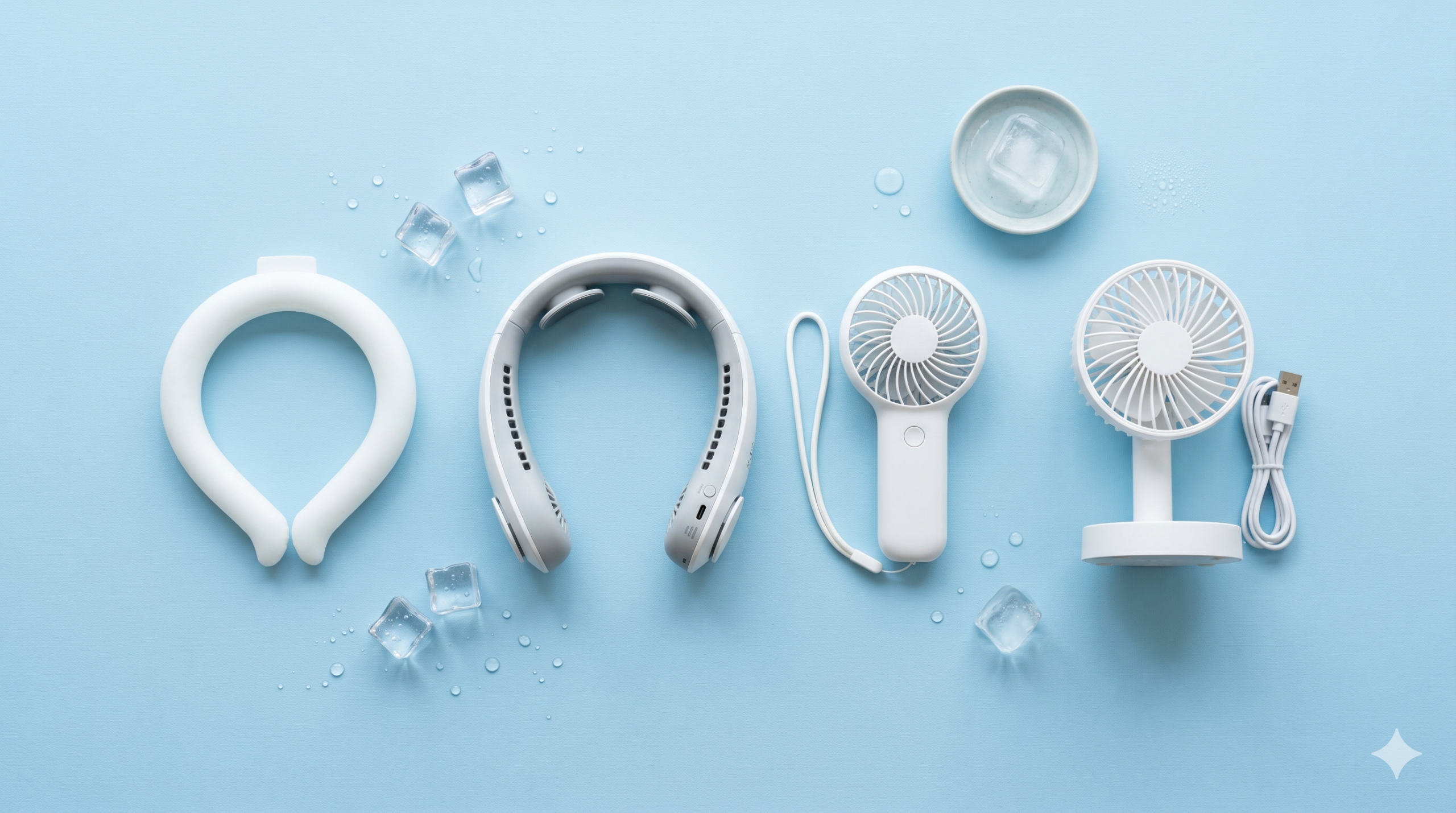
    Neck fans are hands-free and perfect for commuting or outdoor activities. Handheld fans are compact and powerful. Desk fans are best for home or office use. Think about your primary use case — most people in Japan opt for neck fans for daily use and a handheld for travel.

    2. Battery Life

    Japan’s summer days are long and hot. Look for at least 8 hours of battery life on low settings. Top models like the Baseus Neck Fan F40 offer up to 20+ hours. USB-C charging is now the standard, making it easy to recharge on the go.

    3. Airflow (CFM) and Noise Level

    Japanese offices and trains can be quiet environments. Look for fans with a low-noise mode under 30dB. Bladeless neck fan designs tend to be quieter and safer, especially if you have long hair.

    4. Weight and Portability

    A neck fan you’ll actually wear needs to be light — ideally under 150g. Anything heavier gets uncomfortable within an hour. Check the weight specs carefully before buying.

    5. Price and Availability in Japan

    Quality portable fans in Japan range from ¥3,000 to ¥15,000. Chinese brands like Baseus and JISULIFE offer excellent value, while Japanese brands like Panasonic and Iris Ohyama are trusted for reliability. All options below are available on Amazon Japan.

    Top 5 Best Portable Fans in Japan 2026

    1. Baseus Neck Fan F40 — Best Overall

    The Baseus F40 is the runaway bestseller for portable fans in Japan in 2026. Its bladeless design is safe, whisper-quiet (as low as 25dB), and delivers surprisingly powerful airflow thanks to dual turbine motors. The ergonomic arc shape sits comfortably around your neck, and the silicone padding prevents irritation even during long wear.

    Battery life is exceptional — up to 20 hours on low speed and 8 hours on high, thanks to the 4000mAh built-in battery. USB-C charging means you can top it up during your lunch break. It’s available in black, white, and gray, and is one of the most popular neck fan choices across Amazon Japan and Japanese electronics stores like Yodobashi and Bic Camera.

    For expats spending long hours commuting on the Yamanote Line or attending outdoor summer festivals (matsuri), the Baseus F40 is the go-to choice. It folds flat for easy storage in a bag when not in use.

    Battery4000mAh, up to 20 hours
    Noise25–45dB (3 speed settings)
    Weight148g
    ChargingUSB-C
    Price~¥4,500
    ✅ Pros
    • Bladeless design — safe & quiet
    • Exceptional 20-hour battery life
    • Lightweight at 148g
    • USB-C fast charging
    • Folds flat for storage
    • Strong brand support in Japan
    ❌ Cons
    • Limited airflow direction adjustment
    • Not waterproof
    • Counterfeits exist — buy from official sellers

    2. Iris Ohyama HDX-CY3 — Best Japanese Brand Neck Fan

    If you prefer a trusted Japanese brand, Iris Ohyama’s HDX-CY3 is the top pick. Iris Ohyama is a household name in Japan known for reliable, practical home appliances at reasonable prices. The HDX-CY3 features a 360° airflow design that cools both the neck and face simultaneously, with 3 fan speeds and a battery life of up to 14 hours.

    What sets this apart is the Japanese quality control — it’s quieter and more consistent than many cheaper Chinese alternatives. It’s also widely available across Japan at electronics stores and major supermarkets. For expats who want something they can easily replace or buy locally in Japan, Iris Ohyama is the safest bet.

    The HDX-CY3 weighs just 135g, making it one of the lightest neck fans available. Its simple white design fits in anywhere — from the office to the konbini (convenience store) run.

    Battery3000mAh, up to 14 hours
    Noise28–42dB
    Weight135g
    ChargingUSB-C
    Price~¥5,800
    ✅ Pros
    • Trusted Japanese brand
    • 360° airflow (face + neck)
    • Lightest option at 135g
    • Available at Japanese stores
    • Quiet operation
    • Good after-sales support in Japan
    ❌ Cons
    • Shorter battery life than Baseus
    • Higher price per performance
    • Limited international availability

    3. VANKYO Breeze 500 — Best Handheld Fan for Travel

    Not everyone wants to wear a fan around their neck. The VANKYO Breeze 500 is the best compact handheld fan for Japan travelers in 2026. It fits in a pocket or small bag, charges via USB-C, and delivers strong airflow for its size. With 3 fan speeds, it can run for up to 12 hours on the lowest setting.

    The Breeze 500 is particularly popular with tourists visiting Japan during summer for its portability. It also doubles as a power bank — though we’d recommend keeping it for cooling rather than draining the battery charging your phone. The compact design means it easily fits in a fanny pack or backpack outer pocket.

    For those exploring Japan’s summer festivals, hiking Mt. Fuji, or queuing outside a popular ramen shop, having the VANKYO Breeze 500 in hand is a small comfort that makes a big difference.

    Battery5200mAh, up to 12 hours
    Noise30–50dB
    Weight165g
    ChargingUSB-C
    Price~¥3,800
    ✅ Pros
    • Ultra-portable handheld design
    • Large 5200mAh battery
    • Functions as power bank
    • Strong airflow for size
    • Affordable price point
    • Widely available on Amazon Japan
    ❌ Cons
    • Not hands-free like neck fans
    • Louder than bladeless designs
    • Gets warm during extended use

    4. Panasonic F-CPB01 — Best Premium Japanese Fan

    For those who want the absolute best in portable fan technology from Japan’s most trusted electronics brand, the Panasonic F-CPB01 stands alone. Panasonic has engineered this personal fan with Nanoe X technology — the same air purification found in their premium home appliances — which not only cools you down but also moisturizes the air around your face.

    The F-CPB01 has a unique wearable design that sits around your shoulders rather than your neck, providing broader air coverage. It’s significantly more expensive than the competition, but for those who suffer in Japan’s humid heat and want both cooling and skin-care benefits, it’s worth every yen. This is particularly popular among Japanese office workers and people with sensitive skin.

    Available at major Japanese electronics retailers, this is the fan that Japanese tech enthusiasts save up for. If you’re an expat planning to stay in Japan long-term, the investment pays off across multiple summer seasons.

    Battery2500mAh, up to 8 hours
    Noise22–38dB
    Weight200g
    ChargingUSB-C
    Price~¥14,000
    ✅ Pros
    • Premium Panasonic quality
    • Nanoe X air purification technology
    • Quietest fan on this list (22dB)
    • Shoulder-wear design for maximum coverage
    • Built to last multiple seasons
    • Available at Japanese retailers
    ❌ Cons
    • Premium price (~¥14,000)
    • Heavier at 200g
    • Shorter battery life than competitors
    • Bulkier design

    5. JISULIFE FA13 — Best Budget Fan for Expats

    If you’re just arriving in Japan and need a solid portable fan without breaking the bank, the JISULIFE FA13 is your answer. At around ¥2,500–¥3,000, it’s one of the most affordable neck fans that actually works well. It features a 360° bladeless design, 3 speed settings, and up to 15 hours on low speed — impressive for the price point.

    JISULIFE has built a strong reputation for value-for-money portable fans, and the FA13 is their bestseller in Japan. It’s available on Amazon Japan with Prime delivery and is frequently recommended on expat forums and Japan travel communities. The build quality isn’t on par with Panasonic or Iris Ohyama, but for one or two summer seasons, it does the job extremely well.

    Perfect for tourists visiting Japan for the first time who want to stay cool without spending too much, or for newcomer expats who want to test the neck fan lifestyle before committing to a premium model.

    Battery4000mAh, up to 15 hours
    Noise28–46dB
    Weight155g
    ChargingUSB-C
    Price~¥2,800
    ✅ Pros
    • Excellent price-to-performance ratio
    • Long 15-hour battery life
    • Bladeless safe design
    • USB-C charging
    • Amazon Japan Prime eligible
    • Perfect for first-time buyers
    ❌ Cons
    • Lower build quality than Japanese brands
    • Less consistent airflow
    • Shorter lifespan (1–2 seasons)

    Comparison Table: Best Portable Fans in Japan 2026

    FanTypeBatteryWeightNoisePriceBest For
    Baseus F40Neck20h148g25dB~¥4,500Best Overall
    Iris Ohyama HDX-CY3Neck14h135g28dB~¥5,800Japanese Brand
    VANKYO Breeze 500Handheld12h165g30dB~¥3,800Travel
    Panasonic F-CPB01Shoulder8h200g22dB~¥14,000Premium
    JISULIFE FA13Neck15h155g28dB~¥2,800Budget

    Where to Buy Portable Fans in Japan

    You can find portable fans at most major electronics retailers in Japan: Yodobashi Camera, Bic Camera, Yamada Denki, and Kojima all carry a wide selection. For the best prices and widest selection, Amazon Japan (Amazon.co.jp) is typically the easiest option, especially for expats who want Prime delivery.

    Convenience stores like 7-Eleven, FamilyMart, and Lawson also sell small portable fans during summer, though the selection is limited and quality varies. For premium models like Panasonic, dedicated electronics stores are recommended.

    Final Verdict: Best Portable Fan in Japan for 2026

    For most people living in or visiting Japan, the Baseus Neck Fan F40 is the best portable fan in 2026. It strikes the ideal balance of battery life, airflow, noise level, and price. If you prefer a Japanese brand, the Iris Ohyama HDX-CY3 is the top domestic choice. Budget-conscious travelers and newcomer expats will find the JISULIFE FA13 delivers excellent value at under ¥3,000.

    Japan’s summer heat is intense, but with the right portable fan, it becomes much more manageable. Order before June — by July, the best models sell out fast!

    🇯🇵 Looking for Japanese Gadget Reviews?

    Check ガジェナビ — Japan’s #1 Japanese-language gadget comparison site

    175+ in-depth reviews of Japanese electronics, home appliances & smart devices. Amazon Japan links included.

    Visit ガジェナビ (Japanese) →
  • 10 Japanese Products You Can ONLY Buy in Japan 2026 — Stock Up Before You Leave

    10 Japanese Products You Can ONLY Buy in Japan 2026 — Stock Up Before You Leave

    Why Buy Japanese Products Directly from Japan?

    Japan is home to some of the world’s most innovative, beautifully crafted everyday products — yet many of them never make it to shelves outside Japan. Whether you’re an expat living in Japan, a Japan enthusiast shopping from abroad, or simply someone who refuses to settle for less, buying directly from Amazon Japan or using a forwarding service like Buyee gives you access to items that are simply unavailable (or wildly overpriced) everywhere else.

    From thermal mugs that keep drinks warm for 24 hours, to toasters that use steam technology perfected by Japanese engineers — these products represent the best of Japan’s legendary “monozukuri” (craftsmanship) culture. In this guide, we’ve handpicked 5 genuinely Japan-unique products worth importing in 2026.

    5 Best Japan-Exclusive Products to Buy on Amazon Japan in 2026

    1. Zojirushi SM-WA48 — Japan’s Best Vacuum Mug

    Ask any Japanese commuter what’s in their bag, and there’s a good chance it’s a Zojirushi mug. The SM-WA48 is the gold standard of vacuum-insulated stainless steel mugs — keeping drinks hot for up to 6 hours and cold for up to 12. What sets it apart from global competitors like Hydro Flask or Stanley is the obsessive attention to Japanese engineering: the lid opens with a single finger, the seal is perfectly airtight, and the interior is coated with a non-stick finish that resists staining and odors over years of daily use.

    The SM-WA48 is made in Japan’s Osaka factory and uses Zojirushi’s proprietary Stainless-Mug vacuum insulation technology. The mouthpiece diameter (4.8cm) is optimized for drinking without tilting too far — a subtle but brilliant design choice. It weighs just 200g but feels premium in the hand. Available in 12+ colors unique to the Japanese market, many of which are never exported.

    For expats in Japan, this is a must-buy before leaving. For overseas buyers, this is the one “Japanese daily life” item worth importing — Zojirushi mugs available internationally are often older models or limited colorways. Ordering directly from Amazon Japan gives you access to the full 2026 lineup at Japanese retail prices (roughly ¥3,500–¥4,200 vs $30–$50 on Amazon.com for older versions).

    Capacity480ml (16oz)
    Weight200g
    Hot retention6+ hours (60°C or above)
    Cold retention12+ hours (10°C or below)
    MaterialStainless steel, non-stick interior
    Price (Amazon JP)~¥3,800

    2. Panasonic EH-NA0J — Japan-Exclusive Nanoe Hair Dryer

    The Panasonic EH-NA0J is one of Japan’s best-selling hair dryers — and it’s almost impossible to find outside Japan. Why? Because Panasonic manufactures different models for different markets, and the Japan-spec lineup features the latest nanoe technology that reduces hair damage, improves moisture retention, and leaves hair noticeably smoother after just a few uses. The EH-NA0J specifically is the 2025/2026 Japan domestic flagship model.

    Nanoe works by generating nano-sized water particles that penetrate hair fibers rather than sitting on the surface. The result is hair that’s 20% more hydrated compared to conventional drying — measurable with scientific instruments. Panasonic has been refining this technology for over a decade, and the Japanese domestic models are several generations ahead of their export counterparts. The EH-NA0J also includes a “Quick Dry Nozzle” that reduces drying time by 30%, and runs at a noise level of just 60dB (comparable to normal conversation).

    Voltage note: Japanese appliances run on 100V / 50-60Hz. If you’re buying for use outside Japan, you’ll need a voltage converter, or use the dryer’s built-in 200V mode available on newer models. Always check the spec label before purchasing for overseas use.

    Power1200W
    Technologynanoe + mineral
    Voltage100V (Japan spec)
    Noise level~60dB
    Weight430g
    Price (Amazon JP)~¥14,000

    3. Balmuda The Toaster K05A — Japan’s Most Iconic Appliance

    No list of Japan-unique products would be complete without the Balmuda The Toaster. When it launched in 2015, it changed what people expected from a kitchen appliance. The secret? A patented steam toasting system — you add 5ml of water before toasting, and the steam creates a perfectly crispy exterior while keeping the inside moist and soft. For Japanese milk bread (shokupan), the result is something otherworldly: a golden crust that shatters slightly, with a pillowy interior that tastes bakery-fresh.

    Balmuda has since expanded globally, but the Japanese domestic model remains the reference standard — and significantly cheaper than the US/European pricing ($329 on the US Balmuda website vs. ~¥25,000 on Amazon Japan). The K05A is the 2024 updated model with improved temperature control and a revised steam mechanism. It features five toasting modes: sandwich bread, artisan bread, pizza, pastry, and classic toast — each with a precisely calibrated temperature curve developed through years of testing.

    If you appreciate beautiful design and exceptional cooking performance, this is the one Japanese kitchen appliance worth importing. It looks stunning on any counter and consistently outperforms toasters that cost three times as much.

    ModelK05A-BK / K05A-WH
    Toast modes5 (Bread, Artisan, Pizza, Pastry, Classic)
    Power1300W (Japan 100V)
    Steam technologyYes (5ml water)
    Dimensions35 x 17.8 x 20.4cm
    Price (Amazon JP)~¥25,000

    4. Sharp Healsio Hot Cook KN-HW24G — Japan’s Best Smart Cooker

    The Sharp Healsio Hot Cook is a phenomenon in Japan. It’s been the country’s best-selling automatic cooker for five consecutive years — and it’s barely available outside Asia. The Hot Cook is a “waterless cooker” that uses the natural moisture in vegetables and proteins to create deeply flavorful stews, curries, soups, and stir-fries without you adding a single drop of water. The result is concentrated, intense flavor that pressure cookers and slow cookers can’t replicate.

    The KN-HW24G (2.4L capacity) serves 2-4 people and connects to Sharp’s COCORO HOME app, which gives you access to 300+ pre-programmed recipes developed by Japanese professional chefs. You load ingredients, select a recipe, press start, and come back 30-60 minutes later to a perfectly cooked meal — with no stirring, no monitoring, no burned bottoms. The stirring arm (a unique Healsio feature) automatically mixes ingredients throughout cooking.

    This is perhaps the most genuinely Japan-exclusive product on this list — Sharp’s Healsio lineup is simply not sold in Western markets. For expats in Japan, it transforms weeknight cooking. For overseas buyers, it requires a voltage converter but is worth it for cooking enthusiasts who want access to Japan’s most innovative kitchen technology.

    Capacity2.4L (serves 2–4)
    Cooking modes15+ (stew, stir-fry, steam, bake, etc.)
    Auto stirringYes
    App controlCOCORO HOME (iOS/Android)
    Voltage100V (Japan spec)
    Price (Amazon JP)~¥43,000

    5. Iris Ohyama Futon Dryer FK-W1 — A Japan-Only Essential

    Outside Japan, most people have never heard of a futon dryer — because most people outside Japan sleep on futons. But once you understand what it does, you’ll wish you had one. The Iris Ohyama FK-W1 is a compact appliance that blows warm, dehumidified air into your bedding through an inflatable mat attachment, thoroughly drying and warming your futon, mattress topper, or comforter in 30-50 minutes. It eliminates moisture, neutralizes dust mites (which thrive in damp bedding), and warms your bed before you climb in on cold nights.

    In Japan, where humid summers and unheated traditional rooms make damp bedding a year-round concern, futon dryers are as standard as a vacuum cleaner. Iris Ohyama is Japan’s most innovative home appliance brand — they produce over 20,000 products and consistently price them 30-50% below competitors without sacrificing quality. The FK-W1 is their current flagship futon dryer: lightweight (1.5kg), compact, and powerful enough to dry a thick winter futon in under an hour.

    Even if you don’t sleep on a futon, this works brilliantly with Western duvets, mattress toppers, and pillows. Many Japanese buyers use it to warm their bed in winter — it’s extraordinarily comforting. This is a product you didn’t know you needed until you try it, then can’t live without.

    ModelFK-W1-WP
    Drying time30–50 min (futon mode)
    Weight1.5kg
    Hose length1.6m flexible hose
    Voltage100V (Japan spec)
    Price (Amazon JP)~¥7,800

    Quick Comparison: Japan-Exclusive Products 2026

    ProductCategoryPrice (Amazon JP)VoltageBuyee-Friendly
    Zojirushi SM-WA48Vacuum Mug~¥3,800N/A
    Panasonic EH-NA0JHair Dryer~¥14,000100V
    Balmuda K05AToaster~¥25,000100V
    Sharp Hot Cook KN-HW24GSmart Cooker~¥43,000100V
    Iris Ohyama FK-W1Futon Dryer~¥7,800100V

    How to Order Japanese Products from Overseas

    Many items on Amazon Japan now offer international shipping — look for the “Ships internationally” badge on the product listing. However, not all products qualify (especially large appliances). For items that don’t ship internationally, Buyee is the most reliable proxy purchasing service: they buy the item on your behalf in Japan and forward it to your address. Buyee supports over 100 countries and integrates directly with Amazon Japan, Yahoo! Auctions Japan, and Rakuten.

    If you’re an expat living in Japan with a Japanese address, all of these products ship directly to you via Amazon Japan Prime with free delivery. Stock up before you move back home — especially the Balmuda Toaster and Zojirushi mugs, which make excellent gifts and conversation pieces that genuinely impress people who’ve never experienced Japanese product quality.

    Voltage note: Japanese appliances run on 100V/50-60Hz. If your country uses 110V (USA, Canada) you can usually plug in directly with minimal risk. For 220-240V countries (Europe, Australia, UK), you’ll need a step-down voltage converter. The Zojirushi mug requires no electricity, so it’s completely plug-and-play worldwide.

    Final Verdict: The Best of Japan, Delivered to Your Door

    Japan’s consumer product culture is a world apart — built on the principle that everyday items should work flawlessly, last for decades, and bring a small moment of pleasure every time you use them. The five products on this list represent that philosophy at its best: a mug that keeps your coffee hot through your entire commute, a hair dryer that genuinely improves your hair, a toaster that makes breakfast something to look forward to, a cooker that removes the stress from weeknight dinners, and a dryer that keeps your bedding fresh and warm year-round.

    If you can only buy one: start with the Zojirushi SM-WA48 — it’s affordable, ships easily, requires no voltage converter, and is the single product most likely to make you say “why didn’t I discover this sooner?” For a larger splurge, the Balmuda Toaster is worth every yen for anyone who cares about their morning toast.

  • Best Pet Dryer Boxes in Japan 2026: Safe, Fast Drying for Dogs & Cats

    Best Pet Dryer Boxes in Japan 2026: Safe, Fast Drying for Dogs & Cats

    Why Japanese Pet Owners Love Automatic Pet Dryer Boxes

    If you have a dog or cat in Japan, bath time can be one of the most stressful parts of pet ownership. Blow-drying a wriggly pet by hand takes 20–40 minutes, and the noise often scares them. That’s why automatic pet dryer boxes have become a must-have gadget among Japanese pet owners — and they’re now easy to find on Amazon Japan and Rakuten.

    These clever devices work like a mini spa booth: you place your pet inside, set the temperature and timer, and the box gently dries them with warm circulating air. No more struggling with a handheld dryer, no more stressed pets — just fluffy, dry fur in 20–30 minutes.

    In this guide, we’ve reviewed the best pet dryer boxes available in Japan in 2026, covering everything from budget picks to premium models, perfect for dogs and cats of all sizes.

    What to Look for When Choosing a Pet Dryer Box

    1. Size & Capacity

    Make sure the box fits your pet comfortably. Most boxes suit small to medium dogs (under 10kg) and cats. Measure your pet’s length and height before buying, and choose a model with at least 20% extra room so they can stand and turn around.

    2. Temperature Control & Safety

    Look for models with adjustable temperature settings (ideally 25–45°C) and automatic overheat protection. Some premium models have built-in thermometers and humidity sensors that auto-adjust drying conditions.

    3. Noise Level

    Noise-sensitive pets need a quiet model. Look for dryer boxes rated under 55dB — many Japanese brands specifically design for quiet operation to reduce pet anxiety.

    4. Air Circulation System

    360-degree air circulation dries more evenly than single-direction airflow. Look for models with multiple vents on top, sides, and bottom panels for fastest, most uniform drying.

    5. Ease of Cleaning

    Pet fur will accumulate in the filter. Choose a model with a removable, washable filter and easy-access panels. Japanese pet owners particularly value easy-clean designs given how frequently they groom their pets.

    Top 5 Best Pet Dryer Boxes in Japan 2026

    1. PETKIT AIRSALON MAX — Best Overall

    The PETKIT AIRSALON MAX is widely considered the gold standard of pet dryer boxes in Japan. With its sleek white design and smart temperature sensing, it adjusts airflow automatically to keep your pet comfortable throughout the drying cycle. The transparent front door lets you monitor your pet at all times, and the quiet 50dB motor means even nervous dogs stay calm inside.

    What sets the AIRSALON MAX apart is its intelligent 3-mode drying system: Quick Dry, Gentle (for kittens and puppies), and Sterilization mode. The HEPA filter traps allergens and pet dander, making it ideal for allergy-prone households. It handles pets up to 8kg easily, making it suitable for most small to medium breeds popular in Japanese apartments.

    Setup is straightforward — plug in, set the timer (up to 60 minutes), select temperature, and close the door. The digital display is intuitive and the unit is quiet enough to leave running while you do other things.

    CapacityUp to 8kg / approx. 50L
    Temperature Range25°C – 45°C
    Noise Level~50dB
    TimerUp to 60 min
    Special FeaturesHEPA filter, 3 modes, auto temp control
    • ✅ Smart auto-temperature adjustment
    • ✅ HEPA filter — great for allergies
    • ✅ Quiet at 50dB
    • ✅ Transparent door for monitoring
    • ❌ Premium price
    • ❌ Suits pets up to 8kg only

    2. Homerunpet Drybo Plus — Best for Cats

    The Homerunpet Drybo Plus has become a cult favorite among cat owners in Japan, and it’s easy to see why. Its egg-shaped design with a large curved door minimizes the “trapped” feeling cats hate, and the ultra-quiet 45dB fan is gentle enough for even the most skittish feline.

    The Drybo Plus features Homerunpet’s proprietary “Smart Sensing” technology — infrared sensors detect your pet’s body temperature in real time and adjust the heat output accordingly. This prevents overheating, which is especially important for long-haired breeds like Persians and Maine Coons that are popular in Japan.

    The unit also doubles as a pet “calm down” space — many owners report that anxious cats actually choose to nap inside the Drybo after drying sessions, thanks to its cozy enclosed design.

    CapacityUp to 6kg / approx. 35L
    Temperature Range20°C – 40°C
    Noise Level~45dB
    TimerUp to 45 min
    Special FeaturesIR body temp sensing, egg shape design
    • ✅ Ultra-quiet — perfect for nervous cats
    • ✅ Real-time IR temperature sensing
    • ✅ Cats often voluntarily enter it
    • ✅ Compact for Japanese apartments
    • ❌ Smaller capacity (up to 6kg)
    • ❌ Less suitable for large dogs

    3. PAWBBY M1 — Best Budget Pick

    If you want the pet dryer box experience without the premium price tag, the PAWBBY M1 is Japan’s best-value option. Available on Amazon Japan and Rakuten for significantly less than the PETKIT and Homerunpet, it still delivers solid drying performance for small dogs and cats.

    The M1 uses a straightforward warm-air circulation system with three temperature settings (Low/Medium/High) and a 30-minute timer. The clear acrylic door and top observation window let you keep an eye on your pet throughout. Build quality is good for the price — solid plastic construction with a removable fur filter.

    It’s a great starter option for pet owners new to dryer boxes, or for those with smaller budgets. Just note that the noise level (~60dB) is slightly higher than premium models, so very noise-sensitive pets may need gradual acclimatization.

    CapacityUp to 5kg / approx. 28L
    Temperature Range3 fixed levels
    Noise Level~60dB
    TimerUp to 30 min
    Special FeaturesTop observation window, budget-friendly
    • ✅ Most affordable option
    • ✅ Top observation window
    • ✅ Good build quality for the price
    • ✅ Available on Amazon Japan
    • ❌ Louder (~60dB)
    • ❌ Smaller capacity

    4. Shernbao PDC-800 — Best for Medium Dogs

    The Shernbao PDC-800 stands out as the go-to choice for medium-sized dogs (8–15kg) — a segment underserved by most pet dryer boxes. Professional groomers across Japan use Shernbao equipment, and the PDC-800 brings that professional-grade performance to home users.

    The PDC-800 features a powerful dual-fan system that pushes more airflow than consumer models, cutting drying time for thick double-coat breeds like Shiba Inu and Corgi to under 25 minutes. The stainless steel grate floor is hygienic and easy to clean, and the large transparent door accommodates dogs that other boxes can’t fit.

    It’s bulkier than apartment-friendly models, so best suited to homes with more space. But if you have a medium-to-large dog and want the fastest, most thorough drying possible, the PDC-800 is hard to beat.

    CapacityUp to 15kg / approx. 90L
    Temperature Range25°C – 55°C
    Noise Level~58dB
    TimerUp to 90 min
    Special FeaturesDual fan, professional-grade, stainless floor
    • ✅ Largest capacity — fits medium/large dogs
    • ✅ Professional groomer-grade quality
    • ✅ Dual-fan fast drying
    • ✅ Stainless steel hygienic floor
    • ❌ Bulkier — needs more space
    • ❌ Higher price point

    5. PetAmi Deluxe Pet Dryer Box — Best for Nervous Pets

    The PetAmi Deluxe is engineered with anxious pets in mind. Its ultra-low noise operation (42dB) — quieter than a library — combined with a soft interior mat and calming warm airflow makes it the most stress-free drying experience on this list. Many behaviorists and veterinary clinics in Japan recommend it for pets with grooming anxiety.

    Setup includes a “gradual acclimatization” mode that starts at low heat and fan speed, slowly increasing over 10 minutes — mimicking the training approach recommended by professional trainers to help pets associate the box with positive experiences. The PetAmi also has the longest warranty of any model here (2 years), and English support is available, making it especially convenient for expats in Japan.

    CapacityUp to 7kg / approx. 40L
    Temperature Range25°C – 42°C
    Noise Level~42dB (quietest on list)
    TimerUp to 60 min
    Special FeaturesAcclimatization mode, English support, 2yr warranty
    • ✅ Quietest model — 42dB
    • ✅ Gradual acclimatization mode
    • ✅ English customer support (great for expats!)
    • ✅ 2-year warranty
    • ❌ Limited to 7kg
    • ❌ Acclimatization mode adds time

    Comparison Table: Best Pet Dryer Boxes in Japan 2026

    ModelBest ForMax WeightNoisePrice Range
    PETKIT AIRSALON MAXOverall best8kg50dB¥¥¥
    Homerunpet Drybo PlusCats6kg45dB¥¥¥
    PAWBBY M1Budget5kg60dB¥¥
    Shernbao PDC-800Medium/large dogs15kg58dB¥¥¥¥
    PetAmi DeluxeNervous pets / expats7kg42dB¥¥¥

    FAQ: Pet Dryer Boxes in Japan

    Can I buy these in Japan? Yes — all models on this list are available on Amazon Japan (amazon.co.jp). Some are also on Rakuten. The PETKIT and Homerunpet are especially popular and readily available for Prime delivery.

    Are pet dryer boxes safe? Yes, when used correctly. Always ensure the temperature is set appropriately for your pet’s size, never exceed the recommended time, and check on your pet regularly through the observation window. Modern models have automatic overheat shutoff for safety.

    How long does drying take? Most small dogs and cats dry fully in 20–35 minutes. Double-coated or long-haired breeds may take 40–50 minutes. Compared to hand blow-drying (45–60 min), dryer boxes save significant time.

    What size do I need? Measure your pet’s body length + 30% for comfort. Most boxes are rated by pet weight — a 5kg cat needs at least a 6kg-rated box to have enough room to stand and turn.

    Final Verdict

    Pet dryer boxes are one of the best quality-of-life upgrades you can make for both you and your pet in Japan. No more 40-minute blow-dry struggles, no more stressed pets — just fluffy, dry fur with minimal effort.

    For most expats and Japan residents with small dogs or cats, the PETKIT AIRSALON MAX is our top recommendation for its smart features and reliability. Cat owners will love the Homerunpet Drybo Plus, while those on a budget should look at the PAWBBY M1. If your pet is particularly anxious about grooming, the PetAmi Deluxe — with its English support and acclimatization mode — is perfect for expat households.

  • Japan Tax Refund 2026: Foreigners Who Skip This Lose ¥100,000+ Every Year

    Japan Tax Refund 2026: Foreigners Who Skip This Lose ¥100,000+ Every Year

    🔒 VPN Guide Updated May 2026 — All Tested VPNs Work in Japan

    NordVPN, ExpressVPN, Surfshark, and Proton VPN all confirmed working in Japan as of May 2026. VPNs are legal to use in Japan. Use them to access home-country streaming (Netflix, Hulu, BBC iPlayer), secure hotel/café WiFi, and bypass geo-restrictions on banking apps.

    Whether you’re streaming your favorite shows from back home, keeping your data private on Japanese public WiFi, or accessing geo-restricted services, a reliable VPN is essential for life in Japan. In this guide, we review the 5 best VPNs for Japan in 2026 — tested for speed, reliability, and ease of use from inside Japan.

    Editor’s Pick: ExpressVPN — The Fastest, Most Reliable VPN for Japan

    If you want the speed king trusted by travelers and expats worldwide, ExpressVPN is our top recommendation for Japan in 2026. Blazing-fast servers for streaming Japanese and overseas content, audited no-logs policy, and apps for every device — with a 30-day money-back guarantee.

    Why You Need a VPN in Japan

    Japan has fast internet, but there are real reasons to use a VPN:

    • Streaming geo-restrictions — Netflix Japan has a different library than Netflix US/UK; a VPN lets you access your home country’s content
    • Public WiFi security — stations, cafes, and airports have free WiFi, but it’s unsecured; a VPN encrypts your connection
    • Accessing home services — banking apps, Hulu US, BBC iPlayer, and many regional services are blocked outside their home country
    • Privacy — Japanese ISPs log browsing data; a VPN masks your traffic
    • Business use — many companies require VPN access to internal systems

    What to Look for in a VPN for Japan

    • Servers in Japan AND your home country — you need Japan servers for fast local speeds, plus servers in your home country to access geo-blocked content
    • Fast speeds — Japan has gigabit internet; your VPN should keep up
    • Strong encryption — AES-256 and WireGuard protocol are the gold standard
    • No-logs policy — independently audited no-logs policies are essential
    • Easy setup on all devices — iPhone, Android, Mac, Windows, and router support
    • Split tunneling — route only certain apps through the VPN for better performance

    Best VPNs for Japan 2026: Top 5 Picks

    1. NordVPN — Best Overall VPN for Japan

    NordVPN is consistently rated the best VPN for Japan by tech reviewers, and for good reason. With over 100 servers in Japan and thousands worldwide, it offers blazing fast speeds thanks to its proprietary NordLynx protocol (based on WireGuard). Streaming from outside Japan is seamless — Netflix US, BBC iPlayer, Disney+, and Hulu all unblock reliably.

    NordVPN’s Threat Protection Pro feature blocks ads, malware, and trackers even when the VPN is off, making it a genuine security upgrade for your devices. The no-logs policy has been independently audited three times. Apps are available for Windows, Mac, iOS, Android, Linux, and even certain routers. Up to 10 simultaneous device connections per account.

    Price: from about $3.39/month on a 2-year plan. A 30-day money-back guarantee means zero risk to try it from Japan.

    FeatureDetails
    Servers in Japan100+ servers
    Speed (NordLynx)Excellent — minimal speed loss
    No-logsYes — independently audited
    Simultaneous devices10
    Best forStreaming, privacy, all-around use
    PriceFrom $3.39/month (2-year plan)

    🔒 READY TO PROTECT YOUR CONNECTION?

    🏆 Try NordVPN — Best for Japan (30-day money-back)

    ★ Special deal: Up to 72% off + 3 months FREE

    2. ExpressVPN — Fastest VPN for Japan

    ExpressVPN is famous for its Lightspeed protocol, which delivers some of the fastest VPN speeds available anywhere — critical if you’re on Japan’s gigabit fiber or a fast 5G connection. Servers in 105 countries including strong Japan coverage mean you’ll always find a fast connection.

    ExpressVPN is particularly popular among expats for its ability to reliably unblock streaming services. It’s been tested to unblock Netflix US, UK, Australia, and Japan libraries simultaneously. The Network Lock kill switch cuts your internet if the VPN drops, preventing any unprotected data from leaking. 8 simultaneous device connections.

    Price: from about $6.67/month on a 12-month plan. More expensive than competitors but justified by the speed and reliability. 30-day money-back guarantee.

    🔒 READY TO PROTECT YOUR CONNECTION?

    ⚡ Try ExpressVPN — Fastest Speeds

    30-day money-back guarantee

    3. Surfshark — Best Budget VPN for Japan

    Surfshark offers the best value for money among Japan VPNs. At around $2.19/month on a 2-year plan, it’s among the cheapest options — and it allows unlimited simultaneous devices, making it perfect for families or users with many gadgets. Japan server coverage is solid, and it reliably unblocks major streaming services.

    Surfshark’s CleanWeb feature blocks ads, trackers, and malicious sites. The Camouflage Mode disguises VPN traffic as regular HTTPS traffic, helping in environments that block VPN protocols. The Nexus feature routes traffic through multiple VPN servers for extra privacy. 30-day money-back guarantee.

    🔒 READY TO PROTECT YOUR CONNECTION?

    💰 Try Surfshark — Best Budget Option

    Unlimited devices · 30-day money-back guarantee

    4. ProtonVPN — Best VPN for Privacy and Security in Japan

    Built by the team behind ProtonMail (the Swiss encrypted email service), ProtonVPN is the privacy-first choice for Japan. Its strict no-logs policy is backed by Swiss privacy laws — among the strongest in the world. Secure Core servers route traffic through privacy-friendly countries (Switzerland, Iceland, Sweden) before exiting in your destination country.

    ProtonVPN is one of the only premium VPNs with a genuinely free tier (limited to 3 countries but no data cap). The paid plans start at $4.99/month and include access to Proton’s entire suite of privacy tools (Mail, Calendar, Drive). Excellent choice for journalists, activists, or anyone handling sensitive data while living in Japan.

    🔒 READY TO PROTECT YOUR CONNECTION?

    🛡️ Try ProtonVPN — Best for Privacy

    Free plan available · Swiss-based · No-log policy

    5. Mullvad VPN — Most Anonymous VPN for Japan

    Mullvad is the most privacy-focused VPN on this list. It lets you sign up with zero personal information — no email, no account name, just a randomly generated account number. You can even pay with cash or cryptocurrency. Despite the minimalist approach, it delivers fast WireGuard speeds and solid Japan server coverage.

    The interface is simple and stripped-down, which won’t appeal to streaming-focused users but is perfect for anyone who wants pure, audited privacy with no frills. Flat pricing at about €5/month (no long-term discounts). Great for digital nomads and expats who prioritize anonymity above all else.

    🔒 READY TO PROTECT YOUR CONNECTION?

    🕵️ Try Mullvad — Most Anonymous VPN

    No account needed · Pay with cash or crypto

    VPN Comparison: Best VPNs for Japan 2026

    VPNBest ForPrice/monthDevicesNo-logs
    NordVPNAll-around bestFrom $3.3910Yes (audited)
    ExpressVPNFastest speedsFrom $6.678Yes (audited)
    SurfsharkBest budget / unlimited devicesFrom $2.19UnlimitedYes
    ProtonVPNPrivacy-firstFrom $4.9910Yes (audited)
    MullvadMaximum anonymity€5 flat5Yes (audited)

    How to Set Up a VPN in Japan: Quick Guide

    1. Choose a VPN from the list above and subscribe on their official website
    2. Download the app for your device (iOS, Android, Windows, Mac)
    3. Open the app and log in
    4. Choose a server — Japan server for fast local speeds, or your home country to access geo-blocked content
    5. Tap “Connect” — your connection is now encrypted

    Most modern VPNs connect in under 3 seconds. Keep the app running in the background for continuous protection, especially on public WiFi.

    Are VPNs Legal in Japan?

    Yes, VPNs are completely legal in Japan. There are no laws restricting VPN use. Japan respects internet freedom and does not block VPN traffic. You can freely use any VPN service while living in or visiting Japan without legal concern.

    Free VPNs for Japan: Are They Worth It?

    Free VPNs are generally not recommended for use in Japan. Most free VPNs have severe limitations: slow speeds, data caps, few server locations, and — critically — some free VPNs sell your browsing data to third parties, which defeats the purpose entirely. The only free VPN we recommend is ProtonVPN Free (no data cap, 3 server locations, slower speeds) as a starting point before upgrading to a paid plan.

    🔐 Privacy-first pick: Proton VPN

    Made by the team behind Proton Mail (Switzerland). Strict no-logs, a genuinely usable free plan, and great for accessing your home content while in Japan.

    Try Proton VPN →

📖

0 guides available