This article was created with AI writing assistance (ChatGPT, Claude, etc.). Product selection, specifications, and reviews are verified by the Japan Life Lab editorial team.
This article contains promotional / affiliate links.
📌 What you will learn
You do not have to read it all — jump to what you need.
- Introduction: Why Ramen is Japan’s Soul Food
- How to Order Ramen in Japan (Step-by-Step)
- The 5 Major Ramen Styles You Must Try
- Best Ramen Chains for Tourists in Japan
- Ramen Etiquette: Do’s and Don’ts
- Regional Ramen Guide: Japan’s Noodle Road Trip
- Ramen Tips for Long-Term Expats in Japan
※ Start wherever fits your situation.
Prime members get fast, free delivery on millions of items, Prime Video and members-only deals. Eligible new members can try it free for 30 days.
Start your free 30-day Prime trial →Ages 18–24? See Prime for Young Adults
Paid links. As an Amazon Associate, Japan Life Lab earns from qualifying purchases. Trial eligibility and terms are set by Amazon.
Introduction: Why Ramen is Japan’s Soul Food
Few foods define Japan’s culinary identity like ramen (ラーメン). What started as Chinese-influenced noodle soup became, over decades, one of the world’s most celebrated comfort foods — with Japan taking it to extraordinary heights of craftsmanship and regional diversity.
Today, Japan has over 30,000 ramen restaurants, and the country boasts dedicated ramen museums, ramen-themed amusement parks, and neighborhoods so dense with noodle shops that even locals debate which bowl is best. For tourists and expats, navigating this world can feel overwhelming — but incredibly rewarding.
This guide breaks down everything you need to know: the major ramen styles, where to eat in Japan’s cities, how to order, regional specialties, and etiquette tips that’ll make you look like a regular from day one.
🍜 Quick Ramen Facts:
• Average bowl of ramen: ¥800–¥1,500
• Most restaurants open: 11:00–23:00 (varies)
• Common wait times at top spots: 30–90 minutes
• Ticket vending machine (食券機) used at most restaurants
• Slurping your noodles is not only acceptable — it’s encouraged
How to Order Ramen in Japan (Step-by-Step)
Ordering ramen in Japan can feel intimidating at first, especially at traditional shops where everything is in Japanese. Here’s the process, step by step:
Step 1: Find Your Seat (or Join the Queue)
At popular ramen shops, expect a queue outside — especially at lunch (12:00–13:30) and dinner (18:30–21:00). Some restaurants give you a numbered ticket to hold your spot. Solo diners often get priority since counter seating fills faster.
Step 2: Use the Ticket Vending Machine (食券機)
Most ramen shops use a food ticket vending machine (食券機, shokken-ki) near the entrance. You select your ramen type, pay, and receive a paper ticket. Hand this to the staff when seated. Modern machines often have English options or picture menus.
Step 3: Customize Your Bowl
Staff will typically ask for your preferences. Common customization options include:
- Noodle firmness (麺の硬さ): 柔らかめ (soft) / 普通 (normal) / 硬め (firm) / バリカタ (very firm)
- Broth richness (濃さ): 薄め (light) / 普通 (normal) / 濃いめ (rich)
- Oil amount (脂): 少なめ (less) / 普通 (normal) / 多め (extra)
- Garlic (にんにく): あり (yes) / なし (no)
Step 4: Order Toppings and Extras
Beyond the base bowl, you can add extra toppings (トッピング) such as chashu pork (チャーシュー), soft-boiled egg (味玉, ajitama), bamboo shoots (メンマ), extra nori, or corn. Gyoza (餃子), fried rice (炒飯), and karaage chicken are popular side dishes to pair with ramen.
Step 5: Eat at the Counter
Most ramen shops have counter seating. Eat immediately — ramen noodles absorb the broth quickly and become soggy within minutes. At the end, pay at the register or leave your ticket on the counter.
The 5 Major Ramen Styles You Must Try
Japanese ramen is broadly divided by broth type (スープ) and regional origin. Here are the five essential styles every ramen fan should experience:
1. Tonkotsu Ramen (豚骨ラーメン) — Fukuoka/Hakata Style
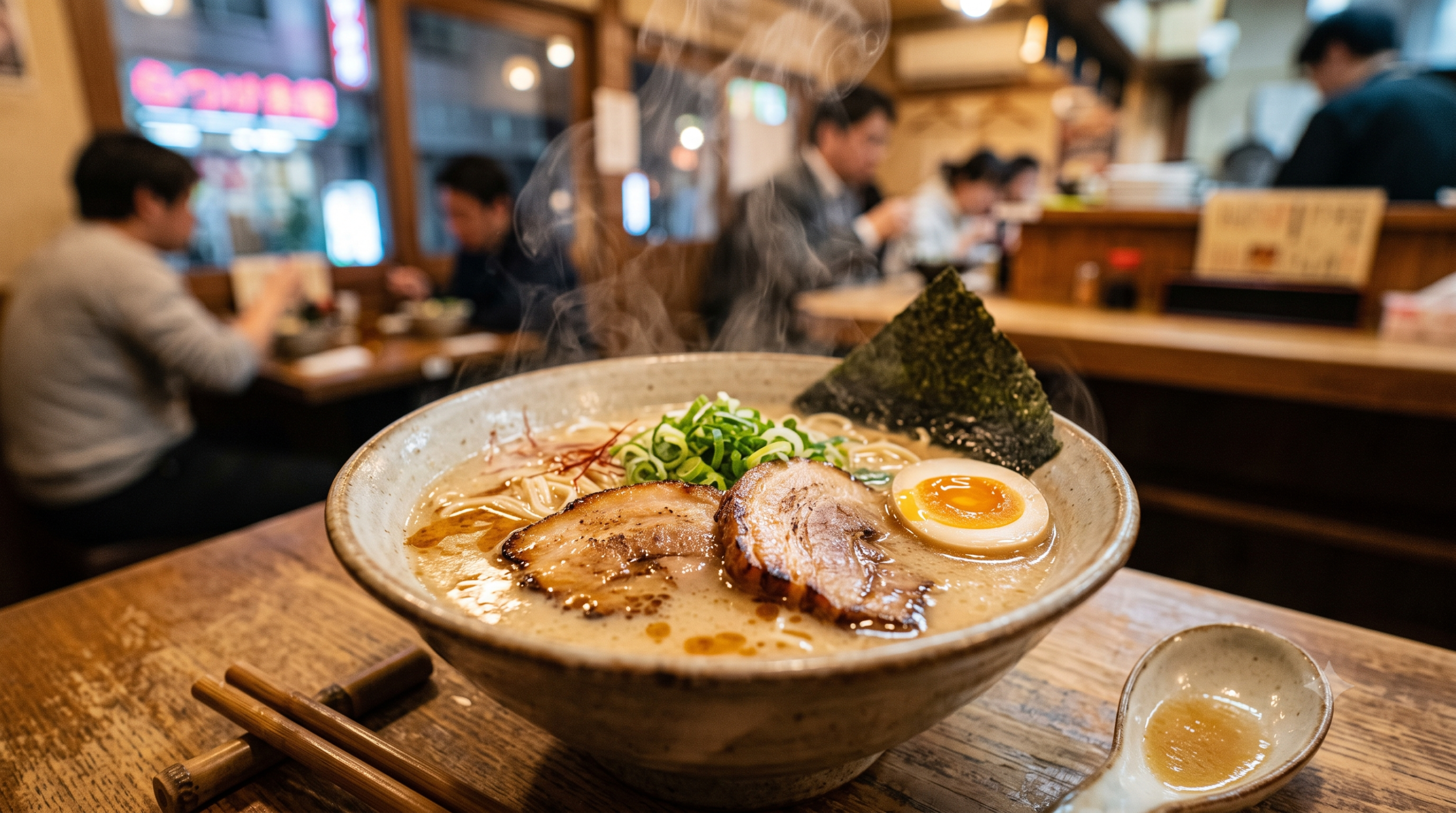
Originating from Hakata, Fukuoka in Kyushu, tonkotsu ramen is made from pork bones boiled at high heat for hours until the broth turns a milky white with an intensely rich, creamy flavor. It pairs with thin, straight noodles (specify your firmness) and typically comes topped with chashu pork, green onions, pickled ginger (紅生姜), and sesame seeds.
🏆 Flavor Profile: Rich, creamy, porky, slightly funky | Broth base: Pork bones | Noodle type: Thin, straight | Origin: Fukuoka, Kyushu
Where to try in Tokyo: Ichiran (一蘭) — with individual booths for solo dining — Ippudo (一風堂), and Shin-Shin (しんしん) are benchmark experiences. Ichiran has English-friendly ordering systems and locations across Japan, making it the go-to for first-timers.
2. Shoyu Ramen (醤油ラーメン) — Tokyo Style
Shoyu (soy sauce) ramen is considered the classic Tokyo style, with a clear, amber-colored broth made from chicken or pork stock seasoned with soy sauce. The flavor is savory, slightly salty, and more delicate than tonkotsu. Curly or wavy noodles (medium thickness) are standard, topped with chashu, menma (bamboo shoots), naruto (fish cake), and nori.
🏆 Flavor Profile: Savory, salty, clear and elegant | Broth base: Chicken/pork + soy sauce | Noodle type: Medium, curly | Origin: Tokyo
Where to try: Fuunji (風神) in Shinjuku is renowned for its shoyu tsukemen variant. Kagari (かがり) in Ginza serves a luxurious chicken paitan shoyu, consistently among Tokyo’s most praised bowls. Classics like Taishoken (大勝軒) have historical significance as originators of modern Tokyo ramen.
3. Miso Ramen (味噌ラーメン) — Sapporo Style
Miso ramen was invented in Sapporo, Hokkaido in the 1950s and became one of Japan’s iconic regional flavors. The broth combines pork or chicken stock with fermented soybean paste (miso), creating a hearty, robust, slightly sweet flavor that’s perfect for Hokkaido’s cold winters. Thick, wavy noodles hold up well to the rich soup, and toppings typically include corn, butter, bean sprouts, ground pork, and green onions.
🏆 Flavor Profile: Rich, umami-forward, hearty, slightly sweet | Broth base: Miso + pork/chicken | Noodle type: Thick, wavy | Origin: Sapporo, Hokkaido
Where to try: In Sapporo, Ramen Yokocho (ラーメン横丁) — a narrow alley of 17 small ramen shops — is the must-visit destination. In Tokyo, try Baikohken (麦香軒) or visit the Ramen Museum in Shin-Yokohama, which has a permanent Sapporo miso ramen stand. The butter-corn-miso combination is Hokkaido’s gift to the world.
4. Shio Ramen (塩ラーメン) — Salt Style
Shio (salt) ramen is the lightest and most delicate of Japan’s major ramen styles. The broth — typically made from chicken, seafood (especially in coastal regions), or pork — is seasoned purely with salt, resulting in a pale golden, crystal-clear soup that lets the subtle flavors of the stock shine through. Thin noodles are standard. Originally from Hakodate, Hokkaido (Japan’s oldest city), it’s beloved for its clean, elegant taste.
🏆 Flavor Profile: Light, clean, delicate, seafood-forward | Broth base: Chicken/seafood + salt | Noodle type: Thin, straight | Origin: Hakodate, Hokkaido
Where to try: In Hakodate, Hakodate Menmitsu (函館麺ミッツ) and Lucky Pierrot (the iconic local chain) serve authentic shio. In Tokyo, Afuri (阿夫利) is famous for its yuzu shio ramen — the bright citrus notes elevate the delicate broth to something extraordinary. Multiple Afuri locations exist in Tokyo, including Ebisu and Harajuku.
5. Tsukemen (つけ麺) — Dipping Noodles
Tsukemen is a modern Japanese invention (created in Tokyo in 1961) where noodles are served cold or room-temperature on the side, and you dip them into a separate, concentrated hot broth before eating. The dipping broth is typically richer and more intense than regular ramen broth since it’s meant to coat each bite of noodle rather than be sipped as soup. Thick noodles that hold up to repeated dipping are essential.
🏆 Flavor Profile: Intense, concentrated, complex | Broth base: Concentrated shoyu or pork | Noodle type: Thick, chewy | Origin: Tokyo
Where to try: Fuunji (風神) in Shinjuku has some of the longest queues in Tokyo for its tsukemen — arrive early. Rokurinsha (六厘舎) at Tokyo Station is another legendary spot, famous for ultra-thick noodles and rich fish-based broth. Both offer exceptional value at under ¥1,200. After finishing the noodles, ask for wari-soup (割りスープ) — diluting stock to drink the remaining dipping broth — it’s part of the ritual.
Best Ramen Chains for Tourists in Japan
For first-time visitors, chain restaurants offer a consistent, tourist-friendly experience with English menus, vending machines, and no language barrier anxiety. Here are the top chains with locations across Japan:
| Chain | Style | Price Range | Tourist-Friendly |
|---|---|---|---|
| Ichiran (一蘭) | Tonkotsu | ¥900–¥1,500 | ★★★★★ English menu, solo booths |
| Ippudo (一風堂) | Tonkotsu | ¥1,000–¥1,600 | ★★★★★ English menu, international locations |
| Afuri (阿夫利) | Yuzu Shio | ¥1,100–¥1,800 | ★★★★ English menus, Harajuku/Ebisu |
| Fujiyama55 (富士山55) | Shoyu/Tonkotsu | ¥800–¥1,200 | ★★★★ Budget-friendly, Tokyo Shinjuku |
| Shin-Yokohama Ramen Museum | Multiple styles | ¥900–¥1,500 | ★★★★★ 8 famous regional shops under one roof |
Ramen Etiquette: Do’s and Don’ts
Ramen culture in Japan has its own unwritten rules. Getting them right will help you fit in — and make the experience more enjoyable.
✅ Do’s
- Slurp loudly — Slurping is not rude in Japan; it’s a sign you’re enjoying the food and actually helps cool the noodles as you eat
- Eat fast — Ramen is meant to be eaten quickly before the noodles get soggy. Finishing within 15–20 minutes is ideal
- Order extra noodles (替え玉) — At many tonkotsu shops, you can order extra noodles for ¥100–¥200 to add to your remaining broth
- Use both hands — Hold the bowl with one hand and chopsticks with the other; it’s good form
- Customize at the machine — Don’t be shy about customizing your order (noodle firmness, broth richness, etc.)
❌ Don’ts
- Don’t add ketchup or unusual condiments — The chef has crafted the broth; trust the recipe
- Don’t linger after finishing — Ramen shops have limited seating and high demand; eat and make room for others
- Don’t talk loudly or on your phone — Many traditional ramen bars have a contemplative atmosphere
- Don’t skip the vending machine — Ordering at the counter instead of the machine causes confusion at many traditional shops
- Don’t waste broth at tonkotsu shops — The rich broth took 18+ hours to make; it’s considered respectful to drink it
Regional Ramen Guide: Japan’s Noodle Road Trip
Each region of Japan has developed its own distinct ramen personality, influenced by local ingredients, climate, and history. If you’re traveling beyond Tokyo, here’s what to look for:
Sapporo, Hokkaido (札幌)
Signature style: Miso ramen with corn, butter, and bean sprouts. Sapporo’s cold winters drove the development of hearty, fat-forward broths. Visit Ramen Yokocho (ラーメン横丁) near Susukino Station — 17 small shops in one alley, all legendary.
Hakodate, Hokkaido (函館)
Signature style: Shio (salt) ramen with clear, delicate broth. Hakodate is Japan’s oldest port city and developed a lighter ramen influenced by seafood trading routes. The city’s shio broth is made with fresh seafood dashi.
Kitakata, Fukushima (喜多方)
Signature style: Kitakata ramen — flat, wavy, wide noodles in a light shoyu broth. This small city of 50,000 people has over 120 ramen shops and a breakfast ramen tradition unique to Japan (called 朝ラー, asa-ra).
Fukuoka, Kyushu (福岡/博多)
Signature style: Tonkotsu ramen — the original. The city’s busy port culture drove development of quick, filling ramen. Hakata Station’s ramen stalls and the famous Nakasu food stalls serve authentic Hakata-style bowls until 3am.
Osaka (大阪)
Signature style: Osaka doesn’t have one dominant ramen style but excels at tantan-men (担々麺, spicy sesame noodles) and kotteri (こってり, rich pork broth). Kinryu Ramen’s dragon-branded noodle stands near Dotonbori are an Osaka institution.
Ramen Tips for Long-Term Expats in Japan
Living in Japan opens up a deeper level of ramen appreciation beyond the tourist trail:
- Follow ramen bloggers: Japanese ramen lovers are obsessive documenters. Sites like Ramen Database (ramendb.sameface.com) catalog every notable shop in Japan with ratings and maps
- Try limited seasonal bowls: Many shops run seasonal specials — summer often brings cold ramen (冷やし中華) and winter brings heavier chintan broths
- Visit during off-peak hours: Weekday lunch before 11:30am or after 13:30pm avoids the worst queues
- Explore neighborhood gems: The best ramen is often found far from tourist areas — local residential neighborhoods often hide exceptional small shops
- Join a ramen tour: Several companies offer guided ramen tours in Tokyo, including evening crawls visiting 3–4 different style shops in one night
Frequently Asked Questions About Ramen in Japan
Is ramen in Japan expensive?
No — ramen is one of Japan’s most affordable dining options. A filling bowl typically costs ¥800–¥1,500 (about $5–$10 USD). Even Tokyo’s most prestigious ramen shops rarely charge more than ¥2,000 for a bowl. It’s excellent value compared to most restaurant meals.
Are there vegetarian or vegan ramen options?
Vegetarian ramen (ベジタリアンラーメン) is increasingly available, especially at shops in tourist areas like Shinjuku, Harajuku, and Asakusa. However, most traditional ramen broths contain pork or chicken-based dashi and aren’t vegetarian. Look for signs saying 野菜ラーメン (vegetable ramen) or visit Afuri, which offers vegan options at select locations.
Can I find ramen that’s halal-certified?
Halal-certified ramen is limited but growing in major cities. Naritaya in Asakusa and several shops in Akihabara offer halal options. The easiest path is to search “halal ramen Tokyo” on Google Maps, which flags certified restaurants.
What is the etiquette around sitting at ramen counters?
Counter seating is standard at most ramen shops. You’ll receive your bowl within 5–10 minutes of ordering. It’s normal to eat alone in silence. When you’re done, leave the bowl and chopsticks on the counter, take your paper receipt, and pay at the register near the exit.
What should I do if I can’t read the menu?
Point to the front of the restaurant window — many shops display their menu with photos outside. At ticket vending machines, look for a help button or ask a staff member to assist. Larger chains like Ichiran and Ippudo always have English or picture menus. Google Translate’s camera feature also works well for menus.
Is it weird to eat ramen alone?
Absolutely not — solo ramen eating is completely normal in Japan, and many shops actually cater specifically to solo diners with individual counter seats or partition booths (Ichiran famously pioneered the “solo dining booth”). Eating alone is never awkward in Japanese ramen culture.
🗾 More Japan Life Guides
🔥 Editor’s Picks for Life & Travel in Japan

Japan Expat Starter Kit 2026 PDF guide
Your first 90 days in Japan, step by step: 17 chapters · 24 pages · 100 phrases in Japanese script · 40 kanji · printable checklists. Bank account, My Number, health insurance, apartment, phone, taxes & pension.
$9.99 $4.99 current price
📥 Get the kit →📄 Read 5 pages free: contents + Chapter 2
⚡ Instant PDF download · 🛡️ 30-day money-back guarantee · 🔄 Free 2026 updates
🛒 Ready to Buy? Shop These in Japan!
Get fast delivery across Japan — including same-day in major cities
Practical guides for life and travel in Japan — free, about once a week. No spam, unsubscribe anytime.
☕ Enjoying our Japan guides?
If this article helped you, you can support our work with a coffee!
Leave a Reply