This article was created with AI writing assistance (ChatGPT, Claude, etc.). Product selection, specifications, and reviews are verified by the Japan Life Lab editorial team.
This article contains promotional / affiliate links.
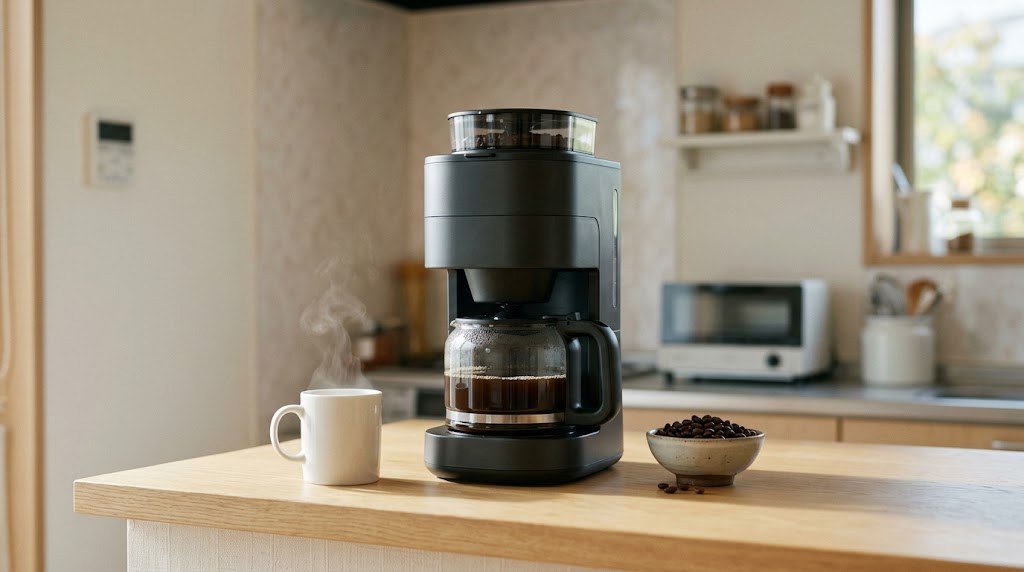
If your mornings in Japan start with instant coffee or a drip bag, a coffee maker is one of the easiest upgrades for the colder months, and a practical Christmas present for a coffee lover. The best ones here grind whole beans for you, so every pot starts with freshly ground coffee.
We compare five coffee makers with an Amazon Japan listing, from ¥10,164 to ¥58,800: a budget drip machine by Zojirushi, three grind-and-brew machines by Panasonic, Melitta and Twinbird, and a bean-to-cup espresso machine by De’Longhi. Specs come from the makers’ pages and manuals (kakaku.com where a maker page lists no spec table); prices from kakaku.com on 17 October 2026. Still choosing beans? See our Japanese coffee guide.
📌 What you will learn
You do not have to read it all — jump to what you need.
- How to choose: grinder, cups, keep-warm, space, filters
- The 5 best coffee makers, from ¥10,164
- Comparison table
- Filters, descaling, outlets, voltage and when to buy
- Frequently asked questions
- The short version
※ Start wherever fits your situation.
Prime members get fast, free delivery on millions of items, Prime Video and members-only deals. Eligible new members can try it free for 30 days.
Start your free 30-day Prime trial →Ages 18–24? See Prime for Young Adults
Paid links. As an Amazon Associate, Japan Life Lab earns from qualifying purchases. Trial eligibility and terms are set by Amazon.
How to choose a coffee maker in Japan
1. Beans or ground coffee?
A grind-and-brew machine (Japanese shops call it 全自動, zen-jidō, “fully automatic”) grinds whole beans right before it brews, so you can buy beans and still get freshly ground coffee every morning. Three of our picks do this for drip coffee, and De’Longhi’s bean-to-cup machine grinds for every espresso-style cup. If you are happy with ground coffee, a machine without a grinder, such as Zojirushi’s EC-KV50, costs about half as much as our cheapest grind-and-brew pick.
2. Cups: match the machine to your household
Makers count cups differently. Zojirushi counts about 120 ml per cup for its 5-cup EC-KV50. Panasonic’s NC-A58 makes up to 4 cups (545 ml at most, per kakaku.com), Melitta’s 6-cup AFG622-1B up to about 600 ml, and Twinbird’s CM-D465B takes up to 900 ml of water (6 cups). The De’Longhi makes one or two cups at a time.
3. Keep-warm: hot plate or thermal server
Glass carafes sit on a heated plate. Panasonic lowers the temperature 30 minutes after brewing and switches keep-warm off after two hours, to reduce stewing; Melitta and Twinbird also keep their glass pots on a warming plate. Zojirushi’s EC-KV50 brews into a vacuum-insulated stainless server instead, which keeps coffee hot without a heater, so it does not stew.
4. Space and power
Counter space in a Japanese flat is often tight. Panasonic’s NC-A58 is 15.2 cm wide; the other four are 16 to 24 cm wide. The Twinbird stands 42.5 cm tall, so check the gap under your wall cabinets, and the De’Longhi is 43 cm deep and weighs 9.5 kg. Power ranges from 650 W (Zojirushi) to 1,450 W (De’Longhi).
5. Filters and cleaning
The four drip machines use paper filters, so check the size before you buy a big pack (see the tips below). Panasonic’s NC-A58 rinses its mill automatically during every brew, and the De’Longhi rinses itself when you switch it on and off. Removable parts still need washing, and limescale has to be removed from time to time.
The 5 best coffee makers to buy in Japan in 2026
Prices include tax. Buttons go to Amazon Japan only, as these are Japan-market 100 V appliances.
1. Zojirushi EC-KV50 — budget pick with a thermal server
Zojirushi’s 珈琲通 (Coffee Tsu) EC-KV50 has no grinder, so you put ground coffee in a paper filter. It brews up to 5 cups (about 120 ml each, says Zojirushi) into a vacuum-insulated stainless server that keeps coffee hot without a heater, so it does not stew on a hot plate. An insulated swing basket limits heat loss for a hotter brew, and a lever sets mild, regular or strong.
You can also brew a single cup straight into a mug up to 12 cm tall, but Zojirushi notes that the machine does not stop by itself when the mug is full, so add only one mug’s worth of water. A water filter removes chlorine, the swing basket, filter case and water tank come off for washing, and the power switches off after brewing. Zojirushi’s page lists it in red (RA). Amazon Japan: ¥11,079; lowest in-stock shop on kakaku.com: ¥10,164 (Joshin).
| Type | Drip, no grinder; paper filter |
|---|---|
| Capacity | 5 cups (about 120 ml per cup); water 675 ml |
| Server | Vacuum-insulated stainless server, no heater |
| Features | Strength lever (3 steps), water filter, brew into a mug, auto off |
| Power | 650 W |
| Size / weight | 24 × 16.5 × 31.5 cm (W × D × H); 2.4 kg |
✅ Pros
- Cheapest pick here
- Coffee stays hot without stewing
- One cup straight into a mug
⚠️ Cons
- No grinder: needs ground coffee
- Red is the only colour Zojirushi lists
👍 Best for
- Students and first flats
- Anyone who already buys ground coffee
2. Panasonic NC-A58 — compact grind-and-brew
Panasonic’s NC-A58 takes over once you add beans and water: a vertical mill grinds them, the water is brought to a boil while circulating to reach the right temperature, the mill is rinsed automatically, and then the grounds are pre-wetted and the coffee drips through. Two mesh filters give two grind sizes, and the Rich, Mild and new Strong courses make six combinations; a separate course is tuned for decaf beans. It also brews from ground coffee.
At 15.2 cm wide it is the narrowest pick here. The glass carafe takes up to 4 cups (545 ml, per kakaku.com), and keep-warm drops in temperature after 30 minutes and switches off after two hours. Panasonic asks you to wash the parts with mild detergent after every use, as they may stain. It comes in black or white: the white was ¥19,500 on Amazon Japan, the lowest on kakaku.com; the black from ¥19,800 (Amazon ¥21,200).
| Type | Grind-and-brew drip (vertical mill); paper filter |
|---|---|
| Capacity | Up to 4 cups; 545 ml max (kakaku.com) |
| Courses | Rich / Mild / Strong with 2 grind filters; decaf course |
| Keep-warm | Lower after 30 min, off after 2 h; glass carafe |
| Power | 770 W (kakaku.com) |
| Size / weight | 15.2 × 27.2 × 34.9 cm (W × D × H, excl. handles); 3.2 kg (kakaku.com) |
✅ Pros
- Narrowest pick here: 15.2 cm
- Automatic mill wash
- Course for decaf beans
⚠️ Cons
- 4 cups at most
- Parts may stain; wash after every use
👍 Best for
- One- or two-person homes
- Narrow counters
3. Melitta Aroma Fresh AFG622-1B — conical mill under ¥20,000
German coffee brand Melitta fits a conical mill to this 6-cup Aroma Fresh for an even grind, with three grind settings. Melitta’s own single-hole filter controls the brewing time, and an extraction setting lets you adjust the taste. A timer can have coffee ready when you wake up, and the mill will not run unless the hopper lid is closed.
The removable tank brews as much water as you pour in, up to 750 ml (about 600 ml of coffee), and the glass pot sits on a heated plate. A reminder tells you when to descale. Melitta says the 6-cup model won a Good Product award in the Specialty Coffee Association of Japan’s 2022 New Product Award. Amazon Japan had it at ¥19,800, the lowest on kakaku.com; the next shop asked ¥26,780.
| Type | Grind-and-brew drip (conical mill, 3 grind settings) |
|---|---|
| Capacity | Water up to 750 ml; coffee about 600 ml (6 cups) |
| Keep-warm | Glass pot on a heated plate |
| Features | Timer, extraction setting, descale reminder |
| Power | AC 100 V, 850 W |
| Size / weight | 23.5 × 20.5 × 41.6 cm (W × D × H); 3.5 kg |
| Filter paper | Melitta 1×2 |
✅ Pros
- Conical mill under ¥20,000
- Wake-up timer
- Descale reminder
⚠️ Cons
- Price varies widely between shops
- Hot-plate keep-warm, no thermal pot
👍 Best for
- Coffee ready when you wake up
- Two to four people
4. Twinbird CM-D465B — hand-drip style for coffee fans
Japanese maker Twinbird says it developed this machine with coffee master Mamoru Taguchi. It grinds with a low-speed flat burr mill (coarse, medium or fine), then showers hot water from six directions to copy a hand pour. You choose 83 °C, which the manual calls the most balanced, or 90 °C for a firmer, more bitter cup that also suits iced coffee, and a dial sets how much water pre-wets the grounds.
Two drippers come with it, one for 1–3 cups and one for 4–6 cups, and the tank holds up to 900 ml of water. It also brews from ground coffee. Twinbird’s own store sells it for ¥48,800 with a five-year warranty that applies to purchases there only; the manual’s standard warranty is one year. On kakaku.com the lowest in-stock shop asked ¥29,700 and Amazon Japan ¥33,318.
| Type | Grind-and-brew drip (low-speed flat burr mill) |
|---|---|
| Capacity | Up to 900 ml of water (6 cups) |
| Brewing | 83 °C or 90 °C; pre-wet water dial; 6-direction shower |
| Grind | Coarse / medium / fine |
| Power | AC 100 V, 50–60 Hz, 800 W; cord 1.4 m |
| Size / weight | 16 × 33.5 × 42.5 cm (W × D × H); 4.5 kg |
| In the box | Measuring cup, brush, size 102 and 103 paper filters (5 each) |
✅ Pros
- Two brewing temperatures
- Flat burr mill, 3 settings
- Up to 6 cups
⚠️ Cons
- 5-year warranty only via Twinbird’s store
- Tallest pick here: 42.5 cm
👍 Best for
- Weekend hand-drip fans
- Iced coffee in summer
5. De’Longhi Magnifica S ECAM22112 — espresso and cappuccino
If you prefer espresso or cappuccino, a bean-to-cup machine grinds and brews each cup. De’Longhi’s Magnifica S uses a low-speed conical grinder, has a dial for coffee strength, and adds a Caffè Japone button for a regular-style cup that De’Longhi says suits Japanese tastes. A traditional steam frother foams milk for cappuccino.
The machine rinses itself automatically when you switch it on and off, and the brew unit, grounds container, drip tray and 1.8-litre water tank come out for washing; an eco mode saves power. It is the biggest pick here, measuring 23.8 × 43 × 35 cm (W × D × H), and it weighs 9.5 kg. De’Longhi’s store lists it at ¥69,800 (out of stock there on 17 October); Amazon Japan had black or white at ¥58,800, the lowest in-stock price on kakaku.com for either colour.
| Type | Bean-to-cup espresso machine (conical grinder) |
|---|---|
| Menus | Coffee (strength dial), Caffè Japone; steam frother |
| Water tank | 1.8 L |
| Power | AC 100 V, 50–60 Hz, 1,450 W (manual) |
| Size / weight | 23.8 × 43 × 35 cm (W × D × H); 9.5 kg (manual) |
| Care | Auto rinse at on/off; removable brew unit; eco mode |
✅ Pros
- Espresso and cappuccino at home
- Grinds every cup fresh
- Automatic rinse
⚠️ Cons
- Most expensive and heaviest pick here
- Milk is frothed by hand with the steam wand
👍 Best for
- Latte and cappuccino drinkers
- Homes that drink one cup at a time
Comparison table
| Model | Best for | Grinder | Capacity | Keep-warm | Width | Price, 17 Oct 2026* |
|---|---|---|---|---|---|---|
| Zojirushi EC-KV50 | Budget, ground coffee | None | 5 cups (675 ml water) | Thermal server | 24 cm | ¥10,164 lowest; Amazon ¥11,079 |
| Panasonic NC-A58 | Small kitchens | Vertical mill, 2 grinds | 4 cups (545 ml) | Hot plate, off after 2 h | 15.2 cm | White ¥19,500 (Amazon, lowest) |
| Melitta AFG622-1B | Beans on a budget | Conical, 3 grinds | About 600 ml | Heated plate | 23.5 cm | ¥19,800 (Amazon, lowest) |
| Twinbird CM-D465B | Coffee fans | Flat burr, 3 grinds | 6 cups (900 ml water) | Warming plate | 16 cm | ¥29,700 lowest; Amazon ¥33,318 |
| De’Longhi ECAM22112 | Espresso, milk drinks | Conical | 1–2 cups at a time | Brews per cup | 23.8 cm | ¥58,800 (Amazon, lowest) |
* Incl. tax, on kakaku.com. “Lowest” = lowest in-stock shop on kakaku.com; “Amazon” = Amazon.co.jp row. Capacities as each maker (or kakaku.com) states them.
Using a coffee maker in Japan: filters, descaling, outlets, voltage
Paper filters
Japanese filter papers are sold by size codes. Melitta’s AFG622-1B takes Melitta 1×2 papers. Twinbird ships size 102 and 103 papers with the CM-D465B and says shop-bought 1×2 or 2–4-person papers can replace the 102s, and 1×4 or 4–7-person papers the 103s. For the Zojirushi and the Panasonic, check the size in the manual before you buy a big pack.
Descaling with citric acid
Tap water leaves limescale inside the heater over time. Twinbird’s manual has a Clean program: dissolve about 10 g (two teaspoons) of citric acid in six cups of water, run it, then run plain tap water three or four times to remove the smell. Melitta’s manual uses 20 g of citric acid in 750 ml of water, and its troubleshooting list asks whether you have descaled in the last one to two months. Citric acid (クエン酸, kuen-san) is sold as a cleaning product in Japan.
Outlets and safe placement
Twinbird’s manual asks you to plug the CM-D465B on its own into a wall outlet rated 15 A or more at 100 V, because sharing a multi-outlet with other appliances can overheat it. The same manual says not to use it on tatami, carpet, a tablecloth or a plastic stand, nor close to walls and furniture, and to keep it out of reach of small children. De’Longhi’s manual for the ECAM22112 also asks for a 15 A, 100 V outlet used on its own, with no extension cord or power strip. Read your own model’s manual for its rules.
Taking it home when you leave Japan
Melitta lists AC 100 V for the AFG622-1B. De’Longhi’s Japanese manual lists 100 V, 50–60 Hz for the ECAM22112 and says not to use it in regions with a different supply voltage, as it is for Japan only. Twinbird’s manual says the CM-D465B is designed and sold for Japan only, cannot be used in countries with a different voltage or frequency, and gets no repair service abroad. The Zojirushi and Panasonic pages we read do not state the voltage, so check the rating label. Plan to sell or give away the machine when you leave.
When to buy
Amazon.co.jp’s Prime Kanshasai (プライム感謝祭), for Prime members only, had its main sale from 16 to 19 October 2026 (until 23:59 on the 19th) after a pre-sale from 13 to 15 October, and its point-up campaign needed an entry and a total spend of ¥10,000 or more. We do not know which coffee makers will be discounted, so add your pick to your wish list and compare with the prices above (see our sale calendar).
Frequently asked questions
Is a grind-and-brew machine worth the extra cost?
If you buy whole beans, it saves grinding by hand every morning. Our three grind-and-brew picks cost ¥19,500 to ¥29,700 at the lowest shop, against ¥10,164 for the Zojirushi EC-KV50, which has no grinder. If you only buy ground coffee, the Zojirushi does the job for about half the price.
Can I use ground coffee in a grind-and-brew machine?
Panasonic says the NC-A58 also brews from ground coffee (put it on the paper filter), and Twinbird’s CM-D465B has a setting for ground coffee. For other models, check the manual.
Which paper filters do I need?
Melitta’s AFG622-1B takes Melitta 1×2 papers. Twinbird includes size 102 and 103 papers and says 1×2 and 1×4 papers also fit. The De’Longhi needs no paper filter. For the Zojirushi and the Panasonic, check the manual.
Can I take a Japanese coffee maker abroad?
Usually not. Twinbird’s manual says the CM-D465B cannot be used in countries with a different voltage or frequency, Melitta lists AC 100 V for the AFG622-1B, and De’Longhi’s Japanese manual says the 100 V ECAM22112 is for Japan only. Check the rating label on any model before you pack it.
Is the De’Longhi hard to keep clean?
It rinses itself when you switch it on and off, and the brew unit, grounds container, drip tray and water tank come out for washing. You still empty the grounds container, and De’Longhi’s manual asks you to clean the milk frother every time you froth milk: dip it in a jug of water, run steam for about 10 seconds and wipe it.
The short version
Ground coffee on a budget: Zojirushi EC-KV50. Fresh beans in a small kitchen: Panasonic NC-A58. Conical mill and a wake-up timer for under ¥20,000: Melitta Aroma Fresh AFG622-1B. Two brewing temperatures and up to six cups: Twinbird CM-D465B. Espresso and cappuccino: De’Longhi Magnifica S ECAM22112. Count your cups, measure the space under your cabinets and check the filter size. If you would rather hand-drip, start with a good kettle from our kettle guide.
🔥 Editor’s Picks for Life & Travel in Japan
Japan Expat Starter Kit 2026 PDF guide
Your first 90 days in Japan, step by step: 17 chapters · 24 pages · 100 phrases in Japanese script · 40 kanji · printable checklists. Bank account, My Number, health insurance, apartment, phone, taxes & pension.
$9.99 $4.99 current price
📥 Get the kit →📄 Read 5 pages free: contents + Chapter 2
⚡ Instant PDF download · 🛡️ 30-day money-back guarantee · 🔄 Free 2026 updates
🛒 Ready to Buy? Shop These in Japan!
Get fast delivery across Japan — including same-day in major cities
Practical guides for life and travel in Japan — free, about once a week. No spam, unsubscribe anytime.
☕ Enjoying our Japan guides?
If this article helped you, you can support our work with a coffee!
Leave a Reply