This article was created with AI writing assistance (ChatGPT, Claude, etc.). Product selection, specifications, and reviews are verified by the Japan Life Lab editorial team.
This article contains promotional / affiliate links.
Lift your futon on a winter morning in a Japanese apartment and the underside may feel cold and clammy. Sweat and condensation from the cold floor collect in the bottom futon, and hanging it on the balcony is hard on short winter days.
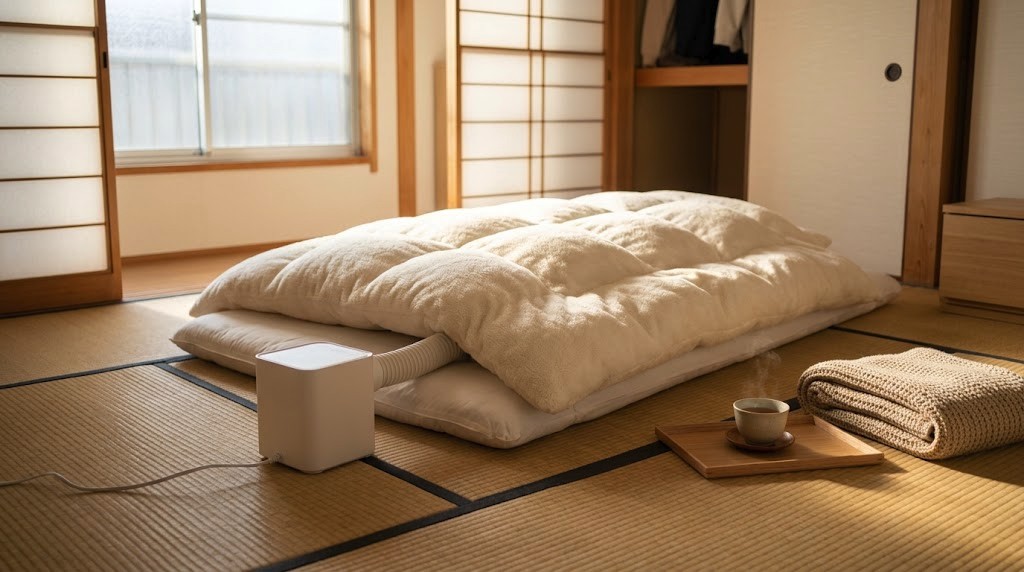
A futon dryer (布団乾燥機, futon kansoki) blows warm air between the bottom futon and the duvet: it drives out the damp, helps against dust mites and turns a cold futon warm in minutes. This guide compares six models on sale now, from about ¥8,690 to ¥17,700, using the makers’ specs, kakaku.com prices as of September 2026 and running costs at the 31 yen/kWh guideline. New to Japanese bedding? See our futon and bedding guide.
📌 What you will learn
You do not have to read it all — jump to what you need.
- Why futons get damp in winter
- How to choose: type, power, speed
- The 6 best futon dryers for 2026
- Comparison and running costs
- Safety, mites and mold tips
- Frequently asked questions
- The short version
※ Start wherever fits your situation.
Why futons get damp (and cold) in a Japanese winter
The bedding maker Nishikawa puts overnight sweat at about 200 ml, a glass of water, most of it absorbed by the futon. In winter, heated room air also condenses on the cold floor under a futon laid on flooring. Nishikawa’s tell-tale sign is a dry duvet over a bottom futon that is wet only underneath, and it warns that dark spots can appear on the lining within weeks. Hitachi agrees that the underside of the shikibuton (bottom futon) is where moisture gathers most.
How to choose a futon dryer
1. Mat, hose or nozzle?
| Type | How it works | Plus | Minus | In this guide |
|---|---|---|---|---|
| Air mat (マットあり) | A mat between the futons fills with warm air | Heat reaches the corners | Mat to fold every time | YAMAZEN |
| Hose or nozzle (マットなし) | A nozzle slides between the futons | Quick; one or two nozzles | Edges get less heat | Hitachi, Iris Ohyama |
| No mat, no hose (マット・ホースなし) | Its outlet goes straight between the futons | Fastest set-up | Fewer accessories | Zojirushi, cado |
That is kakaku.com’s own split, and convenience is winning: on 28 September 2026 it listed 3 mat-type models against 95 mat-free ones.
2. One futon or two?
Zojirushi, Hitachi and cado heat one set at a time, up to double size. Iris Ohyama’s twin-nozzle models serve two single futons at once.
3. Watts, breakers and running costs
The picks draw 420 W to 1,380 W. At Japan’s 100 V, every 100 W is about 1 A, and a standard wall outlet is rated 15 A, or 1,500 W across all its sockets; the security firm ALSOK suggests keeping a power strip to about 1,200–1,300 W. If your breaker trips easily, favor 420–760 W models, such as Hitachi’s compact HFK-CV1B (420 W, about ¥10,384).
Cost is watts × hours ÷ 1,000 × 31 yen. Zojirushi puts a 35-minute RF-FB20 run at about ¥17, and Hitachi a single-futon HFK-VS6000 run at 292 Wh, roughly ¥9. A 10-minute warm-up every night for a month at the RF-FB20’s full 910 W costs at most about ¥141.
4. Warm-up, drying and extras
Warming and drying are separate courses; Zojirushi notes its warm-up does not dry the futon. Iris Ohyama’s BSK-210-W claims the fastest warm-up, about 2 minutes, against 10 on the Zojirushi and cado. To dry a single futon, Hitachi quotes about 27 minutes, Zojirushi 35 and Iris’s winter mode 25–40. Mite modes blow air of about 50°C or more, usually for an hour or longer. Every pick except the cado can dry shoes out of the box, and Zojirushi, Hitachi and YAMAZEN also dry small laundry loads (Hitachi: about 1 kg).
The 6 best futon dryers for 2026
All six are on sale in Japan now. Prices are kakaku.com’s lowest on 28 September 2026 unless stated.
1. Zojirushi Smart Dry RF-FB20 — best overall
Zojirushi pioneered the futon dryer with neither mat nor hose in 2012, and the RF-FB20 (September 2023) is its current large model. Open the body, slip its flat outlet between the futons and press start. A size key switches between single and double. A standard winter run dries a single set in 35 minutes for about ¥17, the quick course warms the bed in 10, and the tilting outlet dries shoes and laundry without attachments.
Smaller sibling: the RF-UA10 (670 W, 3.4 kg), top of kakaku.com’s popularity ranking in late September 2026, needs 50 minutes per winter run and 15 to warm, from about ¥11,838.
| Type / release | No mat, no hose / September 2023 |
|---|---|
| Power (50/60 Hz) | 905 / 910 W |
| Drying / warm-up / mites | 35 or 60 min / 10 or 20 min / 80 min (single) |
| Size / weight | W23 × D15 × H36 cm, 3.8 kg |
| Price | About ¥14,237 on kakaku.com; about ¥15,280 on Amazon.co.jp (as of September 2026) |
✅ Pros
- No mat or hose
- About ¥17 per 35-minute run
- Shoes and laundry without attachments
⚠️ Cons
- Draws up to 910 W
- Heavy for its type at 3.8 kg
- One futon set at a time
👍 Best for
- First-time buyers
- Single or double futons
- Nightly winter warm-ups
Compact RF-UA10:
2. Hitachi Atto Dry HFK-VS6000 — best for futons on the floor
Hitachi’s high-power model (November 2023) blows through a V-shaped attachment that extends and spreads out. Clamp it around the bottom futon and it dries both faces at once, damp underside included. A telescopic hose about 130 cm long overall reaches tall beds (though Hitachi says not every bed), doubles are covered and an allergen filter is built in.
Hitachi publishes the most detailed figures here: about 27 minutes and 292 Wh (roughly ¥9) for a single non-cotton futon, 37 minutes for cotton and 80 for a double. A power-saving course uses about 20% less, the mite course takes about 65 minutes, and it dries up to about 1 kg of laundry.
| Type / release | Hose + V-shaped attachment / November 2023 |
|---|---|
| Power | Max 680 W |
| Drying / mites | About 27 min (cotton 37) / about 65 min (single) |
| Size / weight | W28.3 × D21.7 × H33.8 cm, 4.3 kg |
| Price | About ¥14,580 on kakaku.com (as of September 2026) |
✅ Pros
- Dries both sides of the bottom futon
- About ¥9 per single run
- Long hose; allergen filter
⚠️ Cons
- Heaviest here at 4.3 kg
- Clothes cover costs extra
- Bulky, 28 cm wide
👍 Best for
- Futons on flooring or tatami
- Tall beds and doubles
- Allergy-prone households
3. Iris Ohyama Kararie mini TURBO Twin Nozzle — fastest warm-up
Iris Ohyama fits two nozzles into a 1.4 kg body about half the size of its older KFK-402: two single futons at once, or both nozzles in one futon for speed. The BSK-210-W (1,380 W) is the version Iris says warms a single futon in about 2 minutes on turbo (8 on standard); the slightly less powerful JSK-W10 (1,360 W, three colors) takes about 4. Winter-mode drying runs 25–35 minutes on the BSK-210-W and 30–40 on the JSK-W10. Iris also cites a lab test in which a 60-minute turbo run, with the futon in an optional mite bag, killed over 99% of mites (BSK-210-W).
The catch is power: up to 1,380 W of an outlet’s 1,500 W, and 1,270–1,280 Wh per hour on turbo, about ¥39–40.
| Type / release | Twin nozzle / November–December 2025 |
|---|---|
| Power | Max 1,360 W (JSK-W10) / 1,380 W (BSK-210-W) |
| Warm-up / winter mode | BSK-210-W 2–8 / 25–35 min; JSK-W10 4–10 / 30–40 min |
| Size / weight | W13 × D15.8–16.6 × H26 cm, 1.4 kg; 2 shoe attachments |
| Price | JSK-W10 about ¥15,128–¥17,500; BSK-210-W about ¥16,839 on kakaku.com (as of September 2026) |
✅ Pros
- Fastest warm-up claim here
- Two futons or two pairs of shoes
- Just 1.4 kg
⚠️ Cons
- Up to 1,380 W: own wall outlet
- About ¥39–40 an hour on turbo
- 2-minute claim is BSK-210-W only
👍 Best for
- Couples on two futons
- Warming the bed before sleep
- Tiny closets
4. Iris Ohyama Kararie Twin Nozzle FK-W2 — budget pick for two futons
The FK-W2 is the plainer twin: two nozzles on hoses about 1 m long overall, winter, summer, warm-up, mite (air of about 50°C or more) and manual modes, plus a two-hour keep-warm setting. At 760 W and about ¥11,114, it is the cheapest twin-nozzle pick here.
Coming 5 October 2026: the FK-W3 (¥16,280 direct from Iris, up to 880 W) adds a sleep mode that keeps one single futon warm while you sleep, at 18 dB by Iris’s own measurement.
| Type | Twin nozzle with hoses |
|---|---|
| Power | 760 W |
| Timer | 15 to 180 min, 8 steps |
| Size / weight | W16.6 × D19.6 × H32 cm, 2.4 kg; 2 shoe attachments |
| Price | About ¥11,114 on kakaku.com; about ¥11,149 on Amazon.co.jp (as of September 2026) |
✅ Pros
- Two futons for about ¥11,000
- 760 W suits small breakers
- Mite mode and keep-warm
⚠️ Cons
- No published drying times
- Older design (2021)
- Hoses to store
👍 Best for
- Couples on a budget
- Two futons side by side
- Shoe drying in wet weather
5. cado FOEHN 003 — best if you might leave Japan
cado, the Tokyo air-purifier brand, turned the futon dryer into a 31.5 cm stick weighing about 420 g without the cord: push it between the futons and press one button. It has three courses: a 10-minute warm-up, 80 minutes for drying and mites, and 120 minutes of fan. It draws just 420 W, yet in cado’s thermal test the 80-minute course brought a whole double futon to about 50–60°C. It also uses ozone against odors.
The feature expats should notice: the FOEHN 003 (October 2025) runs on AC100–240 V, so it can move abroad with you, perhaps with a plug adapter; see our leaving-Japan checklist. Shoe drying needs a ¥5,720 stand, and the suggested price is ¥24,200, though kakaku.com lists about ¥17,667.
| Type / release | Stick, no mat or hose / October 2025 |
|---|---|
| Power / voltage | 420 W / AC100–240 V, 50–60 Hz |
| Courses | Warm-up 10 min; drying and mites 80 min; fan 120 min |
| Size / weight | 4.9 cm across × 31.5 cm, about 420 g |
| Price | Suggested ¥24,200; about ¥17,667 on kakaku.com (as of September 2026) |
✅ Pros
- Rated for 100–240 V
- Lowest draw here, 420 W
- Fits in a drawer
⚠️ Cons
- Pricey for its features
- Shoe stand costs ¥5,720
- One fixed 80-minute drying course
👍 Best for
- Expats who may move abroad
- Small studios
- Weak breakers
6. YAMAZEN ZFD-Y500 — cheapest, classic air mat
The ZFD-Y500 is the old-school design: an 80 × 180 cm air mat between the futons carries warm air to the edges, which kakaku.com’s guide says mat types do best, at the cost of laying out and folding the mat each time. It has two courses (winter, and summer with a cool-down fan), draws 500 W, includes a shoe attachment, and its body stands or lies flat for beds or tatami. Listed on kakaku.com since 2017, it is the cheapest pick here.
| Type | Air mat, 80 × 180 cm |
|---|---|
| Power | 500 W |
| Courses | Winter; summer (warm air, then fan) |
| Size / weight | W30.5 × D14 × H24.5 cm, 2.7 kg |
| Price | About ¥8,690 on Amazon.co.jp, the lowest on kakaku.com (as of September 2026) |
✅ Pros
- Cheapest here
- Even heat to the edges
- Gentle 500 W
⚠️ Cons
- Mat to fold every time
- Only two courses
- Old design (2017)
👍 Best for
- Tight budgets
- Even drying of one futon
- Occasional use
Comparison and running costs
| Model | Type | Max power | Cost/hour at max* | Weight | Warm-up** | Drying, single** | Futons | Price |
|---|---|---|---|---|---|---|---|---|
| Zojirushi RF-FB20 | No mat, no hose | 910 W | ¥28 | 3.8 kg | 10 min | 35 min | 1 (to double) | ¥14,237 |
| Hitachi HFK-VS6000 | Hose + V nozzle | 680 W | ¥21 | 4.3 kg | — | 27 min | 1 (to double) | ¥14,580 |
| Iris mini TURBO Twin | Twin nozzle | 1,360–1,380 W | ¥42–43 | 1.4 kg | 2–10 min | 25–40 min | 2 | ¥15,128–¥17,500 |
| Iris FK-W2 | Twin nozzle | 760 W | ¥24 | 2.4 kg | — | — | 2 | ¥11,114 |
| cado FOEHN 003 | Stick | 420 W | ¥13 | 0.42 kg | 10 min | 80 min | 1 (to double) | ¥17,667 |
| YAMAZEN ZFD-Y500 | Air mat | 500 W | ¥16 | 2.7 kg | — | — | 1 | ¥8,690 |
* Rated maximum for one hour at 31 yen/kWh; real runs use less, as heaters cycle. ** Makers’ figures or preset course times, single futon; “—” = not published. Prices: kakaku.com lowest, 28 September 2026.
Safety, mites and mold: using a futon dryer well
Set it up between the futons
Place the nozzle or mat between the bottom futon and the duvet; kakaku.com warns that covering a machine on the floor with a futon can cause faults or accidents. Zojirushi’s Smart Dry stops if the duvet covers it. Check your bedding’s heat tolerance first: cado asks for at least 70°C and warns that memory foam and similar materials can be damaged.
Do not sleep with it running
For its FK-W3, Iris Ohyama warns that outside sleep mode you should not get into the futon while it runs or right after, because of the risk of burns. That is sensible with any model: warm the futon, switch off, then get in. Plug the dryer straight into a wall outlet, not a strip shared with a heater or kettle.
Vacuum after mite mode
Nishikawa says house dust mites die after 20–30 minutes at 50°C, but dead mites and droppings remain allergens, so vacuum the futon afterwards; Iris Ohyama gives the same advice.
Keep the damp away
Under floor futons, Nishikawa suggests a slatted wooden base (すのこ, sunoko) or a moisture-absorbing mat to create an air gap, and propping the futon up in the morning. Windows streaming too? See our dehumidifier guide.
Voltage and where to buy
Every pick except the cado is built for Japan’s 100 V only. On 28 September kakaku.com showed Amazon.co.jp offers for all six (JSK-W10 versions of the mini TURBO). Amazon Japan’s Prime Kanshasai sale for Prime members runs 16–19 October 2026, with a pre-sale on 13–15 October; Amazon has not said which futon dryers will be discounted.
Frequently asked questions
Is a futon dryer worth it if I sleep on a futon on the floor?
Usually, yes. Overnight sweat (about 200 ml, according to Nishikawa) and winter condensation from cold flooring collect in the bottom futon, and a dryer removes that moisture indoors. Most also warm a cold futon in minutes, and makers’ figures work out at roughly ¥9–¥17 per single-futon drying run.
How much electricity does a futon dryer use in Japan?
The models here draw 420 W to 1,380 W. Zojirushi puts a 35-minute RF-FB20 run at about ¥17; Hitachi’s HFK-VS6000 uses about 292 Wh (roughly ¥9) for a single futon. Estimate any model with watts × hours ÷ 1,000 × 31 yen.
Does a futon dryer kill dust mites?
Heat does: Nishikawa says house dust mites die after 20–30 minutes at 50°C, and mite courses run about 60–120 minutes. Mites can escape (Zojirushi), and dead mites still cause allergies, so vacuum afterwards.
Can I use a futon dryer on a bed?
Yes: put the nozzle or mat between the mattress and the duvet. Hitachi’s hose, about 130 cm long overall, is designed to reach tall beds (though not every bed), and the YAMAZEN body can stand upright or lie flat.
Can I sleep with a futon dryer running?
Not with a standard model. Iris Ohyama warns of burns if you get in while it runs or right after, outside sleep mode. Its FK-W3, on sale from 5 October 2026, has a sleep mode designed for use in one single futon.
The short version
Just want one that works? The Zojirushi RF-FB20: no mat or hose, 35-minute drying, about ¥14,200. Floor futons: the Hitachi HFK-VS6000, about ¥9 per single-futon run. Two futons: the Iris Ohyama FK-W2 (about ¥11,100) or the fast mini TURBO Twin on its own outlet. Leaving Japan one day: the 100–240 V cado FOEHN 003. Tight budget: the YAMAZEN ZFD-Y500, about ¥8,700. Then add a slatted base and vacuum after mite mode.
🔥 Editor’s Picks for Life & Travel in Japan
📘 The Japan Expat Starter Kit 2026
Banking, housing, My Number, taxes, 100 phrases and a 40-kanji cheat sheet — everything from this site in one 17-chapter PDF field manual. Free lifetime 2026 updates.
Reader price: $9.99 $6.99 with code JLL30 at checkout
30-day money-back guarantee · Instant download · PR
🛒 Ready to Buy? Shop These in Japan!
Get fast delivery across Japan — including same-day in major cities
Practical guides for life and travel in Japan — free, about once a week. No spam, unsubscribe anytime.
☕ Enjoying our Japan guides?
If this article helped you, you can support our work with a coffee!
Leave a Reply