This article was created with AI writing assistance (ChatGPT, Claude, etc.). Product selection, specifications, and reviews are verified by the Japan Life Lab editorial team.
This article contains promotional / affiliate links.
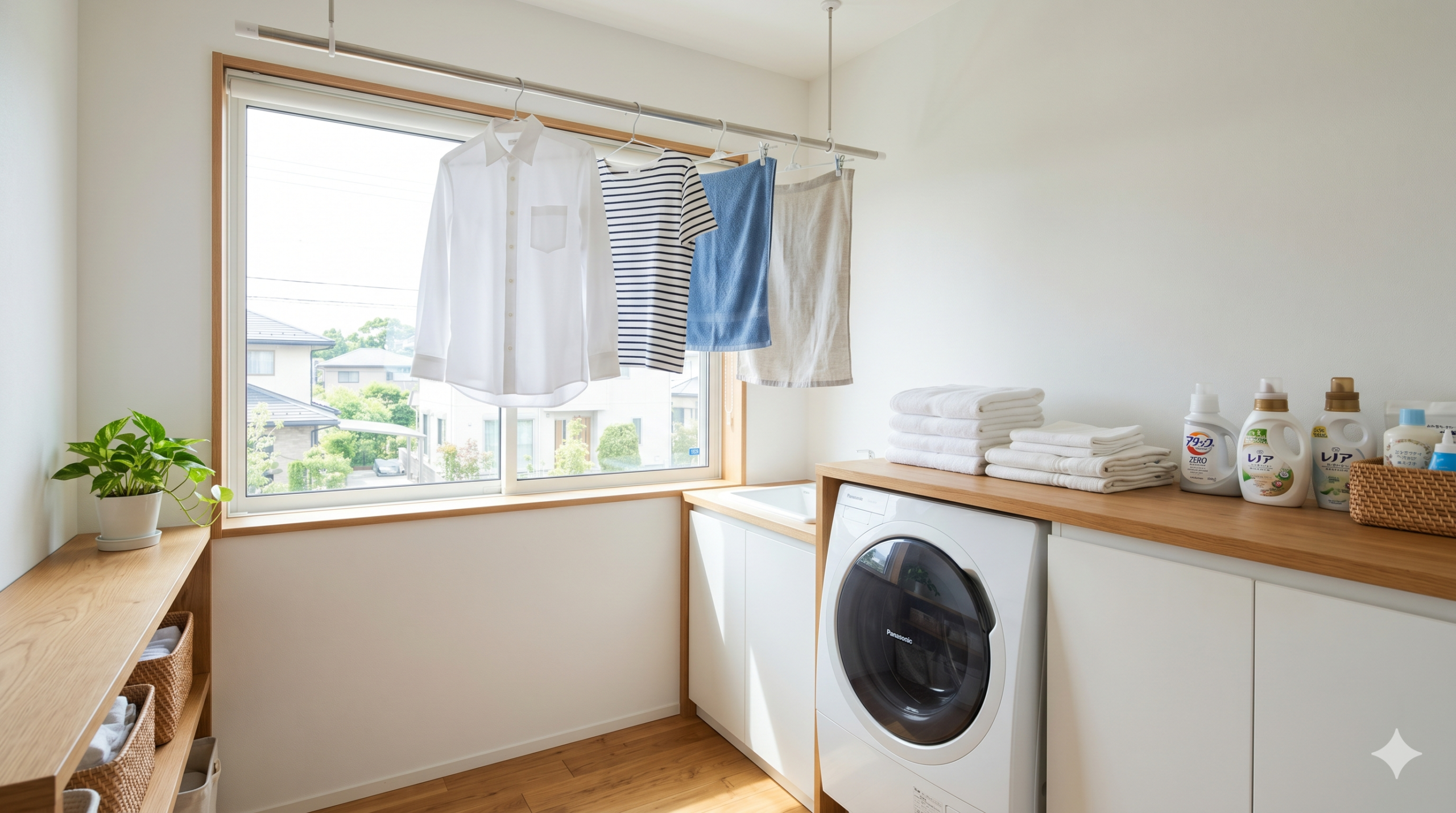
Doing laundry in Japan looks simple until you stand in front of a washing machine covered in kanji, with no idea which button starts it. Add the rainy season, tiny balconies, no clothes dryer, and detergent bottles you can’t read, and laundry day becomes surprisingly stressful. This complete guide walks you through everything: decoding your washing machine, buying the right detergent, using a coin laundry, and drying clothes indoors without that musty smell.
📌 What you will learn
You do not have to read it all — jump to what you need.
- 1. Understanding Japanese Washing Machines
- 2. Choosing the Right Detergent (and Where to Pour It)
- 3. The Rainy Season Problem: Drying Clothes Indoors
- 4. Using a Coin Laundry (Coin-Operated Laundromat)
- 5. Quick Tips Japanese People Know
- Final Thoughts
※ Start wherever fits your situation.
1. Understanding Japanese Washing Machines
Most Japanese homes have a top-loading washer (cheaper, common in apartments) or a front-loading washer-dryer (drum type, dries clothes too). Crucially, most Japanese washers do NOT heat the water — they wash in cold tap water, which is normal here and fine for everyday clothes.
Key buttons (with the kanji you’ll see)
- 入/切 (On/Off) — power
- スタート/一時停止 (Start/Pause) — begins the cycle
- 標準 (Standard) — the normal everyday wash; just press this and Start for 90% of loads
- 洗い (Wash) / すすぎ (Rinse) / 脱水 (Spin) — the three stages
- おまかせ (Auto) — the machine senses the load and decides everything
- 乾燥 (Dry) — only on drum-type washer-dryers
The easy method: add clothes, add detergent, press 標準 (Standard) then スタート (Start). That’s it for most loads.
2. Choosing the Right Detergent (and Where to Pour It)
Japanese detergents come in three main types, and the packaging is mostly in Japanese, so here’s how to tell them apart:
- 洗濯洗剤 (Laundry detergent) — liquid or pods; the main cleaner. Top brands: Attack, Ariel, NANOX.
- 柔軟剤 (Fabric softener) — makes clothes soft and scented (Lenor, Humming). This is NOT detergent — it goes in a separate slot.
- 漂白剤 (Bleach) — oxygen bleach (酸素系) is safe for colors; chlorine (塩素系) is whites only.
Pour detergent into the slot marked 洗剤 and softener into 柔軟剤. Pod-type (ジェルボール) detergents are the most foolproof — just toss one in with the clothes, no measuring.
3. The Rainy Season Problem: Drying Clothes Indoors
Here’s the biggest culture shock: most Japanese homes have no clothes dryer. People hang laundry outside on balconies — but during the June–July rainy season (tsuyu) and typhoon season, you’re stuck drying indoors (heya-boshi), and clothes develop a sour, musty smell.
How to dry indoors without the smell
- Use a clothes-drying dehumidifier — the single best fix; it blasts dry air at the rack and dries a load in hours.
- Space clothes out with an indoor drying rack and point a fan or circulator at them.
- Use antibacterial detergent (labeled 部屋干し, “room-drying”) made specifically to prevent odor.
- Don’t leave wet laundry bunched up — hang it immediately after the spin cycle.
4. Using a Coin Laundry (Coin-Operated Laundromat)
No washer at home, or need to dry a big load fast? A coin laundry (コインランドリー) is your friend — and they have powerful gas dryers that home machines lack.
- Put clothes in the washer (洗濯機), choose a course, insert coins (usually ¥300–600).
- Detergent is often dispensed automatically; if not, machines or a shop nearby sell it.
- Move clothes to the dryer (乾燥機) — about ¥100 per 10 minutes. A full load takes 30–40 minutes.
Many coin laundries now accept IC cards or app payment, and some are open 24 hours. Great for futons and large blankets too.
5. Quick Tips Japanese People Know
- Turn clothes inside out to protect prints and reduce fading.
- Use a laundry net (洗濯ネット) for delicates, bras and anything with hooks.
- Don’t overload — clothes need room to move to get clean.
- Wipe the rubber seal and leave the door open on drum washers to prevent mold.
- Hang shirts on hangers straight from the washer to skip ironing.
Final Thoughts
Once you learn three buttons (標準 → スタート), pick the right detergent, and solve the rainy-season drying problem with a dehumidifier, laundry in Japan becomes genuinely easy. Keep a clothes-drying dehumidifier and a room-drying detergent on hand, and you’ll never fear tsuyu — or that musty smell — again.
🔥 Editor’s Picks for Life & Travel in Japan

Japan Expat Starter Kit 2026 PDF guide
Your first 90 days in Japan, step by step: 17 chapters · 24 pages · 100 phrases in Japanese script · 40 kanji · printable checklists. Bank account, My Number, health insurance, apartment, phone, taxes & pension.
$9.99 $4.99 current price
📥 Get the kit →📄 Read 5 pages free: contents + Chapter 2
⚡ Instant PDF download · 🛡️ 30-day money-back guarantee · 🔄 Free 2026 updates
Practical guides for life and travel in Japan — free, about once a week. No spam, unsubscribe anytime.
☕ Enjoying our Japan guides?
If this article helped you, you can support our work with a coffee!
Did this guide help you? 🍵
Japan Life Lab is a small independent blog, and every guide we publish is completely free — no paywalls, ever. If our work saved you time (or a headache), you can support us with a cup of Japanese tea. Every contribution, big or small, goes straight into keeping these guides free, accurate and up to date for everyone.
☕ Support Japan Life Lab
Leave a Reply