This article was created with AI writing assistance (ChatGPT, Claude, etc.). Product selection, specifications, and reviews are verified by the Japan Life Lab editorial team.
This article contains promotional / affiliate links.
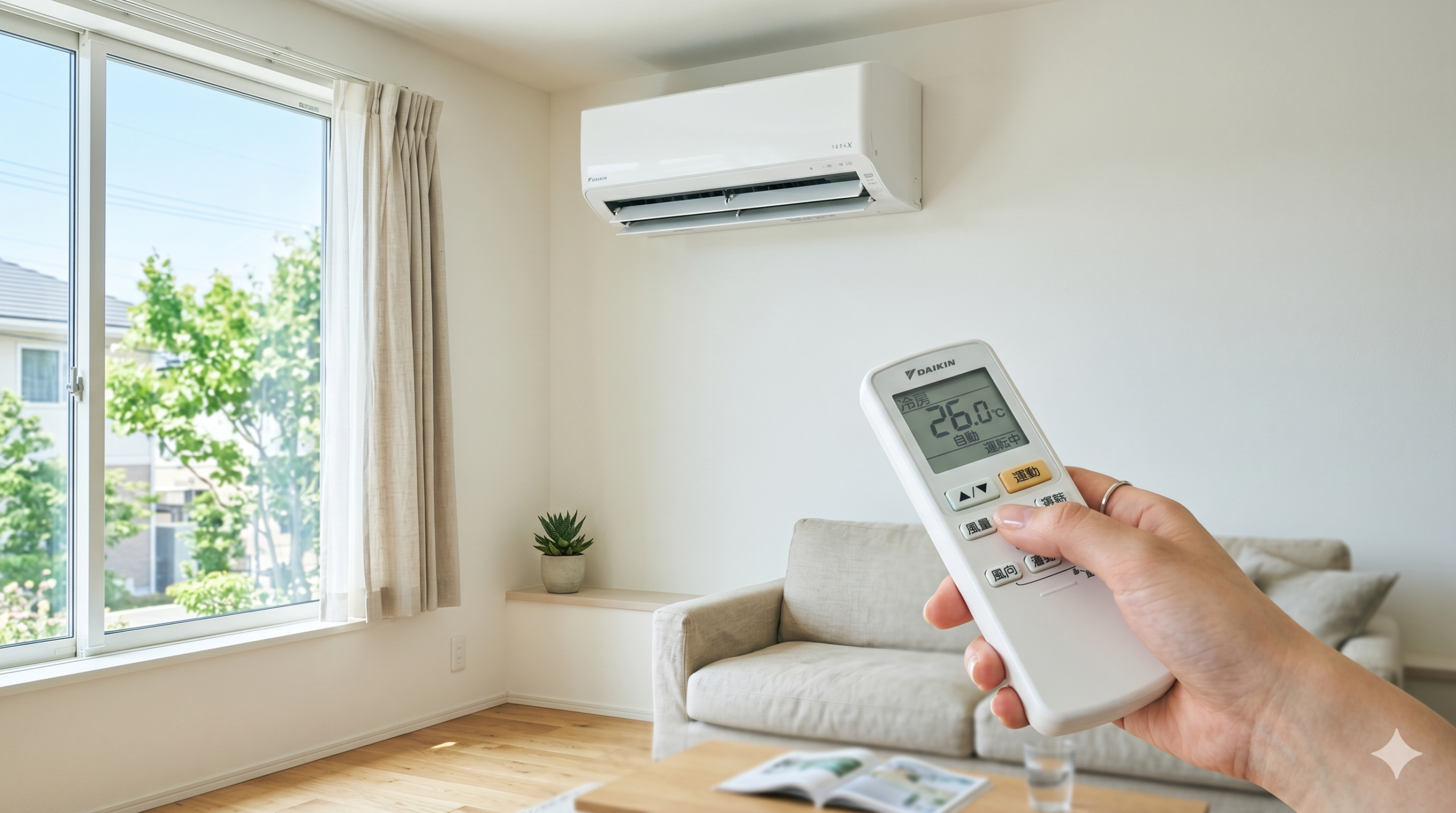
Japanese summers are brutally hot and humid, and your apartment’s air conditioner (エアコン, eakon) is your lifeline. The problem? The remote is covered in kanji, the modes are confusing, and used wrong, your AC can send your electricity bill through the roof. This guide decodes the Japanese AC remote button by button and shows you how to stay cool while cutting your summer bill in 2026.
📌 What you will learn
You do not have to read it all — jump to what you need.
- Decoding the Japanese AC Remote: Key Buttons
- 冷房 (Cooling) vs 除湿 (Dry): Which to Use?
- How to Cut Your Summer Electricity Bill
- Make Your Old AC Smart (Rentals OK)
- Common Mistakes to Avoid
- Final Thoughts
※ Start wherever fits your situation.
Decoding the Japanese AC Remote: Key Buttons
Almost every Japanese AC remote shares the same core buttons. Here are the ones that matter, with the kanji you’ll see:
- 運転/停止 (Start/Stop) — turns the AC on and off.
- 冷房 (Cooling) — this is the one you want in summer. Blue snowflake icon.
- 暖房 (Heating) — winter heat. Red sun icon. Don’t press this in summer!
- 除湿/ドライ (Dehumidify / Dry) — removes humidity; great for the muggy rainy season.
- 自動 (Auto) — the unit picks the mode and temperature for you.
- 温度 ▲▼ (Temperature up/down) — set your target temperature in Celsius.
- 風量 (Fan speed) — 自動 (auto), 弱 (low), 強 (high).
- 風向 (Air direction / swing) — aims the louvers up/down.
- タイマー (Timer) — auto on/off after set hours; great for sleeping.
The simple summer method: press 運転 (Start), select 冷房 (Cooling), and set the temperature to around 27–28°C. That’s it.
冷房 (Cooling) vs 除湿 (Dry): Which to Use?
This trips up everyone. 冷房 (Cooling) lowers the air temperature — use it on hot days. 除湿 (Dry) removes moisture while barely cooling — perfect for the sticky June–July rainy season when it’s humid but not scorching. On a hot, humid day, Cooling is usually both cooler and, surprisingly, often more energy-efficient than the older “weak dry” mode.
How to Cut Your Summer Electricity Bill
Air conditioning is the biggest summer expense for most households in Japan. These habits make a real difference:
- Set it to 28°C, not 24°C. Every degree lower significantly raises consumption. Pair 28°C with a fan for comfort.
- Use a fan or circulator to spread the cool air — you’ll feel cooler at a higher set temperature.
- Leave it on auto fan (風量自動) rather than constantly turning the AC on and off — restarting uses the most power.
- Clean the filters every two weeks. Clogged filters make the unit work much harder.
- Block the sun with curtains or a reed screen (sudare) so the room doesn’t heat up.
- Use the timer so the AC isn’t running all night at full blast.
Make Your Old AC Smart (Rentals OK)
Can’t read the remote, or want to turn the AC on from your phone before you get home? A smart IR remote hub like the SwitchBot Hub learns your existing AC remote and lets you control it by app or voice — in English. It also shows room temperature and humidity, and can auto-turn-on the AC when the room gets too hot. It installs with no wiring, so it’s perfect for renters.
Common Mistakes to Avoid
- Pressing 暖房 (Heating) by mistake in summer — if warm air comes out, you hit the red one.
- Setting the temperature far too low, then freezing and turning it off — just set 27–28°C and leave it.
- Never cleaning the filter — the #1 cause of weak cooling and high bills.
- Forgetting the AC also dries laundry — 除湿 mode helps clothes dry indoors during tsuyu.
Final Thoughts
Once you know that 冷房 means cooling, set it to 28°C with a fan, and clean the filters, the Japanese AC remote stops being scary — and your summer bill drops. Add a smart IR hub and you can control the whole thing from your phone in English. Stay cool out there.
🔥 Editor’s Picks for Life & Travel in Japan
Japan Expat Starter Kit 2026 PDF guide
Your first 90 days in Japan, step by step: 17 chapters · 24 pages · 100 phrases in Japanese script · 40 kanji · printable checklists. Bank account, My Number, health insurance, apartment, phone, taxes & pension.
$9.99 $4.99 current price
📥 Get the kit →📄 Read 5 pages free: contents + Chapter 2
⚡ Instant PDF download · 🛡️ 30-day money-back guarantee · 🔄 Free 2026 updates
Practical guides for life and travel in Japan — free, about once a week. No spam, unsubscribe anytime.
☕ Enjoying our Japan guides?
If this article helped you, you can support our work with a coffee!
Did this guide help you? 🍵
Japan Life Lab is a small independent blog, and every guide we publish is completely free — no paywalls, ever. If our work saved you time (or a headache), you can support us with a cup of Japanese tea. Every contribution, big or small, goes straight into keeping these guides free, accurate and up to date for everyone.
☕ Support Japan Life Lab
Leave a Reply