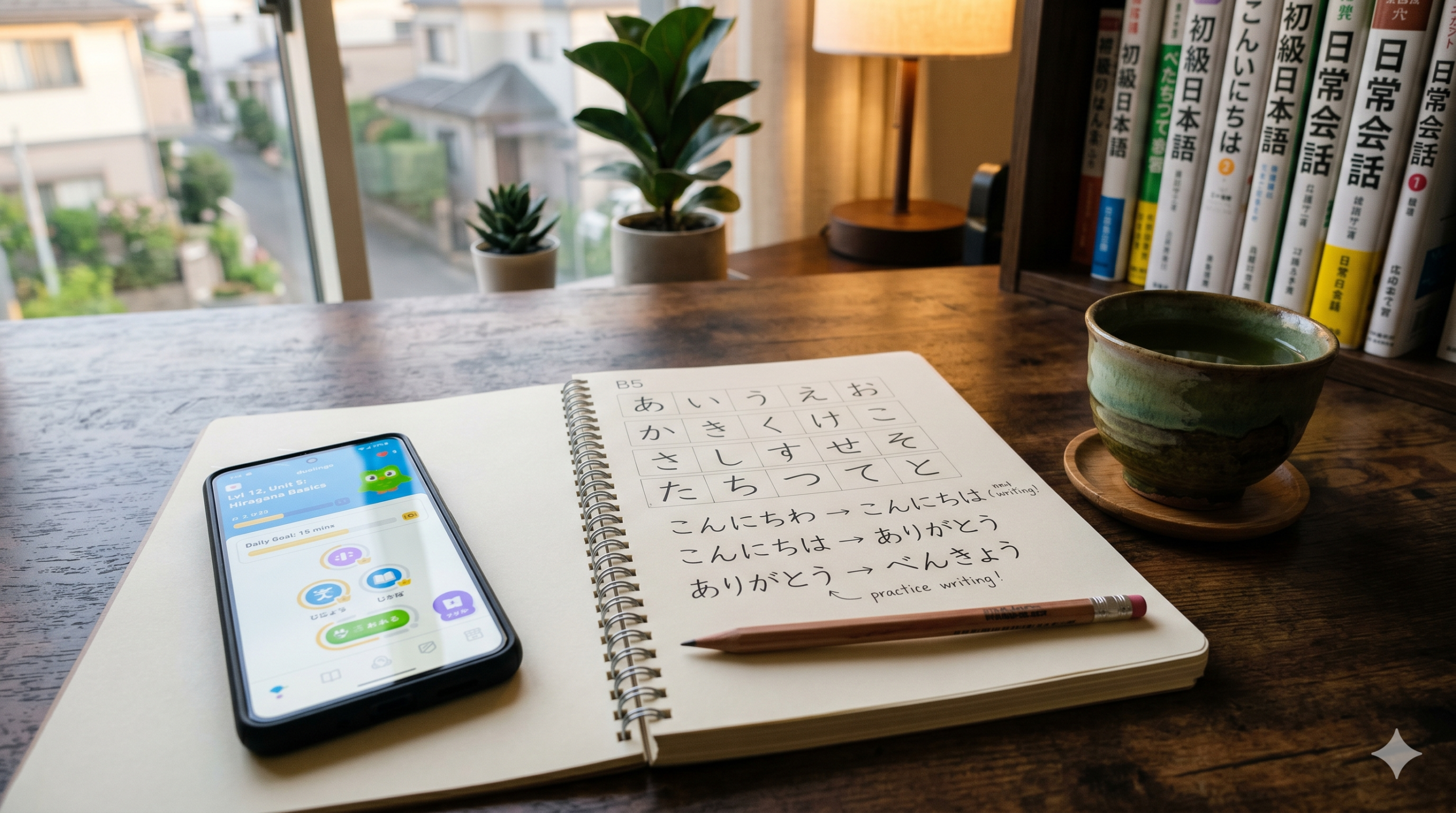
This article was created with AI writing assistance (ChatGPT, Claude, etc.). Product selection, specifications, and reviews are verified by the Japan Life Lab editorial team.
This article contains promotional / affiliate links.
📌 What you will learn
You do not have to read it all — jump to what you need.
- How to Learn Japanese in 2026: A Practical Guide for Beginners
- Understanding the Three Writing Systems
- The Best Apps to Learn Japanese
- Textbooks & Structured Courses
- A Simple Learning Roadmap
- Tips to Stay Motivated
- Frequently Asked Questions
※ Start wherever fits your situation.
How to Learn Japanese in 2026: A Practical Guide for Beginners
Learning even a little Japanese transforms your time in Japan — ordering food, reading signs, making friends, and navigating daily life all become easier and more fun. The language has a reputation for being hard, but with the right tools and a realistic plan, steady progress is very achievable. This 2026 guide breaks down how the language works, the best apps and methods, and a simple roadmap to follow.
Understanding the Three Writing Systems
Japanese uses three scripts together, and knowing what each does removes a lot of the fear:
- Hiragana: 46 phonetic characters for native Japanese words and grammar. Learn this first — it’s the foundation.
- Katakana: 46 characters for foreign/loan words (コーヒー = “coffee”). Surprisingly useful for travelers reading menus.
- Kanji: Characters borrowed from Chinese, used for most nouns and word stems. There are thousands, but you only need a few hundred for daily life — and you can learn them gradually.
Good news for pronunciation: Japanese has just five vowel sounds and is spoken in clear, even syllables, so it’s easier to pronounce than English.
The Best Apps to Learn Japanese
- Duolingo: Free, gamified, and great for building a daily habit and basic vocabulary.
- Anki: A free spaced-repetition flashcard app — the gold standard for memorizing kana and kanji efficiently.
- WaniKani: A structured system for learning kanji and vocabulary through mnemonics, loved by serious learners.
- Bunpro: Focused on grammar, with spaced repetition to lock in sentence patterns.
- Tandem / HelloTalk: Language-exchange apps to chat with native speakers for free.
A common winning combo: Duolingo for habit, Anki or WaniKani for kana/kanji, and a textbook or grammar app for structure.
Textbooks & Structured Courses
Apps are great, but a structured course prevents gaps. Popular beginner resources include Genki (the classic university textbook), Japanese From Zero (gentle and beginner-friendly), and Tae Kim’s Grammar Guide (free online). If you prefer guidance, online tutoring platforms like italki connect you with affordable native tutors for conversation practice.
A Simple Learning Roadmap
- Weeks 1–3: Master hiragana, then katakana (Anki + a kana app).
- Months 1–3: Work through a beginner textbook (Genki I), learn ~100 common kanji, and practice basic phrases daily.
- Months 3–6: Build vocabulary, study core grammar (Bunpro), and start speaking with a tutor or exchange partner.
- Ongoing: Immerse with anime, podcasts, NHK Easy News, and real conversations. Consistency beats intensity.
Tips to Stay Motivated
- Study a little every day — 15 focused minutes beats a rare three-hour session.
- Learn what you’ll use: restaurant, shopping, and travel phrases give instant rewards.
- Make it fun: watch shows with Japanese subtitles, play games in Japanese, label items at home.
- Track progress and celebrate milestones to keep the habit alive.
Frequently Asked Questions
How long does it take to learn Japanese?
Basic conversational ability takes around 6–12 months of consistent study; fluency takes years. Survival travel phrases can be learned in weeks.
Do I need to learn kanji?
For reading daily life (signs, menus, apps), a few hundred kanji help enormously. You can speak and travel with far less.
Is Duolingo enough on its own?
It’s great for habit and basics, but combine it with a grammar resource and speaking practice for real progress.
What’s the hardest part of Japanese?
For most learners it’s kanji and getting used to sentence structure — both very manageable with spaced repetition and practice.
Conclusion
Japanese is far more learnable than its reputation suggests. Start with hiragana, build a daily habit with apps like Anki and Duolingo, add a structured textbook, and practice speaking early. Even a few months of steady effort will make living in or traveling around Japan dramatically richer. Ganbatte — you’ve got this!
A Realistic 12-Month Roadmap (30 Minutes a Day)
| Months | Goal | Tools |
|---|---|---|
| 1–2 | Perfect hiragana + katakana | Kana apps, 15 min/day — do not skip ahead without this |
| 3–5 | 300 core words + survival phrases | Anki/WaniKani + N5 grammar (Genki I, Tae Kim) |
| 6–9 | N5–N4 grammar + first 100 kanji | Genki II, Bunpro; add slow podcasts for listening |
| 10–12 | Real conversation | HelloTalk exchanges or 1–2 iTalki lessons a week + shadowing |
The bottleneck is never talent or the “best app” — it’s daily consistency. Ten minutes of Anki on the train beats a three-hour Sunday binge every time.
The Mistakes That Stall Almost Everyone
⚠️ Avoid these classics
- Learning romaji instead of kana — it caps your progress from day one
- Collecting apps and courses without finishing any single one
- Studying only grammar without listening to real Japanese from the start
- Postponing speaking “until I’m ready” — you never feel ready; start in month 3
- Avoiding kanji out of fear — with mnemonics (WaniKani/RTK) they’re far easier than they look
Frequently Asked Questions
How long until I reach a useful level (N4–N3)?
With 30–60 minutes daily, N4 in 10–14 months and N3 in about 2 years. Living in Japan with active immersion shortens both considerably.
Are language schools in Japan worth it?
A 2-year student-visa language school is the fastest route to fluency but costs serious money. For residents, municipal volunteer classes (100–500 yen per session) are a fantastic hidden option for speaking practice.
Can I learn from anime and dramas?
As listening reinforcement and motivation, absolutely — with Japanese subtitles rather than English. But without a grammar base it stays passive; pair it with structured study.
Is JLPT worth taking?
If you plan to work in Japan, yes — N2 is the filter many employers use. If you just want to speak, treat JLPT levels as milestones, not the goal.
🔥 Editor’s Picks for Life & Travel in Japan

Japan Expat Starter Kit 2026 PDF guide
Your first 90 days in Japan, step by step: 17 chapters · 24 pages · 100 phrases in Japanese script · 40 kanji · printable checklists. Bank account, My Number, health insurance, apartment, phone, taxes & pension.
$9.99 $4.99 current price
📥 Get the kit →📄 Read 5 pages free: contents + Chapter 2
⚡ Instant PDF download · 🛡️ 30-day money-back guarantee · 🔄 Free 2026 updates
Practical guides for life and travel in Japan — free, about once a week. No spam, unsubscribe anytime.
☕ Enjoying our Japan guides?
If this article helped you, you can support our work with a coffee!
🇯🇵 Travel & Life Essentials for Japan
Hand-picked gear to make your time in Japan easier. Available on Amazon US & Amazon Japan.
🔋 Portable charger
A must for long days of sightseeing and photos.
View on Amazon (US)View on Amazon Japan🔌 Travel plug adapter
Japan uses Type A outlets. Bring the right adapter.
View on Amazon (US)View on Amazon Japan🎧 Translation earbuds
Real-time translation to talk without barriers.
View on Amazon (US)View on Amazon JapanAs an Amazon Associate, Japan Life Lab earns from qualifying purchases.
Did this guide help you? 🍵
Japan Life Lab is a small independent blog, and every guide we publish is completely free — no paywalls, ever. If our work saved you time (or a headache), you can support us with a cup of Japanese tea. Every contribution, big or small, goes straight into keeping these guides free, accurate and up to date for everyone.
☕ Support Japan Life Lab
Leave a Reply