This article was created with AI writing assistance (ChatGPT, Claude, etc.). Product selection, specifications, and reviews are verified by the Japan Life Lab editorial team.
Why Japanese Convenience Stores Will Change Your Life
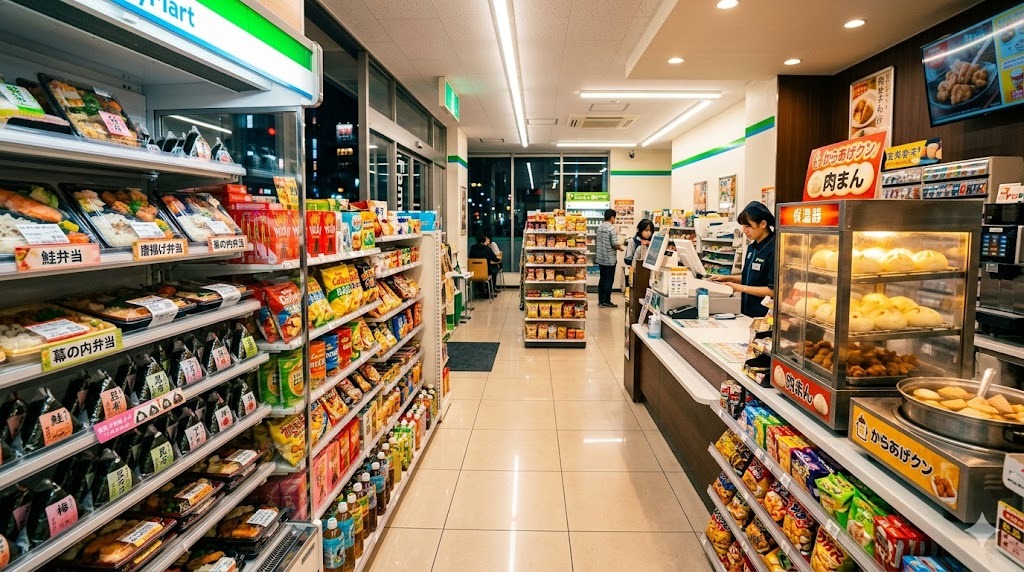
If you’ve heard that Japanese convenience stores — known as コンビニ (konbini) — are different from anything in your home country, believe it. This is not an exaggeration. Japan’s convenience stores are a genuine cultural institution: open 24 hours a day, 365 days a year, stocking freshly made food, offering dozens of essential services, and maintaining standards of cleanliness and quality that would shame most full-service restaurants elsewhere in the world.
There are approximately 56,000 convenience stores across Japan — roughly one for every 2,200 people. In central Tokyo, you’re almost never more than a 5-minute walk from one. The three major chains — 7-Eleven Japan, Lawson, and FamilyMart — account for over 90% of the market, and each has its own personality, loyal following, and signature products.
For travelers and expats, konbini are not just convenient — they’re often essential. Need to pay a utility bill? Pick up your online shopping? Print a document? Get emergency cold medicine at 3am? Withdraw yen from an international-friendly ATM? The convenience store handles all of this, and much more.
• 7-Eleven Japan (セブン-イレブン): ~21,000 stores — famous for sandwiches, premium desserts, 7Pay app
• Lawson (ローソン): ~14,500 stores — famous for fried chicken (Karaage-kun), Uchi Café sweets
• FamilyMart (ファミリーマート): ~16,500 stores — famous for FamiChiki fried chicken, wider hot snack range
Japanese Convenience Store Food: What to Buy
This is where konbini truly earn their legendary status. Unlike convenience store food elsewhere, Japanese konbini food is genuinely good — made fresh daily using quality ingredients, with enough variety to constitute a full diet if you needed it. Here’s what to look for:
Onigiri (おにぎり) — Rice Balls
The quintessential konbini food. Triangular rice balls wrapped in nori seaweed, filled with everything from classic tuna mayo and salmon to more adventurous flavors like ikura (salmon roe), mentaiko (spicy pollock roe), or kombu. Prices range from ¥110–¥200. The three-step opening sequence (pull the tabs in order) is a rite of passage for all Japan visitors. At 7-Eleven, the premium “Gold” series onigiri use higher-grade rice and more generous fillings.
Sandwiches and Buns
Japanese konbini sandwiches are a revelation — soft milk bread crustless sandwiches filled with egg salad, tuna, or fruit and cream (the latter being a surprisingly popular and delicious option). Hot steamed buns (nikuman) are sold year-round at the heated counter, with pork, pizza, and pizza-cheese varieties typically available. At ¥130–¥180, they’re one of the best snack values in Japan.
Bento and Hot Food
Pre-made bento boxes (¥400–¥700) cover every category: hamburger steak, yakitori, sushi, katsu curry, and more. Staff will microwave them for you on request — just say “atatamete kudasai” (温めてください). Hot food counters vary by chain: 7-Eleven focuses on quality ingredients, Lawson’s Karaage-kun fried chicken nuggets are a national obsession, and FamilyMart’s FamiChiki is the crispiest fried chicken in the konbini world.
Sweets and Desserts
Konbini desserts are a serious business in Japan. Lawson’s Uchi Café range includes seasonal purin (custard pudding), cream puffs, and roll cakes that rival dedicated patisseries. 7-Eleven’s parfaits and cream-filled pastries are premium quality. Seasonal limited editions — sakura flavors in spring, chestnut in autumn, strawberry in winter — create genuine excitement and social media buzz.
Drinks
The refrigerated drinks section is vast: canned coffee, green tea (hot and cold), sports drinks, flavored waters, beer, sake, canned cocktails (chuhai), energy drinks, and seasonal limited editions. The hot drinks section near the register — drip coffee made to order for ¥100–¥150 — rivals branded coffee chains. 7-Eleven’s drip coffee machine (¥110 for regular) is particularly well-regarded.
Essential Services at Japanese Convenience Stores
ATMs — International Card Friendly
This is critical knowledge for foreign visitors: not all Japanese ATMs accept international cards, but konbini ATMs almost universally do. 7-Eleven Bank ATMs accept Visa, Mastercard, American Express, UnionPay, and Cirrus/Plus network cards. Lawson ATMs (operated by Lawson Bank) accept most major international cards. FamilyMart ATMs (operated by E-net) similarly support international cards.
Withdrawal fees vary: typically ¥110–¥220 per transaction from the Japanese side, plus whatever fee your home bank charges. 7-Eleven Bank tends to have the widest international card acceptance and the most ATMs (one per store, nationwide). Fees are lower during certain hours — many ATMs are free on weekdays between 8:45am–6pm.
Bill Payment (公共料金支払い)
You can pay almost any bill at a Japanese convenience store — utility bills (electricity, gas, water), credit card bills, NHK fees, tax payments, insurance premiums, and more. Bring the barcode slip (usually sent by post or email) and pay in cash at the register. The clerk scans the barcode and hands you a receipt. This system handles hundreds of millions of transactions per year and is one of the most widely used financial services in Japan.
Printing and Photocopying
Every major konbini chain has a multifunction printer/copier/scanner available for public use. You can print from a USB drive, print documents sent via email or web upload (using the chain’s dedicated app), scan physical documents to USB or email, and make color or black-and-white copies. Prices: B&W copies ¥10/sheet, color copies ¥50–¥80/sheet, A3 available at most locations. The apps (7-Eleven’s netprint, Lawson/FamilyMart’s PrintSmash) allow you to send files from your phone and pick them up at any store nationally.
Package Pickup and Delivery
Japan’s convenience stores are deeply integrated with the national parcel delivery system. You can:
- Send packages via Yamato Transport (ヤマト運輸) or Sagawa Express from store counters
- Receive packages at your local konbini as a pickup point — particularly useful for short-term renters and travelers
- Pick up online shopping orders from Amazon Japan, Mercari, and other e-commerce platforms
- Receive airport duty-free purchases delivered to konbini near Narita/Haneda before your departure
Tickets and Event Booking
Japanese convenience stores are major ticket distribution points. The in-store multifunction terminals (Lawson’s Loppi, FamilyMart’s Famiポート, 7-Eleven’s multi-copy machine) allow you to purchase and print tickets for concerts, sports events, theme parks (Disney, Universal Studios Japan), shinkansen reserved seats, and local attractions. This is particularly useful for international visitors who can’t easily access Japanese ticketing websites from abroad.
SIM Cards and Mobile Top-Up
Most major konbini stock prepaid SIM cards for tourists, typically IIJ, b-mobile, or carrier-branded cards sold at face value. These are useful if you arrive without a pre-arranged eSIM (see our Best eSIM Cards for Japan guide for better options). You can also top up prepaid phone credit and buy LINE Pay or PayPay top-up cards at many locations.
Healthcare and Pharmacy Items
Konbini stock a surprisingly complete range of over-the-counter medications: cold and flu medicine, pain relievers, stomach remedies, allergy tablets, eye drops, and bandages. While selection is narrower than a dedicated pharmacy (yakkyoku), for late-night emergencies the 24/7 availability is invaluable. Personal care items — toothbrushes, razors, contact lens solution, face masks — are also well-stocked.
How to Pay at Japanese Convenience Stores
Cash (現金)
Japan remains significantly more cash-reliant than most developed countries, and konbini are no exception. All stores accept all yen denominations. If paying with a ¥10,000 note for a small purchase, this is completely normal and expected — change will be provided without issue.
IC Cards (Suica, PASMO, ICOCA)
IC transit cards like Suica and PASMO are accepted as payment at all major convenience stores. Simply tap your card on the reader and payment is deducted from your stored balance. This is the fastest payment method and avoids handling cash. You can top up your Suica balance at konbini ATMs (7-Eleven Bank ATMs accept Suica), though topping up is typically easier at train station machines. See our Suica guide for full details.
Credit and Debit Cards
Contactless card acceptance has expanded enormously in Japanese convenience stores since 2020. All three major chains now accept Visa, Mastercard, JCB, and American Express contactless payments (both physical card tap and phone/watch NFC). Note that some older store terminals still require chip-and-PIN for non-Japanese cards — if contactless fails, try inserting your card instead.
QR Code Payments (PayPay, LINE Pay, d払い)
Japan’s QR code payment ecosystem is extensive. PayPay (Japan’s largest QR pay service with 60M+ users) is accepted at all major konbini. LINE Pay, d払い (docomo), au Pay, and Rakuten Pay are also accepted at most locations. As a foreigner, PayPay can now be set up with foreign Visa/Mastercard if you have a Japanese phone number.
Convenience Store Chain Comparison: 7-Eleven vs Lawson vs FamilyMart
| Category | 7-Eleven 🏆 | Lawson | FamilyMart |
|---|---|---|---|
| Number of stores | ~21,000 | ~14,500 | ~16,500 |
| Signature food | Egg salad sandwich | Karaage-kun | FamiChiki |
| Best desserts | Premium parfaits | Uchi Café range | Sweets+ range |
| ATM | 7-Eleven Bank ✅ | Lawson Bank ✅ | E-net ATM ✅ |
| Print terminal | netprint app | PrintSmash | PrintSmash |
| Ticket terminal | Multi-copy machine | Loppi | Famiポート |
| Best coffee | ✅ 7-Café (¥110) | MACHI café | Famima Café |
| Overall rating | ★★★★★ | ★★★★☆ | ★★★★☆ |
Useful Japanese Phrases for Konbini
| Situation | Japanese | Pronunciation |
|---|---|---|
| Please heat this up | 温めてください | Atatamete kudasai |
| No bag needed | 袋は不要です | Fukuro wa furyo desu |
| Card payment please | カードで払います | Kādo de haraimasu |
| Where is the ATM? | ATMはどこですか? | ATM wa doko desu ka? |
| Do you have a fork? | フォークはありますか? | Fōku wa arimasu ka? |
| I want to pay a bill | 料金を払いたいです | Ryōkin wo haraitai desu |
| I’d like to print | 印刷したいです | Insatsu shitai desu |
Konbini Etiquette: Dos and Don’ts
Do: Say “arigatou gozaimasu” (ありがとうございます) when leaving — staff work hard and it’s appreciated. Use the designated eating area (there’s usually a small counter by the window) rather than eating while walking around the store. Sort your garbage correctly — the bins near the door have separate compartments for burnable waste, plastic bottles, and cans.
Don’t: Eat food before paying (this applies to everywhere in Japan, not just konbini). Leave bags or items blocking the aisles. Talk loudly on your phone near the registers. Expect staff to speak English — while many young konbini workers have basic English, it’s not guaranteed and pointing at items or using Google Translate works well.
Frequently Asked Questions
Are Japanese convenience stores really open 24 hours?
The vast majority are, yes — 24/7/365 including national holidays. A small number of rural locations have reduced hours, and some stores temporarily reduced hours during the COVID-19 pandemic, but the “24 hours” promise is essentially universal in urban and suburban areas. Konbini are one of the few places you can reliably find food, ATM access, and basic services at 3am.
Can I use my foreign credit card at konbini ATMs?
Yes, with high reliability at 7-Eleven Bank ATMs and good reliability at Lawson Bank and E-net ATMs. 7-Eleven Bank is particularly recommended for international cards — they display English interfaces and accept Visa, Mastercard, Maestro, Cirrus, UnionPay, and American Express. There will be a transaction fee (¥110–¥220) from the Japanese side plus any international withdrawal fee from your home bank.
What are the best things to eat at Japanese convenience stores?
Personal favorites among frequent travelers: onigiri (especially tuna mayo or salmon), nikuman (steamed pork bun), any seasonal dessert from Lawson’s Uchi Café range, 7-Eleven’s egg salad sandwich, Karaage-kun from Lawson, and FamiChiki from FamilyMart. For drinks, the fresh drip coffee (around ¥110) from any chain is a daily staple. Don’t overlook the hot oden (Japanese fish cake stew) available in autumn and winter.
How do I use the printing service?
Download the app for your target chain: 7-Eleven’s “netprint” app, or “PrintSmash” for Lawson and FamilyMart. Upload your document or photo, receive a reservation number, enter it at the in-store multi-function machine, select your print options, and pay (from ¥10/sheet B&W). You can also walk in with a USB drive containing your files and print directly. The machines handle PDF, Word, Excel, JPG, and most common formats.
Is there Wi-Fi at Japanese convenience stores?
Yes — all three major chains offer free Wi-Fi. 7-Eleven provides “7SPOT” WiFi, Lawson offers “Lawson_Free_Wi-Fi,” and FamilyMart has “FamilyMart_Wi-Fi.” You’ll need to register with an email address (or social media login) for the first connection. Session duration is typically 30–60 minutes per connection, after which you reconnect. Speed is decent for email and maps; not ideal for streaming.
Top 10 Things Every Visitor Should Buy at a Japanese Convenience Store
- Onigiri — Try at least three different fillings during your trip
- Coffee from the machine — Fresh drip for ¥110 is exceptional value
- Seasonal dessert — Whatever the current limited edition is, try it
- Lawson Karaage-kun — Five small fried chicken pieces for ¥230
- FamiChiki — FamilyMart’s crispier fried chicken alternative
- Nikuman (steamed pork bun) — Best in autumn/winter from the heated counter
- Onsen tamago (soft-boiled egg) — Perfect protein-rich snack
- Chu-hi canned cocktail — Light fizzy Japanese cocktail, great for picnics
- Cup noodles with hot water — Most stores have a hot water station
- Kit Kat Japan-exclusive flavor — Matcha, sake, wasabi — buy as souvenirs too
✅ Japan Convenience Store Quick Tips
- Carry a Suica card for instant tap-to-pay at all konbini
- Use 7-Eleven Bank ATMs for the most reliable international card access
- Download the netprint or PrintSmash app before you arrive for easy printing
- Ask staff “atatamete kudasai” to get your food microwaved
- Check for limited edition seasonal items — they’re genuinely special
- Free WiFi is available at all chains, useful when your data runs low
🗾 More Japan Life Guides
Leave a Reply