This article was created with AI writing assistance (ChatGPT, Claude, etc.). Product selection, specifications, and reviews are verified by the Japan Life Lab editorial team.
This article contains promotional / affiliate links.
If you live in or visit Japan long enough, you will feel an earthquake. Most are harmless — but knowing exactly what to do in the first 60 seconds, the first 10 minutes, and the first 72 hours can save your life. This guide is written for foreigners: no assumed knowledge, the Japanese vocabulary you’ll actually see and hear, and the apps that give you warnings in English. Read it once now; your body will remember when it matters.
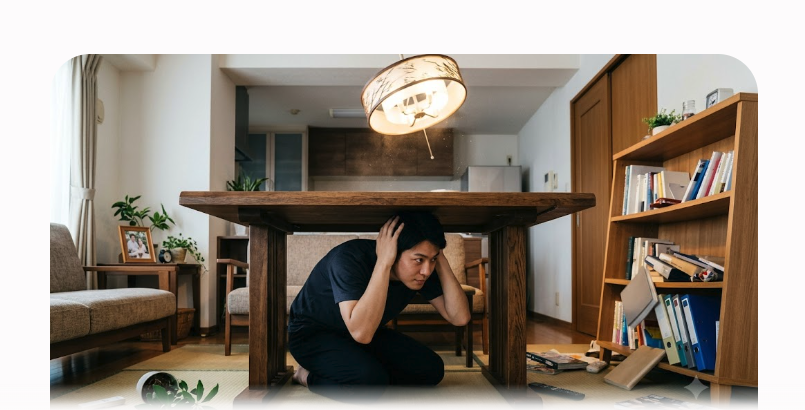
During the Shaking (0–60 seconds): Drop, Cover, Hold On
When strong shaking starts, you cannot walk or run — don’t try. Do exactly this: get low, get under a sturdy table (or protect your head with a cushion or bag), and hold on until the shaking stops. Stay away from windows and tall furniture.
What NOT to do while shaking
- Don’t run outside — falling roof tiles, glass and signs make the building edge the most dangerous place
- Don’t rush to turn off the stove — modern Japanese gas meters shut off automatically; deal with fire after the shaking
- Don’t use elevators — if you’re inside one, press every floor button and exit at the first stop
In bed? Cover your head with your pillow and stay put. Driving? Hazard lights on, slow down, pull over left, stay in the car until it stops.
Understanding Japan’s Warnings
Your phone may suddenly blare a loud alarm: that’s the Earthquake Early Warning (緊急地震速報, kinkyū jishin sokuhō) — you have seconds before shaking arrives. Get low immediately. Japan measures quakes by Shindo (震度), intensity from 1 to 7, not just magnitude: Shindo 4 rattles shelves, Shindo 5+ (5弱/5強) can topple furniture — that’s when this guide matters.
Right After (1–10 minutes)
1. Check for fire — turn off the gas valve. 2. Open a door or window — buildings can warp and trap you inside. 3. Put on shoes or slippers — broken glass causes many post-quake injuries. 4. Check the news — NHK World (English) or the apps below.
If you are near the coast: TSUNAMI RULES
- Long or strong shaking near the sea = evacuate to high ground immediately, don’t wait for the official warning
- Follow green tsunami evacuation signs (津波避難場所 / 津波避難ビル)
- Go on foot, go high, and do not return until warnings are fully lifted — tsunamis come in waves for hours
Should You Evacuate or Stay Home?
If your building is undamaged and there’s no fire nearby, staying home (在宅避難) is usually best — shelters are crowded and basic. Evacuate if: the building is cracked or tilting, fire is spreading nearby, you’re in a landslide/tsunami zone, or authorities issue an evacuation order. Before leaving, switch off the breaker (prevents fires when power returns) and close the gas valve. Evacuation sites are marked 避難所 (hinanjo) — usually the local elementary school. Everyone is welcome, foreigners included; bring your passport/residence card.
Contacting Family (and Being Contacted)
Phone calls often fail after big quakes, but data (LINE, WhatsApp, Messenger) usually works — send a short “I’m safe” first. Tell family abroad your status before they panic-call. Japan also runs Disaster Message Dial 171 and web171 (English available) for leaving voice/text messages tied to a phone number. Public Wi-Fi named “00000JAPAN” opens for free during major disasters.
The First 72 Hours
Rescue teams prioritize life-saving for ~3 days; shops empty and logistics pause. Plan to self-sustain for 72 hours: 3L of water per person per day, easy food, phone in power-saving mode, and — critically — don’t flush toilets if pipes may be damaged (use emergency toilet bags). Beware of aftershocks near damaged furniture, and verify SNS rumors against NHK or the Japan Meteorological Agency before acting or sharing.
Japanese Words You’ll See and Hear
| Japanese | Reading | Meaning |
|---|---|---|
| 地震 | jishin | Earthquake |
| 津波 | tsunami | Tsunami |
| 避難 | hinan | Evacuation |
| 避難所 | hinanjo | Evacuation shelter |
| 余震 | yoshin | Aftershock |
| 停電 / 断水 | teiden / dansui | Power outage / water outage |
| 高台へ避難 | takadai e hinan | Evacuate to high ground |
Prepare Today: 5 Things in 10 Minutes
1. Download Safety Tips (JNTO’s official app — quake & tsunami alerts in English) and NHK World. 2. Check nothing heavy can fall on your bed; move or secure it. 3. Put slippers and a flashlight by your bed. 4. Save your local hinanjo location (Google Maps: “evacuation shelter”). 5. Buy 2L water bottles × 6 and some ready-to-eat food. A basic emergency backpack (bōsai set) covers the rest:
FAQ
My phone screamed but the shaking was tiny — was it a false alarm?
No. The Early Warning triggers on predicted intensity for your area; sometimes you’re at the edge of the zone. Treat every alarm as real — get low first, judge later.
Can tourists use evacuation shelters?
Yes. Shelters are open to everyone regardless of nationality or visa status. Staff may not speak English, so translation apps help; food and blankets are provided as available.
Is Japan safe to visit despite earthquakes?
Yes — Japan’s buildings and warning systems are the world’s best. Most quakes cause zero damage. Preparedness, not fear, is the right response.
🔥 Editor’s Picks for Life & Travel in Japan
📘 The Japan Expat Starter Kit 2026
Banking, housing, My Number, taxes, 100 phrases and a 40-kanji cheat sheet — everything from this site in one 17-chapter PDF field manual. Free lifetime 2026 updates.
Reader price: $19 $9.90 with code JLL30 at checkout
30-day money-back guarantee · Instant download · PR
Practical guides for life and travel in Japan — free, about once a week. No spam, unsubscribe anytime.
Leave a Reply