This article was created with AI writing assistance (ChatGPT, Claude, etc.). Product selection, specifications, and reviews are verified by the Japan Life Lab editorial team.
This article contains promotional / affiliate links.
Japanese winters are deceptively brutal. Tokyo rarely drops below freezing, yet visitors and new residents are shocked by how cold they feel indoors — thin walls, single-pane windows, and no central heating are the norm. Meanwhile, northern Japan buries itself under meters of snow. This survival guide covers what to pack, how the Japanese actually stay warm, and the winter gear worth buying when you arrive (November–March).
📌 What you will learn
You do not have to read it all — jump to what you need.
- What Winter in Japan Actually Feels Like
- How the Japanese Stay Warm (Steal These Tricks)
- Winter Packing List for Visitors
- Winter-Only Experiences Worth the Cold
※ Start wherever fits your situation.
What Winter in Japan Actually Feels Like
| Region | Dec–Feb Temps | What to Expect |
|---|---|---|
| Hokkaido / Tohoku | -10 to 0°C | Heavy snow, real winter gear needed |
| Tokyo / Osaka / Kyoto | 0 to 12°C | Dry, sunny, cold wind; freezing indoor spaces |
| Japan Sea coast (Kanazawa, Niigata) | -2 to 8°C | Grey skies, wet snow, umbrellas essential |
| Okinawa / Kyushu south | 10 to 20°C | Mild; light jacket weather |
The golden rule: the cold in Japan comes from inside the buildings. Layer up, and learn the local heating tricks below.
How the Japanese Stay Warm (Steal These Tricks)
1. Heat Tech Layering (Uniqlo’s National Uniform)
Uniqlo HEATTECH innerwear is the unofficial winter uniform of Japan. The Extra Warm and Ultra Warm lines are absurdly effective for their thinness. One top + one leggings under normal clothes handles most Tokyo days. Buy them here — they’re cheaper in Japan than abroad.
2. Kairo — Pocket Hand Warmers
Disposable heat packs sold everywhere (¥300–500 for 10). Stick-on types (haru kairo) go on your back or stomach under clothes and stay warm for 12+ hours. Our complete Kairo Guide explains every type.
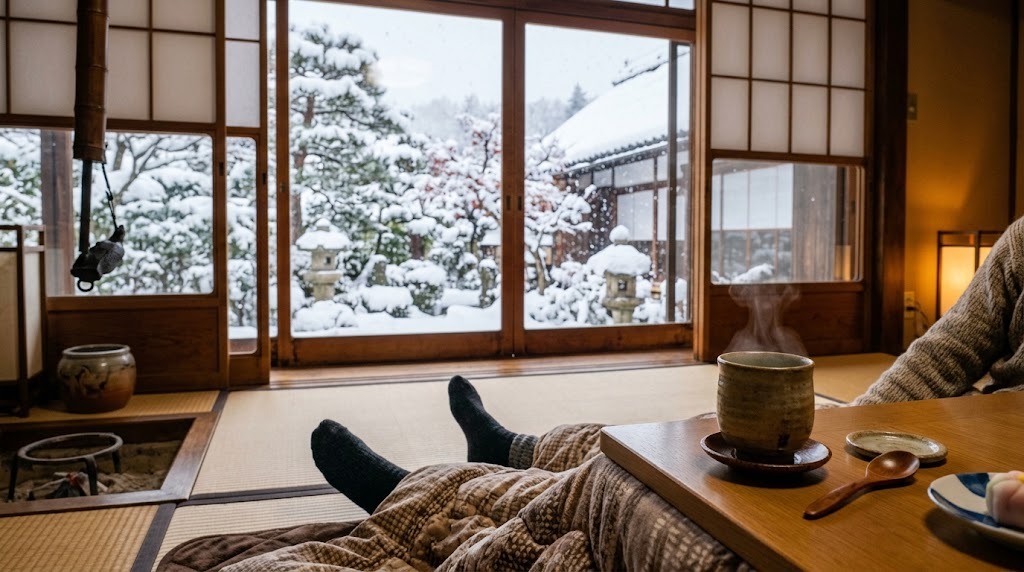
3. The Kotatsu & Electric Blankets
The heated table with a blanket is Japan’s greatest winter invention — once you’re in, you’re not leaving. For beds, Japanese electric blankets cost as little as ¥3,000 and slash heating bills.
4. Yutanpo — Hot Water Bottles
Fill before bed, sleep warm all night, zero electricity. Available at any drugstore or 100-yen shop from ¥500.
5. Smart Heater Use
Most homes rely on aircon heating plus spot heaters. See our guide to Japanese space heaters — ceramic fan heaters for bathrooms, oil-free heaters for bedrooms. Pair with a humidifier: Japanese winter air is desert-dry, and humidity makes rooms feel warmer.
Winter Packing List for Visitors
Essential: windproof coat (down for the north), thermal innerwear ×2–3, sweater layers, warm socks, gloves, scarf, lip balm and moisturizer (the dryness is real), and shoes with grip if heading to snow country.
Buy in Japan instead: HEATTECH (cheaper here), kairo warmers, umbrella (¥500 at any konbini), and snow boots if you’re only visiting Hokkaido briefly — rental shops at ski resorts and even Workman stores have you covered cheaply.
Pro tips: Trains and department stores are overheated to ~25°C — dress in layers you can shed fast. Hotel rooms have aircon heating; the air gets very dry, so hang a wet towel or request a humidifier at the front desk.
Winter-Only Experiences Worth the Cold
Winter is arguably Japan’s most magical season: the world-famous Japow powder snow, snow monkeys bathing in hot springs at Jigokudani, the Sapporo Snow Festival (early February), steaming onsen baths in the snow, winter illuminations, and hot nabe hot pot dinners. Fewer tourists, crisp blue skies in Tokyo, and the cheapest flights of the year (mid-January to February) are a bonus.
Was this guide helpful? Support Japan Life Lab and keep our guides free!
FAQ
Is Tokyo cold in winter?
Outdoor temps are mild (5–12°C daytime), but indoor cold and wind chill surprise most visitors. Layers + HEATTECH handle it easily.
Does it snow in Tokyo or Kyoto?
Rarely — Tokyo sees snow settle maybe once or twice a year. Kyoto gets occasional dustings that make the temples spectacular for a morning. For guaranteed snow, head to Nagano, Tohoku, or Hokkaido.
Why don’t Japanese homes have central heating?
A mix of history, earthquake-resistant light construction, and a culture of heating the person rather than the space — hence kotatsu, kairo, and yutanpo. Modern apartments rely on reverse-cycle aircon.
What’s the cheapest way to keep a Japanese apartment warm?
Layer clothing, electric blanket (¥3,000, pennies to run), thick curtains, bubble-wrap window insulation from the 100-yen shop, and a humidifier. Aircon set to 20°C beats resistive heaters for cost.
Related Guides
🔥 Editor’s Picks for Life & Travel in Japan

Japan Expat Starter Kit 2026 PDF guide
Your first 90 days in Japan, step by step: 17 chapters · 24 pages · 100 phrases in Japanese script · 40 kanji · printable checklists. Bank account, My Number, health insurance, apartment, phone, taxes & pension.
$9.99 $4.99 current price
📥 Get the kit →📄 Read 5 pages free: contents + Chapter 2
⚡ Instant PDF download · 🛡️ 30-day money-back guarantee · 🔄 Free 2026 updates
Practical guides for life and travel in Japan — free, about once a week. No spam, unsubscribe anytime.
🇯🇵 Travel & Life Essentials for Japan
Hand-picked gear to make your time in Japan easier. Available on Amazon US & Amazon Japan.
🔋 Portable charger
A must for long days of sightseeing and photos.
View on Amazon (US)View on Amazon Japan🔌 Travel plug adapter
Japan uses Type A outlets. Bring the right adapter.
View on Amazon (US)View on Amazon Japan🎧 Translation earbuds
Real-time translation to talk without barriers.
View on Amazon (US)View on Amazon JapanAs an Amazon Associate, Japan Life Lab earns from qualifying purchases.
Did this guide help you? 🍵
Japan Life Lab is a small independent blog, and every guide we publish is completely free — no paywalls, ever. If our work saved you time (or a headache), you can support us with a cup of Japanese tea. Every contribution, big or small, goes straight into keeping these guides free, accurate and up to date for everyone.
☕ Support Japan Life Lab
Leave a Reply