This article was created with AI writing assistance (ChatGPT, Claude, etc.). Product selection, specifications, and reviews are verified by the Japan Life Lab editorial team.
This article contains promotional / affiliate links.
📌 What you will learn
You do not have to read it all — jump to what you need.
- The one piece of Japanese furniture that ruins winter everywhere else
- What exactly is a kotatsu?
- Choosing a kotatsu: six decisions
- What to buy: the three-part shopping list
- Living with a kotatsu: what nobody tells you
- Buying from outside Japan
- A cheaper alternative if you cannot commit
※ Start wherever fits your situation.
The one piece of Japanese furniture that ruins winter everywhere else
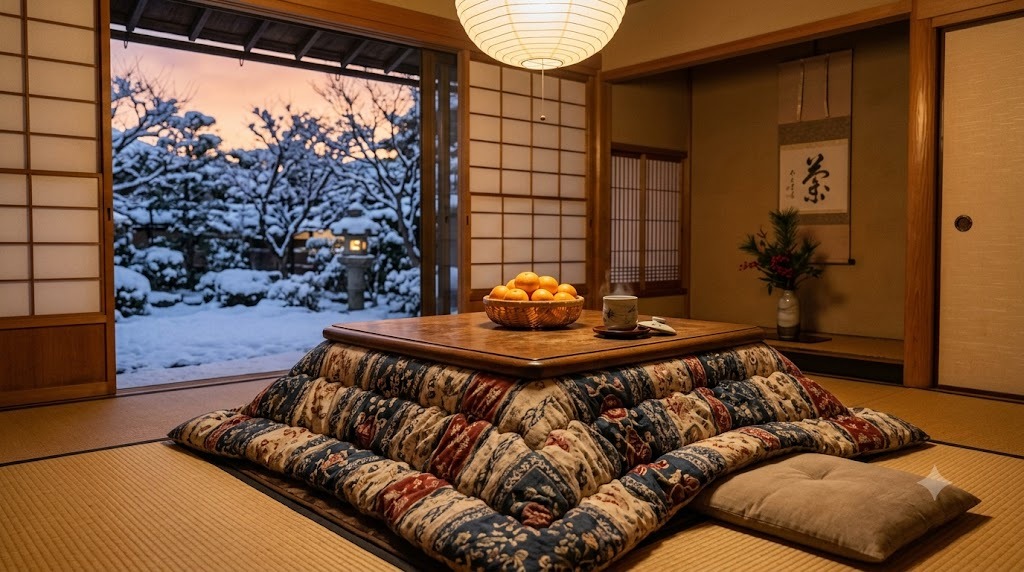
Ask anyone who has spent a winter in Japan what they miss most, and a surprising number will say the same thing: the kotatsu. A low table with a heater fixed underneath, draped in a heavy quilt, with a tabletop pressed on top to hold everything in place.
It sounds almost primitive next to central heating. It is also, once you have experienced it, extremely difficult to give up. Japanese homes are traditionally heated by room rather than centrally, and the kotatsu is the logical conclusion of that philosophy: do not heat the room, heat the person.
This guide covers what a kotatsu actually is, the sizes and heater types available, what it costs to run, the voltage problem you must solve before importing one, and how to buy from outside Japan.
What exactly is a kotatsu?
A modern kotatsu is three separate items that work together:
| The frame | A low wooden table with an electric heater mounted under the tabletop |
|---|---|
| The futon | A thick quilt laid over the frame to trap heat underneath |
| The tabletop | A separate flat board placed on top of the futon, giving you a usable surface |
You sit on the floor — usually on a zaisu (legless chair) or cushion — and slide your legs underneath. The quilt keeps the warm air in. Your upper body stays in the cool room air, which is precisely why a kotatsu feels comfortable rather than stuffy.
Many kotatsu frames are designed to be used year-round: remove the futon in spring and you have an ordinary low table.
Choosing a kotatsu: six decisions
1. Size
Kotatsu are sold by tabletop dimensions in centimetres. The common sizes and who they suit:
| Size | Seats | Typical use |
|---|---|---|
| 75 × 75 cm (square) | 1–2 people | Studio apartments, solo living |
| 80 × 80 cm (square) | 2 people | Couples, small rooms |
| 105 × 75 cm | 2–3 people | The most common size in Japan |
| 120 × 80 cm | 4 people | Family living rooms |
| 150 × 90 cm | 4–6 people | Large rooms, entertaining |
A crucial point: the futon must be much larger than the table. A 120 × 80 cm frame typically needs a futon around 200 × 190 cm or larger so it drapes properly to the floor on all sides. Buying a futon that is too small is the single most common mistake.
2. Heater type
Older kotatsu used quartz or halogen heaters that glowed orange and ran hot. Almost all modern units use a flat carbon or graphite heater, which is thinner, more even, quieter and does not intrude on legroom.
If you are buying new, choose a flat carbon heater. If you are buying second-hand and see a bulky orange-glowing element, expect less legroom and a higher running temperature.
3. Height
Standard kotatsu sit around 36–40 cm high — floor-seating height. Some models offer adjustable legs or extension blocks that raise the table to roughly 55–65 cm so you can use it with a low sofa or a proper chair. If sitting on the floor is uncomfortable for you, look specifically for a “ハイタイプ” (high type) model.
4. Shape
Rectangular is the default. Square suits smaller rooms and even seating. Round kotatsu exist and are wonderful for conversation, but round futons are harder to find and more expensive.
5. Power and voltage — read this before you order
This is the part that catches people out. Japanese kotatsu are built for 100V, 50/60Hz, with a Japanese Type A plug. Most of the world is not.
| Your country | Mains voltage | What you need |
|---|---|---|
| Japan | 100V | Nothing. Plug it in |
| United States / Canada | 120V | Usually works, but check the maker’s tolerance. A step-down transformer is safer |
| UK / EU / Australia | 230–240V | A step-down transformer rated well above the heater wattage. A plug adapter alone is NOT enough |
| Gulf states | 220–240V | Same as above — transformer required |
A kotatsu heater typically draws 300–600W. If you need a transformer, buy one rated at least 1.5× the heater’s wattage — so a 500W kotatsu wants a 750W or 1000W transformer. Using a simple plug adapter on 230V mains will destroy the heater and is a genuine fire risk.
Some sellers outside Japan offer kotatsu with heaters rewired for local voltage. If you are not comfortable with transformers, that is the option to look for.
6. Running cost
This is the pleasant surprise. Because a kotatsu heats a small enclosed space rather than a whole room, it is one of the cheapest heating methods available. Most units draw 300–600W at maximum but cycle on and off via a thermostat, so average consumption is far lower — commonly quoted around 100–200W in steady use.
For comparison, an air conditioner heating a living room can draw several times that continuously. This is exactly why kotatsu remain popular in Japan despite modern heating being widely available.
What to buy: the three-part shopping list
The frame with heater
Look for a flat carbon heater, a temperature control dial, and a size that matches your room. Japanese-made wooden frames in 105 × 75 cm and 120 × 80 cm are the easiest to find internationally. Expect roughly $150–400 depending on size and finish.
The kotatsu futon (quilt)
Sold separately in most cases. Check the recommended table size printed on the product. Thicker is warmer but harder to store; a “薄掛け” (usugake, thin) futon is easier to live with in a small apartment and still perfectly warm.
Many sets include a shikibuton — a rug that goes under the whole assembly. On a hard floor this matters more than people expect: it insulates from below and stops the heat draining into the floor.
Floor seating
A zaisu (legless chair with a back) transforms the experience if you are not used to sitting on the floor. Cheaper alternative: a firm floor cushion (zabuton). Your back will thank you within the first week.
Living with a kotatsu: what nobody tells you
✅ What we like
- You will not want to get up. This is not a joke. The Japanese phrase for kotatsu-induced immobility exists for a reason
- Never fall asleep under it regularly. Dehydration and poor sleep quality are real. A short nap is fine; a whole night is not
- Cats will claim it. If you have a cat, the kotatsu is now the cat’s
- Air the futon. Hang it out or vacuum it periodically. Warm enclosed spaces attract dust mites
- Do not put anything flammable inside. Newspapers, laundry and plastic bags do not belong under the quilt
- Turn it off when you leave. Most units have a thermostat but not an auto-shutoff timer
The dehydration point deserves emphasis. Sleeping under a kotatsu all night is a common cautionary tale in Japan — you wake up dried out, stiff and unrested. Set an alarm if you are prone to dozing off.
Buying from outside Japan
There are three realistic routes, and they suit different budgets.
| Route | Pros | Cons |
|---|---|---|
| Amazon.com / local retailers | Local voltage in some cases, simple returns, no proxy fees | Limited selection, higher prices, fewer Japanese-made frames |
| Amazon Japan (international shipping) | Full Japanese range, authentic models | 100V only, heavy shipping cost, not every item ships abroad |
| Proxy service (Buyee etc.) | Access to Rakuten, Yahoo Auctions and domestic-only shops | Proxy fee plus forwarding, longer wait, 100V only |
A practical strategy: buy the frame locally if a decent one exists, and use a proxy for the futon. Frames are bulky and expensive to ship; futons compress well and the Japanese selection is far better in both pattern and quality.
If you are currently living in Japan and plan to move abroad, buying here and shipping with your household goods is by far the cheapest route. Just remember the voltage issue at the other end.
A cheaper alternative if you cannot commit
Not ready for a full kotatsu? Two options exist:
Kotatsu heater units are sold separately. If you already own a low table, you can bolt a Japanese heater unit to the underside. This is a common upgrade in Japan and dramatically cheaper than a complete set.
A heated blanket plus a low table gets you perhaps 70% of the experience for a fraction of the price, and sidesteps the voltage problem entirely if you buy locally. It is not the same, but it is warm.
Kotatsu FAQ
Is it safe to leave on overnight?
Modern units are thermostat-controlled and designed for extended use, but the manufacturers still recommend switching off when unattended. The bigger risk is not fire but dehydration if you sleep under it.
Can I use it on carpet?
Yes, and it works well — carpet insulates from below. On hard flooring, add a rug or the dedicated shikibuton for noticeably better heat retention.
How do I wash the futon?
Check the label. Many modern kotatsu futons are machine washable in a large-capacity machine or at a coin laundry. Thicker traditional ones usually need professional cleaning. Airing them in the sun every few weeks does most of the work.
Does it work in a small apartment?
Extremely well — this is arguably its ideal environment. A 75 × 75 cm kotatsu fits in a studio, doubles as your dining and work table, and costs far less to run than heating the whole room.
What do I do with it in summer?
Remove the futon and the tabletop sits directly on the frame, giving you a normal low table. Store the futon compressed in a vacuum bag. This year-round usability is a big part of why kotatsu remain standard in Japanese homes.
Will it heat the whole room?
No, and that is the point. A kotatsu heats the space under the quilt. In a cold climate you will still want a room heater for your upper body — the two work well together, and the kotatsu lets you keep the room heater at a lower setting.
The verdict
A kotatsu is not efficient in the sense of warming a house. It is efficient in the sense of warming the person, cheaply, in the exact spot where they actually are. For anyone in a small apartment, or anyone who spends winter evenings at a table reading, working or eating, it is one of the best-value pieces of furniture in existence.
Sort out the voltage first, buy a futon that is bigger than you think you need, and accept that your productivity in January is now negotiable.
Related guides
More Japanese winter warmth guides
- Best Japanese Space Heaters 2026
- Best Japanese Electric Blankets 2026 (Sugiyama & mofua)
- Best Japanese Humidifiers 2026 (the cult Zojirushi)
- Japanese Kairo Guide 2026: ¥30 Hand Warmers
🔥 Editor’s Picks for Life & Travel in Japan
📘 The Japan Expat Starter Kit 2026
Banking, housing, My Number, taxes, 100 phrases and a 40-kanji cheat sheet — everything from this site in one 17-chapter PDF field manual. Free lifetime 2026 updates.
Reader price: $9.99 $6.99 with code JLL30 at checkout
30-day money-back guarantee · Instant download · PR
Practical guides for life and travel in Japan — free, about once a week. No spam, unsubscribe anytime.
☕ Enjoying our Japan guides?
If this article helped you, you can support our work with a coffee!
Did this guide help you? 🍵
Japan Life Lab is a small independent blog, and every guide we publish is completely free — no paywalls, ever. If our work saved you time (or a headache), you can support us with a cup of Japanese tea. Every contribution, big or small, goes straight into keeping these guides free, accurate and up to date for everyone.
☕ Support Japan Life Lab
Leave a Reply