This article was created with AI writing assistance (ChatGPT, Claude, etc.). Product selection, specifications, and reviews are verified by the Japan Life Lab editorial team.
This article contains promotional / affiliate links.
📌 What you will learn
You do not have to read it all — jump to what you need.
- Japan Typhoon Season 2026: Key Dates and Facts
- How to Track Typhoons in Japan (Real-Time Apps & Websites)
- What to Do Before a Typhoon Hits
- During a Typhoon: What NOT to Do
- Evacuating in Japan as a Foreigner
- After the Typhoon: When Is It Safe?
- Travel Insurance and Typhoons in Japan
※ Start wherever fits your situation.
Understanding Japan’s Typhoon Season 2026: What Every Visitor Needs to Know
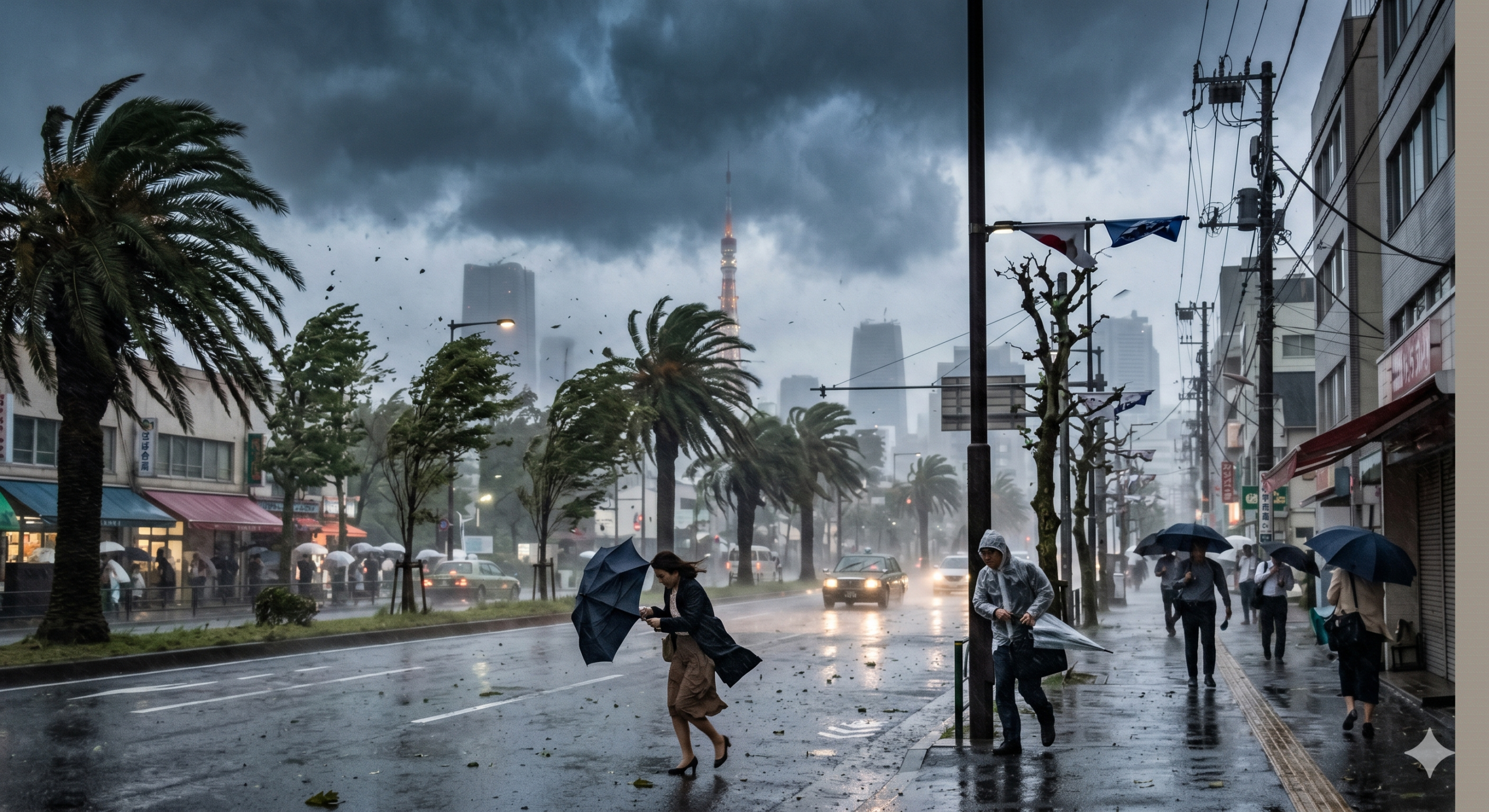
Japan’s typhoon season runs from June through November, with the peak hitting between August and October. In 2026, meteorologists are forecasting an active season due to warmer Pacific sea surface temperatures — making preparation more important than ever for tourists and expats alike.
Each year, Japan is struck by an average of 3–5 typhoons that make landfall on the main islands. While Japan’s disaster infrastructure is world-class, the storms can disrupt travel, cut power, and cause dangerous flooding. Knowing what to do before, during, and after a typhoon can make all the difference between a frightening experience and a manageable inconvenience.
This guide covers everything: how to track typhoons in real time, where to find shelter, what to stockpile, and the surprising beauty of Japan’s post-typhoon clear skies.
Japan Typhoon Season 2026: Key Dates and Facts
Japan’s typhoon season officially begins in early June and tapers off by late November. Here’s what to expect month by month:
| Month | Typhoon Risk | Notes |
|---|---|---|
| June | Low–Medium | Season begins; overlaps with rainy season (tsuyu) |
| July | Medium | Typhoons typically form in the Pacific; may graze Okinawa |
| August | High | Peak formation month; Kyushu and Okinawa most at risk |
| September | Very High | Highest probability of direct mainland hits; Golden Week of typhoons |
| October | High | Typhoons still active; Kanto region more vulnerable |
| November | Low–Medium | Season winds down; occasional late typhoons still possible |
How to Track Typhoons in Japan (Real-Time Apps & Websites)
Japan has excellent typhoon tracking infrastructure. Use these official sources for the most reliable information:
✅ Best Typhoon Tracking Resources
- Japan Meteorological Agency (JMA) — jma.go.jp — Japan’s official typhoon tracker with 5-day path forecasts updated every 6 hours
- NHK World Weather — nhk.or.jp/english/weather — English-language updates with evacuation zone maps
- Windy.com — Best for visual, real-time wind speed mapping across Japan
- Yahoo! Japan 台風情報 — Extremely popular in Japan; best Japanese-language tracker
- Safety tips app — Government-issued multilingual disaster alert app (push notifications for your area)
- NHK World App — English-language emergency broadcasts
What to Do Before a Typhoon Hits
72-Hour Emergency Stockpile
The Japanese government recommends preparing a 3-day emergency supply kit. Here’s exactly what to stock:
| Category | Items | Amount (per person) |
|---|---|---|
| Water | Bottled water | 3L per day × 3 days = 9L |
| Food | Instant noodles, canned goods, retort pouches | 3 days worth |
| Power | Portable charger, flashlight, radio | 1 each |
| First Aid | Basic kit, prescription medications | 3-day supply |
| Cash | Yen bills (ATMs go down) | ¥10,000+ per person |
| Documents | Passport, residence card, insurance card (photos on phone) | Always accessible |
Secure Your Space
Before a typhoon makes landfall, take these precautions in your home or hotel:
✅ Pre-Typhoon Home Checklist
- Bring in all outdoor furniture, potted plants, and loose items
- Tape or reinforce large windows with tape in an X pattern (reduces shattering risk)
- Fill your bathtub with water (emergency water supply if pipes cut)
- Charge all electronic devices to 100%
- Download offline maps of your area (Google Maps, Maps.me)
- Know your nearest evacuation center (hinanjo 避難所) — check your city’s website
During a Typhoon: What NOT to Do
⚠️ Critical Mistakes to Avoid
- Don’t go outside — even briefly. Typhoon winds can hurl debris at fatal speeds
- Don’t underestimate flooding — even 30cm of fast-moving water can knock you off your feet
- Don’t try to drive — roads close and cars can be swept away
- Don’t assume hotel floors are safe — upper floors sway, lower floors flood; middle floors are safest
- Don’t ignore evacuation orders — Japan’s Level 4–5 alerts are serious emergencies
Japan’s Evacuation Alert System (5 Levels)
| Level | Meaning | Action Required |
|---|---|---|
| Level 1 | Early warning | Check information, prepare kit |
| Level 2 | High risk | Review evacuation route, ready to go |
| Level 3 | Evacuation recommended | Elderly, disabled: evacuate NOW |
| Level 4 | Evacuation order | Everyone must evacuate immediately |
| Level 5 | Disaster occurring | Protect your life by any means |
Evacuating in Japan as a Foreigner
Japan’s evacuation shelters (hinanjo) are open to everyone, including tourists and foreigners. Here’s what to know:
✅ Evacuation Shelter Tips for Foreigners
- Bring your passport or residence card
- Most shelters are schools, community centers, or public halls — look for the hinanjo (避難所) sign
- Staff may not speak English — download a translation app (Google Translate with Japanese downloaded offline)
- Bring your own food, water, blanket, and hygiene supplies for 2–3 days
- Pet policies vary by shelter — some accept pets in designated areas
- Tourist shelters (観光客向け避難所) may exist in popular tourist areas
After the Typhoon: When Is It Safe?
Once a typhoon passes, resist the urge to go outside immediately. In Japan, the post-typhoon protocol is:
- Wait for the all-clear announcement from local government (via loudspeaker, NHK, or Safety Tips app)
- Watch for secondary hazards: landslides, swollen rivers, downed power lines
- Avoid floodwaters — they may contain sewage and debris
- Check if your transportation is running before heading out (train delays of 12–24 hours are common)
Travel Insurance and Typhoons in Japan
Typhoons are a major reason travel insurance is essential for Japan trips. Coverage typically includes:
✅ What Good Travel Insurance Covers
- Trip cancellation due to typhoon warnings
- Flight delays and missed connections caused by typhoons
- Hotel expenses during unexpected extended stays
- Medical evacuation if injured
- Emergency medical treatment
⚠️ Common Exclusions
- Typhoons announced before you purchased insurance (known event exclusion)
- “Cancel for Any Reason” coverage costs extra
- Pre-existing conditions without a waiver
The Silver Lining: Post-Typhoon Japan Is Stunning
Here’s a secret most tourists don’t know: the days immediately after a major typhoon often bring the clearest, most beautiful weather of the year. The storm scrubs pollution from the air, leaving vibrant blue skies and crisp visibility. Mount Fuji is often visible from Tokyo for days post-typhoon. If you’re visiting in typhoon season, consider building a flexible itinerary that lets you take advantage of these spectacular post-storm days.
Useful Japanese Phrases for Typhoon Situations
| English | Japanese | Pronunciation |
|---|---|---|
| Where is the evacuation shelter? | 避難所はどこですか? | Hinanjo wa doko desu ka? |
| Is it safe to go outside? | 外に出ても大丈夫ですか? | Soto ni detemo daijoubu desu ka? |
| Has the typhoon passed? | 台風は通過しましたか? | Taifuu wa tsuuka shimashita ka? |
| The train is stopped | 電車が止まっています | Densha ga tomatte imasu |
| I need help | 助けてください | Tasukete kudasai |
まとめ: Typhoon Season in Japan — Be Prepared, Not Scared
Typhoons are a real part of visiting or living in Japan from summer through fall. But with the right preparation, they’re very manageable. Japan’s infrastructure, warning systems, and evacuation facilities are among the best in the world. Follow the JMA alerts, stock your emergency kit, know your nearest shelter, and you’ll be well-equipped to ride out any storm.
The Japanese have a phrase: 備えあれば憂いなし — “Prepared people have no worries.” With this guide, you’re prepared.
🇯🇵 Travel & Life Essentials for Japan
Hand-picked gear to make your time in Japan easier. Available on Amazon US & Amazon Japan.
🔋 Portable charger
A must for long days of sightseeing and photos.
🔌 Travel plug adapter
Japan uses Type A outlets. Bring the right adapter.
🎧 Translation earbuds
Real-time translation to talk without barriers.
As an Amazon Associate, Japan Life Lab earns from qualifying purchases.
🔥 Editor’s Picks for Life & Travel in Japan
📘 The Japan Expat Starter Kit 2026
Banking, housing, My Number, taxes, 100 phrases and a 40-kanji cheat sheet — everything from this site in one 17-chapter PDF field manual. Free lifetime 2026 updates.
Reader price: $9.99 $6.99 with code JLL30 at checkout
30-day money-back guarantee · Instant download · PR
Practical guides for life and travel in Japan — free, about once a week. No spam, unsubscribe anytime.
☕ Enjoying our Japan guides?
If this article helped you, you can support our work with a coffee!
Did this guide help you? 🍵
Japan Life Lab is a small independent blog, and every guide we publish is completely free — no paywalls, ever. If our work saved you time (or a headache), you can support us with a cup of Japanese tea. Every contribution, big or small, goes straight into keeping these guides free, accurate and up to date for everyone.
☕ Support Japan Life Lab
Leave a Reply