This article was created with AI writing assistance (ChatGPT, Claude, etc.). Product selection, specifications, and reviews are verified by the Japan Life Lab editorial team.
This article contains promotional / affiliate links.
Japan’s summer is no joke. Tokyo in August hits 35–38°C (95–100°F) with humidity above 80% — the kind of heat that saps your energy within 30 minutes outdoors. Yet millions of tourists visit Japan in summer every year and have amazing trips. The secret? The right gear.
We researched and researched the best heat-survival products for Japan. These 15 items — all available on Amazon — are what separate tourists who wilt by noon from travelers who keep exploring until midnight.
⚠️ Japan Summer Reality Check: Japan’s Ministry of Health reports 71,000+ heat illness hospitalizations each summer. This is not hyperbole — hydration, cooling, and UV protection are genuine safety concerns, especially in Tokyo, Kyoto, and Osaka.
💰 Affiliate Disclosure: We earn a small Amazon commission on qualifying purchases — at no extra cost to you.
📌 What you will learn
You do not have to read it all — jump to what you need.
- 🌡️ Understanding Japan’s Summer Heat
- ☀️ The 15 Best Amazon Items for Japan Summer Survival
- 🆘 Recognizing Heat Illness in Japan
- 📅 Japan Summer Travel Calendar
- Frequently Asked Questions
※ Start wherever fits your situation.
🌡️ Understanding Japan’s Summer Heat
Japan’s summer heat is uniquely brutal because of the combination of temperature AND humidity. High humidity prevents sweat from evaporating, meaning your body can’t cool itself effectively. The “feels like” temperature in Tokyo often reaches 42–45°C (107–113°F).
Key facts:
- Peak heat: July–August (Obon holiday mid-August is worst)
- Rainy season: June (humid but slightly cooler)
- Typhoon season: August–September
- Heat illness risk: Very High between 11am–3pm outdoors
☀️ The 15 Best Amazon Items for Japan Summer Survival
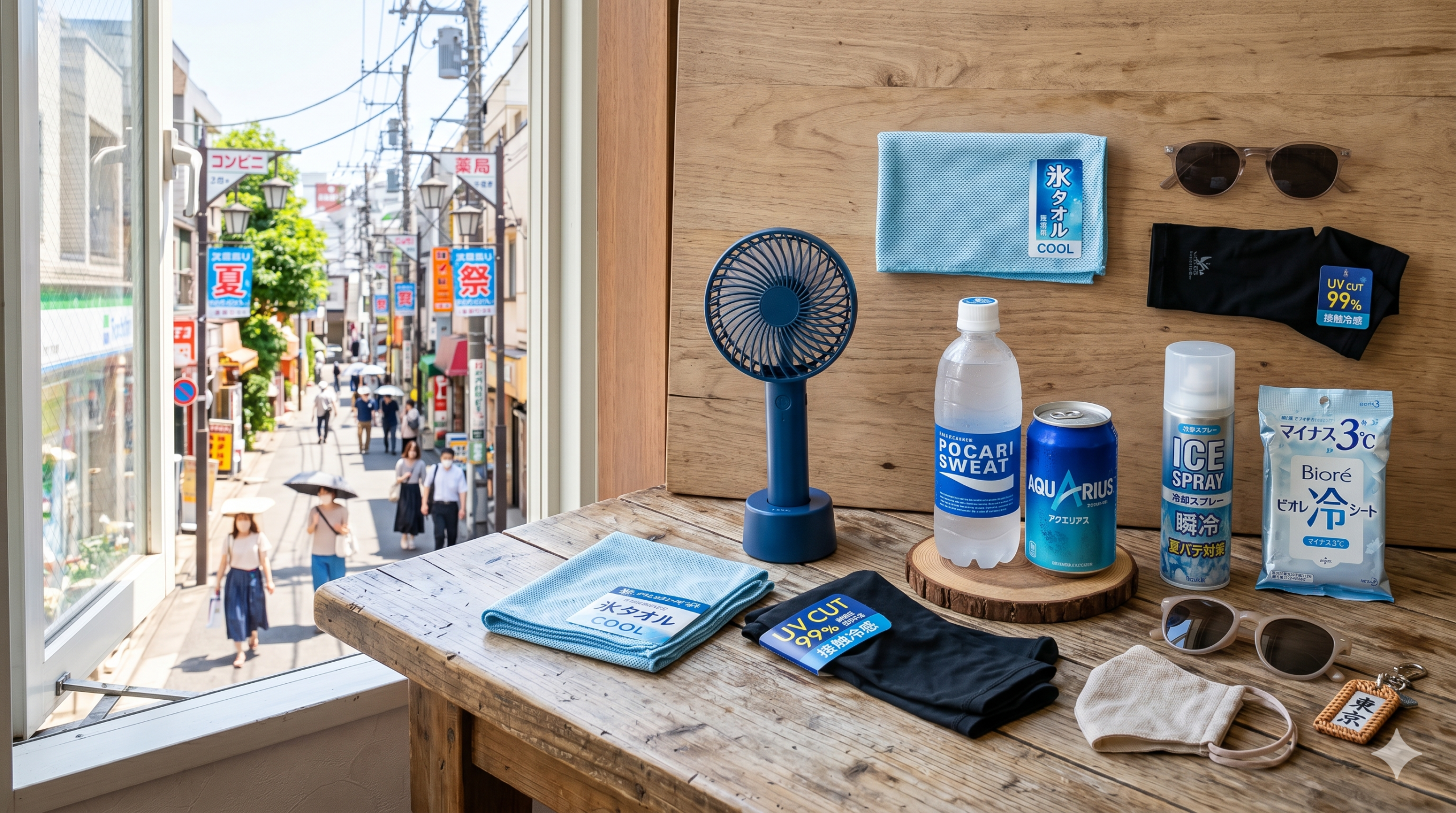
1. USB Rechargeable Handheld Mini Fan
The single most important summer item. Japanese people of all ages — salarymen in suits, schoolkids, elderly grandmothers — carry personal fans everywhere. It’s not a tourist thing; it’s a survival strategy. Models by JISULIFE, Comlife, and TriBit get 20+ hours of runtime on one charge and fit in a shirt pocket. Get one with a built-in power bank option for double duty.
💡 Pro tip: Wet your wrist or neck first, then fan — the cooling effect doubles instantly.
2. Neck-Mounted Cooling Fan (Hands-Free)
For serious heat — walking through Kyoto’s outdoor shrines, Nara deer park, or hiking to Fushimi Inari — a wearable neck fan is a game-changer. These bladeless fans hang around your neck and blow air directly at your face and neck. Battery lasts 8–12 hours; fits in a bag when not wearing.
3. Instant Cooling Towel (Pack of 3)
These microfiber towels drop ~20°C below ambient temperature when wet. Drape around your neck at Senso-ji or Arashiyama and the relief is immediate and lasting. Buy a 3-pack — they dry and re-activate throughout the day. Chill Pal, Frogg Toggs, and Mission make the top-rated versions.
4. Cooling Neck Ring (Phase-Change Technology)
Phase-change cooling rings freeze at exactly 28°C (82°F) — just pop them in a convenience store freezer for a few minutes. Unlike ice packs, they don’t melt into water and stay at 28°C for hours. Japanese tourists use these constantly in summer; you’ll see them everywhere.
5. UV Protection Arm Sleeves (UPF 50+)
Japan’s UV index in summer is rated “Very High” (8–10) — comparable to tropical destinations. UV arm sleeves provide UPF 50+ protection across both arms without constant sunscreen reapplication. They’re also cooling — the light fabric with airflow actually feels cooler than bare arms in direct sun.
6. UV-Blocking Sun Hat (UPF 50+, Packable)
A quality wide-brim sun hat blocks direct sun from your face and neck — the areas most at risk for heat stroke and sunburn. Packable versions fold flat and fit in your daypack. Look for UPF 50+ rating and a chin strap — Japan’s summer winds will test any hat without one.
7. High-SPF Sunscreen (SPF 50+, Water-Resistant)
Japanese sunscreen is excellent — Biore UV Aqua Rich is legendary among travelers — but you need to survive the first day before you can buy any. Bring an SPF 50+ water-resistant formula in TSA-compliant 3oz bottles. Reapply every 2 hours while outdoors. Sun damage happens in 15 minutes in peak Japan summer sun.
8. Electrolyte Hydration Powder Packets
Sweat rate in Japan summer can reach 1–2 liters per hour during outdoor activities. Water alone doesn’t replace the sodium, potassium, and magnesium you lose. Electrolyte packets (Liquid I.V., LMNT, Nuun) prevent heat exhaustion before it starts. TSA-approved in carry-on. Drink one before your afternoon outdoor activities.
9. Cooling Mist Spray Bottle
A fine-mist spray bottle filled with water + a few drops of peppermint oil = instant 10-degree cooldown on your skin. Japan’s konbini sell cooling sprays (Gatsby Ice Deodorant Spray is famous), but having your own refillable bottle is more economical. Mist your face and use a fan simultaneously for maximum effect.
10. Moisture-Wicking Clothing (Quick-Dry)
Cotton clothing in Japan summer becomes a soggy, heavy liability within 20 minutes of walking. Moisture-wicking quick-dry fabrics (polyester or nylon blend) pull sweat away and dry in minutes. Uniqlo’s AIRism line is fantastic, but buy a few pieces on Amazon before you go so you arrive prepared.
11. High-Capacity Power Bank (For Charging the Fan)
Your handheld fan (item #1 above) needs power all day. A 20,000mAh+ power bank keeps your fan, phone, camera, and earbuds running through the longest Japan summer day. Anker 737 (140W, TSA-compliant) is the gold standard.
12. Blister Bandages (Compeed Advanced)
Summer + heat + 20km walking days + sandals = blister catastrophe. Compeed Advanced Blister Bandages are the gold standard — they cushion, protect, and stay on through multiple days. Japanese pharmacies have bandages but blister-specific products are hard to find in English.
13. Anti-Chafing Balm (Body Glide or Monistat)
Heat + humidity + walking = thigh chafing. It’s unglamorous but real. Anti-chafing balm (Body Glide is the travel standard) prevents the painful skin irritation that can ruin the second half of your trip. Apply before any outdoor activity. Available on Amazon; harder to find abroad.
14. Compact Windproof Umbrella (UV Blocking)
A UV-blocking umbrella (kasa with UPF protection) is more effective sun protection than any hat or sleeve — it blocks direct and reflected UV simultaneously. Japanese women use these year-round; tourists quickly adopt them after one afternoon in Kyoto. Look for compact folding versions with wind-resistance and UPF 50+ rating.
15. Lightweight Collapsible Water Bottle (1L+)
Japan tap water is perfectly safe and among the world’s best. Stay hydrated by filling up at hotel sinks, temple water stations, and park fountains. A collapsible bottle folds to wallet-size when empty. Drink a minimum of 3–4 liters daily in Japan summer — this is a medical recommendation, not a suggestion.
🆘 Recognizing Heat Illness in Japan
Know the warning signs:
- Heat exhaustion: Heavy sweating, weakness, cold/pale skin, weak pulse, nausea. Get to shade and AC immediately, drink electrolytes.
- Heat stroke: High body temp (103°F+), hot/red/dry skin, rapid pulse, confusion. Call 119 (Japan emergency) immediately.
Every Japanese train station, major convenience store, and department store has air conditioning. When in doubt, go inside. Japan is also known for excellent free water at convenience store counters — don’t hesitate to ask.
📅 Japan Summer Travel Calendar
| Month | Conditions | Must-Have Items |
|---|---|---|
| June | Rainy season, humid, 25–30°C | Umbrella, light layers, electrolytes |
| July | Peak heat begins, festivals, 30–35°C | All 15 items — full kit |
| August | Hottest month, 35–38°C+, typhoons possible | All 15 items — critical |
| September | Still hot early month, cools by end, typhoons | Fan, UV, electrolytes + poncho |
Frequently Asked Questions
Is Japan too hot to visit in summer?
No — millions visit Japan in summer and have incredible experiences. The key is adjusting your schedule: outdoor activities in the morning (before 10am) and evening (after 5pm), indoor attractions midday. Air conditioning is absolutely everywhere in Japan — department stores, restaurants, train stations, museums, convenience stores. You’re never far from relief.
What do Japanese people do to stay cool in summer?
Japanese people have perfected summer survival: handheld electric fans (almost everyone carries one), neck coolers, UV-blocking parasols, cooling sprays (Gatsby Ice Body Spray is a convenience store staple), shaved ice (kakigori) at festivals, and strategic use of air-conditioned spaces. Following local habits is the best survival strategy.
Can I buy these cooling products in Japan?
Yes, most are available at 100-yen shops (Daiso), drugstores (Matsukiyo), convenience stores, and Don Quijote. However, buying from Amazon before your trip means you arrive prepared from day one — and you’re guaranteed your preferred brand and size. Some items (like US-brand electrolytes and Western-size UV clothing) are hard to find in Japan.
What’s the best time to visit Japan to avoid the heat?
Spring (late March–May) and autumn (October–November) are Japan’s most comfortable seasons — 15–25°C, low humidity, beautiful foliage or cherry blossoms. However, summer has its own magic: vibrant matsuri (festivals), fireworks displays, and fewer international tourists compared to spring. With the right gear, summer is absolutely worth visiting.
🔥 Editor’s Picks for Life & Travel in Japan
📘 The Japan Expat Starter Kit 2026
Banking, housing, My Number, taxes, 100 phrases and a 40-kanji cheat sheet — everything from this site in one 17-chapter PDF field manual. Free lifetime 2026 updates.
Reader price: $9.99 $6.99 with code JLL30 at checkout
30-day money-back guarantee · Instant download · PR
Practical guides for life and travel in Japan — free, about once a week. No spam, unsubscribe anytime.
☕ Enjoying our Japan guides?
If this article helped you, you can support our work with a coffee!
Did this guide help you? 🍵
Japan Life Lab is a small independent blog, and every guide we publish is completely free — no paywalls, ever. If our work saved you time (or a headache), you can support us with a cup of Japanese tea. Every contribution, big or small, goes straight into keeping these guides free, accurate and up to date for everyone.
☕ Support Japan Life Lab
Leave a Reply