This article was created with AI writing assistance (ChatGPT, Claude, etc.). Product selection, specifications, and reviews are verified by the Japan Life Lab editorial team.
This article contains promotional / affiliate links.
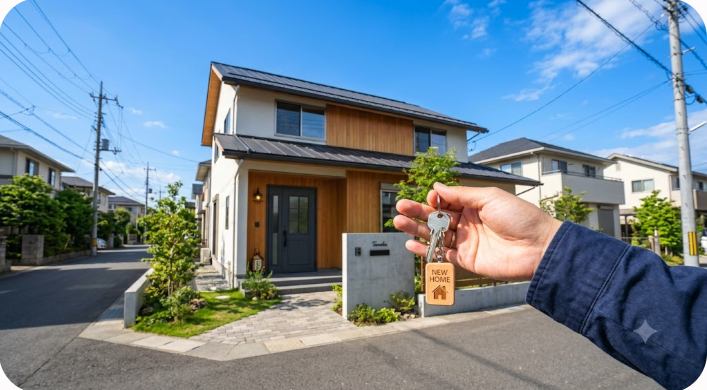
Yes — foreigners can buy property in Japan. There are no citizenship or visa requirements to own land or a home, ownership is freehold and permanent, and property prices in most of the country remain remarkably affordable compared with other developed nations. The hard part is not the law — it is the mortgage. This guide walks you through the full process: who can realistically get financing, how much you need, every fee you will pay, and the step-by-step path from house hunting to getting the keys.
📌 What you will learn
You do not have to read it all — jump to what you need.
- The one-minute reality check
- The mortgage: what banks actually require
- The real cost: add 6–9% on top of the price
- Mansion (condo) vs house vs akiya
- Step-by-step: from search to keys (2–3 months typical)
- Conclusion
※ Start wherever fits your situation.
The one-minute reality check
| Question | Answer |
|---|---|
| Can I own property without PR? | ✅ Yes — even tourists can legally buy (cash) |
| Can I get a mortgage without PR? | ⚠️ Difficult but possible — a few banks lend to long-term residents with stable income |
| Does buying property help me get a visa? | ❌ No — property ownership grants no residency rights |
| Is ownership freehold? | ✅ Yes — you own the land and building outright, forever, and can sell or rent it out |
The mortgage: what banks actually require
Japanese mortgage rates are among the lowest in the world — variable rates for qualified borrowers have hovered around 0.5–1%, though they have been edging up as the Bank of Japan normalises policy. To access them, banks generally look for:
- Permanent residency (PR) — the golden ticket. With PR, you are treated like a Japanese applicant at almost every bank
- Without PR: some banks will still lend if you have a Japanese spouse (as guarantor or co-borrower), long job tenure in Japan (2+ years at the same employer), stable income (roughly ¥4–5 million+ per year helps), and Japanese language ability for the paperwork. Banks known for considering non-PR applicants include SMBC Trust (PRESTIA), Shinsei/SBI Shinsei and Suruga — policies change, so ask several
- Flat 35: the government-backed fixed-rate loan is available to foreign residents on the same terms as Japanese nationals — PR is not formally required, though screening still favours stability
💡 Typical numbers
Down payment: 10–20% (non-PR applicants are often asked for 20%+). Borrowing limit: roughly 7–8× annual income. Loan term: up to 35 years (age at maturity usually capped at 79–80). Group credit life insurance (dan-shin) is mandatory at most banks and built into the rate.
The real cost: add 6–9% on top of the price
| Cost item | Amount |
|---|---|
| Agent commission | 3% of price + ¥60,000 + tax (used properties) |
| Registration & judicial scrivener | 0.5–1% (title registration, shiho-shoshi fees) |
| Loan fees & guarantee | Around 2% of the loan amount at many banks |
| Stamp duty & acquisition tax | Tens of thousands of yen + one-time real estate acquisition tax |
| Fire & earthquake insurance | ¥100,000–300,000 for multi-year cover |
| Ongoing: fixed asset tax | About 1.4% of assessed value per year (assessed value is well below market price) |
| Condos only: management + repair fund | Typically ¥20,000–40,000/month combined |
Mansion (condo) vs house vs akiya
- Condo (manshon): easier to maintain and resell, better locations, but monthly fees forever. Check the repair fund health and management association minutes before buying
- Detached house: full freedom, no monthly fees — but Japanese houses depreciate; the land holds the value. Budget for your own maintenance
- Akiya (vacant house): prices from a few million yen, but renovation can cost more than the house. We cover this route in detail in our akiya buying guide
⚠️ The 1981 earthquake rule
Buildings approved after June 1981 follow the shin-taishin (new earthquake resistance) standard. Older buildings can be excellent value but may need seismic retrofitting, are harder to finance and insure, and resell poorly. Always check the building approval date, not just the completion date.
Step-by-step: from search to keys (2–3 months typical)
- Get pre-screened for a loan (jizen shinsa) — do this BEFORE house hunting; it takes about a week and tells you your real budget
- Search — SUUMO and AtHome list most properties; any licensed agent can show you any listing
- Offer (kaitsuke) — written offer; mild negotiation (1–5%) is normal on used properties
- Important matters explanation (juyo jiko setsumei) — a licensed agent must explain the legal details; bring a translator if needed, as everything is in Japanese
- Contract + deposit — typically 5–10% earnest money; read the cancellation clauses
- Formal loan screening (honshinsa) — 2–4 weeks
- Closing (kessai) — remaining payment, title transfer by the judicial scrivener, keys handed over the same day
FAQ
Can I buy remotely from overseas?
Legally yes (cash buyers), and some agencies specialise in overseas purchasers. You will need a Japanese contact point, an affidavit in place of a registered seal, and expect extra paperwork for the money transfer under foreign exchange reporting rules.
Do I pay tax when I sell?
Capital gains are taxed at roughly 39% if you sell within 5 years of purchase, dropping to about 20% after 5 years — a major reason to think long-term.
Is now a good time to buy?
Tokyo condo prices have risen strongly, while regional prices remain flat or falling. Rather than timing the market, compare your rent against a mortgage payment: with low rates, monthly loan payments on a comparable property are often similar to rent — but remember the 6–9% purchase costs and the resale reality of Japanese buildings. (This is general information, not financial advice — consult a professional for your situation.)
What if I leave Japan?
You keep the property. You can rent it out (notify your bank first — some mortgages require owner-occupancy) or sell. Non-resident landlords need a tax agent in Japan.
Conclusion
Buying a home in Japan as a foreigner is entirely realistic: ownership is open to everyone, prices outside central Tokyo are reasonable, and mortgage rates are world-beatingly low if you can access them. The practical path is: build stability (PR or long tenure + stable income) → pre-screening → hunt with the 1981 rule in mind → budget price + 8% → close in 2–3 months. Start with the loan pre-screening; it turns the whole dream into a concrete number. If ownership is not for you yet, see our renting guide — and if you are dreaming cheap and rural, the akiya route awaits.
Japan Expat Starter Kit 2026 PDF guide
Your first 90 days in Japan, step by step: 17 chapters · 24 pages · 100 phrases in Japanese script · 40 kanji · printable checklists. Bank account, My Number, health insurance, apartment, phone, taxes & pension.
$9.99 $4.99 current price
📄 Read 5 pages free: contents + Chapter 2
⚡ Instant PDF download · 🛡️ 30-day money-back guarantee · 🔄 Free 2026 updates
🔥 Editor’s Picks for Life & Travel in Japan
Practical guides for life and travel in Japan — free, about once a week. No spam, unsubscribe anytime.
☕ Enjoying our Japan guides?
If this article helped you, you can support our work with a coffee!
🇯🇵 Travel & Life Essentials for Japan
Hand-picked gear to make your time in Japan easier. Available on Amazon US & Amazon Japan.
🔋 Portable charger
A must for long days of sightseeing and photos.
View on Amazon (US)View on Amazon Japan🔌 Travel plug adapter
Japan uses Type A outlets. Bring the right adapter.
View on Amazon (US)View on Amazon Japan🎧 Translation earbuds
Real-time translation to talk without barriers.
View on Amazon (US)View on Amazon JapanAs an Amazon Associate, Japan Life Lab earns from qualifying purchases.
Did this guide help you? 🍵
Japan Life Lab is a small independent blog, and every guide we publish is completely free — no paywalls, ever. If our work saved you time (or a headache), you can support us with a cup of Japanese tea. Every contribution, big or small, goes straight into keeping these guides free, accurate and up to date for everyone.
☕ Support Japan Life Lab
Leave a Reply