This article was created with AI writing assistance (ChatGPT, Claude, etc.). Product selection, specifications, and reviews are verified by the Japan Life Lab editorial team.
This article contains promotional / affiliate links.
Enrolling your child in Japanese daycare or school feels like a maze of paperwork, deadlines and untranslated forms — but once you understand the system, it is remarkably fair and affordable. This guide walks foreign parents through the whole path: hoikuen vs yochien, the application calendar that catches everyone off guard, what “points” mean, costs, and what really happens if your child does not speak Japanese yet.
📌 What you will learn
You do not have to read it all — jump to what you need.
- The Japanese System at a Glance
- Hoikuen: How the Points System Works
- Costs: Cheaper Than You Fear
- “My Child Does Not Speak Japanese” — What Actually Happens
- Elementary School Enrollment: The Automatic Path
- Paperwork Checklist
※ Start wherever fits your situation.
The Japanese System at a Glance
| Type | Ages | What it is | Key point |
|---|---|---|---|
| Hoikuen 保育園 | 0–5 | Daycare for working parents (full day, incl. lunch/naps) | Entry decided by municipality via a points system |
| Yochien 幼稚園 | 3–5 | Kindergarten, education-focused, shorter hours | Apply directly to each school; many offer extended care |
| Kodomo-en こども園 | 0–5 | Hybrid of the two | Growing fast; rules blend both systems |
| Shogakko 小学校 | 6–12 | Elementary school | Public school is open to all resident children — enrollment is essentially automatic by address |
Two facts that surprise many foreign parents: (1) Public elementary school is open to every child living in Japan regardless of nationality or visa status, and (2) daycare/kindergarten for ages 3–5 is largely free under the national free early-education program (meals and extras still cost a little).
Hoikuen: How the Points System Works
Licensed hoikuen (ninka) spots are allocated by your city office, not the daycare itself. Each family gets a score based on need for care: both parents working full-time scores high; part-time, job-hunting or freelance score lower; single parents and some situations get bonus points. High scorers get spots first. This is why the phrase hokatsu (保活, “daycare hunting”) exists.
The calendar that catches everyone
- April is the main entry month. Applications for April usually open October–December the year before — missing this window is the number-one mistake
- Mid-year entry is possible only if a spot happens to be free (rare in cities for ages 0–2)
- Age 0–1 entry is statistically easier than age 2 entry in competitive wards
- Unlicensed (ninka-gai) daycares accept direct applications year-round — a common bridge while waiting
What to do: visit the childcare section (保育課) of your city office as soon as you know you need care. Bring your residence cards; many offices in big cities offer translation support. Ask for the application form, the list of local hoikuen, and your likely score.
Costs: Cheaper Than You Fear
Ages 3–5: tuition is free at licensed facilities nationwide (you pay lunch, snacks, event fees — typically a few thousand yen per month). Ages 0–2: fees are income-based, calculated from your municipal tax — roughly ¥0 to ¥70,000+ per month depending on income and city, with sibling discounts. Yochien extras (uniforms, bus) vary by school. Compared with daycare costs in the US or UK, most expat families find Japan strikingly affordable.
“My Child Does Not Speak Japanese” — What Actually Happens
This is the biggest worry, and the news is good: young children typically pick up conversational Japanese within 6–12 months of immersion, and teachers are used to it. For elementary school, many municipalities provide Japanese-as-a-second-language support classes (nihongo shido) and some assign support staff initially. Practical tips: (1) tell the school in advance so support can be arranged, (2) teach your child a few survival phrases (トイレ = toilet, 痛い = it hurts, 先生 = teacher), (3) connect with other foreign parents — schools often know who they are. International schools are the alternative route, but at ¥1.5–3M+ per year they are a different financial universe; many bilingual families thrive in public school plus weekend heritage-language classes.
Elementary School Enrollment: The Automatic Path
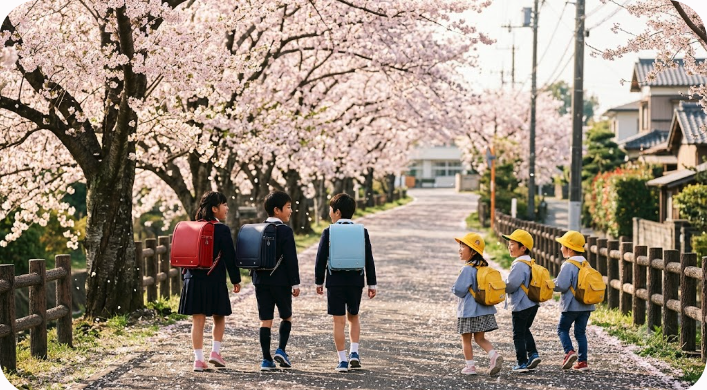
Once your child is registered as a resident, the city sends an enrollment notice (就学通知書) the autumn before they turn 6, assigning the local public school. Steps: health check in autumn → orientation in Jan–Feb → entrance ceremony in April. Budget for the famous randoseru backpack (¥30,000–70,000; grandparents traditionally buy it) and school supplies. School lunch (kyushoku) is nutritious, cheap (around ¥4,000–5,000 per month) and a cultural institution — allergies are handled via a form at enrollment.
Paperwork Checklist
Documents you will likely need (hoikuen)
- Residence cards (parents + child) and My Number
- Proof of employment (就労証明書) from each parent’s employer — freelancers submit work records or contracts instead
- Latest municipal tax certificate (for fee calculation)
- Child’s health and vaccination records (Boshi Techo — the Mother-Child Handbook)
Employers in Japan know the 就労証明書 form well — HR can usually turn it around in days. Ask early anyway; it expires in some cities if too old.
FAQ
Can we get in if both parents do not speak Japanese?
Yes. The system judges need, not language. Bring a translation app or a friend for city-office visits; several big cities have multilingual childcare desks.
We might leave Japan in 2 years — is public school still OK?
Many families do exactly this. Kids gain a language and adaptability; weekend home-language study helps reentry. International school matters more for high-school continuity than early years.
What is a taikijido (待機児童)?
A “waitlisted child” — one who applied to licensed daycare but got no spot. Numbers have dropped sharply in recent years, but competitive districts for ages 0–2 still exist. Apply for multiple choices (most cities let you rank 5–10).
Japan Expat Starter Kit 2026 PDF guide
Your first 90 days in Japan, step by step: 17 chapters · 24 pages · 100 phrases in Japanese script · 40 kanji · printable checklists. Bank account, My Number, health insurance, apartment, phone, taxes & pension.
$9.99 $4.99 current price
📥 Get the kit →📄 Read 5 pages free: contents + Chapter 2
⚡ Instant PDF download · 🛡️ 30-day money-back guarantee · 🔄 Free 2026 updates
🔥 Editor’s Picks for Life & Travel in Japan
Practical guides for life and travel in Japan — free, about once a week. No spam, unsubscribe anytime.
☕ Enjoying our Japan guides?
If this article helped you, you can support our work with a coffee!
🇯🇵 Travel & Life Essentials for Japan
Hand-picked gear to make your time in Japan easier. Available on Amazon US & Amazon Japan.
🔋 Portable charger
A must for long days of sightseeing and photos.
View on Amazon (US)View on Amazon Japan🔌 Travel plug adapter
Japan uses Type A outlets. Bring the right adapter.
View on Amazon (US)View on Amazon Japan🎧 Translation earbuds
Real-time translation to talk without barriers.
View on Amazon (US)View on Amazon JapanAs an Amazon Associate, Japan Life Lab earns from qualifying purchases.
Did this guide help you? 🍵
Japan Life Lab is a small independent blog, and every guide we publish is completely free — no paywalls, ever. If our work saved you time (or a headache), you can support us with a cup of Japanese tea. Every contribution, big or small, goes straight into keeping these guides free, accurate and up to date for everyone.
☕ Support Japan Life Lab
Leave a Reply