This article was created with AI writing assistance (ChatGPT, Claude, etc.). Product selection, specifications, and reviews are verified by the Japan Life Lab editorial team.
This article contains promotional / affiliate links.
📌 What you will learn
You do not have to read it all — jump to what you need.
- The invisible ingredient behind almost every Japanese dish
- The four building blocks
- How to make dashi from scratch
- The shortcuts: what Japanese households actually use
- What to buy: a starter shopping list
- Storage: the mistake that wastes good ingredients
- Three dishes to make with your first batch
※ Start wherever fits your situation.
The invisible ingredient behind almost every Japanese dish
You can buy the right soy sauce, the right miso and the right rice, and your Japanese cooking will still taste flat. The missing element is almost always dashi — the light, savoury stock that sits underneath miso soup, simmered dishes, noodle broths, tamagoyaki, and the dipping sauce for tempura.
Dashi is where Japanese food gets its umami. And unlike a French stock that simmers for hours, a proper dashi takes about fifteen minutes — or thirty seconds if you use a pack.
This guide explains the main types of dashi, what to buy, how to make it from scratch, and which shortcut products are worth your money.
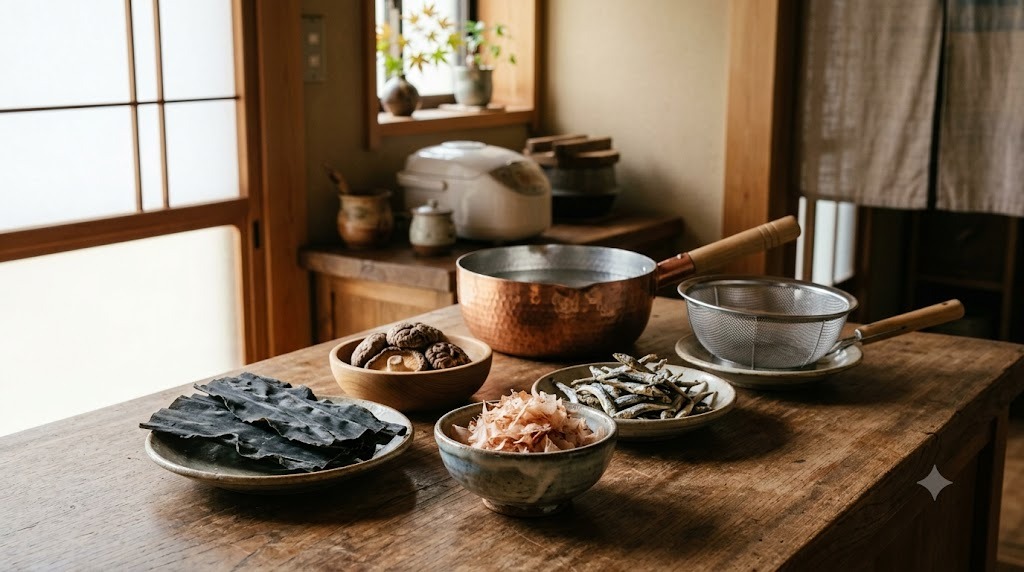
The four building blocks
| Ingredient | What it is | Flavour it gives |
|---|---|---|
| Kombu (昆布) | Dried kelp | Clean, mineral, deeply savoury. Vegan |
| Katsuobushi (鰹節) | Dried, smoked and fermented skipjack tuna, shaved | Smoky, aromatic, distinctly “Japanese” |
| Niboshi / iriko (煮干し) | Small dried sardines | Strong, punchy, slightly bitter. Great in miso soup |
| Hoshi-shiitake (干し椎茸) | Dried shiitake mushrooms | Earthy, rich. Vegan, and pairs well with kombu |
The most common combination — awase dashi — is kombu plus katsuobushi. Kombu brings glutamates, katsuobushi brings inosinates, and the two together produce far more umami than either alone. This synergy is not folklore; it is the reason the pairing became standard.
How to make dashi from scratch
Ichiban dashi (first brew) — for clear soups
| Ingredients | 1 litre water, 10g kombu, 20–30g katsuobushi |
|---|---|
| Step 1 | Wipe the kombu lightly with a dry cloth. Do not wash off the white powder — that is umami |
| Step 2 | Soak the kombu in the water for 30 minutes (or overnight in the fridge) |
| Step 3 | Heat slowly. Remove the kombu just before the water boils |
| Step 4 | Bring to a boil, turn off the heat, add the katsuobushi |
| Step 5 | Let it sink for 1–2 minutes, then strain through a fine sieve or cloth |
| Do not | Squeeze the katsuobushi. It turns the stock bitter and cloudy |
The result is pale gold and delicate. Use it where the dashi is the star: clear soup (suimono), chawanmushi, or a simple miso soup.
Niban dashi (second brew) — do not throw away the solids
Put the used kombu and katsuobushi back in a pot with 500ml of water, simmer gently for about 10 minutes, and strain. The result is stronger and less refined — perfect for simmered dishes, nikujaga, and anything with soy sauce and mirin where subtlety would be lost anyway.
Making niban dashi is standard practice in Japanese home kitchens. It halves the effective cost of your ingredients.
Kombu dashi — the vegan version
Simply soak 10g of kombu in 1 litre of cold water overnight in the fridge. That is the entire method — no heat required. Add dried shiitake to the same jar and you get a fuller, rounder vegan stock with real depth.
The shortcuts: what Japanese households actually use
Here is the honest truth that recipe blogs rarely admit: most Japanese homes do not make dashi from scratch on a weekday. They use packs or granules, and the results are genuinely good.
Dashi packs (だしパック) — the best balance
Teabag-style sachets containing ground kombu, katsuobushi, niboshi and sometimes shiitake. Drop one in simmering water for 3–5 minutes, remove, done. This is the shortcut worth adopting.
Quality varies enormously. Look for packs where the ingredient list is just dried fish and seaweed. Cheaper packs add salt, sugar and MSG, which is not a crime but removes your control over seasoning. If the pack is already salty, your miso soup will end up too salty.
✅ What we like
- Close to homemade in flavour
- Ready in 3–5 minutes
- Long shelf life, easy to store
- Easy to carry home in luggage
- Many varieties: katsuo-heavy, niboshi-heavy, vegan kombu-shiitake
- You can tear one open and use the contents as furikake
Granulated dashi (顆粒だし) — fastest, most compromised
Powder you dissolve directly in hot water. Hondashi is the ubiquitous brand. It is fast, cheap, consistent and contains salt and MSG. Millions of excellent bowls of miso soup are made with it every day.
Use it when speed matters. Just remember it is pre-salted — reduce the miso or soy sauce accordingly.
Liquid concentrate (だしつゆ / めんつゆ) — different thing entirely
Mentsuyu is dashi already seasoned with soy sauce, mirin and sugar. It is not a substitute for plain dashi — it is a finished sauce base. Brilliant for noodle dipping sauce, donburi and simmered vegetables. Wrong for clear soup.
Note for readers avoiding alcohol: mentsuyu almost always contains mirin, and many contain added alcohol. Plain dashi packs and kombu dashi do not. Check the label if this matters to you.
What to buy: a starter shopping list
| Item | Why | Rough price in Japan |
|---|---|---|
| Kombu (100g bag) | Vegan base, keeps for years | ¥500–1,500 |
| Katsuobushi (small bags) | Aroma and umami. Buy small — it goes stale | ¥300–800 |
| Dashi packs (20–30 sachets) | Your everyday workhorse | ¥500–1,500 |
| Dried shiitake | Vegan depth, also great in stews | ¥400–1,000 |
| Niboshi | Strong dashi for hearty miso soup | ¥400–900 |
If you are buying one thing to take home from Japan, make it a box of good dashi packs. They are light, flat, shelf-stable and instantly upgrade every Japanese dish you cook.
Storage: the mistake that wastes good ingredients
⚠️ Things to consider
- Katsuobushi goes stale fast once opened. Seal it and refrigerate or freeze. Buy small bags rather than one large one
- Kombu keeps for years in a cool dark place, but absorbs moisture. Store sealed with the silica packet
- Niboshi can go rancid. The oils oxidise. Freeze if you use it slowly
- Homemade dashi lasts 3–4 days refrigerated. Freeze it in ice cube trays for portioned use
- Do not wash kombu. The white powder on the surface is mannitol — pure umami. Wipe, do not rinse
The ice cube trick is worth adopting: make a litre of dashi on Sunday, freeze it in cubes, and you have single-portion stock ready all week.
Three dishes to make with your first batch
Miso soup (the two-minute version)
Heat 400ml dashi. Add whatever you have — tofu cubes, wakame, thinly sliced spring onion. Turn off the heat, then dissolve about 2 tablespoons of miso through a ladle or strainer. Never boil miso after adding it; boiling destroys the aroma. Serve immediately.
Ohitashi (blanched greens in dashi)
Blanch spinach or komatsuna, squeeze out the water, cut into 4cm lengths. Soak in 200ml dashi with a tablespoon of soy sauce for 20 minutes. Top with katsuobushi. This is the dish that makes people realise dashi is not just for soup.
Tamagoyaki (rolled omelette)
Three eggs, 3 tablespoons dashi, a teaspoon of sugar, a splash of soy sauce. The dashi is what makes a Japanese rolled omelette silky rather than rubbery. Cook in thin layers in a rectangular pan and roll each one forward.
Dashi FAQ
Is dashi vegan?
Katsuobushi and niboshi are fish, so standard dashi is not. Kombu dashi and kombu-shiitake dashi are fully vegan and widely used in shojin ryori (Buddhist temple cuisine). Vegan dashi packs are also sold in Japan — look for 昆布 and 椎茸 on the ingredient list with no 鰹.
Is dashi gluten free?
Plain dashi from kombu and katsuobushi is. But many granulated and liquid products contain soy sauce, which usually contains wheat. If you need gluten-free, make it yourself or read labels carefully.
Can I substitute chicken stock?
You can cook with it, but the dish stops being Japanese in character. Chicken stock is heavier and fattier; dashi is light and clean. If you have no dashi, a kombu-only stock made from a piece of kelp in cold water is closer than any Western stock.
Why does my dashi taste bitter or fishy?
Three usual causes: you boiled the kombu, you squeezed the katsuobushi when straining, or you simmered the katsuobushi too long. Dashi wants gentle heat and short contact time.
How much does homemade cost per litre?
Roughly 10g kombu and 25g katsuobushi per litre. At Japanese retail prices this is a modest amount per litre — and if you make niban dashi from the same solids, the effective cost roughly halves.
Can I buy the ingredients outside Japan?
Yes. Kombu, katsuobushi and dashi packs are all available from Japanese grocers, Amazon in most countries, and via proxy services for the specialist brands. Because everything is dried, shipping is light and customs is generally straightforward — though some countries restrict fish products, so check your local rules before ordering katsuobushi or niboshi.
Start here
If you take one thing from this guide: buy a box of good dashi packs, and make ohitashi once. The packs will carry your everyday cooking, and the ohitashi will show you what dashi actually tastes like when it is not hiding under miso.
From there, making ichiban dashi from scratch on a weekend stops feeling like a project and starts feeling like fifteen minutes well spent.
Related guides
🔥 Editor’s Picks for Life & Travel in Japan
📘 The Japan Expat Starter Kit 2026
Banking, housing, My Number, taxes, 100 phrases and a 40-kanji cheat sheet — everything from this site in one 17-chapter PDF field manual. Free lifetime 2026 updates.
Reader price: $9.99 $6.99 with code JLL30 at checkout
30-day money-back guarantee · Instant download · PR
Practical guides for life and travel in Japan — free, about once a week. No spam, unsubscribe anytime.
☕ Enjoying our Japan guides?
If this article helped you, you can support our work with a coffee!
Did this guide help you? 🍵
Japan Life Lab is a small independent blog, and every guide we publish is completely free — no paywalls, ever. If our work saved you time (or a headache), you can support us with a cup of Japanese tea. Every contribution, big or small, goes straight into keeping these guides free, accurate and up to date for everyone.
☕ Support Japan Life Lab
Leave a Reply