This article was created with AI writing assistance (ChatGPT, Claude, etc.). Product selection, specifications, and reviews are verified by the Japan Life Lab editorial team.
This article contains promotional / affiliate links.
Walk into any Japanese convenience store from October to March and you will find a wall of little paper packets called kairo (カイロ) — disposable heat pads that stay warm for up to 24 hours. They cost about the price of a candy bar, they work with zero electricity, and they are one of Japan’s great unsung inventions. Ask anyone who has stood through a January morning at a shrine, a football match, or a Tokyo Disney queue: kairo are survival gear.
This guide explains the types, how to use them properly (there is technique!), and the best ones to buy — including the century-old platinum kairo that collectors love.
⏱ The short answer (30 seconds)
In a hurry? The full reasons and prices are right below.
- Kiribai Kairothe gold-standard disposable
- Kiribai foot kairo (Kutsushita-yō and Kutsu-yō types)for frozen toes
- Hakkin Kairo (Peacock)the 100-year-old reusable legend
- USB rechargeable hand warmersthe commuter favorite
※ If in doubt, go with #1. Budget picks are further down the page.
Prime members get fast, free delivery on millions of items, Prime Video and members-only deals. Eligible new members can try it free for 30 days.
Start your free 30-day Prime trial →Ages 18–24? See Prime for Young Adults
Paid links. As an Amazon Associate, Japan Life Lab earns from qualifying purchases. Trial eligibility and terms are set by Amazon.
What is a kairo and how does it work?
Disposable kairo contain iron powder that oxidizes when exposed to air — the same rusting reaction you know, sped up and controlled, releasing steady heat around 50-60°C for 8-24 hours depending on the type. Open the packet, shake once or twice, and it warms up within minutes. When it cools, it goes in the metal-recycling or burnable bin depending on your city.
The main types (and when to use each)
- Regular (貼らないカイロ): loose pads for pockets and gloved hands. The classic.
- Stick-on (貼るカイロ): adhesive pads you stick on clothing — lower back and stomach are the pro spots. Never directly on skin.
- Foot type (靴下用・くつ用): thin insoles and toe pads engineered to work in the low-oxygen environment inside shoes.
- Rechargeable/reusable: USB-charged electric warmers and the legendary platinum-catalyst Hakkin type below.
The 4 Best Kairo & Hand Warmers in 2026
1. Kiribai Kairo — the gold-standard disposable
Kiribai (桐灰), now part of Kobayashi Pharmaceutical, is the brand Japanese people mean when they say kairo. The red-box standard pads hold their temperature remarkably steadily for up to 24 hours, and the stick-on versions keep a consistent 40-50°C zone against your clothing layer all workday.
Buy the 30-pack before winter; a box under the sink is as standard in Japanese households as tissues. They are also a brilliant, feather-light souvenir — overseas friends are always astonished by them.
2. Kiribai foot kairo (Kutsushita-yō and Kutsu-yō types) — for frozen toes
Regular kairo suffocate inside shoes — they need oxygen. Foot-type kairo are chemically tuned for low airflow, sold as thin pads you stick on the outside of your sock (under the toes, across the whole sole or over the top of the toes) or as insoles you lay inside the shoe. For winter stadiums, ski resorts, shrine visits at New Year and anyone with permanently cold feet, they are transformative.
Expect 5-9 hours of warmth. Safety first: the sock types go on the outside of the sock, never inside it against bare skin. Use the toe type under the toes, the long type across the whole sole, or the Kō ni Haru type on the top of the toes, then put your shoes on straight away. Follow the pack instructions and take the pad off if your feet get too hot, to avoid low-temperature burns.
3. Hakkin Kairo (Peacock) — the 100-year-old reusable legend
Before disposables, Japan warmed its hands with this: a polished metal flask in a felt pouch, invented in 1923, that generates heat through platinum-catalyzed oxidation of lighter fluid — no flame, no electricity, and roughly 13 times the heat output of a disposable pad. Fill, touch the catalyst with a lighter for a few seconds, and it stays hot for up to 24 hours.
Mountaineers, ice fishermen and gear romantics swear by them, and vintage-style Hakkin warmers have become a genuinely popular Japan souvenir. One flask can last decades — the ultimate anti-disposable.
4. USB rechargeable hand warmers — the commuter favorite
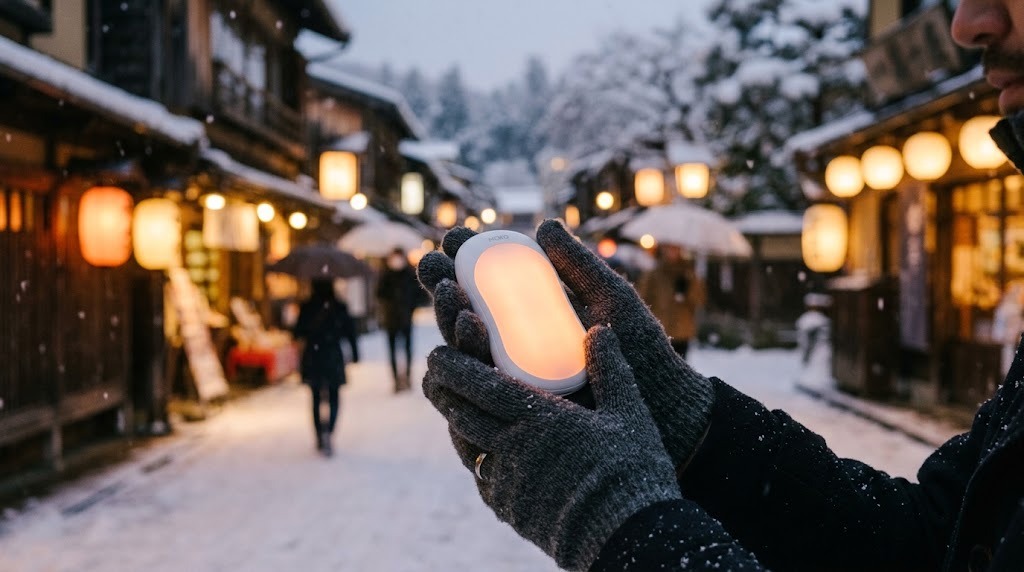
Japan’s gadget shops are full of palm-sized USB warmers that double as phone power banks. They heat in seconds, offer 2-3 temperature levels, and last a commute or an evening walk per charge. For daily train commuters who do not want to burn through disposables, one of these plus a pocket kairo as backup is the standard winter loadout.
Choose known brands with PSE-marked batteries, and check heat-time claims against battery capacity — bigger mAh, longer warmth.
How to use kairo like a local
- The magic spots: stick-on kairo go on the lower back (腰) or below the navel — warming your core warms your hands and feet more than warming your hands does.
- Never on bare skin: low-temperature burns (低温やけど) are real. Always keep a clothing layer between kairo and skin, and don’t sleep on one.
- Slow it down: a kairo in a sealed zip bag pauses the reaction — useful to stretch one pad across two short outings.
- Stock up at drugstores: convenience stores sell singles at a markup; drugstores and supermarkets sell 30-packs for far less per pad.
FAQ
How long does a Japanese kairo stay warm?
Regular disposable kairo last 12-24 hours depending on the model; stick-on types typically 8-14 hours; foot types 5-9 hours. The Hakkin platinum kairo lasts up to 24 hours per fill of lighter fluid.
Can I take kairo on an airplane?
Disposable iron-powder kairo are generally fine in carry-on and checked luggage. The Hakkin-type liquid-fuel warmer is restricted like lighter fluid — check your airline before flying with fuel.
Are kairo safe?
Yes, used correctly: keep a fabric layer between pad and skin, avoid prolonged pressure (sitting or sleeping on them), and follow the low-temperature-burn warnings on the pack. They contain iron powder, salt, water and vermiculite — no toxic chemicals.
Where can I buy kairo outside Japan?
Kiribai and other Japanese kairo are sold on Amazon and Japanese import shops overseas, and generic air-activated warmers (like HotHands) are widely available. The Japanese foot-type and Hakkin warmers are the ones worth importing.
Related guides
- Best Japanese Space Heaters 2026: How Residents Survive Uninsulated Apartments
- Best Japanese Humidifiers 2026: The Cult Zojirushi & 4 More
- Japanese Kotatsu Guide 2026: How to Buy & Use the Coziest Table on Earth
- Japan Onsen Guide 2026
🔥 Editor’s Picks for Life & Travel in Japan

Japan Expat Starter Kit 2026 PDF guide
Your first 90 days in Japan, step by step: 17 chapters · 24 pages · 100 phrases in Japanese script · 40 kanji · printable checklists. Bank account, My Number, health insurance, apartment, phone, taxes & pension.
$9.99 $4.99 current price
📥 Get the kit →📄 Read 5 pages free: contents + Chapter 2
⚡ Instant PDF download · 🛡️ 30-day money-back guarantee · 🔄 Free 2026 updates
Practical guides for life and travel in Japan — free, about once a week. No spam, unsubscribe anytime.
☕ Enjoying our Japan guides?
If this article helped you, you can support our work with a coffee!
Did this guide help you? 🍵
Japan Life Lab is a small independent blog, and every guide we publish is completely free — no paywalls, ever. If our work saved you time (or a headache), you can support us with a cup of Japanese tea. Every contribution, big or small, goes straight into keeping these guides free, accurate and up to date for everyone.
☕ Support Japan Life Lab
Leave a Reply