This article was created with AI writing assistance (ChatGPT, Claude, etc.). Product selection, specifications, and reviews are verified by the Japan Life Lab editorial team.
This article contains promotional / affiliate links.
⏱ Quick Answer
Vermont Curry is what most Japanese families actually eat — apple, honey, gentle. Golden Curry is the spice-forward one you have probably already tasted abroad. Java Curry is the adult one: roasted onion, cardamom, real heat. If you want “the taste of a Japanese home”, buy Vermont 中辛 (medium). Full comparison below.
Stand in the curry aisle of any Japanese supermarket and you will see the same three boxes, over and over: a green-and-yellow one, a red one, and a dark one with a red band. They are House Vermont Curry, S&B Golden Curry, and House Java Curry — and almost every curry-roux question a visitor asks comes down to choosing between them.
This is not a list of ten boxes. It is a straight head-to-head between the three, with the heat levels explained, the prices you will actually pay in Japan, the allergens printed on the back, and a clear answer for each type of cook.
The three at a glance
| Vermont Curry (バーモントカレー) |
Golden Curry (ゴールデンカレー) |
Java Curry (ジャワカレー) |
|
|---|---|---|---|
| Maker | House Foods | S&B Foods | House Foods |
| Signature taste | Apple and honey; mellow, slightly sweet, creamy | Dry, aromatic, spice-led; the most “curry powder” of the three | Roasted onion, cardamom and coriander; deep and savoury |
| Heat levels sold | Sweet / Medium / Hot | Mild through Extra Hot | Sweet / Medium / Hot / Spicy Blend |
| Standard box | 230g (12 servings) | 198g (11 servings) | 185g |
| Supermarket price in Japan | ¥300–400 | ¥280–310 | ¥280–320 |
| Who it is for | Families, children, anyone recreating Japanese home curry | First-timers, people cooking outside Japan, katsu curry | Adults who find most Japanese curry too sweet |
Prices are 2026 supermarket ranges in Japan and move with the store and the campaign. Servings are as printed on the box.
1. Vermont Curry — the one Japanese homes actually buy
If you have eaten curry at a Japanese friend’s house, there is a good chance it was this. House Foods’ own 2026 ranking puts Vermont at number one across its entire curry line-up, and it has held that position for decades.
The reason is in the name. Vermont Curry was built on the American folk-remedy idea of apple and honey, and that is exactly what you taste: apple paste and honey rounding off the spice, with dairy giving it body. It is the least aggressive of the three. Nothing in it fights the carrot, the potato or the onion.
- Flavour: mellow, faintly fruity, creamy
- Heat: Sweet (甘口) / Medium (中辛) / Hot (辛口). Even the Hot is gentle by Indian or Thai standards
- Box: 230g, 12 servings, ¥300–400
- Allergens on the Japanese box: wheat, egg, dairy; also soy, chicken, pork, banana, apple
Buy this if you are cooking for children, cooking for someone who says they do not like spicy food, or you specifically want the flavour Japanese people mean when they say “curry”.
2. Golden Curry — the one the world already knows
S&B has been making curry powder in Japan since 1930, and Golden Curry is the box that travels. It is exported to more than fifty countries, which is why so many people meet Japanese curry through this one long before they ever land at Narita.
Taste-wise it is the driest and most spice-forward of the three. Where Vermont leans on fruit and dairy, Golden Curry leans on the blend itself — you smell it the moment the block hits the pot. It is the safest choice for katsu curry, because it does not compete with a fried cutlet the way a sweeter roux does.
- Flavour: aromatic, spice-led, only lightly sweet
- Heat: a full ladder from Mild to Extra Hot — the widest range of the three
- Box: 198g, 11 servings, ¥280–310 in Japan
- Bonus: the easiest of the three to find outside Japan, so you can keep cooking the same curry after you go home
Buy this if it is your first Japanese roux, if you are making katsu curry, or if you want something you can reorder from a supermarket in your own country.
3. Java Curry — the adult one
Java is House’s answer to everyone who finds Japanese curry a little too soft. The roux is built on roasted onion with cardamom and coriander running through it, and the result is darker, drier and more savoury. House describes the heat as “refreshing” rather than blunt — it arrives after the umami rather than in front of it.
There is also a Spicy Blend version, which is the hottest roux House makes. If you have been disappointed by “Hot” boxes in Japan before, that is the one to reach for.
- Flavour: roasted onion, cardamom, coriander; deep and savoury
- Heat: Sweet / Medium / Hot / Spicy Blend
- Box: 185g, ¥280–320 in Japan
- Works especially well with: beef, mushrooms, and curry left overnight
Buy this if you cook curry for adults, you like cardamom, or Vermont tastes too sweet to you.
About those heat levels (this is where people get caught out)
Japanese boxes use three words, and they do not mean what a traveller expects.
| Japanese | Reading | On the box | What it really is |
|---|---|---|---|
| 甘口 | amakuchi | Sweet / Mild | No heat at all. Made for small children. |
| 中辛 | chūkara | Medium Hot | The default adult choice in Japan. Roughly a mild korma to most Western palates. |
| 辛口 | karakuchi | Hot | Noticeable warmth, still far below a vindaloo. |
If you normally eat spicy food, start at 辛口 and do not expect to be challenged. If you are buying for a mixed table, 中辛 is the answer — it is what most Japanese households buy.
A trick Japanese cooks use
Buy two boxes at different heat levels and combine them — half sweet, half hot. It is not a compromise; the sweet roux carries more fruit and dairy, the hot one carries more spice, and mixing gives you a depth neither has alone. Many recipes in Japanese cookbooks are written this way on purpose.
Three more boxes worth knowing
Once you have picked between the big three, these are the ones a Japanese shopper reaches for next.
- Kokumaro Curry(こくまろ) — House. Two roux blended together, caramelised onion plus cream, with cumin and cardamom underneath. Smaller box: 140–145g, 8 servings, ¥170–210, so it is the cheapest way to try a richer roux.
- Zeppin(Glico 熟カレー / premium line) — Glico builds its roux from a large spice blend with cocoa mass, and moulds it as a two-layer block with a paste centre. Deeper and glossier than the standard boxes.
- The Curry(ザ・カリー) — House’s premium box: specially roasted roux plus a bouillon paste sachet. The closest supermarket roux to a restaurant curry.
Our wider round-up of the whole aisle is here: Best Japanese Curry Roux.
Cost per plate
Curry roux is one of the cheapest meals in Japan, and the differences between brands are small once you divide them out.
| Box | Price | Servings | Roux cost per plate |
|---|---|---|---|
| Vermont Curry 230g | ¥300–400 | 12 | ¥25–33 |
| Golden Curry 198g | ¥280–310 | 11 | ¥25–28 |
| Kokumaro 140g | ¥170–210 | 8 | ¥21–26 |
Add rice, an onion, a carrot, two potatoes and some meat and a family curry still lands well under ¥1,000 for four people. This is why it is the default weeknight dinner in Japan.
Read the back of the box: allergens and diets
This is the part that catches most visitors out, so it is worth being specific.
Standard Japanese curry roux is not vegetarian. Most boxes contain animal fats or extracts, and the Japanese Vermont Curry box lists wheat, egg and dairy as allergens plus soy, chicken, pork, banana and apple. Roux sold in Japan is also frequently different in formulation from the export version of the same brand — do not assume the box you bought abroad matches the one on the shelf in Japan.
If you avoid pork or need halal: according to halal-focused guides published for 2026, the standard Japanese-market S&B Golden Curry lists pork-derived gelatin, and House Vermont, Glico and Kokumaro contain beef or chicken extract or alcohol. The practical options are products that state 動物由来原料不使用 (“no animal-derived ingredients”) on the front — S&B sells a vegetarian curry roux in that style — but note that these are generally not halal-certified, only animal-free. Certified products exist mainly outside Japan.
Formulations change without announcement. Whatever your requirement, read the 原材料名 (ingredients) panel on the box in your hand before buying.
Japanese words to photograph before you shop
- 動物由来原料不使用 — no animal-derived ingredients (green flag)
- ゼラチン — gelatin
- 牛脂 / 豚脂 / 鶏脂 — beef tallow / lard / chicken fat
- チキンエキス / ビーフエキス — chicken / beef extract
- 乳成分・小麦・卵 — dairy / wheat / egg
How to make it taste like it does in Japan
The roux does most of the work, but four things separate a good pot from a flat one.
- Follow the water amount on the box, not a recipe you found online. Each brand is balanced to a specific volume. Too much water is the single most common mistake.
- Turn the heat off before you add the roux. Break the blocks in, let them dissolve in the residual heat, then return to a low simmer. Adding roux to a boiling pot makes it grainy.
- Brown the onions properly first. Ten extra minutes on the onions does more for the final taste than any secret ingredient.
- Eat it the next day. Japanese households genuinely prefer day-two curry, and Java in particular improves overnight.
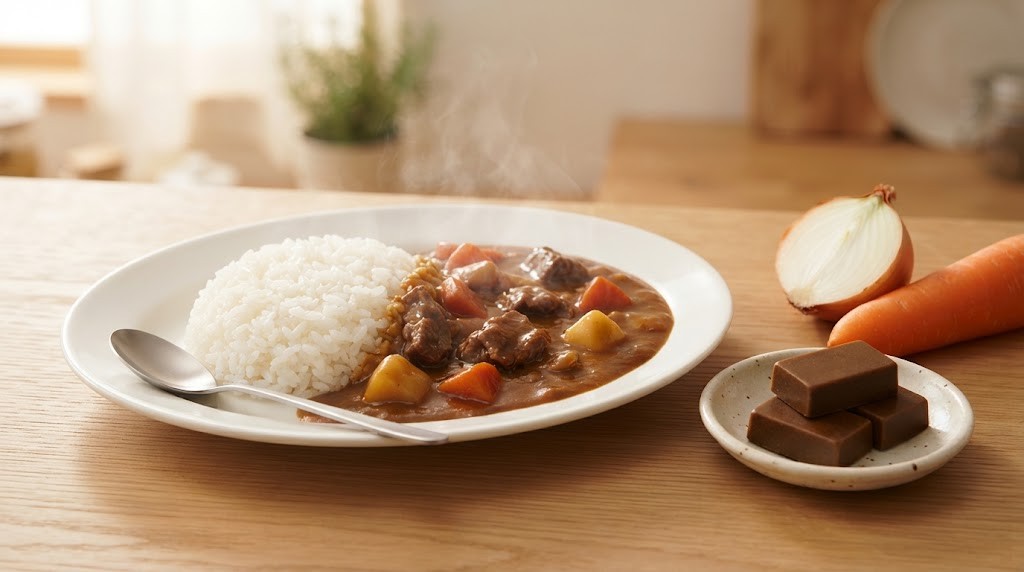
If you are adding a 隠し味 (secret ingredient), remember that Vermont already contains apple and honey — adding more usually makes it cloying. Save the grated apple, the square of chocolate or the spoon of instant coffee for Golden Curry or Java, which have room for it.
Where to buy it in Japan
| Where | Selection | Price | Notes |
|---|---|---|---|
| Supermarket (Life, Summit, Aeon, Ito-Yokado) | ★★★ | Cheapest | Every heat level, plus regional and seasonal boxes |
| Don Quijote | ★★ | Cheap, varies | Open late, tax-free counters, good for bulk |
| Konbini | ★ | Highest | Usually one box of one brand, if any |
| Amazon Japan | ★★★ | Mid | Multi-packs; useful if you are shipping home |
| Airport shops | ★ | Highest | Convenient, but you pay for it |
Roux is dry, light, unbreakable and stacks flat — which makes it one of the better things to put in a suitcase. For the rest of the shopping list, see the tax-free shopping guide and the Don Quijote guide.
So which one should you buy?
| If you are… | Buy | Heat level |
|---|---|---|
| Cooking for children | Vermont | 甘口 (Sweet) |
| Trying Japanese curry for the first time | Golden Curry | 中辛 (Medium) |
| Recreating a Japanese friend’s home cooking | Vermont | 中辛 (Medium) |
| Making katsu curry | Golden Curry | 中辛 or 辛口 |
| Someone who eats a lot of spicy food | Java | Spicy Blend |
| Buying one box as a souvenir | Vermont | 中辛 (Medium) |
| On a tight budget | Kokumaro | 中辛 (Medium) |
FAQ
Is Vermont Curry actually from Vermont?
No. House Foods named it after the American folk remedy of apple cider vinegar and honey associated with Vermont, and built the roux around apple and honey. The curry itself is entirely Japanese.
Which one tastes most like curry from a Japanese restaurant?
None of the three exactly — restaurant curry is usually simmered far longer with its own stock. The closest supermarket box is House’s premium The Curry, which includes a separate bouillon paste. Java is the closest of the big three.
Can I bring curry roux home on a plane?
It is a dry solid block, so it travels in checked or carry-on baggage without trouble in most countries. Check your own country’s rules on meat-derived ingredients if you are entering somewhere strict — some roux contains beef or pork extract.
How long does an opened box last?
Japanese boxes are usually divided into two sealed trays for exactly this reason. Keep the unused tray sealed, in a cool dark place, and use it within a few months. Once the tray is opened, wrap it and refrigerate.
What is the difference between the Japanese box and the export box?
Size, servings and sometimes the recipe. Export boxes are frequently smaller (around 220g for 8–10 servings) and may be reformulated for the destination market. If you found a flavour you liked abroad, photograph the box before you go looking for it in Japan.
The short version
Vermont for the taste of a Japanese home. Golden Curry for your first box and for katsu curry. Java when you want the adult version. Buy 中辛 unless you have a specific reason not to, and buy two boxes — one sweet, one hot — if you want to cook it the way Japanese cooks actually do.
Related reading
Sources: House Foods curry roux ranking (2026); Japanese Taste brand guide; Japanese retail price surveys (2026); halal-navi 2026 curry roux guide; allergen panels published by House Foods. Prices are indicative supermarket ranges in Japan as of September 2026.
🔥 Editor’s Picks for Life & Travel in Japan
📘 The Japan Expat Starter Kit 2026
Banking, housing, My Number, taxes, 100 phrases and a 40-kanji cheat sheet — everything from this site in one 17-chapter PDF field manual. Free lifetime 2026 updates.
Reader price: $9.99 $6.99 with code JLL30 at checkout
30-day money-back guarantee · Instant download · PR
Practical guides for life and travel in Japan — free, about once a week. No spam, unsubscribe anytime.
☕ Enjoying our Japan guides?
If this article helped you, you can support our work with a coffee!
Did this guide help you? 🍵
Japan Life Lab is a small independent blog, and every guide we publish is completely free — no paywalls, ever. If our work saved you time (or a headache), you can support us with a cup of Japanese tea. Every contribution, big or small, goes straight into keeping these guides free, accurate and up to date for everyone.
☕ Support Japan Life Lab
Leave a Reply