This article was created with AI writing assistance (ChatGPT, Claude, etc.). Product selection, specifications, and reviews are verified by the Japan Life Lab editorial team.
This article contains promotional / affiliate links.
In a small Japanese flat with wooden floors and little storage, a cordless stick vacuum is the easy choice. The catch is the spec sheet: makers measure weight and run time differently, and short boost times and tiny dust bins hide in the footnotes.
We compare six Japan-market cordless sticks sold on Amazon Japan, from ¥14,800 to ¥54,979: Makita, Panasonic, two Hitachi models, Shark and Dyson. Specs come from the makers’ pages and manuals; prices from kakaku.com on 12 October 2026. Prefer a robot? See our robot vacuum guide.
📌 What you will learn
You do not have to read it all — jump to what you need.
- How to choose: weight, real run time, dust, battery, storage
- The 6 best cordless sticks, from ¥14,800
- Comparison table
- Japanese buttons, safety, disposal and when to buy
- Frequently asked questions
- The short version
※ Start wherever fits your situation.
Prime members get fast, free delivery on millions of items, Prime Video and members-only deals. Eligible new members can try it free for 30 days.
Start your free 30-day Prime trial →Ages 18–24? See Prime for Young Adults
Paid links. As an Amazon Associate, Japan Life Lab earns from qualifying purchases. Trial eligibility and terms are set by Amazon.
How to choose a cordless vacuum in Japan
1. Weight: check what is included in the number
Our picks weigh 0.97 kg to 2.2 kg, but makers measure differently. Hitachi quotes the stick with pipe, head and battery under the Japan Electrical Manufacturers’ Association (JEMA) standard; Dyson quotes 2.2 kg with its cleaner head fitted; Makita quotes 1.1 kg with the battery but without the nozzle and pipe. For stairs or high shelves, also check the handheld weight: 0.64 kg for Hitachi’s PV-BS1M, 0.8 kg for Shark.
2. Run time: read the strongest mode, not the longest number
The headline figure comes from the weakest setting: Dyson’s “up to 60 minutes” is on eco with a non-motorised tool. On the strongest mode they shrink to about 8 minutes for Panasonic and both Hitachis, about 10 for Makita and about 15 for Shark, using its two batteries in turn. Check that standard mode covers your flat on one charge, or pick a removable battery and keep a spare.
3. Paper pack, dust bin or self-emptying dock
Cyclone models collect dust in a small bin (0.13 L to 0.35 L here), and Hitachi notes that cyclone cleaners need frequent emptying and filter care. Paper-pack sticks (Makita, Hitachi PKV-BK3P) seal the dust in a bag you throw away; Hitachi says its 0.4 L pack lasts about two months in a JEMA test of 1 g of dust a day. Shark’s dock sucks the dust out of the stick each time you put it back.
4. Battery: removable or built in
Makita, Shark and Dyson batteries click out, so you can swap in a spare (Shark includes two; Dyson sells spares separately). Hitachi’s PKV-BK3P battery also comes out, and the PV-BS1M’s is built in; for both, Hitachi says replacements go through the shop, with a labour fee on top of the part.
5. Storage in a small flat
Makita’s nozzle is designed to stand upright; Hitachi’s PKV-BK3P comes with a stick stand; with the stick in its dock, Shark’s BOOST+ takes 1,111 × 230 × 324 mm (H × W × D). Dyson includes a wall-mounted charging bracket, which means screws in the wall, so check your lease first (see our renting guide); a freestanding stand costs extra.
The 6 best cordless vacuums to buy in Japan in 2026
Prices include tax. Buttons go to Amazon Japan only, as these are Japan-market models.
1. Makita CL107FDSHW — best budget pick
Makita’s simple 10.8 V stick uses a paper pack and a one-touch switch, so there is no trigger to hold down. Amazon Japan sold it for ¥14,800 on 12 October 2026, the lowest price on kakaku.com. Buy the SHW set: Makita’s body-only CL107FDZW comes without the battery and charger.
The battery slides out, recharges in about 22 minutes and, Makita says, fits more than 100 Makita models, from impact drivers to radios. Run time is modest: about 25 minutes on standard, 12 on strong and 10 on the powerful mode.
| Type / dust | Stick; paper pack 330 mL, or the included dust bag, 500 mL |
|---|---|
| Battery | 10.8 V slide lithium-ion BL1015 (1.5 Ah), removable; charger DC10SA, about 22 min |
| Run time | Powerful about 10 min, strong about 12 min, standard about 25 min |
| Weight / length | 1.1 kg with battery, without nozzle and pipe; 960 mm with pipe and nozzle |
| In the box | Battery, charger, nozzle, straight pipe, crevice nozzle and holder, dust bag, 10 paper packs |
✅ Pros
- About ¥15,000 with battery and charger
- Paper packs: no dusty bin to empty
- 22-minute charge, removable battery
⚠️ Cons
- No motorised brush head
- About 10 minutes on the powerful mode
- Charger is for AC 100 V only
👍 Best for
- Students and one-room flats
- Quick daily clean-ups on wooden floors
2. Panasonic MC-SB34J — best light stick under ¥20,000
Panasonic’s MC-SB34J (released on 30 August 2024, per kakaku.com) is, Panasonic says, the lightest model in its Power Cordless range as of 29 July 2024: 1.3 kg as a stick and 0.9 kg for the main unit. Its self-propelled power nozzle with “Rakusuru Assist” glides forward, back and sideways with little effort, Panasonic says.
Panasonic advertises lean-to charging, so it is ready to grab, and the 0.15 L dust box can be washed. Amazon Japan charged ¥18,800; the lowest shop was ¥16,500.
| Type / dust | Stick, cyclone; 0.15 L washable dust box |
|---|---|
| Run time | HIGH about 8 min; ON about 25 min (about 30 min with the included nozzle) |
| Charging | About 3.0 hours |
| Weight | 1.3 kg as a stick (unit, pipe and floor nozzle); main unit 0.9 kg |
| Noise / extras | 67 to about 63 dB; brush crevice nozzle included |
✅ Pros
- Japanese-brand power nozzle under ¥20,000
- Light at 1.3 kg
- Washable dust box
⚠️ Cons
- Small 0.15 L bin
- About 8 minutes on HIGH
- 3-hour charge
👍 Best for
- Couples in a 1LDK
- Anyone who wants a motorised brush on a budget
3. Hitachi PV-BS1M — lightest pick
Hitachi’s “Sugo-karu” PV-BS1M weighs 0.97 kg as a stick, including pipe, head and battery, and 0.64 kg as a handheld: the lightest of our six. It still has a self-propelled motorised head with a tangle-resistant brush, plus an auto mode.
The trade-offs: a 0.13 L bin to empty often, a built-in 14.4 V battery, and no stand in Hitachi’s list of included items. Released in mid-September 2024 according to kakaku.com, it cost ¥28,700 at Amazon Japan; the lowest shop charged ¥27,980.
| Type / dust | Stick and handheld (2-way), cyclone; 0.13 L |
|---|---|
| Battery | Built-in lithium-ion, 14.4 V; charge about 2 hours |
| Run time | Strong about 8 min; auto about 8–30 min; standard about 30 min (about 35 min without the motorised head) |
| Weight | 0.97 kg as a stick (incl. pipe, head, battery); 0.64 kg handheld |
| In the box | Handheld brush, crevice nozzle, extension pipe, AC adapter, cleaning brush |
✅ Pros
- Under 1 kg as a stick
- Motorised self-propelled head
- 2-hour charge
⚠️ Cons
- Tiny 0.13 L bin
- Battery is built in
- No stand listed in the box
👍 Best for
- Stairs, lofts and high shelves
- Anyone with sore wrists or shoulders
4. Hitachi PKV-BK3P — best paper-pack stick
Hitachi’s “Karu-pack” PKV-BK3P (released in early August 2025) is a 1.1 kg cordless stick with a 0.4 L paper pack. Hitachi says its suction packs the dust tightly into the bag, so it needs emptying only about once every two months in a JEMA-based test of 1 g of dust a day on strong.
The 18 V cassette battery comes out so it can be separated when you dispose of the cleaner, a stick stand is included, and kakaku.com lists it as made in Japan. Amazon Japan charged ¥38,397; the lowest shop was ¥35,980.
| Type / dust | Stick and handheld, paper pack; 0.4 L |
|---|---|
| Battery | Cassette lithium-ion, 18 V, detachable; charge about 2 hours |
| Run time | Strong about 8 min; auto about 8–30 min; standard about 30 min (about 45 min without the motorised head) |
| Weight | 1.1 kg as a stick (incl. pipe, head, battery); 0.77 kg handheld |
| In the box | Handheld brush, 2-way crevice brush, extension pipe, stick stand, AC adapter, 1 paper pack (GP-S120FS) |
✅ Pros
- Bag lasts about two months (Hitachi test)
- Light 1.1 kg with a motorised head
- Stand included
⚠️ Cons
- Paper packs are an ongoing cost
- About 8 minutes on strong
- Costs about ¥36,000 to ¥38,000
👍 Best for
- Anyone who hates emptying dusty bins
- Families who want a stand-and-go stick
5. Shark EVOPOWER SYSTEM BOOST+ LC751JLV — best self-emptying
Shark developed its EVOPOWER SYSTEM line specifically for Japan and has sold it since 2020; the BOOST+ (released on 1 September 2025) includes a dock that empties the dust cup automatically when you put the stick back. Shark’s in-house test says you then need to empty the dock only about every 30 days, and its HEPA filter holds 99.99% of 0.3–10 µm particles in the dock (ASTM F1977-22).
The LC751JLV adds a bendable “FLEX” pipe for reaching under furniture without bending down, and it ships with two batteries: about 60 minutes on eco, 15 on boost. Stick weight: about 1.7 kg. Amazon Japan charged ¥51,604; the lowest shop was ¥45,700.
| Type / dust | Stick and handheld, cyclone; self-emptying charging dock with HEPA filter |
|---|---|
| Batteries | Two lithium-ion batteries (235 g each); charge about 3.5 hours |
| Run time (stick, 2 batteries) | Boost about 15 min; iQ about 15–60 min; eco about 60 min |
| Weight | Stick about 1.7 kg; handheld about 0.8 kg; dock about 3.0 kg |
| Size stored | 1,111 × 230 × 324 mm (H × W × D); 2-year warranty excluding batteries and consumables |
✅ Pros
- Dock empties the bin for you
- Two batteries, bendable FLEX pipe
- Made for Japanese homes
⚠️ Cons
- About ¥46,000 to ¥52,000
- Dock needs floor space and an outlet
- Heavier than the Hitachis
👍 Best for
- Pet owners and families
- Anyone who wants the stick emptied automatically
6. Dyson V12 Detect Slim Fluffy SV46 FF2 — best for dust detail
Dyson’s V12 Detect Slim Fluffy SV46 FF2 (released on 28 July 2026, per kakaku.com) is Dyson’s named successor to the SV46 FF, which Dyson says is no longer sold. A piezo sensor measures the amount and size of dust and adjusts suction, an LCD shows what it picked up by particle size, and the Fluffy Optic head has an LED. Modes are auto, eco and boost (強).
Dyson quotes up to 60 minutes, but only on eco with a non-motorised tool. The battery clicks out and a spare is sold separately. At 2.2 kg with the head it is the heaviest here, and the included bracket mounts on the wall. Amazon Japan charged ¥54,979; the lowest shop was ¥50,645.
| Type / dust | Stick and handheld, cyclone; 0.35 L |
|---|---|
| Run time | Up to 60 min (eco, non-motorised tool) |
| Charging / battery | About 3.5 hours; removable battery, spare sold separately |
| Weight | 2.2 kg with the Fluffy Optic head |
| In the box | Fluffy Optic head, crevice nozzle, hair screw tool, charger, wall-mounted bracket |
✅ Pros
- Particle sensor and LCD readout
- LED-lit Fluffy Optic head
- Swappable battery
⚠️ Cons
- Heaviest pick at 2.2 kg
- Freestanding stand costs extra
- Highest price here
👍 Best for
- Hard floors; hair, with the screw tool
- People who like to see dust data
Comparison table
| Model | Best for | Weight (maker) | Dust | Strongest mode | Battery | Price, 12 Oct 2026* |
|---|---|---|---|---|---|---|
| Makita CL107FDSHW | Budget pick | 1.1 kg (no pipe/nozzle) | Paper pack 330 mL | About 10 min | Removable 10.8 V | ¥14,800 (Amazon, lowest) |
| Panasonic MC-SB34J | Light value stick | 1.3 kg stick | Bin 0.15 L | About 8 min | Lithium-ion | ¥18,800 (Amazon); lowest ¥16,500 |
| Hitachi PV-BS1M | Lightest | 0.97 kg stick | Bin 0.13 L | About 8 min | Built-in 14.4 V | ¥28,700 (Amazon); lowest ¥27,980 |
| Hitachi PKV-BK3P | Paper pack | 1.1 kg stick | Paper pack 0.4 L | About 8 min | Detachable 18 V | ¥38,397 (Amazon); lowest ¥35,980 |
| Shark LC751JLV | Self-emptying | About 1.7 kg stick | Bin + dock | About 15 min (2 batteries) | Two removable | ¥51,604 (Amazon); lowest ¥45,700 |
| Dyson SV46 FF2 | Dust detail | 2.2 kg with head | Bin 0.35 L | Not listed | Removable | ¥54,979 (Amazon); lowest ¥50,645 |
* Amazon.co.jp offer on kakaku.com, incl. tax; “lowest” = lowest shop on kakaku.com. Weights and run times as each maker states them.
Using a cordless vacuum in Japan: buttons, safety, disposal, timing
The Japanese buttons you will see
Labels vary by maker: パワフル or 強 (kyou, strong) for the strongest mode (on the Makita, パワフル is one step above 強), 標準 (hyoujun) for standard, オート or 自動 (jidou) for auto, and エコ for eco. Panasonic’s MC-SB34J simply says HIGH and ON, and Shark uses iQ plus ブースト (boost). On the box, 紙パック (kami pakku) means paper pack, サイクロン cyclone, and 充電時間 charging time.
Safety rules from the manual
Makita’s CL107FD manual lists rules worth knowing (your own manual comes first): never vacuum anything burning or hot, such as cigarette butts, incense or hot ash, nor flammable liquids, solvents, toner or spray gas; do not wash it or use it in a bathroom or other wet place; charge on AC 100 V only, never through a transformer; do not store it where it can exceed 50 °C, such as a car in summer; use only Makita’s own paper packs, as other packs can make the motor smoke or catch fire; and remove the battery before cleaning the filters.
Throwing an old vacuum away
Japan’s Ministry of the Environment warns that lithium-ion batteries can catch fire after a strong impact or heat and have caused fires at waste plants. Do not slip one into the burnable rubbish: follow your city’s rules for the battery and the appliance (our garbage sorting guide explains how to find them). Hitachi gives the same advice and designed the PKV-BK3P battery to come out easily for this reason.
When to buy
Amazon.co.jp’s Prime Kanshasai (プライム感謝祭) runs a pre-sale from 13 to 15 October and the main sale from 16 to 19 October 2026, for Prime members; the point-up campaign needs an entry. Amazon names Dyson among the brands in its daily deals (厳選日替わりセール) on 16–19 October, with items revealed each day; we do not know which vacuums will be discounted, so compare with our prices (see our sale calendar).
Frequently asked questions
Can I take a Japanese cordless vacuum abroad?
Check the charger first. Makita’s manual for the CL107FD says to charge only on AC 100 V and never through a transformer, and the DC10SA charger is rated for single-phase 100 V input. Do not assume any of these chargers accepts 240 V; read the label on your own charger or AC adapter.
How long does a cordless vacuum really run?
On the strongest mode: about 8 minutes for the Panasonic and both Hitachis, 10 for the Makita and 15 for the Shark with its two batteries. The up-to-60-minute figures for Dyson and Shark are on eco, for Dyson with a non-motorised tool.
Paper pack or bagless?
A paper pack keeps the dust sealed: Hitachi says the PKV-BK3P pack lasts about two months in its JEMA-based test, and Makita includes 10 packs. Bagless bins need no packs but need emptying often, unless Shark’s dock does it for you.
How do I dispose of an old cordless vacuum in Japan?
Follow your city’s rules. The Ministry of the Environment says lithium-ion batteries and products containing them should be thrown away according to your municipality’s garbage rules, because they can catch fire and have caused fires at waste plants. Check those rules before putting anything out.
The short version
On a budget, buy Makita’s CL107FDSHW; for a powered head under ¥20,000, Panasonic’s MC-SB34J; for the lightest stick, Hitachi’s PV-BS1M; to avoid dusty bins, Hitachi’s PKV-BK3P; for a dock that empties the stick for you, Shark’s EVOPOWER SYSTEM BOOST+; to see the dust you remove, Dyson’s V12 Detect Slim Fluffy. Compare weights with the pipe on, judge run time on the strongest mode, and plan where it charges.
🔥 Editor’s Picks for Life & Travel in Japan
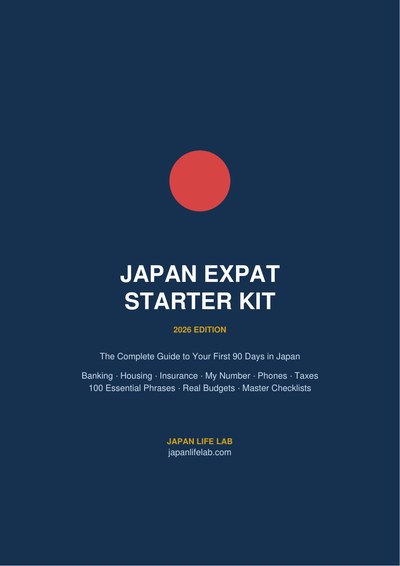
Japan Expat Starter Kit 2026 PDF guide
Your first 90 days in Japan, step by step: 17 chapters · 24 pages · 100 phrases in Japanese script · 40 kanji · printable checklists. Bank account, My Number, health insurance, apartment, phone, taxes & pension.
$9.99 $4.99 current price
📥 Get the kit →📄 Read 5 pages free: contents + Chapter 2
⚡ Instant PDF download · 🛡️ 30-day money-back guarantee · 🔄 Free 2026 updates
🛒 Ready to Buy? Shop These in Japan!
Get fast delivery across Japan — including same-day in major cities
Practical guides for life and travel in Japan — free, about once a week. No spam, unsubscribe anytime.
☕ Enjoying our Japan guides?
If this article helped you, you can support our work with a coffee!
Leave a Reply