This article was created with AI writing assistance (ChatGPT, Claude, etc.). Product selection, specifications, and reviews are verified by the Japan Life Lab editorial team.
This article contains promotional / affiliate links.
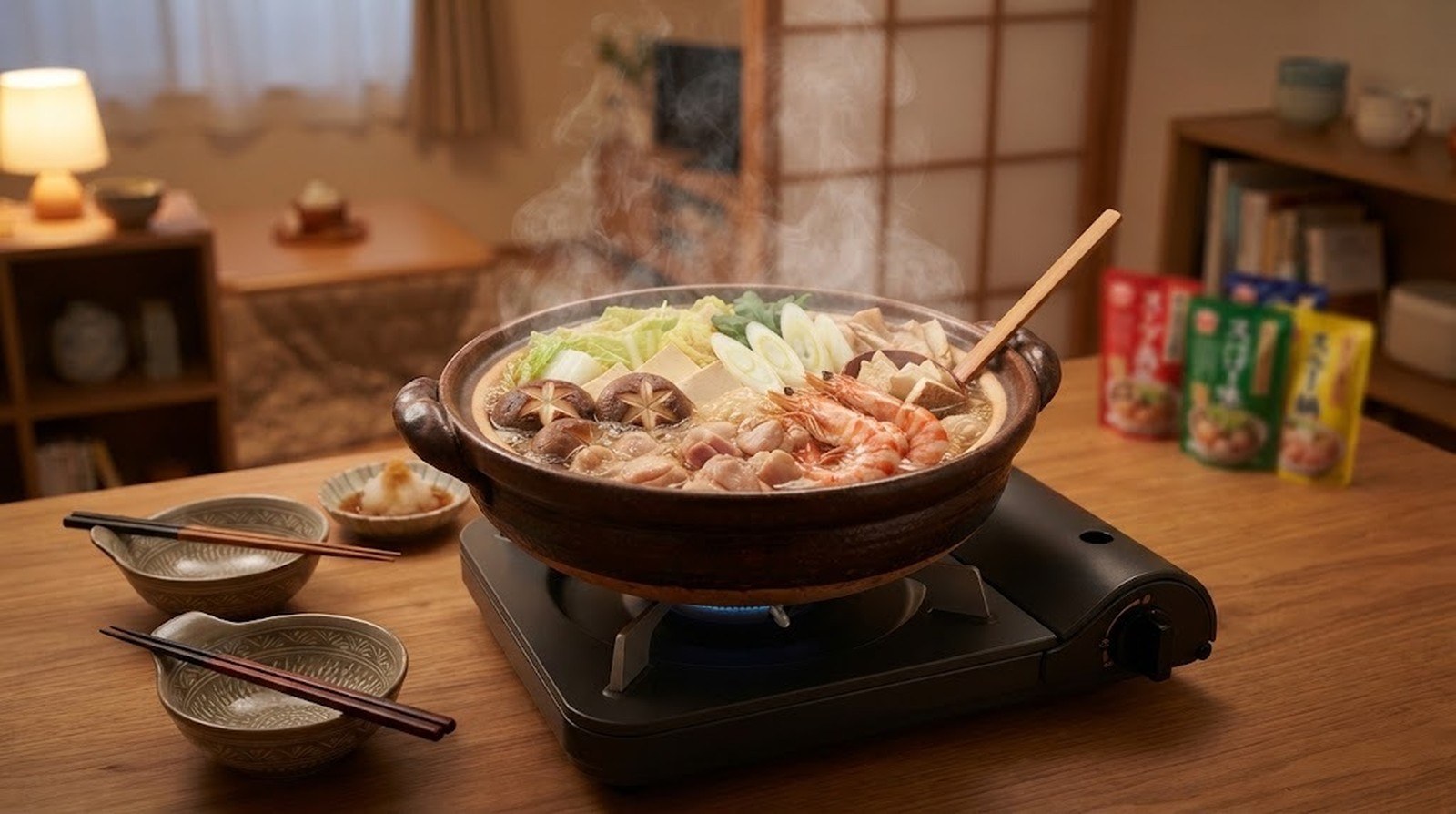
From October, every Japanese supermarket builds a nabe corner: a wall of hot pot soup bases called nabe tsuyu (鍋つゆ) or nabe no moto (鍋の素). The trade paper Nissyoku puts the nabe tsuyu market at about ¥50 billion a year, and a big store can carry dozens of flavours. For newcomers, it is one of the easiest and cheapest ways to cook a warm Japanese dinner: pour, add vegetables and meat or fish, simmer, done.
The hard part is choosing. The packs are in Japanese, they come in four different formats, and a “kimchi” or “sesame” base can still contain pork. Below we explain the formats, our 6 picks for 2026 from Mizkan, Ebara and Ajinomoto, and how to read the ingredient list (原材料名) for pork, chicken, fish and alcohol. We read each maker’s official ingredient list and checked prices on 27 October 2026.
📌 What you will learn
In a hurry? First hot pot: Mizkan Yosenabe. Mild and creamy: Mizkan Goma Tonyu. Cooking for one: Ajinomoto Nabe Cube. No pork, seafood OK: Nabe Cube Sea Bream & Scallop or Ebara Petit Nabe Kimchi. None of the six is halal-certified or vegetarian.
- The 4 formats on the shelf
- Our 6 picks for 2026 (about ¥322 each)
- Comparison table: servings, salt, pork, alcohol
- How to read the label for pork, chicken, fish and alcohol
- How to cook nabe, the shime, and leftovers
- Frequently asked questions
- The short version
※ Prices checked on 27 October 2026 at AEON’s online supermarket (Green Beans) and on makers’ sites.
Prime members get fast, free delivery on millions of items, Prime Video and members-only deals. Eligible new members can try it free for 30 days.
Start your free 30-day Prime trial →Ages 18–24? See Prime for Young Adults
Paid links. As an Amazon Associate, Japan Life Lab earns from qualifying purchases. Trial eligibility and terms are set by Amazon.
The 4 formats of nabe tsuyu in Japanese supermarkets
Before flavour, pick the format. It decides how many people you can feed and whether you need to add water.
| Format | What it is | Servings | Add water? |
|---|---|---|---|
| Straight (ストレート) | Ready-to-use liquid in a large pouch | 750 g = 3–4 people (3~4人前) | No. Pour it straight into the pot |
| Mini pack (ミニパック) | Concentrated liquid, one small sachet per person | 1 sachet = 1 person | Yes, as printed on the pack |
| Portion / capsule (ポーション) | Concentrated cups you pop out, e.g. Ebara プチッと鍋 | 1 cup = 1 person | Yes: about 150 ml per cup (2 cups to 300 ml) |
| Cube (キューブ) | Solid cube, e.g. Ajinomoto 鍋キューブ | 1 cube = 1 person | Yes: 180 ml per cube |
※ From Mizkan, Ebara and Ajinomoto product pages.
Rule of thumb: 3–4 people, buy a straight pouch. 1–2 people, buy a cup or cube type, so you are not left with half a pouch. Straight types are the biggest part of the shelf, but single-portion types are spreading fast.
Popular flavours, in Japanese
- 寄せ鍋 (yosenabe): soy sauce and dashi broth. The classic all-rounder.
- ごま豆乳 (goma tonyu): sesame and soy milk. Mild, creamy, not spicy.
- キムチ (kimchi): spicy Korean-style.
- 塩 (shio) / 鶏だし (tori dashi): light salt or chicken broth.
- 白湯 (paitan): creamy pork-bone and chicken broth.
- 鯛 (tai) / 帆立 (hotate): sea bream and scallop seafood broth.
The 6 best nabe soup bases to buy in Japan in 2026
All six cost the same at AEON’s online supermarket on 27 October 2026: ¥322 including tax. The cost per serving is very different, though: about ¥80–107 for a straight pouch (3–4 people), about ¥54 for a Petit Nabe cup and about ¥46 for a Nabe Cube (our calculation). Prices vary by store and change often.
1. Mizkan Yosenabe Tsuyu (straight): the classic first hot pot
If you only buy one, buy this. Mizkan’s 〆まで美味しい 寄せ鍋つゆ (“delicious to the last bite” yosenabe) blends four kinds of dashi: bonito, kombu, scallop and chicken. The result is light but rich, and it suits almost anything: napa cabbage, tofu, white fish, chicken, mushrooms.
Mizkan’s suggested finish (shime) is zosui: add cooked rice to the leftover soup, pour in a beaten egg, and turn off the heat. One 750 g pouch feeds 3–4 people.
| Japanese name | ミツカン 〆まで美味しい 寄せ鍋つゆ ストレート |
|---|---|
| Format | Straight, 750 g (3–4 servings) |
| Salt | 4.2 g per serving (214 g) |
| Contains | Chicken, bonito, scallop; fermented seasonings (米発酵調味料・発酵調味料) |
| Price seen | ¥322 at AEON Green Beans; maker reference price ¥446 (27 Oct 2026) |
✅ Pros
- The standard Japanese hot pot taste
- Goes with any ingredient
- Sold almost everywhere
⚠️ Cons
- Contains chicken and fish
- Fermented seasonings may contain alcohol
- A whole pouch is a lot for one person (a mini-pack version exists)
👍 Best for
- First-time nabe cooks
- Families and groups
- Dinner with Japanese friends
2. Mizkan Goma Tonyu Tsuyu (straight): mild and creamy
A creamy soup of ground sesame and soy milk. It is not spicy, so it is popular with children and with people new to Japanese flavours. Pork, napa cabbage, spinach and tofu all go well with it.
For the shime, Mizkan suggests udon, or a “goma tonyu carbonara” made with thin spaghetti. The ingredient list has no pork, fish or alcohol words, but it does contain chicken extract (チキンエキス).
| Japanese name | ミツカン 〆まで美味しい ごま豆乳鍋つゆ ストレート |
|---|---|
| Format | Straight, 750 g (3–4 servings) |
| Salt | 3.9 g per serving (214 g) |
| Contains | Chicken extract; sesame and soy |
| Price seen | ¥322 at AEON Green Beans; maker reference price ¥446 (27 Oct 2026) |
✅ Pros
- Mild, creamy and not spicy
- Good for kids
- No pork, fish or alcohol words in the ingredients
⚠️ Cons
- Contains chicken extract: not vegetarian, and halal status not stated
- Sesame and soy allergies
👍 Best for
- Families with children
- People who dislike spicy food
- No-pork households that eat chicken
3. Mizkan Kimchi Nabe Tsuyu (straight): spicy, and it contains pork
A big, garlicky, spicy kimchi broth with gochujang and chilli fried in sesame oil and chicken fat. It is a crowd-pleaser with pork belly, tofu and kimchi, and Mizkan’s shime is ramen.
We include it partly as a lesson: the ingredient list contains ポークチキン香味オイル (pork and chicken flavoured oil). Nothing on the front says pork. If you avoid pork, this is exactly the kind of pack to check. It also has the most salt of the six: 6.2 g per serving.
| Japanese name | ミツカン 〆まで美味しい キムチ鍋つゆ ストレート |
|---|---|
| Format | Straight, 750 g (3–4 servings) |
| Salt | 6.2 g per serving (214 g), the highest of our six |
| Contains | Pork (ポークチキン香味オイル), chicken fat, fish sauce, dried sardine |
| Price seen | ¥322 at AEON Green Beans; maker reference price ¥446 (27 Oct 2026) |
✅ Pros
- Rich, spicy and very popular
- Great with ramen to finish
⚠️ Cons
- Contains pork: not for halal or no-pork diets
- High salt
- Spicy
👍 Best for
- Spice lovers
- Parties
- Ramen fans
4. Ebara Petit Nabe Kimchi (cups): exact portions, no meat in the list
Ebara’s プチッと鍋 (Petit Nabe) is a pack of small cups of concentrated soup. One cup makes one serving, so you can cook for one person tonight and keep the rest for later. Basic method: 2 cups to 300 ml water.
Compare it with Mizkan’s kimchi above: Ebara’s kimchi cup has no meat and no alcohol words in its official ingredient list. The broth gets its depth from fish sauce, krill and salmon extract, dried sardine and bonito. Be careful, though: other flavours in the same series are different. The rich miso (濃厚みそ) and tantan sesame (担々ごま) cups list pork fat or pork extract, and the yosenabe cup contains mirin.
| Japanese name | エバラ プチッと鍋 キムチ鍋 23g×6個 |
|---|---|
| Format | Concentrated cups, 6 × 23 g (6 servings) |
| How to use | 2 cups + 300 ml water |
| Salt | 3.4 g per cup |
| Contains | Fish and seafood (fish sauce, krill, salmon, sardine, bonito). No meat or alcohol words listed |
| Price seen | ¥322 at AEON Green Beans (27 Oct 2026); about ¥54 per serving |
✅ Pros
- Cook exactly the number of servings you need
- No meat or alcohol words in the ingredient list
- Cheap per serving
⚠️ Cons
- Seafood-based: not vegetarian
- Not halal-certified
- Other Petit Nabe flavours contain pork or mirin: check each one
👍 Best for
- People living alone
- Students and dorms
- No-pork diets that eat seafood
5. Ajinomoto Nabe Cube Chicken & Salt: compact and lightest on salt
Ajinomoto’s 鍋キューブ (Nabe Cube) comes as 7 small cubes in a zip pouch. Use 1 cube and 180 ml water per person. The cube melts in about 5–6 minutes while the ingredients cook. There is no liquid to spill, and it fits in the smallest kitchen.
The chicken-and-salt flavour (鶏だし・うま塩) is light and goes with anything. At 2.8 g per cube, it is the lowest in salt per serving of our six. Ajinomoto’s shime is chicken zosui. Note that it lists gelatin without saying which animal it comes from, plus a “meat-flavour seasoning”.
| Japanese name | 味の素 鍋キューブ 鶏だし・うま塩 7個入 |
|---|---|
| Format | Cube, 7 cubes (7 servings) |
| How to use | 1 cube + 180 ml water per person |
| Salt | 2.8 g per cube, the lowest of our six |
| Contains | Chicken, gelatin (animal not stated), meat-flavour seasoning, dairy (lactose) |
| Price seen | ¥322 at AEON Green Beans (27 Oct 2026); about ¥46 per serving |
✅ Pros
- Compact; zip pouch
- Lowest salt per serving
- Cheapest per serving
⚠️ Cons
- Gelatin source not stated: ask Ajinomoto if you avoid pork
- Contains dairy and chicken
- Not halal-certified
👍 Best for
- Solo cooks
- Small kitchens
- People watching their salt
6. Ajinomoto Nabe Cube Sea Bream & Scallop: the seafood, no-meat cube
A seafood broth of sea bream, scallop, crab, kombu and bonito, in the same handy cube format. Its official ingredient list has no meat, no gelatin and no alcohol words, so it is our pick for people who eat seafood but avoid pork or chicken.
It is excellent with white fish, prawns, clams and tofu, and the shime is a seafood zosui. Allergy note: it contains crab and dairy (lactose).
| Japanese name | 味の素 鍋キューブ 鯛と帆立の極みだし鍋 7個入 |
|---|---|
| Format | Cube, 7 cubes (7 servings) |
| How to use | 1 cube + 180 ml water per person |
| Salt | 3.4 g per cube |
| Contains | Sea bream, scallop, crab, bonito; dairy (lactose). No meat, gelatin or alcohol words listed |
| Price seen | ¥322 at AEON Green Beans (27 Oct 2026); about ¥46 per serving |
✅ Pros
- No meat, gelatin or alcohol words in the ingredient list
- Elegant seafood flavour
- Compact cubes
⚠️ Cons
- Crab and dairy allergens
- Not vegetarian
- Not halal-certified
👍 Best for
- Seafood lovers
- No-pork, no-chicken diets that eat seafood
- Solo cooks
Comparison table: servings, salt, pork and alcohol
| Product | Format | Servings | Salt / serving | Pork? | Meat-free? | Alcohol words? |
|---|---|---|---|---|---|---|
| Mizkan Yosenabe | Straight 750 g | 3–4 | 4.2 g | Not listed | No (chicken, fish) | Fermented seasonings (may contain) |
| Mizkan Goma Tonyu | Straight 750 g | 3–4 | 3.9 g | Not listed | No (chicken extract) | None listed |
| Mizkan Kimchi | Straight 750 g | 3–4 | 6.2 g | Yes | No | None listed |
| Ebara Petit Nabe Kimchi | 6 cups | 6 | 3.4 g | Not listed | Seafood only | None listed |
| Nabe Cube Chicken & Salt | 7 cubes | 7 | 2.8 g | Gelatin: source not stated | No (chicken) | None listed |
| Nabe Cube Sea Bream & Scallop | 7 cubes | 7 | 3.4 g | Not listed | Seafood only | None listed |
※ Based on each maker’s official ingredient list (checked 27 October 2026). Recipes can change: always read the pack. “Not listed” is not a halal certification.
How to read the label: pork, chicken, fish and alcohol in Japanese
Japanese packs have a short allergen box and a full ingredient list (原材料名). Do not rely on the allergen box. Under Japan’s labelling rules, only 9 items must be shown (cashew nuts were added in April 2026). Pork, chicken, beef and gelatin are only “recommended” items, so a pack can contain pork without saying so in the allergen box. For example, the Mizkan kimchi pouch lists pork oil in its ingredients, while one retailer’s allergen field only said “recommended allergens: yes”. Always read the full 原材料名 line.
| If you avoid… | Look for these words in 原材料名 |
|---|---|
| Pork | 豚肉, 豚, ポーク, ポークエキス, 豚脂, ラード, とんこつ (豚骨). Also check ゼラチン (gelatin), whose animal source is usually not stated |
| Chicken | 鶏肉, 鶏, チキン, チキンエキス, 鶏がら, 鶏脂, 鶏油 |
| Beef | 牛, 牛肉, ビーフ |
| Fish and seafood | かつお (鰹), さば節, 煮干し, 魚醤, 魚介エキス, ほたて, かに, えび, オキアミ |
| Alcohol | 酒精, アルコール, みりん, 料理酒, 酒, ワイン. 発酵調味料 and 米発酵調味料 (fermented seasonings) may contain alcohol |
※ Seasonings such as 肉風味調味パウダー (meat-flavour seasoning) or 食用油脂 (edible oil and fat) do not say which animal they come from. Ask the maker if it matters to you.
Is there a halal or vegetarian nabe tsuyu?
We did not find a halal-certified or vegetarian nabe soup base from the major makers. None of our six is vegetarian: each contains chicken, fish or seafood. The ones with no pork words in their official lists are Mizkan Yosenabe (but chicken and fermented seasonings), Mizkan Goma Tonyu (chicken extract), Ebara Petit Nabe Kimchi (seafood only) and Nabe Cube Sea Bream & Scallop (seafood only, no gelatin). “No pork words” is not a halal certification. If you need a strictly vegetarian or halal broth, the simplest option is to make your own with kombu, dried shiitake, salt and a soy sauce you have checked (some Japanese soy sauces contain added alcohol, 酒精).
How to cook nabe, the shime, and leftovers
The basic method
- Prepare the soup. Straight pouch: pour it in, no water. Cups and cubes: use the water on the pack (Nabe Cube 180 ml per cube; Petit Nabe 2 cups to 300 ml).
- Start cold with the slow items. Mizkan’s nabe guide suggests putting long-cooking ingredients (leek, tofu, white fish) into the cold soup, lid on, medium heat. They cook more evenly than if dropped into boiling soup.
- Never let it boil hard. Flavour escapes. It is ready when the soup at the edge starts to shimmer.
- Add the rest in rounds, not all at once. Enoki needs about 10 seconds; napa cabbage leaves are best still a little crunchy.
- Put items that make a lot of scum (アク) in last, such as prawns, shungiku and chicken thigh, so the soup stays clear.
The shime (〆): the best part
Japanese hot pot ends with a shime: you cook rice or noodles in the leftover soup, which is now full of flavour. Makers suggest:
| Soup | Suggested shime |
|---|---|
| Yosenabe | Zosui (rice porridge with egg) |
| Goma Tonyu | Udon, or “carbonara” with thin spaghetti |
| Kimchi | Ramen |
| Nabe Cube Chicken & Salt | Chicken zosui |
| Nabe Cube Sea Bream & Scallop | Seafood zosui |
※ From Mizkan and Ajinomoto official pages.
Zosui in 1 minute: add cooked rice to the remaining soup without boiling it, loosen it, pour in a beaten egg, turn off the heat, cover for 30 seconds, and top with yuzu or green onion.
Salt: watch the soup
Our six contain 2.8–6.2 g of salt per serving before the shime. Most of it is in the soup. If you are watching your salt, add a little extra water to cups and cubes, and don’t finish every drop.
Leftovers: cool them fast
Japan’s Ministry of Agriculture (MAFF) warns about Clostridium perfringens (ウエルシュ菌) in stews and soups left to cool slowly. It grows at about 12–50 °C, and heating does not fully destroy its spores. Do not leave the pot on the stove overnight. Divide leftovers into shallow containers, refrigerate or freeze them quickly, eat them soon, and reheat while stirring all the way to the bottom.
The pot
Any pot works. A traditional clay pot (土鍋, donabe) should not be soaked or put in the dishwasher. Many clay pots do not work on IH hobs, so if your kitchen is IH, use an IH-compatible pot or an electric hot pot. Our donabe and nabe gear guide explains the options.
Where to buy
Supermarkets such as AEON, Life and Seiyu set up a nabe corner from around autumn; new flavours launch in August and the big sales push starts in October. Drugstores and discount stores also stock nabe tsuyu, and you can order online from Amazon Japan and Rakuten.
Frequently asked questions
How many people does one pack of nabe tsuyu serve?
A straight 750 g pouch serves 3–4 people. Cups and cubes are one per person: Ebara Petit Nabe has 6 (or 4) cups, and Ajinomoto Nabe Cube has 7 cubes.
Do I add water to nabe tsuyu?
Not to the straight type: it is ready to use, and water makes it bland. Cubes need 180 ml of water per cube, and Petit Nabe cups about 150 ml per cup (2 cups to 300 ml).
Is there a halal or no-pork nabe soup base?
We found no halal-certified one from the major makers. Of our six, Mizkan Yosenabe, Mizkan Goma Tonyu, Ebara Petit Nabe Kimchi and Nabe Cube Sea Bream & Scallop have no pork words in their official ingredient lists. Avoid Mizkan Kimchi (pork oil), Nabe Cube Paitan (pork extract) and Petit Nabe rich miso and tantan sesame (pork fat or extract). Gelatin and fermented seasonings are uncertain, so ask the maker.
Is there a vegetarian nabe tsuyu?
None of the major-brand products we checked is vegetarian; even sesame, soy-milk and kimchi bases contain chicken or fish. Make your own broth with kombu, dried shiitake, salt and a soy sauce you have checked.
Can I make nabe on an IH hob or an electric hot plate?
Yes. The soup base does not matter; the pot does. Use an IH-compatible pot, because many clay pots do not work on IH, or use an electric hot pot.
How do I store leftover nabe?
Cool it quickly in shallow containers, then refrigerate or freeze it, eat it soon and reheat it thoroughly while stirring (MAFF advice on Clostridium perfringens). For an opened cube pouch, close the zip and keep it away from heat and humidity.
The short version
Pick the format first: a 750 g straight pouch for 3–4 people, cups or cubes for 1–2. For a first hot pot, Mizkan Yosenabe; for a mild, creamy soup, Mizkan Goma Tonyu; for spice, Mizkan Kimchi (contains pork) or Ebara Petit Nabe Kimchi (no meat listed). Cooking for one: Nabe Cube, with Sea Bream & Scallop as the no-meat, no-gelatin choice. Whatever you buy, read the 原材料名 line, never let the pot boil hard, finish with a shime, and cool leftovers quickly.
🔥 Editor’s Picks for Life & Travel in Japan

Japan Expat Starter Kit 2026 PDF guide
Your first 90 days in Japan, step by step: 17 chapters · 24 pages · 100 phrases in Japanese script · 40 kanji · printable checklists. Bank account, My Number, health insurance, apartment, phone, taxes & pension.
$9.99 $4.99 current price
📥 Get the kit →📄 Read 5 pages free: contents + Chapter 2
⚡ Instant PDF download · 🛡️ 30-day money-back guarantee · 🔄 Free 2026 updates
🛒 Ready to Buy? Shop These in Japan!
Get fast delivery across Japan — including same-day in major cities
Practical guides for life and travel in Japan — free, about once a week. No spam, unsubscribe anytime.
☕ Enjoying our Japan guides?
If this article helped you, you can support our work with a coffee!
Leave a Reply