This article was created with AI writing assistance (ChatGPT, Claude, etc.). Product selection, specifications, and reviews are verified by the Japan Life Lab editorial team.
This article contains promotional / affiliate links.
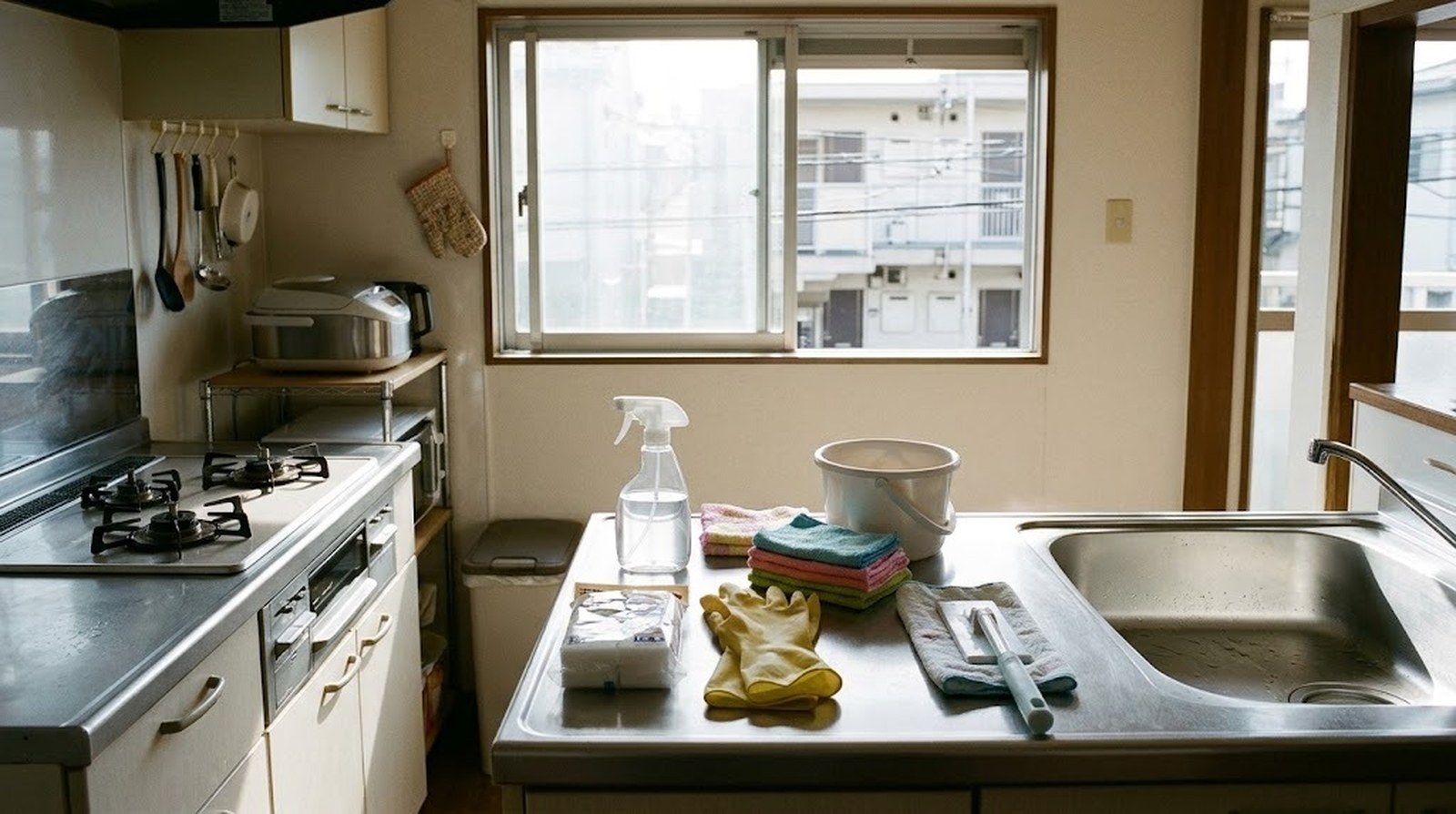
In the last weeks of December, Japanese homes, offices and even temples do a big year-end clean called ōsōji (大掃除). The idea is simple: start the New Year with a clean house. If you rent in Japan, it is also the moment to deal with the mould in the bathroom, the grease on the range hood and that old sofa you have been meaning to throw away.
Japanese cleaning shelves can be confusing, though. Labels are in Japanese, some products must never be mixed, and big items cannot simply go out with the normal trash. Below we explain the custom, the safety rules, our 6 picks from any drugstore, and how bulky trash and old appliances work over New Year. We checked official pages and prices on 28 October 2026.
📌 What you will learn
In a hurry? Six cheap products (¥244–¥1,518) handle most of a Japanese year-end clean. Never use a chlorine mould remover (塩素系) on the same day as an acid cleaner, citric acid or vinegar: together they make toxic gas. Book bulky-trash pickup early: last season Tokyo wards stopped taking bookings around 27–28 December. TVs, fridges, washers and air conditioners are not bulky trash.
- What is ōsōji? Timing and a simple plan
- Safety first: “まぜるな危険” and which products never mix
- Our 6 picks for ōsōji 2026
- Comparison table: price, type, what it cleans
- Bulky trash and old appliances before New Year
- Frequently asked questions
- The short version
※ Prices are the lowest shop prices we saw on 価格.com (kakaku.com) on 28 October 2026, tax included; shipping may be extra. Rules from official city, ward and government pages.
What is ōsōji? Timing and a simple plan
Ōsōji grew out of susuharai (煤払い, “soot sweeping”), a year-end cleaning before New Year. In Edo (old Tokyo), Edo Castle held its susuharai on 13 December from 1640, and townspeople later used the same date. The custom lives on at temples: at Higashi Honganji in Kyoto, participants beat the tatami with bamboo and blow the dust out with a huge fan every year on 20 December.
Today most families clean on the weekends before New Year. A simple plan for a small apartment:
| When | What to do |
|---|---|
| November | Book bulky-trash pickup for anything big (sofa, bed, bicycle). December slots fill up |
| 1st weekend of December | Kitchen: range hood, stove grates, fan filter (alkaline cleaner, soak parts) |
| 2nd weekend | Bathroom: mould on grout and silicone (chlorine cleaner, used alone, window open) |
| 3rd weekend | Top to bottom: ceiling and walls, lights, windows and sills, then floors |
| Last days | Entrance, balcony drain, fridge clean-out. Put trash out before collection stops for New Year |
※ Work from top to bottom and from dry to wet, so falling dust does not land on clean surfaces.
Safety first: “まぜるな危険” and which products never mix
Japanese law requires household cleaners that can release chlorine gas to show 「まぜるな危険」 (“dangerous if mixed”) on the front, together with either 「塩素系」 (chlorine type) or 「酸性タイプ」 (acid type). Learn these three labels before you shop.
In March 2026, the National Consumer Affairs Center of Japan (国民生活センター) warned about accidents in bathrooms. In its tests, a chlorine cleaner mixed with a strong acid cleaner released more than 50 ppm of chlorine gas within minutes, and with grain vinegar more than 40 ppm. In a closed bathroom with the fan off, a chlorine spray and an acid cleaner together passed 16 ppm in 2–3 minutes. Ethanol and lemon juice also produced chlorine gas. The Japan Poison Information Center found that mixing products caused 31% of December accidents with chlorine cleaners (2017–2021), and that calls rise sharply from 29 to 31 December.
| Type (label) | Examples | Good for | Never use with |
|---|---|---|---|
| Chlorine 塩素系 | カビキラー, キッチン泡ハイター, chlorine toilet cleaners | Black mould, bleaching | Acid cleaners, クエン酸 (citric acid), vinegar, alcohol |
| Acid 酸性タイプ | クエン酸 sprays, vinegar, acid toilet cleaners | Limescale, soap scum, water spots | Chlorine products |
| Alkaline | マジックリン, セスキ, オキシクリーン (weak) | Grease, hand marks, soaking | Check each label; do not combine products |
| No chemicals | Melamine sponge, クイックルワイパー | Scuffs, dust | — |
※ カビキラー is alkaline but chlorine-based: treat it as 塩素系. Sources: 国民生活センター (18 March 2026), 日本中毒情報センター.
⚠️ Safety checklist
- Use chlorine cleaners alone. Do the bathroom mould and the citric-acid limescale on different days
- After a chlorine cleaner, flush with plenty of water — at least about one bucket — before using another product. Residue can stay in the drain trap
- Open the window and turn on the fan. Do not use chlorine products where you cannot ventilate
- Wear rubber gloves, a mask and goggles. Do not spray above eye level; use a sponge on a pole for the ceiling
- Never pour a cleaner into another product’s bottle: the legal warning labels are how you tell them apart
- If you smell gas, open windows, leave the room and stay out. If you inhaled it, see a doctor
- Poison hotline 中毒110番 (free, 24 hours, Japanese): Osaka 072-727-2499, Tsukuba 029-852-9999
Our 6 picks for ōsōji 2026
You do not need a cupboard full of products. These six from any Japanese drugstore cover the bathroom, the kitchen, soaking jobs, scuffs and dust. Prices are the lowest we saw on 価格.com on 28 October 2026; drugstores and 100-yen shops may have similar items. Show the Japanese name to staff if you cannot find it.
1. カビキラー (Kabi Killer): black mould in the bathroom
The classic Japanese mould spray, made by Johnson (S.C. Johnson’s company in Japan). It is a chlorine-based cleaner (sodium hypochlorite), and the bottle carries まぜるな危険 塩素系. Spray it on black mould in tile grout and silicone, wait, and rinse well.
The label says not to use it on enamel, aluminium or brass (rust), wood, fabric or plaster walls, or magnetic steel unit-bath walls. Spray from about 15 cm, never toward your face or above eye level, and wash your hands and face afterwards. It also bleaches clothes. A refill (つけかえ用) costs about ¥214.
| Japanese name | カビキラー 本体 400g |
|---|---|
| Type | Chlorine (塩素系), alkaline |
| Size | 400 g spray |
| Price | from ¥248 (+¥11 shipping) |
✅ Pros
- Strong on black mould in grout
- Cheap and sold everywhere
- Refill bottle available
⚠️ Cons
- Never with acids, vinegar or alcohol
- Strong smell; bleaches fabric
- Not for aluminium, brass, enamel or wood
👍 Best for
- Bathrooms with black mould
- People who can ventilate well
- One job at a time
2. マジックリン ハンディスプレー (Magiclean): grease on the stove and range hood
Kao’s alkaline kitchen degreaser for baked-on oil on stove grates, grills and the range hood. Spray, wait a moment and wipe. For range-hood filters, it is quicker than scrubbing.
Kao’s label says not to use it on copper, brass or galvanized steel, furniture or wood floors. Test first on aluminium (it may discolour), damaged paint or fluorine coatings, and tile grout. Use kitchen gloves and ventilate. If it gets in your eyes, do not rub: rinse for 15 minutes or more and see an eye doctor.
| Japanese name | マジックリン ハンディスプレー 400ml |
|---|---|
| Type | Alkaline degreaser |
| Size | 400 ml spray |
| Price | from ¥362 |
✅ Pros
- Fast on heavy kitchen grease
- Sold in every drugstore
- Good on range hoods
⚠️ Cons
- Harsh on skin: wear gloves
- Not for copper, brass or zinc-coated metal
- Test on aluminium first
👍 Best for
- People who fry often
- Range hoods and stove grates
- Year-end kitchen deep clean
3. セスキの激落ちくん (Sesqui Gekiochi-kun): mild everyday cleaner
A spray from LEC made of alkaline electrolysed water and sodium sesquicarbonate (セスキ炭酸ソーダ), with no surfactant. LEC suggests it for microwaves, fridges, toys and pet goods. It is gentler than マジックリン, so it suits light grease, hand marks on switches and doors, and wiping down the fridge.
LEC’s shop page does not list surfaces to avoid, so read the bottle and test a small hidden spot first. For heavy baked-on oil, use #2. A foam version (泡スプレー) is also sold for about ¥380.
| Japanese name | セスキの激落ちくん 400ml |
|---|---|
| Type | Mild alkaline, no surfactant |
| Size | 400 ml spray |
| Price | from ¥278 |
✅ Pros
- Mild, no surfactant
- One bottle for many rooms
- Cheap
⚠️ Cons
- Too weak for baked-on oil
- Surfaces to avoid not listed online: test first
- Wipe off residue
👍 Best for
- Families with children or pets
- Light grease and hand marks
- Fridge and microwave
4. オキシクリーン (OxiClean, Japan version): soak it clean
An oxygen bleach powder (sodium percarbonate and sodium carbonate), weakly alkaline. The standard Japanese version has no surfactant or fragrance. People in Japan call soaking with it “oxi-zuke” (オキシ漬け): dissolve it in water, soak bath stools, buckets, the washing-machine tub or stained towels, then rinse. Follow the water temperature on the label.
Do not use it on wool, silk, leather, tatami, marble, finished wood, or most metals (they may discolour). Never seal the solution in a closed bottle: it can swell and burst. Do not mix it with anything except laundry detergent, including chlorine bleach. Wear rubber gloves. The 1.5 kg tub is about ¥1,173.
| Japanese name | オキシクリーン 500g |
|---|---|
| Type | Oxygen bleach powder, weakly alkaline |
| Size | 500 g (also 1,500 g) |
| Price | from ¥545 |
✅ Pros
- Soaks dirt off with little scrubbing
- Laundry, bath goods, cutting boards
- No fragrance (Japan standard version)
⚠️ Cons
- Slow: needs soaking time
- Not for metals, wool, silk or tatami
- Never store the solution in a closed bottle
👍 Best for
- Bath stools and buckets
- Stained towels and clothes
- People who hate scrubbing
5. 激落ちくん ダブルパパ S-699 (melamine sponge): marks without chemicals
A tall melamine sponge from LEC (about 83×29×250 mm, cut it to size). Wet it with water and rub: it works like a very fine eraser and wears away as it cleans. It is great for sink rims, tiles, switch plates, stained mugs and crayon marks, with no detergent at all.
Because it scratches, LEC says not to use it on glossy stainless steel or plastic, painted or coated surfaces, car bodies, flooring, lacquerware, anti-fog mirrors, or TV, PC and phone screens. It will not remove grease, mould or limescale. Rinse dishes well after using it.
| Japanese name | 激落ちくん ダブルパパ S-699 |
|---|---|
| Type | Melamine foam, water only |
| Size | about 83×29×250 mm |
| Price | from ¥244 (LEC official shop ¥603) |
✅ Pros
- No chemicals: water only
- Very cheap
- Great on scuffs and stains
⚠️ Cons
- Scratches glossy, coated or painted surfaces
- Not for floors or screens
- Wears out fast
👍 Best for
- Renters before moving out
- Homes with small children
- Sinks, tiles and switch plates
6. クイックルワイパー (Quickle Wiper): dust from ceiling to floor
Kao’s floor wiper with disposable sheets. The set has a grip, 3 pipes and a head, about 110 cm long and 340 g. Use it on flooring, tatami, and also walls and ceilings, which makes it ideal for the “top to bottom” order of ōsōji. Dry sheets (立体吸着ドライシート, 20 sheets about ¥348) catch dust; wet sheets handle sticky dirt.
Use only Kao’s sheets, and clean the head with diluted neutral detergent (alkaline or acid cleaners damage it). One Kao online shop shows this model as sold out, but it is still in Kao’s line-up and in stock at many shops.
| Japanese name | クイックルワイパー 本体 |
|---|---|
| Type | Floor wiper with disposable sheets |
| Size | about 110 cm, 340 g |
| Price | from ¥1,518 (+shipping at some shops) |
✅ Pros
- No chemicals, no noise
- Reaches walls and ceilings
- Perfect for small apartments
⚠️ Cons
- Not for sticky grime (use wet sheets)
- Ongoing cost of sheets
- Kao sheets only
👍 Best for
- Small apartments
- Night-time cleaning (no vacuum noise)
- Tatami rooms
For limescale: an acid spray such as 激落ちくん クエン酸スプレー (about ¥338) removes white water spots on taps and mirrors. Remember: never on the same day as カビキラー.
Do not forget protective gear: rubber gloves and goggles cost little and prevent most injuries.
Comparison table: price, type, what it cleans
| Product | Type | Best for | Do not use on | Price from |
|---|---|---|---|---|
| カビキラー | Chlorine 塩素系 | Black mould | Aluminium, brass, enamel, wood, fabric | ¥248 |
| マジックリン ハンディスプレー | Alkaline | Kitchen grease | Copper, brass, zinc-coated metal; test aluminium | ¥362 |
| セスキの激落ちくん | Mild alkaline | Light grease, hand marks | Test first (not listed online) | ¥278 |
| オキシクリーン | Oxygen bleach | Soaking, laundry | Metals, wool, silk, tatami, marble | ¥545 |
| 激落ちくん S-699 | Melamine, water only | Scuffs, stains | Glossy or coated surfaces, floors, screens | ¥244 |
| クイックルワイパー | Dry/wet sheets | Dust, floors, walls | — | ¥1,518 |
※ Lowest shop prices on 価格.com on 28 October 2026; shipping may be extra. Warnings from each maker’s page or label.
Bulky trash and old appliances before New Year
Bulky trash (粗大ごみ, sodai gomi)
Furniture, bedding, bicycles and other large items are bulky trash. In Shinjuku and Osaka this means items over about 30 cm; Yokohama uses 30 cm for metal and 50 cm for other materials. Taking an item apart does not change this. The steps are similar everywhere:
- Book by phone, online (and in Yokohama, LINE). You get a receipt number, a date and a fee.
- Buy fee stickers at a convenience store or supermarket (or pay online where offered).
- Write your receipt number or name on the sticker and attach it.
- Put the item out at the agreed place on the morning of collection (Osaka by 8:30, Yokohama by 8:00).
| City | How to book | Fee stickers | Example fees |
|---|---|---|---|
| Shinjuku (Tokyo) | 03-5304-8080 (Mon–Sat 8:00–19:00) or online 24 h | A券 ¥200, B券 ¥300 | Chair or futon ¥400; 3-seat sofa ¥2,300; single bed frame ¥1,300 |
| Osaka City | Online 24 h (cashless) or 0120-79-0053 / 06-6530-1530 | ¥200 / ¥400 / ¥700 / ¥1,000 | Collection 3 days to 1 month after booking |
| Yokohama City | 0570-200-530, online or LINE | 粗大ごみ収集シール (banks, post offices, konbini) | Allow about 2 weeks |
※ Fees and stickers differ by ward and city. Check your own city’s page. Items put out without booking or the right stickers are not collected.
Year-end deadlines: the 2026–27 dates were not yet published on 28 October 2026. Last season, Shinjuku’s phone booking closed from 28 December to 4 January, and Bunkyo and Minato stopped bookings on 27 December and reopened on 5 January. Osaka takes no applications from 29 December to 3 January. Book in November or early December, and look for your ward’s New Year notice.
TVs, fridges, washers and air conditioners
These four are covered by the Home Appliance Recycling Law (家電リサイクル法) and are never bulky trash (OLED TVs were added in April 2024). You pay a recycling fee plus a collection fee.
| Item | Recycling fee (tax incl.) |
|---|---|
| Air conditioner | ¥550–¥990 (by maker) |
| LCD / OLED / plasma TV, 15V or smaller | ¥1,870 |
| LCD / OLED / plasma TV, 16V or larger | ¥2,970 |
| Fridge / freezer, 170 L or less | ¥3,740 |
| Fridge / freezer, 171 L or more | ¥4,730 |
| Washing machine / clothes dryer | ¥2,530 |
※ Major makers, from the 家電リサイクル券センター fee page. Some smaller brands cost more. The collection fee is set by the shop or collector (one large retailer charges ¥2,750–¥3,300).
How to dispose: (1) the shop selling you a new one takes the old one; (2) the shop where you bought it; (3) in Tokyo’s 23 wards, the 家電リサイクル受付センター (0570-087200 or kaden23rc.jp); or (4) buy a recycling ticket at a post office and take the item to a designated drop-off site. For 2026–27 the 23-ward centre’s phone booking stops at 17:00 on 28 December and restarts at 9:00 on 4 January; the website takes bookings all year.
Live in Tokyo? Our bulky trash guide for all 23 wards lists every ward’s booking number, fees for sofas, beds and bicycles, and self drop-off sites. For everyday sorting rules, see our garbage guide in the related articles below.
Frequently asked questions
When do Japanese people do ōsōji?
Usually in the last weeks of December, before New Year. Edo Castle held its year-end soot sweeping on 13 December from 1640, and Higashi Honganji in Kyoto still holds it on 20 December. Many households now clean over the December weekends.
Can I use カビキラー and citric acid or vinegar together?
No. Chlorine plus acid makes toxic chlorine gas. Use chlorine products alone, ventilate, and flush with plenty of water (at least about a bucket) before using another product. Doing them on different days is safest.
How do I get rid of a sofa or bed before New Year?
Book bulky-trash collection with your city or ward, buy fee stickers at a convenience store, attach them and put the item out on the day. In Shinjuku, a 3-seat sofa is ¥2,300. Book early: last season Tokyo wards stopped bookings around 27–28 December.
Can I throw away an old TV or fridge as bulky trash?
No. TVs, fridges and freezers, washers and dryers, and air conditioners go through the appliance recycling system. You pay a recycling fee (for example ¥4,730 for a large fridge, ¥2,970 for a large TV) plus a collection fee.
Is a melamine sponge safe on everything?
No. It works like very fine sandpaper. Do not use it on glossy, coated or painted surfaces, car bodies, flooring, or TV and phone screens.
What is the difference between セスキ, マジックリン and オキシクリーン?
All are alkaline. セスキの激落ちくん is mild and surfactant-free for everyday dirt. マジックリン is a stronger degreaser for kitchens (not for copper or brass; test on aluminium). オキシクリーン is an oxygen-bleach powder for soaking (not for metals, wool, silk or tatami).
The short version
Ōsōji is Japan’s year-end clean. Six drugstore products cover most of it: カビキラー for mould, マジックリン for kitchen grease, セスキの激落ちくん for everyday dirt, オキシクリーン for soaking, a melamine sponge for marks and a クイックルワイパー for dust. Learn the labels 「まぜるな危険」「塩素系」「酸性タイプ」, never use chlorine and acid on the same day, ventilate and wear gloves. Book bulky trash in November or early December, and send TVs, fridges, washers and air conditioners through appliance recycling.
🔥 Editor’s Picks for Life & Travel in Japan

Japan Expat Starter Kit 2026 PDF guide
Your first 90 days in Japan, step by step: 17 chapters · 24 pages · 100 phrases in Japanese script · 40 kanji · printable checklists. Bank account, My Number, health insurance, apartment, phone, taxes & pension.
$9.99 $4.99 current price
📥 Get the kit →📄 Read 5 pages free: contents + Chapter 2
⚡ Instant PDF download · 🛡️ 30-day money-back guarantee · 🔄 Free 2026 updates
Practical guides for life and travel in Japan — free, about once a week. No spam, unsubscribe anytime.
☕ Enjoying our Japan guides?
If this article helped you, you can support our work with a coffee!
Did this guide help you? 🍵
Japan Life Lab is a small independent blog, and every guide we publish is completely free — no paywalls, ever. If our work saved you time (or a headache), you can support us with a cup of Japanese tea. Every contribution, big or small, goes straight into keeping these guides free, accurate and up to date for everyone.
☕ Support Japan Life Lab
Leave a Reply