This article was created with AI writing assistance (ChatGPT, Claude, etc.). Product selection, specifications, and reviews are verified by the Japan Life Lab editorial team.
This article contains promotional / affiliate links.
Tax-free shopping in Japan changes on 1 November 2026
Until 31 October you show your passport at the till and simply pay without the 10% consumption tax. From 1 November you pay the full tax-included price in the shop and claim the tax back at the airport — at a customs kiosk or through Visit Japan Web — before you check in.
- The ¥5,000 minimum per shop, per day stays the same.
- The general-goods / consumables split is abolished, and so is the ¥500,000 cap on consumables.
- Sealed packaging is abolished — but consumables still have to leave Japan unused.
- Everything on the receipt has to be with you at departure. Customs can ask to see it.
Shopping before 1 November? Nothing changes for you yet.
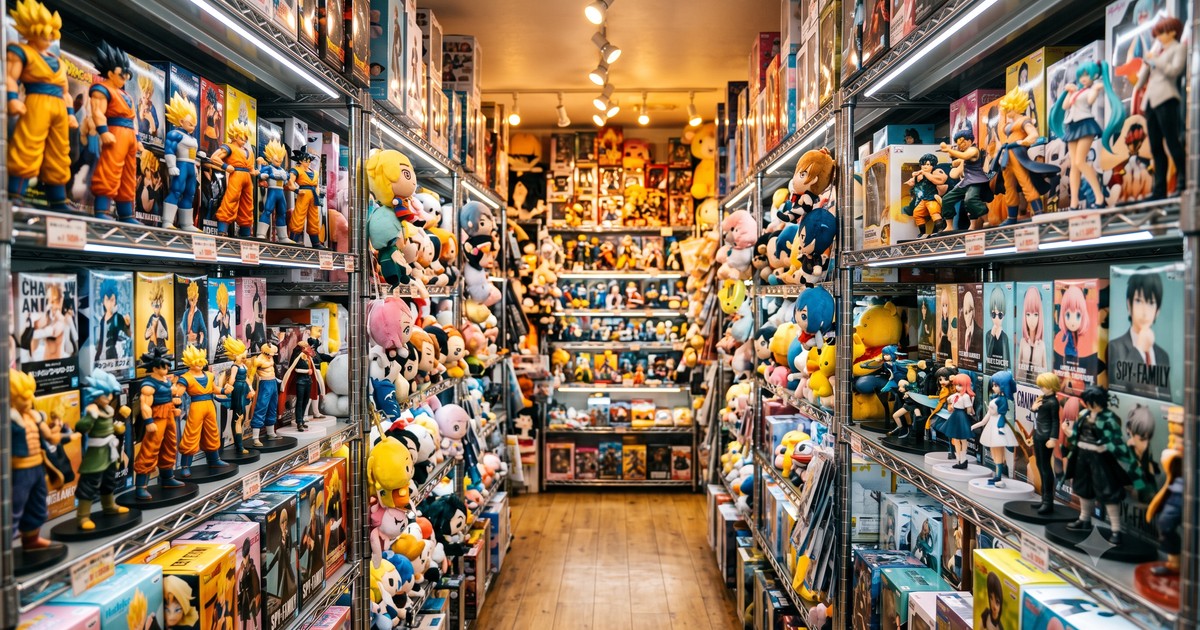
Japan is the source. Whatever anime, manga or game you love, the merchandise was designed here, released here first, and a large share of it never officially leaves the country. That is why anime shopping is one of the few things in Japan that genuinely cannot be replicated anywhere else — not in a convention hall, not on eBay, not in a Western pop-culture chain.
But the reality on the ground surprises most first-time visitors. Akihabara is not one giant anime mall. It is eight floors of one building, then a completely different eight floors across the street, each specialising in something narrow. Without a plan you can spend an entire day walking and come home with a keychain.
This guide covers where to go, what each district and chain is actually good for, what things cost in 2026, how to use tax-free shopping properly, and — for readers who are not in Japan — how to buy the same items from abroad through proxy services.
📌 What you will learn
You do not have to read it all — jump to what you need.
- The five districts that matter
- The chains you need to recognise
- What things actually cost in 2026
- Tax-free shopping: how it actually works
- Buying from abroad: proxy services and the alternatives
- Getting it home in one piece
- Frequently asked questions
※ Start wherever fits your situation.
The five districts that matter
Anime retail in Japan is concentrated in a handful of neighbourhoods, and each has developed its own personality over decades. Knowing which one matches what you collect saves an enormous amount of time.
1. Akihabara, Tokyo — the default answer, for good reason
Akihabara is the largest and most concentrated anime shopping district in the world, packed into roughly a ten-minute walk from the station. Almost every major chain has a flagship here, and the vertical layout means a single building can hold figures on one floor, trading cards on another and doujinshi above that.
What makes Akihabara unbeatable is breadth. Current-season merchandise, twenty-year-old back catalogue, retro games, cosplay supplies, and the largest concentration of gachapon machines anywhere all sit within a few blocks. If you only have one day, spend it here.
The trade-off is crowds and price. Akihabara is the tourist default, so second-hand pricing is generally less generous than in Nakano, and weekends can be uncomfortably busy. Go on a weekday morning if you can.
2. Nakano Broadway, Tokyo — where the collectors go
Fifteen minutes west of Shinjuku sits a slightly worn 1960s shopping complex that happens to contain one of the densest collections of anime and manga shops on earth. Nakano Broadway is where Tokyo collectors go when they want something specific and old.
The building is dominated by Mandarake, which does not occupy one shop here but dozens of small specialised units scattered across several floors — one for vintage figures, one for cels, one for idol goods, one for shoujo manga, and so on. Prices for second-hand and out-of-print items are typically better than Akihabara.
Nakano is not the place for brand-new seasonal merchandise. It is the place for the figure that was released in 2009 and never reprinted, for original animation cels, and for genuinely rare doujinshi. Set aside three hours minimum.
3. Ikebukuro and Otome Road, Tokyo — the other half of the fandom
If Akihabara historically leaned male-oriented, Ikebukuro is its counterpart. Otome Road, a short stretch behind the Sunshine City complex, is the centre of josei and BL merchandise, otome games, and character goods aimed at women.
Ikebukuro also hosts the Animate flagship — a tower devoted entirely to anime and manga goods — and a rotating schedule of collaboration cafés tied to whatever series is currently airing. These cafés are often the only place to obtain certain limited goods.
Practically, Ikebukuro is more comfortable than Akihabara: wider streets, more places to sit, and shops that are less overwhelming to navigate. For many visitors it is the more pleasant day out.
4. Den Den Town, Osaka — Akihabara without the tour groups
Officially Nipponbashi, Den Den Town is Osaka’s electronics-and-anime district and functions as a smaller, calmer Akihabara. All the major chains are represented, the streets are less congested, and second-hand pricing is often noticeably softer.
If your itinerary includes Osaka or Kyoto, there is no need to save all your anime shopping for Tokyo. Den Den Town covers the essentials, and the reduced crowding makes browsing far more enjoyable.
5. Everywhere else — the shops you will stumble into
Anime merchandise in Japan is not confined to specialist districts. Animate has branches in most major cities. Pokémon Centers exist in Tokyo, Osaka, Kyoto, Yokohama, Sapporo and more. Don Quijote stocks character goods in every prefecture, and even ordinary shopping malls carry gachapon banks and capsule toys.
This matters because it removes the pressure to buy everything in one place. If you see something in Akihabara at full price, there is a reasonable chance you will find it cheaper — or second-hand — later in your trip.
| District | Best for | Time needed | Crowd level |
|---|---|---|---|
| Akihabara (Tokyo) | Breadth, new releases, gachapon, retro games | Half to full day | Very high |
| Nakano Broadway (Tokyo) | Rare, vintage, out-of-print, cels | 2 to 3 hours | Moderate |
| Ikebukuro / Otome Road (Tokyo) | Josei, BL, otome, collab cafés | Half day | Moderate |
| Den Den Town (Osaka) | Everything, with fewer crowds | Half day | Low to moderate |
| Chain stores nationwide | Convenience, current season goods | 30 minutes | Low |
The chains you need to recognise
Animate
The largest anime goods chain in Japan and the most reliable place for current-season merchandise. Everything is new, officially licensed, and organised by series. Animate is where you go for the show that is airing right now — acrylic stands, badges, clear files, drama CDs and manga volumes.
Mandarake
The dominant second-hand chain, and the reason Nakano Broadway exists in its current form. Mandarake buys and resells everything from figures and doujinshi to original cels and vintage toys. Condition grading is honest and pricing reflects genuine market value rather than nostalgia.
Surugaya
Another major second-hand operator, generally cheaper than Mandarake but with less rigorous presentation. Surugaya is worth checking for games, CDs and mid-range figures, particularly if you are hunting for a specific item rather than browsing.
Pokémon Center and other official stores
Official brand stores — Pokémon Center, Jump Shop, Ghibli’s Donguri Kyowakoku, Sanrio — carry exclusive merchandise you will not find in general retailers. If a specific franchise is your priority, these are non-negotiable stops.
Book-Off and Hard-Off
General-purpose second-hand chains found in nearly every town. Their anime sections are unpredictable, but that is precisely the appeal: the pricing does not reflect collector demand, so genuine bargains surface regularly. Worth a fifteen-minute look whenever you pass one.
What things actually cost in 2026
Merchandise pricing in Japan is more structured than newcomers expect. Knowing the standard tiers helps you judge instantly whether something is a normal price or an inflated one.
| Item type | Typical price (new) | Notes |
|---|---|---|
| Gachapon capsule toy | ¥300 – ¥500 | Single play. Blind contents, five to six variants per machine |
| Acrylic stand / keychain | ¥800 – ¥1,800 | The default modern souvenir. Light and easy to pack |
| Can badge | ¥400 – ¥700 | Usually blind-boxed and sold in sets |
| Nendoroid | ¥6,000 – ¥9,000 | Chibi-style poseable figure with swappable parts |
| Prize figure (from arcades) | ¥1,500 – ¥3,500 | Resold in shops. Excellent value for the size |
| 1/7 scale figure | ¥15,000 – ¥35,000 | Collector tier. Heavy and bulky to transport |
| Doujinshi | ¥500 – ¥2,000 | Second-hand. Condition and rarity drive price |
| Trading card booster pack | ¥180 – ¥600 | Pokémon, One Piece, Yu-Gi-Oh and others |
Two categories consistently deliver the best value. Prize figures — the ones originally won in arcade crane games — are manufactured to a decent standard and resold in shops for a fraction of what a scale figure costs. And gachapon offers the highest fun-per-yen of anything in Japan, with a ¥400 capsule producing a genuinely well-made miniature.
Tax-free shopping: how it actually works
Foreign visitors on a short-stay status can buy goods free of Japan’s 10% consumption tax at licensed tax-free shops, and most major anime retailers are licensed. On a ¥30,000 figure that is ¥3,000 back — not trivial.
The rules are straightforward. You need a minimum purchase of ¥5,000 (before tax) at a single store on a single day, your physical passport, and the goods must leave Japan with you. Residents of Japan are not eligible, and neither are visitors who have been in the country for six months or more.
The practical mistakes are predictable. People carry a photo of their passport instead of the passport itself — that is not accepted. They split purchases across two visits to the same store on the same day and fall below the threshold. Or they buy at three different branches of the same chain, each below ¥5,000, when consolidating into one transaction would have qualified.
One further point worth knowing: Japan’s tax-free system has been undergoing reform, with a shift toward a refund-at-departure model announced for implementation later in the decade. For 2026, the in-store exemption process described above still applies, but it is sensible to confirm the current procedure with the shop rather than assume.
Buying from abroad: proxy services and the alternatives
Most anime merchandise released in Japan is never distributed internationally. Limited edition goods, collaboration café items, convention exclusives and second-hand listings on Japanese auction sites are all, in principle, out of reach. Proxy shopping services exist to close that gap.
How proxy services work
The mechanism is the same across providers. The service maintains a Japanese address and buys on your behalf from Japanese sites — Yahoo! Auctions, Mercari Japan, Rakuten, Amazon Japan and specialist retailers. The item ships to their warehouse, they consolidate your purchases into one parcel, and forward it internationally.
Costs come in three layers: the item price, a service fee per purchase, and international shipping. The service fee is usually modest; the shipping is where the real cost sits, particularly for heavy scale figures in large boxes.
Consolidation is the single biggest lever on cost. Buying six items over a month and shipping them together in one box can cut per-item shipping dramatically compared with six separate parcels. Most services will hold your items for a period specifically to allow this.
Buyee
The most widely used proxy service internationally, with English, Chinese and Korean interfaces and direct integration with Yahoo! Auctions Japan, Mercari and Rakuten. Buyee is the default recommendation for most people because the interface requires no Japanese and the process is well documented.
Other routes worth knowing
ZenMarket and FromJapan operate on the same model with slightly different fee structures — worth comparing if you buy regularly. Amazon Japan ships a surprising amount of merchandise internationally without any proxy at all, and is often the simplest option for mainstream items. And a growing number of Japanese publishers now run their own international online stores with direct shipping.
For trading cards specifically, the calculation changes. Sealed booster boxes are heavy relative to value and attract customs scrutiny in some countries. Check your own import thresholds before ordering in volume.
Getting it home in one piece
Anime merchandise is disproportionately fragile and bulky for its value. A single 1/7 scale figure typically arrives in a box roughly the size of a shoebox, and collectors generally do not want that box damaged — for many items, the packaging is part of the value.
The realistic approach is to plan luggage capacity before you shop, not after. Many visitors bring a folded duffel bag inside their suitcase specifically for the return journey, or buy an inexpensive additional suitcase in Japan. Don Quijote sells cheap hard cases for exactly this reason.
For genuinely fragile items, international courier services operating from Japan will pack and ship separately, which is often safer than trusting checked baggage. Convenience stores and hotel front desks can usually arrange domestic forwarding to your final hotel, so you are not carrying purchases around for the rest of the trip.
Finally, check your home country’s customs allowance. Personal-use merchandise below the de minimis threshold usually passes without duty, but a large haul of figures can exceed it. Keeping receipts makes any conversation at the border considerably shorter.
Frequently asked questions
Is Akihabara or Nakano Broadway better for anime shopping?
Akihabara is better for breadth and for new, current-season merchandise; it has more shops, more gachapon and more variety. Nakano Broadway is better for rare, vintage and out-of-print items, and second-hand pricing there is generally lower. If you have one day, choose Akihabara. If you are hunting for something specific and old, go to Nakano.
Can tourists get tax-free anime merchandise in Japan?
Yes. Visitors on a short-stay status can buy free of the 10% consumption tax at licensed tax-free shops, which includes most major anime retailers. You need to spend at least 5,000 yen before tax at one store on one day, present your physical passport, and take the goods out of Japan.
Are anime figures sold in Japan authentic?
Merchandise sold through Japanese specialist chains such as Animate, Mandarake, Surugaya and official brand stores is almost always officially licensed. Bootlegs are far more common on international marketplaces than in Japanese retail.
How can I buy Japanese anime merchandise if I am not in Japan?
Use a proxy shopping service such as Buyee, ZenMarket or FromJapan. They buy from Japanese sites on your behalf, receive the goods at a Japanese address, consolidate them and forward the parcel internationally. Amazon Japan also ships many mainstream items abroad directly.
What is the cheapest anime merchandise worth buying in Japan?
Gachapon capsule toys at 300 to 500 yen offer the best value for money, and second-hand prize figures at 1,500 to 3,500 yen are excellent value for their size. Both are also light and easy to pack.
🔥 Editor’s Picks for Life & Travel in Japan
📘 The Japan Expat Starter Kit 2026
Banking, housing, My Number, taxes, 100 phrases and a 40-kanji cheat sheet — everything from this site in one 17-chapter PDF field manual. Free lifetime 2026 updates.
Reader price: $9.99 $6.99 with code JLL30 at checkout
30-day money-back guarantee · Instant download · PR
Practical guides for life and travel in Japan — free, about once a week. No spam, unsubscribe anytime.
☕ Enjoying our Japan guides?
If this article helped you, you can support our work with a coffee!
Did this guide help you? 🍵
Japan Life Lab is a small independent blog, and every guide we publish is completely free — no paywalls, ever. If our work saved you time (or a headache), you can support us with a cup of Japanese tea. Every contribution, big or small, goes straight into keeping these guides free, accurate and up to date for everyone.
☕ Support Japan Life Lab
Leave a Reply