This article was created with AI writing assistance (ChatGPT, Claude, etc.). Product selection, specifications, and reviews are verified by the Japan Life Lab editorial team.
This article contains promotional / affiliate links.
For a lot of people, autumn — not spring — is the best time to be in Japan. The crowds are big but not sakura-big, the weather is dry and comfortable, and the colour lasts for weeks instead of days. But 2026 comes with an important asterisk: after a hotter-than-normal summer, peak colour is expected to arrive three to five days later than the historical average.
If you are booking a trip, those few days decide whether you stand under a blazing red maple or a mostly green tree. This guide covers the 2026 forecast region by region, the 12 best places to see it, how to book without overpaying, and the mistakes almost every first-timer makes.
📌 What you will learn
You do not have to read it all — jump to what you need.
- What koyo actually is
- Japan autumn foliage forecast 2026: dates by region
- The 12 best places to see autumn leaves in Japan
- How to plan a koyo trip without losing your mind
- What to pack for Japanese autumn
- Five mistakes almost every visitor makes
- Autumn foliage in Japan: FAQ
※ Start wherever fits your situation.
What koyo actually is
Koyo (紅葉) literally means “crimson leaves.” Just as spring has the sakura zensen (cherry blossom front), autumn has the koyo zensen — a front of colour that starts in Hokkaido’s high mountains in mid-September and creeps south, finishing in Kyushu around mid-December.
Going to look at it has its own name: momijigari (紅葉狩り), literally “maple hunting.” It has been a documented pastime since the Heian period, when court nobles wrote poems under the trees.
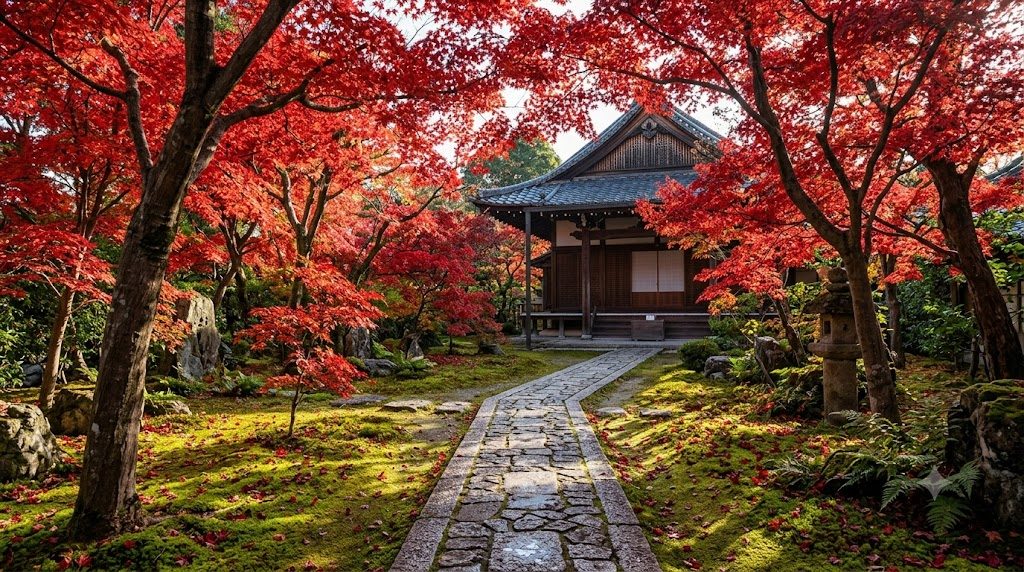
What makes Japanese autumn different from New England or Bavaria is the species mix. The momiji (Japanese maple) turns deep scarlet, the icho (ginkgo) turns brilliant yellow, and beeches and larches fill in the oranges. A single temple garden often shows all three at once, layered against dark pines and grey stone.
Japan autumn foliage forecast 2026: dates by region
The Japan Meteorological Agency forecast above-normal temperatures nationwide for June through August 2026. That matters, because maples need several consecutive nights below roughly 8°C to trigger the red pigment. A warm autumn means a late — and sometimes duller — koyo.
Below are the estimated windows for 2026. Treat them as planning ranges, not promises: the Japan Meteorological Corporation publishes its first detailed koyo forecast around mid-September, then updates monthly through late November.
| Region / Spot | Estimated 2026 peak | Notes |
|---|---|---|
| Hokkaido (Daisetsuzan) | Mid-September | Japan’s first koyo, alpine |
| Hokkaido (Sapporo, Jozankei) | Mid-October | Easy day trip from the city |
| Tohoku (Aomori, Akita) | Mid-to-late October | Oirase Gorge, Lake Towada |
| Oku-Nikko (high elevation) | Oct 5-10 | Senjogahara marsh, 1,400 m |
| Lake Chuzenji & Kegon Falls | Oct 18 – Nov 1 | Pair with Irohazaka |
| Irohazaka winding road | ~Oct 25 | Legendary weekend traffic |
| Nikko town | Nov 5-12 | Toshogu and Rinnoji |
| Japan Alps (Kamikochi) | Late October | Valley closes mid-November |
| Kanazawa, Takayama | Early November | Kenrokuen night illumination |
| Hakone, Kawaguchiko | Early-to-mid November | Maples with Mt. Fuji behind |
| Kyoto | Nov 25 – Dec 7 | Several days later than the norm |
| Nara, Osaka | Late Nov – early Dec | Minoo Falls, Nara Park |
| Tokyo (city parks) | Nov 20 – Dec 5 | Ginkgos hold into December |
| Hiroshima, Miyajima | Mid-to-late November | Momijidani, “maple valley” |
| Kyushu (Fukuoka, Kumamoto) | Mid-December | The country’s last koyo |
⚠️ The single most expensive planning mistake: booking Kyoto for November 15-20 “because that’s when it turns red.” In 2026 you will most likely arrive too early. If you only get one week in Kyoto, aim for November 25 – December 5.
The 12 best places to see autumn leaves in Japan
1. Nikko (Tochigi) — the most accessible koyo from Tokyo
Two hours from Asakusa on the Tobu Limited Express. Nikko’s advantage is that it gives you three separate seasons in one destination depending on elevation: Senjogahara in early October, Lake Chuzenji mid-to-late October, and the town’s temples in early November.
The Irohazaka road, 48 hairpin turns climbing from the town to the lake, is one of Japan’s most famous autumn drives — and one of its worst traffic jams. If you drive, leave before 7 a.m. Otherwise take the bus.
2. Kyoto — Tofuku-ji, Eikando and Arashiyama
Tofuku-ji is the koyo temple. The Tsutenkyo bridge crosses a ravine holding more than 2,000 maples. It opens at 8:30 a.m. and there is a queue by 9:30. In peak season photography is banned from the main bridge to keep people moving.
Eikan-do has the city’s best night illumination (raito-appu). Arashiyama combines bamboo, river and mountain — take the Sagano Romantic Train for the view from above.
💡 Local tip: the lesser-known temples in northern Kyoto — Ruriko-in, Shisen-do, Enko-ji — deliver the same colour with a fraction of the crowd. Ruriko-in requires an advance online reservation.
3. Tokyo — you don’t actually have to leave the city
Plenty of visitors assume autumn means a road trip. It doesn’t. Rikugien, an Edo-era strolling garden, runs a night illumination in late November. Meiji Jingu Gaien has the famous avenue of 146 ginkgo trees that becomes a gold tunnel in early December. Showa Kinen Park in Tachikawa mixes ginkgos and maples across 165 hectares.
Tokyo’s ginkgos are the season’s last chance — they hold colour into the first week of December, well after Kyoto’s maples have dropped.
4. Kawaguchiko — autumn leaves with Mt. Fuji behind them
The Momiji Kairo (“maple corridor”) along Lake Kawaguchi is the classic shot: red maples framing a snow-dusted Fuji. The autumn festival includes evening illumination, typically November 1-23.
Arrive early or stay overnight. Buses back to Tokyo fill up, and Sunday-afternoon traffic routinely runs two to three hours.
5. Hakone — onsen, art and maples
The best couples’ option. The Hakone Museum of Art has a moss garden under maples that looks painted, and the Owakudani ropeway gives you the whole valley in colour. Finish in an onsen with a rotenburo (outdoor bath) surrounded by red.
6. Nara — deer among the maples
Nara Park in autumn is one of Japan’s most photogenic scenes: sika deer wandering between red maples with Todai-ji behind. Walk on to Isuien Garden, which is far quieter and arguably more beautiful.
7. Minoo (Osaka) — the waterfall and fried maple leaves
Thirty minutes from central Osaka. A 3 km riverside trail leads to the 33-metre Minoo Falls. The local speciality is momiji tempura — real maple leaves battered and deep-fried, sweet and crunchy. It sounds strange. It is excellent.
8. Miyajima and Hiroshima — Momijidani, “maple valley”
Momijidani Park at the foot of Mt. Misen holds around 700 maples. Combine it with Itsukushima Shrine and its floating torii. In Hiroshima city, try momiji manju, the maple-leaf-shaped cake that is the region’s signature souvenir.
9. Kanazawa — Kenroku-en illuminated
One of the “three great gardens of Japan.” In early November the staff install the yukitsuri — conical rope structures that protect the pines from snow load. Seeing yukitsuri and koyo together, lit at night and free on certain dates, is one of the quiet highlights of Japanese autumn.
10. Takayama and the Shokawa valley
Takayama’s Edo-era wooden old town, ringed by colour. Nearby Shirakawa-go, a UNESCO site, sets thatched gassho-zukuri farmhouses against orange hillsides.
11. Kamikochi (Japan Alps) — alpine autumn
Golden larches, the turquoise Azusa River, and the snow-topped Hotaka range. Peak arrives in late October and the valley closes in mid-November until spring. Private cars are banned; access is by bus from Hirayu or Sawando.
12. Daisetsuzan (Hokkaido) — the year’s first koyo
If you are travelling in September, this is where to go. The Asahidake ropeway lifts you to 1,600 m, where colour arrives by mid-September. It is a different kind of koyo: red alpine shrubs and yellow birches over volcanic rock, with steam vents in the background.
How to plan a koyo trip without losing your mind
Book accommodation now, not in October
Along with sakura, koyo is the most expensive and most booked-out season of the year. Premium Kyoto ryokan for the November 20-30 window are expected to be full by August. Most ryokan open reservations six months ahead.
If you are already late: base yourself in Osaka or Otsu and day-trip into Kyoto (20-30 minutes by train). You will easily save 40%.
Book a window, not a date
Because 2026’s peaks may shift, reserve a four-to-five-day window in each area instead of chasing one perfect day. For the Kanto region the safe bracket is October 20 – November 5; for Kansai, November 22 – December 5.
Get up early. Genuinely early.
The difference between Tofuku-ji at 8:30 and at 11:00 is the difference between a postcard photo and a 90-minute queue. Kyoto’s famous temples are calm until about 9:30 a.m. and again after 3:30 p.m.
Use the night illuminations
Many temples and gardens open after dark only during koyo season (raito-appu). They typically start around 5:30 p.m. and often need a separate ticket. Kyoto (Eikan-do, Kodai-ji), Tokyo (Rikugien) and Kanazawa (Kenroku-en) are the strongest.
Is the Japan Rail Pass worth it for an autumn trip?
If you are doing Tokyo → Kyoto → Hiroshima and back, yes. If you stay in one region, almost never. Run the numbers against your route first.
What to pack for Japanese autumn
November in Japan is deceptive. Kyoto can hit 18°C in midday sun and 6°C at 6 p.m. while you wait for a bus. In the mountains — Nikko, Kamikochi, Hakone — it drops below freezing overnight.
Layers, always
Light thermal base layer + thin sweater + windproof shell. There is a reason half of Japan lives in Uniqlo HEATTECH from October onward: it packs down to nothing and it works. Add a thin scarf — in Japan it is the evening wind that gets you, not the temperature.
Comfortable, water-resistant shoes
You will walk 12,000-20,000 steps a day, much of it on temple gravel and damp trails. Light trail runners or water-resistant walking shoes. And socks without holes — you will take your shoes off several times a day in temples and restaurants.
Power bank and a spare memory card
You will take far more photos than you expect, and cold drains batteries faster. A 10,000 mAh power bank and a spare SD card are worth their weight.
A serious folding umbrella
Autumn rain is short but heavy. Japanese umbrellas are genuinely excellent and cost ¥1,500-3,000 at any station shop — but if you would rather arrive prepared, buy one before you fly.
Gear worth packing
Lightweight thermal base layer — the single most useful thing you can bring. Warm at 6°C, not sweaty at 18°C.
10,000 mAh power bank — cold weather plus a full day of photos will drain a phone by mid-afternoon.
Windproof folding umbrella — Japanese folding umbrellas are in a different league from the drugstore variety.
Compression walking socks — 20,000 steps a day on stone and gravel adds up fast.
Five mistakes almost every visitor makes
- Only going to the famous spots. Tofuku-ji is spectacular, but a neighbourhood temple ten minutes’ walk away has the same colour and no queue at all. In Kyoto, walking one stop further north is usually worth more than any ticket.
- Booking Kyoto too early. We have said it twice because it is the costliest error: mid-November in Kyoto is frequently still green.
- Driving to Nikko or Hakone on a weekend. Irohazaka traffic is legendary. Go midweek, or use public transport and enjoy the view instead of the brake pedal.
- Ignoring the weekly forecast. The Japan Meteorological Corporation and Weathernews publish updated koyo maps from mid-September. Check them before locking in your final itinerary — you can often shift a booking by three days and double the payoff.
- Underestimating the evening cold. Most illuminations are outdoors and involve standing still for one to two hours. Carry one extra layer in your day bag.
Autumn foliage in Japan: FAQ
When is the best time to see autumn leaves in Japan in 2026?
It depends entirely on the region. Hokkaido runs mid-September to mid-October; the Tokyo and Nikko area late October through early December; Kyoto roughly November 25 to December 7. In 2026, peaks are expected three to five days later than average because of a warm summer.
Is koyo as crowded as cherry blossom season?
Yes, and in some places more so. Autumn lasts more weeks than sakura, which spreads the load, but mid-to-late November weekends in Kyoto are among the busiest tourist days of the entire year. Travel midweek if you possibly can.
How much does an autumn trip to Japan cost?
Accommodation runs 30-80% above low season. A realistic two-week budget with mid-range lodging is roughly $2,700-3,800 per person excluding flights. Sleeping in Osaka instead of Kyoto is the easiest single saving.
Do I need to reserve temples in advance?
Most, no. Some, yes — Ruriko-in in Kyoto requires an online reservation, and several night illuminations sell timed-entry tickets. Check about a week ahead.
Can I see autumn leaves and Mt. Fuji together?
Yes. The Momiji Kairo at Lake Kawaguchi is the classic location, peaking early-to-mid November. Oshino Hakkai and Arakurayama Sengen Park (the one with the pagoda) also work well.
What is the weather like in Japan in November?
Pleasant by day (15-20°C in Tokyo and Kyoto) and cool after dark (6-10°C). Mountains can drop below freezing. It rains less than in June, but when it rains it rains hard.
Is autumn a good time to visit Japan for the first time?
It is arguably the best. The weather is the most comfortable of the year, the food is at its seasonal peak (matsutake, chestnuts, new-crop rice, sanma), and the colour lasts for weeks rather than the ten-day sakura window.
🍁 Keep planning your trip
🔥 Editor’s Picks for Life & Travel in Japan
📘 The Japan Expat Starter Kit 2026
Banking, housing, My Number, taxes, 100 phrases and a 40-kanji cheat sheet — everything from this site in one 17-chapter PDF field manual. Free lifetime 2026 updates.
Reader price: $9.99 $6.99 with code JLL30 at checkout
30-day money-back guarantee · Instant download · PR
Practical guides for life and travel in Japan — free, about once a week. No spam, unsubscribe anytime.
☕ Enjoying our Japan guides?
If this article helped you, you can support our work with a coffee!
Did this guide help you? 🍵
Japan Life Lab is a small independent blog, and every guide we publish is completely free — no paywalls, ever. If our work saved you time (or a headache), you can support us with a cup of Japanese tea. Every contribution, big or small, goes straight into keeping these guides free, accurate and up to date for everyone.
☕ Support Japan Life Lab
Leave a Reply