This article was created with AI writing assistance (ChatGPT, Claude, etc.). Product selection, specifications, and reviews are verified by the Japan Life Lab editorial team.
This article contains promotional / affiliate links.
📌 What you will learn
You do not have to read it all — jump to what you need.
- Why Moving to Japan Is Harder Than You Think (But These Hacks Help)
- Before You Arrive: Preparation Hacks
- First Week in Japan: Survival Hacks
- Housing and Money Hacks
- Daily Life Hacks
- Long-Term Hacks
- Your Japan Moving Checklist
※ Start wherever fits your situation.
Why Moving to Japan Is Harder Than You Think (But These Hacks Help)
Moving to Japan is exciting — but between the paperwork, language barriers, and unwritten rules, most expats hit the same walls. After helping thousands of foreigners navigate Japanese bureaucracy, we’ve compiled the 15 most game-changing hacks that official guides never mention. Use these to save time, money, and sanity.
Before You Arrive: Preparation Hacks
Hack #1: Get Your International Driving Permit BEFORE You Leave Home
Japan’s driving license conversion requires a Japanese translation of your foreign license — which takes 1–3 weeks and ¥3,000+ from JAF. But if you get an International Driving Permit (IDP) from your home country before moving, you can drive legally for up to 1 year from your entry date. This buys you time to sort out the conversion without being stranded.
- Get your IDP at your country’s automobile association (AAA, AA, ADAC, etc.) for $20–$30
- Valid in Japan for 1 year from arrival (check your entry stamp date)
- After 1 year, you MUST convert or stop driving — no exceptions
- Countries excluded from IDP: China, South Korea, Germany (different treaty) — check JAF’s list
Hack #2: Open a Wise Account in Your Home Country
Japanese banks are notoriously hard to open for newcomers (most require 6 months of residence). Wise gives you a Japanese bank account number before you even land, lets you receive JPY, and offers real exchange rates. Use it to pay rent deposits and utilities until your Japanese bank account is sorted.
- Open online before departure — verification takes 1–3 days
- Get a Japanese virtual account number to receive yen transfers
- Exchange rate is mid-market (banks charge 3–5% more)
- Pairs perfectly with Rakuten Bank (easiest Japanese bank for foreigners)
Hack #3: Bring Physical Copies of EVERYTHING
Japanese bureaucracy loves paper. Bring certified copies of your birth certificate, passport, university degree, marriage certificate (if applicable), and employment contract. Getting these documents re-certified internationally while in Japan is a nightmare of embassies and apostilles.
- Bring 5+ passport photos (Japanese sizes: 3×4cm, 3.5×4.5cm, 4×3cm — different for different forms)
- Certified translations add ¥3,000–¥10,000 per document in Japan
- Some documents need apostille certification (check with the target Japanese authority)
- Store everything in a waterproof A4 folder with labeled sections
First Week in Japan: Survival Hacks
Hack #4: Register at Your Ward Office Within 14 Days
The Juminhyo (住民票) is Japan’s master document for everything: bank accounts, health insurance, SIM cards, and more. You legally must register within 14 days of moving in.
- Bring: Passport, Residence Card, and your address
- Ward office hours: typically 8:30am–5:15pm weekdays
- Request 3–5 copies of your Juminhyo (¥300 each) — you’ll need them repeatedly
- Share house operators can confirm your address for registration
Hack #5: Apply for My Number Card Immediately
The My Number Card is now your health insurance card and unlocks online government services. It takes 6–8 weeks to arrive — apply the same week you register at the ward office.
- Apply online using the QR code on your notification letter
- Old health insurance cards are no longer accepted (the grace period ended on 31 July 2026): show your My Number Card registered for health insurance, or the eligibility certificate (shikaku kakuninsho) mailed to you
- Link to your bank account to receive government payments faster
- Store the 4-digit PIN safely — needed for all digital uses
Hack #6: Buy a Suica Card at the Airport
Suica works on trains, buses, convenience stores, vending machines, and even some taxis. Get one immediately at the airport — don’t fight ticket machines in Japanese with luggage.
- Available at JR East ticket machines at Narita and Haneda airports
- Load ¥5,000–¥10,000 to start
- iPhone/Android with Suica app can add it digitally (no physical card needed)
- ¥500 deposit is refundable when you return the card
Housing and Money Hacks
Hack #7: Start in a Guesthouse, Then Switch to Regular Apartment
Monthly apartments for foreigners charge a 30–50% premium. Once you have your Juminhyo and a rental guarantee company, switch to a standard contract for massive savings.
- Regular apartments: ¥60,000–¥90,000/month (1K–1LDK Tokyo suburbs)
- Foreigner-targeted furnished: ¥90,000–¥150,000/month equivalent space
- Use Suumo.jp, HOMES, or At Home for standard listings
- Rental guarantee companies replace the need for a Japanese guarantor
Hack #8: Negotiate Shikikin and Reikin
Shikikin (deposit) and Reikin (key money — non-refundable gift to landlord) are both negotiable, especially in areas with vacant units.
- Standard: 2 months shikikin + 2 months reikin = 4–5 months upfront
- Negotiated: Often get 1+0 or 1+1, saving ¥100,000–¥200,000
- Reikin is more negotiable in Osaka than Tokyo culturally
- Zero-zero apartments exist but often have higher monthly rent
Hack #9: Open Rakuten Bank + Rakuten Card Together
Rakuten Bank is the easiest Japanese bank to open as a foreigner (online, accepts new residents) and Rakuten Card is one of the only cards that doesn’t require years of credit history in Japan.
- Rakuten Bank: 100% online application, English UI, decision in 1–3 days
- Rakuten Card approval rate for new foreigners is higher than other cards
- 1% points on all purchases, 3–5× during Rakuten Sales events
- Set up automatic payments to earn passive Rakuten Points every month
Daily Life Hacks
Hack #10: Start with IIJmio or Rakuten Mobile SIM
Major carriers require proof of address and a Japanese credit card. Start with IIJmio or Rakuten Mobile (both accept new residents) and switch to a cheaper plan after you’re settled.
- Rakuten Mobile: ¥0 for up to 1GB/month — genuinely free tier
- IIJmio: ¥858/month for 2GB — cheapest reliable option
- Both accept new residents with just a Residence Card and Juminhyo
- After 6 months, consider ahamo (docomo) for better nationwide coverage
Hack #11: Use Convenience Stores as Your Admin Office
Japanese convenience stores have multifunction printers for official documents, tax payments, and utility bills — saving hours of ward office queuing.
- Print Juminhyo copies from My Number Card at any combini: ¥100–¥200
- Pay NHK, tax bills, and utilities at the register
- 7-Eleven netprint: upload PDF online, print at any 7-Eleven within 24 hours
- Scan and print any document: ¥30–¥60 per page
Hack #12: Download These Apps Before You Need Them
Japan’s app ecosystem is fragmented. Have these installed before a stressful moment arrives.
- Google Translate with camera — point at menus, signs, documents
- Yahoo! Transit — Japan’s most accurate train/bus app
- PayPay — dominant cashless payment, works at 90%+ of shops
- Mercari — Japan’s best secondhand marketplace for furnishing cheaply
- Line — Japan’s primary messaging app for landlords, employers, friends
Hack #13: Furnish with Mercari and Sodai Gomi Days
Use Mercari (Japan’s biggest secondhand app) to buy essentially-new items at 30–70% off. Watch for sodai gomi (粗大ごみ) collection days — furniture left on the kerb is free.
- Mercari: Set location filter 5–10km, search in Japanese (洗濯機, 冷蔵庫, etc.)
- Sodai gomi days: Check your ward’s website for monthly collection schedule
- Nitori and IKEA for budget new furniture when needed
- Hard Off and 2nd Street: physical recycle shops for electronics and appliances
Long-Term Hacks
Hack #14: Build a Document System from Day One
Japanese bureaucracy generates enormous paperwork. Set up a physical folder and digital backup immediately — future-you will need that 3-year-old tax certificate for visa renewal.
- Physical folder sections: Visa/Residence, Tax, Insurance, Housing, Bank, Employment
- Digital: scan everything with your phone camera the day you receive it
- Keep at least 7 years of tax records (Japanese law requirement)
- Photograph all large purchase receipts (warranty claims can be strict)
Hack #15: Start Learning Japanese Even If You Think You Don’t Need It
English works in tourist areas but fails at ward offices, hospitals, and lease negotiations. Even N5–N4 level Japanese opens up 10× more apartments, better jobs, and real friendships.
- Anki flashcards: 15 minutes/day builds compound retention over years
- HelloTalk or Tandem: free conversation practice with native speakers
- NHK Web Easy: simplified Japanese news for intermediate learners
- Language exchange meetups (Meetup.com): free and genuinely social
Your Japan Moving Checklist
- ✅ IDP from home country before leaving
- ✅ Wise account opened before arrival
- ✅ Physical document copies packed
- ✅ Ward office registration within 14 days
- ✅ My Number Card application submitted
- ✅ Suica card loaded at airport
- ✅ Temporary housing booked, budget apartment search started
- ✅ Shikikin/Reikin negotiation attempted
- ✅ Rakuten Bank and Card applications submitted
- ✅ IIJmio or Rakuten Mobile SIM activated
- ✅ Combini services explored
- ✅ Essential apps installed
- ✅ Mercari account created
- ✅ Document folder system set up
- ✅ Japanese study routine started
More Japan Life Guides
🔥 Editor’s Picks for Life & Travel in Japan
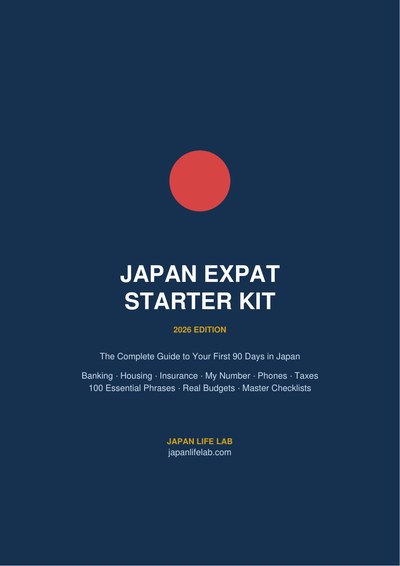
Japan Expat Starter Kit 2026 PDF guide
Your first 90 days in Japan, step by step: 17 chapters · 24 pages · 100 phrases in Japanese script · 40 kanji · printable checklists. Bank account, My Number, health insurance, apartment, phone, taxes & pension.
$9.99 $4.99 current price
📥 Get the kit →📄 Read 5 pages free: contents + Chapter 2
⚡ Instant PDF download · 🛡️ 30-day money-back guarantee · 🔄 Free 2026 updates
Practical guides for life and travel in Japan — free, about once a week. No spam, unsubscribe anytime.
☕ Enjoying our Japan guides?
If this article helped you, you can support our work with a coffee!
🇯🇵 Travel & Life Essentials for Japan
Hand-picked gear to make your time in Japan easier. Available on Amazon US & Amazon Japan.
🔋 Portable charger
A must for long days of sightseeing and photos.
View on Amazon (US)View on Amazon Japan🔌 Travel plug adapter
Japan uses Type A outlets. Bring the right adapter.
View on Amazon (US)View on Amazon Japan🎧 Translation earbuds
Real-time translation to talk without barriers.
View on Amazon (US)View on Amazon JapanAs an Amazon Associate, Japan Life Lab earns from qualifying purchases.
Did this guide help you? 🍵
Japan Life Lab is a small independent blog, and every guide we publish is completely free — no paywalls, ever. If our work saved you time (or a headache), you can support us with a cup of Japanese tea. Every contribution, big or small, goes straight into keeping these guides free, accurate and up to date for everyone.
☕ Support Japan Life Lab
Leave a Reply