This article was created with AI writing assistance (ChatGPT, Claude, etc.). Product selection, specifications, and reviews are verified by the Japan Life Lab editorial team.
This article contains promotional / affiliate links.
Japan’s rainy season — called Tsuyu (梅雨) — is one of the most misunderstood times to visit. Yes, it rains. But it’s also crowd-free, beautiful, and surprisingly affordable. This is your complete guide to Japan’s rainy season in June 2026.
🌧️ Tsuyu 2026 Quick Facts
- Tokyo, Osaka, Kyoto: Early June – mid-July
- Okinawa: Mid-May – late June
- Hokkaido: Usually rainy season-free
- Temperatures: 22–28°C — warm but comfortable
- Rain chance: ~40–60% — not all-day rain, just showers
⏱ The short answer (30 seconds)
In a hurry? The full reasons and prices are right below.
※ If in doubt, go with #1. Budget picks are further down the page.
What Is Tsuyu? The Real Picture
Tsuyu doesn’t mean constant rain. Most days bring light drizzle, intermittent showers, and misty mornings — not non-stop downpours. Think London weather, warmer, with better food. The humidity (70–85%) is the real challenge, but it’s manageable with the right clothing.
5 Reasons to Actually Visit Japan During Rainy Season
1. Dramatically Fewer Crowds
Fushimi Inari with 40% fewer tourists? Yes. Arashiyama bamboo grove in the mist? Genuinely stunning. Popular attractions are far more manageable during tsuyu than during Golden Week or autumn.
2. Lower Prices
Flights and hotels drop noticeably during rainy season. Ryokans that are fully booked in October often have availability. It’s one of Japan’s few true “value travel” windows.
3. Hydrangea Season at Its Peak
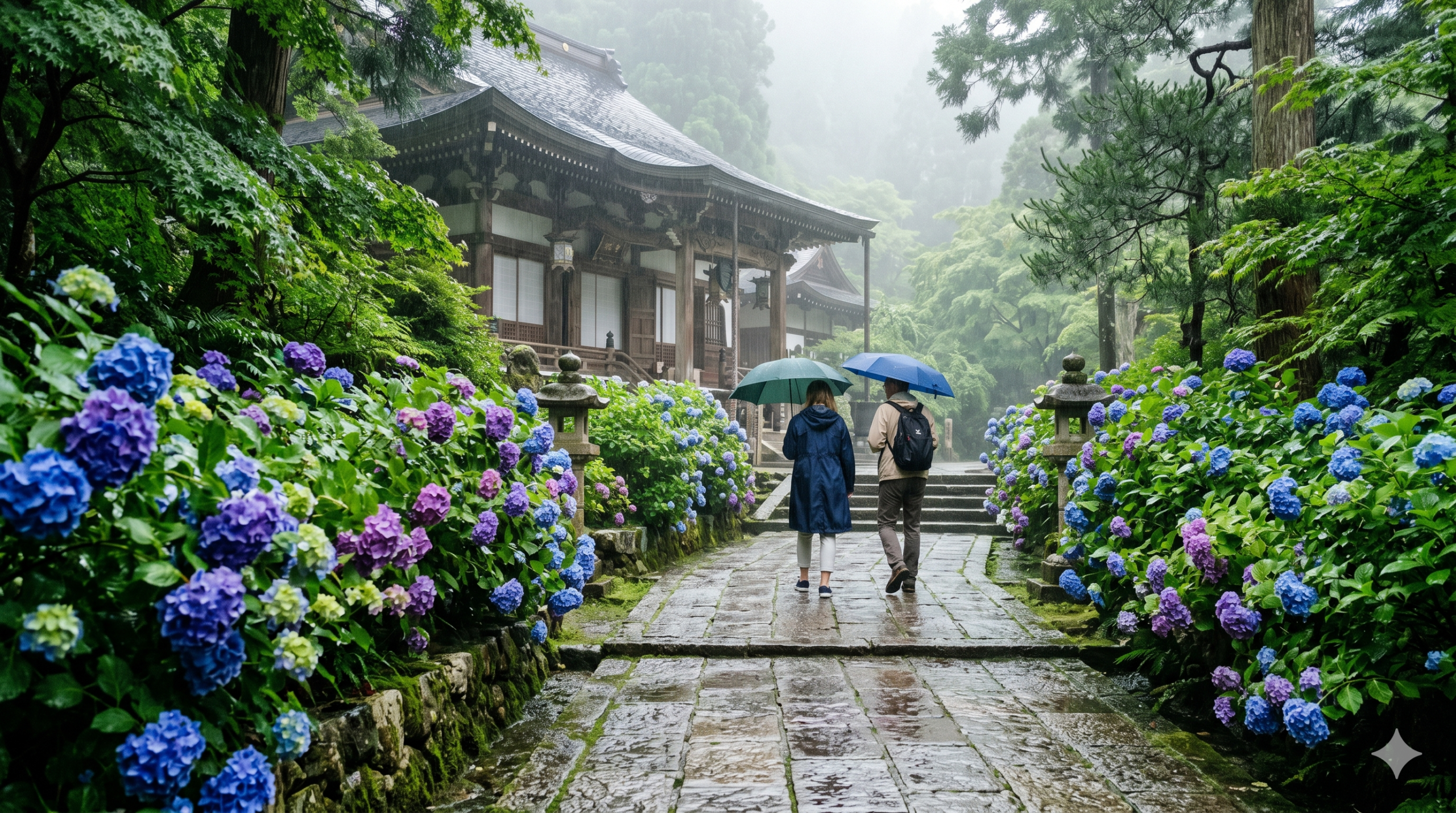
Hydrangeas (ajisai) bloom during tsuyu and they’re breathtaking. Top spots:
- Meigetsuin Temple, Kamakura — The “Hydrangea Temple,” 2,500 plants lining the paths
- Hakone — Hydrangeas with misty mountain backdrops
- Bunkyo Hydrangea Festival, Tokyo — Free June festival at Hakusan Shrine
- Nishi Park, Fukuoka — 250 varieties
4. Misty Temples Look Incredible
Kyoto in the mist is a photographer’s dream. Kurama and Kibune mountain villages, Philosopher’s Path, Sanjusangendo — all take on an otherworldly quality in rainy season light.
5. Onsen in the Rain
Outdoor hot spring baths (rotenburo) in misty rain is a once-in-a-lifetime sensory experience. The combination of warm water, cool air, and mist is uniquely Japanese.
What to Pack for Japan’s Rainy Season
☂️ Rainy Season Packing List
Waterproof shoes — Most important item. Wet socks ruin entire days. Waterproof sneakers or light boots are perfect.
Compact umbrella — Available at every konbini for ¥500–¥1,000 if you forget yours. Avoid large umbrellas on crowded streets.
Lightweight rain jacket — Packable, breathable, with a hood. Far better than a poncho.
Quick-dry clothing — Merino wool, linen, synthetics. Avoid heavy denim — it takes forever to dry.
Dehumidifying packets — For your bag and shoes. Available at Daiso (100-yen shop) everywhere in Japan.
Best Activities by City During Tsuyu
Tokyo
- teamLab Borderless/Planets — Digital art that’s even more atmospheric on rainy days
- Depachika basement food halls — Isetan Shinjuku, Mitsukoshi Ginza: world-class food shopping
- Yanaka district — Old-Tokyo neighborhood that looks incredible in the rain
- Tokyo National Museum — World-class Japanese art collection in Ueno Park
Kyoto
- Kurama and Kibune — Mountain temple villages that glow in the mist
- Sanjusangendo — Indoor hall of 1,001 warrior statues
- Nishiki Market — Covered arcade “Kyoto’s Kitchen”
Kamakura (Day Trip from Tokyo)
- Meigetsuin Temple — Arrive before 9am for the hydrangeas without crowds
- Engakuji Temple — Ancient Zen temple complex in the mist
Practical Survival Tips
Use Tokyo’s Underground Network
Tokyo’s underground shopping malls connect major train stations. In Shinjuku, you can travel between multiple stations completely sheltered from rain. Osaka’s Namba underground connects entire districts.
Check Hourly Weather Forecasts
Japanese weather apps are remarkably accurate. Use Yahoo!天気 (Yahoo! Weather Japan) or Weather News for hourly rainfall forecasts. Plan outdoor sightseeing for predicted dry windows — often morning or after 3pm.
The Konbini Umbrella Strategy
If you get caught in rain, buy a ¥700 convenience store umbrella. When done, leave it in the umbrella stand at a temple or station for the next person. Very Japanese.
Tsuyu 2026 Timeline by Region
| Region | Start | End |
|---|---|---|
| Okinawa | Mid-May | Late June |
| Kyushu/Shikoku | Late May–Early June | Mid-July |
| Kansai (Osaka, Kyoto) | Early June | Mid-July |
| Kanto (Tokyo) | Early June | Mid-July |
| Tohoku | Mid-June | Late July |
| Hokkaido | Usually rainy season-free ✅ | |
The Bottom Line
Japan’s rainy season rewards travelers who prepare. Come with waterproof shoes, a good rain jacket, and an open mind — and you’ll find June to be one of Japan’s most atmospheric and genuinely memorable travel experiences.
🗾 More Japan Travel Guides
🇯🇵 Travel & Life Essentials for Japan
Hand-picked gear to make your time in Japan easier. Available on Amazon US & Amazon Japan.
🔋 Portable charger
A must for long days of sightseeing and photos.
View on Amazon (US)View on Amazon Japan🔌 Travel plug adapter
Japan uses Type A outlets. Bring the right adapter.
View on Amazon (US)View on Amazon Japan🎧 Translation earbuds
Real-time translation to talk without barriers.
View on Amazon (US)View on Amazon JapanAs an Amazon Associate, Japan Life Lab earns from qualifying purchases.
🔥 Editor’s Picks for Life & Travel in Japan
📘 The Japan Expat Starter Kit 2026
Banking, housing, My Number, taxes, 100 phrases and a 40-kanji cheat sheet — everything from this site in one 17-chapter PDF field manual. Free lifetime 2026 updates.
Reader price: $9.99 $6.99 with code JLL30 at checkout
30-day money-back guarantee · Instant download · PR
Practical guides for life and travel in Japan — free, about once a week. No spam, unsubscribe anytime.
☕ Enjoying our Japan guides?
If this article helped you, you can support our work with a coffee!
Did this guide help you? 🍵
Japan Life Lab is a small independent blog, and every guide we publish is completely free — no paywalls, ever. If our work saved you time (or a headache), you can support us with a cup of Japanese tea. Every contribution, big or small, goes straight into keeping these guides free, accurate and up to date for everyone.
☕ Support Japan Life Lab
Leave a Reply