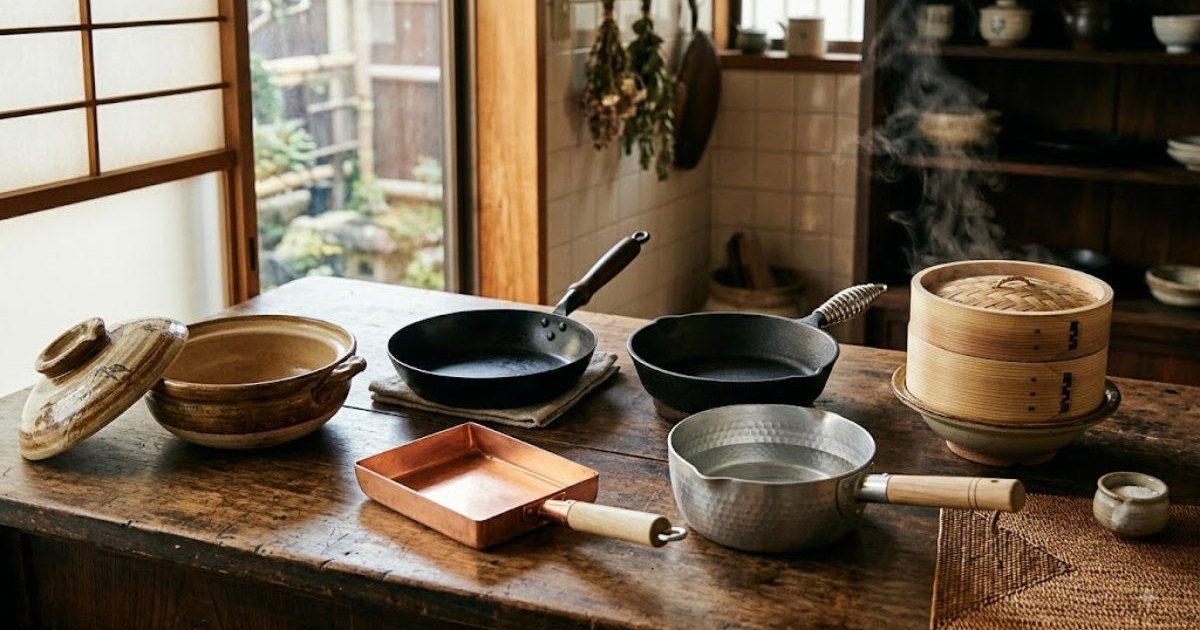
This article was created with AI writing assistance (ChatGPT, Claude, etc.). Product selection, specifications, and reviews are verified by the Japan Life Lab editorial team.
This article contains promotional / affiliate links.
Japanese knives get all the attention. But walk into any home kitchen in Japan and you will find something the knife obsessives rarely talk about: a clay pot that cooks rice better than a $400 machine, a carbon-steel pan that has outlived three generations, and a copper omelette pan that costs more than the stove it sits on.
Japanese cookware is built around a different premise than Western cookware. Where a Le Creuset is designed to be bought once and passed down, a Japanese donabe or iron pan is designed to be maintained — seasoned, dried, occasionally repaired — and that maintenance is understood as part of using it, not a chore attached to it. The tools are lighter, thinner, and more specialised, and they reward attention.
This guide covers ten pieces that are genuinely worth importing, with honest notes on what each one is difficult about. Every item listed is made in Japan and available internationally. It also covers the parts most buying guides skip: what the materials actually do, where each craft comes from, how to season and repair these things, what they cost to own over ten years, and how to get them shipped without the postage exceeding the pan. Prices are approximate and fluctuate with exchange rates and stock.
📌 What you will learn
You do not have to read it all — jump to what you need.
- How Japanese cookware differs — and why it matters before you buy
- The materials, explained
- Where these things are actually made
- The 10 best Japanese cookware pieces worth importing in 2026
- Comparison at a glance
- Care and maintenance, in detail
- The five mistakes that ruin Japanese cookware
※ Start wherever fits your situation.
How Japanese cookware differs — and why it matters before you buy
Thin and responsive, not thick and forgiving
Western pans tend to be thick, so they hold heat and forgive inattention. Japanese pans tend to be thin, so they respond instantly to a change in flame. This is a direct consequence of the cuisine: tempura needs oil temperature held within a narrow band, tamagoyaki needs heat you can back off in two seconds, and a stir-fry needs a pan that reheats the instant ingredients hit it.
The practical implication is that Japanese cookware is less forgiving on electric coil and some induction hobs where power changes lag. If you cook on gas, everything below will feel natural. If you are on induction, check compatibility per item — several are compatible, but not all.
Carbon steel and iron, not nonstick
Most Japanese frying pans are carbon steel or iron with no coating. They rust if you leave them wet. In exchange they take searing heat that would destroy a nonstick surface, they build their own release layer over time, and they last decades. The maintenance ritual is short: wash with hot water and a brush (soap is fine for modern nitrided pans), dry on the heat until no moisture remains, and store dry.
If the idea of a pan that needs drying on the stove sounds like too much, be honest with yourself about that now. A rusted, resented iron pan helps no one.
Clay that stores heat and finishes cooking off the flame
The donabe is the opposite of the thin pan — porous clay that heats slowly, holds heat enormously, and continues cooking after the burner is off. Iga clay in particular, from the Mie region, is fired from an ancient lakebed deposit whose fossilised organic matter burns out to leave a porous body that withstands direct flame. That porosity is why donabe cook rice so well and why they crack if you shock them with cold water while hot.
Specialisation over versatility
A Western kitchen aims for a small number of pans that do everything acceptably. A Japanese kitchen accepts a larger number of tools that each do one thing extremely well. The rectangular tamagoyaki pan makes exactly one dish. The yukihira saucepan is optimised for dashi and blanching, not braising. This is not inefficiency — it is a different trade. Each tool is cheap and light enough that owning several is reasonable, and because each is simple, each lasts.
The practical consequence for a buyer outside Japan is that you should not try to replace your whole kitchen. Pick the two or three pieces that match what you actually cook most often, and leave the rest.
The materials, explained
Almost every decision below comes down to one property: how fast the material moves heat. Thermal conductivity is measured in watts per metre-kelvin (W/m·K), and the spread across these materials is enormous.
| Material | Relative heat conduction | Heat retention | What it is good at | What it is bad at |
|---|---|---|---|---|
| Copper | Highest of the group | Low | Perfectly even surface, instant response | Reacts with acid, needs tin lining, expensive |
| Aluminium | Very high | Low | Fast boiling, instant response, very light | Poor retention, soft, reacts with strong acid |
| Carbon steel | Moderate | Moderate | Searing, stir-frying, building a seasoning layer | Rusts if stored damp |
| Cast iron | Moderate but very thick | Very high | Sustained searing, oven-to-table | Heavy, slow to preheat |
| Clay (Iga / Banko) | Very low | Extremely high | Rice, hotpot, finishing off the flame | Fragile, cracks from thermal shock |
| Bamboo | n/a (steam) | n/a | Absorbing condensation while steaming | Mould if stored damp, no soap |
Why copper is used for exactly one thing
Copper conducts heat several times faster than iron. In a thin pan that produces a surface with no measurable hot spots. For tamagoyaki — thin egg layers cooked in sequence, where a single hot patch browns one strip and ruins the roll — that uniformity is the whole point. For almost everything else it is overkill, and the tin lining that makes copper food-safe is soft enough that it becomes a liability. Hence one copper pan in a Japanese kitchen, not a set.
Why nitriding changed carbon steel
Traditional carbon steel is iron with a little carbon, and untreated iron oxidises the moment it meets water and air. Nitriding diffuses nitrogen into the surface layer at high temperature, forming a hard iron-nitride skin. The result is metal that behaves like carbon steel thermally — thin, responsive, high-heat tolerant — but resists rust far better and tolerates detergent. This single process is why a Japanese iron pan is now a realistic purchase for someone who has never owned one.
Why clay behaves like a second cook
Clay conducts heat very slowly and stores a great deal of it. Put a donabe on a flame and the pot itself becomes a heat battery. Turn the flame off and the contents keep cooking at a gently falling temperature for fifteen to twenty minutes. That is exactly the profile rice wants: a hard boil, then a long declining rest that lets the starch finish gelatinising and the grains equalise moisture. An electric cooker simulates this curve with a thermostat. A donabe simply is the curve.
Why bamboo beats metal for steaming
In a metal steamer, water vapour condenses on the cold underside of the lid, gathers into drops and falls back onto the food. This is why steamed buns from a metal steamer often have a soggy patch on top. Bamboo is porous and hygroscopic: the woven lid absorbs the condensate instead of returning it. The difference is not subtle — it is the difference between a bun with a dry, springy surface and one with a wet stripe across it.
Where these things are actually made
Almost every item here comes from a region that has been making that one category of object for centuries, often with formal designation as a traditional craft. Knowing the place names makes it much easier to tell a real product from a generic import with Japanese branding.
| Iga, Mie Prefecture | Iga-yaki clay, quarried from an ancient lakebed. Highly porous and heat-resistant; the material for rice donabe including Nagatani-en’s Kamado-san. |
|---|---|
| Yokkaichi, Mie Prefecture | Banko-yaki, a designated traditional craft. Its lithium-bearing clay resists thermal expansion, making it the standard body for nabe hotpots and kyusu teapots. |
| Morioka and Oshu, Iwate Prefecture | Nambu tekki cast iron, produced since the 17th century. Skillets, sukiyaki pans and tetsubin kettles, often finished with the pebbled arare surface. |
| Tsubame-Sanjo, Niigata Prefecture | Japan’s metalworking capital — cutlery, hand tools and pressed metalware. River Light’s nitrided iron pans come from this region. |
| Osaka | Aluminium and copper hollowware for the professional trade, including Nakao Alumi’s yukihira saucepans. |
| Tokyo (Taito / Kappabashi) | Copperware workshops such as Nakamura Douki supplying restaurant kitchens; Kappabashi is the street where professionals buy. |
| Sakai, Osaka Prefecture | Forged knives; historically the tobacco-knife trade that became the blade industry supplying Japanese professional kitchens. |
| Mino, Gifu Prefecture | Mino-yaki ceramics, the largest pottery production area in Japan, and the usual source of suribachi grinding bowls. |
If a listing does not tell you where the item was made, that is itself information. Genuine makers put the region on the box, because the region is the selling point.
The 10 best Japanese cookware pieces worth importing in 2026
1. River Light Kiwame — the iron frying pan that does not rust easily
River Light is a small manufacturer in Niigata that solved the single biggest objection to iron pans. Their Kiwame line uses nitriding — a heat treatment that diffuses nitrogen into the surface of the steel — producing a pan that is dramatically more rust-resistant than plain carbon steel while keeping the thin, responsive character that makes iron worth cooking on.
What this means in daily use: you can wash it with soap, you do not need to oil it after every wash, and if you forget it in the sink overnight it will probably be fine. Traditional carbon steel forgives none of that. The pan still needs to be dried properly and it still builds a seasoning layer over months, but the maintenance floor is much lower.
The pans are light for their class — noticeably lighter than cast iron of the same diameter — which matters if you actually toss food. Sizes run from about 20cm up to 30cm+, and there are both flat frying pans and wok-shaped versions. For a first purchase, 24cm or 26cm covers most home cooking. The handle is wood on the standard line, which stays cool but means you cannot put it in the oven above modest temperatures.
One habit worth forming: heat the empty pan for thirty seconds or so before adding oil, then add the oil and let it shimmer before the food goes in. Iron releases food far better from a properly preheated surface than from a cold one, and most complaints about sticking trace back to skipping this step.
| Material | Nitrided carbon steel, made in Japan |
|---|---|
| Typical sizes | 20cm / 24cm / 26cm / 28cm / 30cm, flat and wok shapes |
| Induction | Compatible |
| Coating | None — builds natural seasoning |
| Maintenance | Wash, dry thoroughly on heat, store dry. Soap is acceptable |
| Approximate price | $60–$130 depending on size |
✅ What works
- Nitriding makes it far more rust-resistant than ordinary carbon steel
- Light enough to toss food comfortably, unlike cast iron
- Takes very high heat — proper searing, wok hei on a home burner
- No coating to wear out; with care this outlasts you
- Induction compatible
- Soap-safe, which removes the main daily friction of iron pans
⚠️ What to know
- Still needs to be dried on the heat — leaving it wet will eventually cause rust
- The wooden handle limits oven use
- Takes a few months of cooking before release performance peaks
- Highly acidic dishes (long tomato simmers) are best cooked elsewhere
2. Nagatani-en Kamado-san — the donabe that beats an electric rice cooker
This is the item people are most sceptical about and most converted by. Kamado-san is a double-lidded Iga-clay rice donabe made by Nagatani-en, a pottery founded in 1832 in Iga, Mie Prefecture. It cooks rice on a gas burner in roughly 20 minutes including the rest, and the result has a texture and aroma that mid-range electric cookers do not reproduce — separate grains, a faint sweetness, and if you want it, a crisp okoge layer at the bottom.
The mechanism is not mystical. The thick porous clay holds a large amount of heat and releases it slowly, so the rice finishes cooking after the flame is off. The double lid traps steam and raises internal pressure slightly. Because the pot retains heat so well, the procedure is genuinely simple: soak the rice, bring to a boil on medium, cook a fixed number of minutes, turn off, rest 20 minutes. No stirring, no judgement calls.
Sizes are given in gō, the traditional Japanese rice measure of about 180ml. The CT-50 handles roughly 5 gō (about 5 rice-cooker cups) and suits a family; a 2–3 gō model suits one or two people. Buy for the amount you actually cook — donabe work best when reasonably full.
The real caution is fragility. Clay cracks from thermal shock. Never put a hot donabe on a cold wet surface, never pour cold water into it while hot, and never heat it empty. Handled sensibly, they last for decades; handled carelessly, one mistake ends it.
| Material | Iga clay (Iga-yaki), made in Japan |
|---|---|
| Model | CT-50 approx. 5 gō; smaller sizes available |
| Hob | Direct gas flame. Not induction. Heat diffuser needed on electric — check manufacturer guidance |
| Cook time | About 20 minutes plus 20 minutes rest |
| Care | Dry completely before storing. Never heat empty or shock with cold water |
| Approximate price | $110–$200 depending on size |
✅ What works
- Rice quality genuinely exceeds most electric cookers under $300
- No electricity, no electronics to fail
- Fixed, repeatable procedure — no skill required after the first try
- Doubles as a serving vessel; keeps rice warm at the table
- Optional crisp okoge layer, which electric cookers cannot make
- Iga clay is fired for direct flame, unlike ordinary earthenware
⚠️ What to know
- Fragile — thermal shock cracks it and that damage is terminal
- Not induction compatible; electric hobs need a diffuser and may not be recommended
- Must be fully dried before storage or it can develop mildew smell
- Heavy, and shipping cost reflects that
- You have to be present for the 20 minutes; no timer, no keep-warm
3. Ginpo Hanamishima donabe — the winter hotpot standard
If Kamado-san is the specialist, the Ginpo Hanamishima is the generalist. This is the donabe you see in Japanese homes every winter: a wide, shallow, glazed clay pot with the distinctive blue-grey mishima pattern, used for nabe — the communal simmered hotpot that anchors the Japanese cold season.
Ginpo Toki is based in Yokkaichi, Mie Prefecture, in the Banko-yaki pottery tradition. Banko clay contains a high proportion of lithium-bearing petalite, which gives it strong resistance to thermal expansion — the technical reason these pots survive repeated direct-flame use.
A nabe pot is a different proposition from a Western Dutch oven. It is wider and shallower so ingredients cook in a single visible layer and everyone can reach in with chopsticks. It goes from the burner to a portable gas ring in the middle of the table, and the food keeps cooking as you eat. Beyond nabe it handles soups, braises, and steamed dishes, and the wide surface is genuinely useful for anything you want to reduce.
Sizes are numbered in gō of pot diameter. Roughly: size 8 (about 25cm) serves 2–3, size 9 serves 3–4, size 10 serves 4–5. As with all donabe, buy for typical use rather than maximum use.
| Material | Banko-yaki clay (Yokkaichi, Mie), made in Japan |
|---|---|
| Typical sizes | No. 8 (~25cm, 2–3 people) to No. 10 (~31cm, 4–5 people) |
| Hob | Direct gas flame. Not induction unless specified |
| Best for | Nabe hotpot, soups, braises, steaming |
| Care | Season with rice porridge before first use if instructed; dry fully before storage |
| Approximate price | $50–$110 depending on size |
✅ What works
- Purpose-built for communal hotpot — the shape genuinely matters
- Banko clay resists thermal expansion, so it tolerates direct flame well
- Retains heat at the table long after the burner is off
- Much cheaper than a comparable cast-iron Dutch oven
- Beautiful enough to serve from directly
- Versatile beyond nabe: soups, braises, steamed dishes
⚠️ What to know
- Same thermal-shock fragility as all clay pots
- Not induction compatible in the standard version
- The glaze can craze over years — cosmetic, but it happens
- Needs full drying before storage
- Bulky to store
4. Iwachu Nambu tekki cast iron — 400 years of ironwork from Morioka
Nambu tekki is the cast ironware of Iwate Prefecture, produced in Morioka and Oshu since the 17th century. Iwachu, founded in 1902, is the best-known maker exporting internationally. The range covers skillets, small frying pans, sukiyaki pans, and the iconic tetsubin kettles.
Two things distinguish Nambu tekki from Western cast iron. First, the surface finish: rather than a rough sand-cast texture, Nambu pieces are often finished with a fine pebbled or line-carved surface — arare — which is decorative but also increases surface area for heat transfer. Second, many pieces are treated with a traditional oxidised finish rather than a modern enamel or pre-seasoning, giving them a matte black character that develops with use.
For cooking, the small skillets are the sweet spot for import. They go from hob to oven to table, hold heat superbly for searing, and are sized sensibly for one or two portions — gyoza, a steak, a baked egg dish. A Nambu sukiyaki pan is the traditional vessel for that dish and works equally well for any tabletop braise.
The tetsubin kettles are a separate category worth mentioning: unlined iron kettles used to boil water for tea, which impart a trace of iron and are said to soften the water. Note the distinction — a tetsubin is unlined and for the stove; an enamel-lined iron teapot is for steeping tea and must not be put on a flame. Confusing the two ruins the pot.
| Material | Cast iron, Nambu tekki tradition, made in Iwate, Japan |
|---|---|
| Range | Skillets, frying pans, sukiyaki pans, tetsubin kettles |
| Induction | Compatible (cookware). Confirm per item |
| Oven | Yes for cookware pieces |
| Care | Dry on the heat after washing; a light oiling extends life |
| Approximate price | $50–$250 depending on piece |
✅ What works
- Exceptional heat retention — the best searing surface here
- Hob to oven to table in one vessel
- Four centuries of production tradition behind the design
- Induction compatible
- Genuinely a lifetime object
- The arare surface finish is beautiful in a way mass-market cast iron is not
⚠️ What to know
- Heavy — and international shipping on cast iron is expensive
- Rusts if stored damp
- Slow to heat up compared with the thin steel pans here
- Unlined tetsubin need specific care and are not for steeping tea
- Enamelled teapots must never go on a flame
5. Nakamura Douki copper tamagoyaki pan — the professional's omelette pan
This is the most specialised item on the list and the one that most rewards a specific obsession. Tamagoyaki — the layered rolled Japanese omelette found in bento boxes and at sushi counters — is made in a rectangular pan, and the copper version is what sushi chefs use.
Copper conducts heat several times faster than iron, and the practical consequence is that the pan surface is uniform. There are no hot spots. For a dish that is nothing but thin layers of egg cooked in sequence, that uniformity is the entire game: the egg sets evenly, does not brown unevenly, and the finished roll has the soft, custardy texture that is nearly impossible to achieve in a thin steel pan.
Nakamura Douki is a Tokyo copperware workshop supplying professional kitchens. Their tamagoyaki pans are tin-lined on the interior — copper reacts with acidic food, so the tin layer is the actual cooking surface. That tin layer is the pan's one real vulnerability: it is soft, it can be scratched by metal utensils, and over many years of hard use it wears and needs re-tinning. Use wooden or bamboo chopsticks, keep the heat moderate, and it will last a very long time.
Rectangular pans come in Kanto (square) and Kansai (longer rectangle) shapes. Either works; the Kanto shape is more common outside Japan. This is not a pan to buy unless you intend to make tamagoyaki regularly — but if you do, nothing else comes close.
| Material | Copper body with tin-lined interior, made in Japan |
|---|---|
| Shapes | Kanto (square) and Kansai (rectangular) |
| Induction | Not compatible — gas only |
| Utensils | Wood or bamboo only; metal scratches the tin lining |
| Heat | Moderate. High heat can damage the tin lining |
| Approximate price | $120–$300 depending on size |
✅ What works
- Copper gives near-perfect heat uniformity — no hot spots at all
- Produces the soft, layered tamagoyaki texture steel pans cannot match
- What professional sushi kitchens actually use
- Responds instantly to heat changes
- Handmade by a specialist Tokyo workshop
- Ages beautifully as the copper patinates
⚠️ What to know
- Expensive for a single-purpose pan
- Not induction compatible
- The tin lining is soft and can be damaged by metal utensils or excessive heat
- Requires re-tinning after years of heavy use
- Copper exterior tarnishes and needs polishing to stay bright
- Truly single-purpose — it does one thing
6. Nakao Alumi yukihira saucepan — the pan every Japanese kitchen has
The yukihira nabe is the workhorse of the Japanese kitchen and almost unknown outside it. It is a light aluminium saucepan with a hammered, dimpled surface, a pouring lip, and usually a wooden handle. Nakao Alumi, based in Osaka, is the standard maker.
The hammered surface is not decoration. The dimples increase the surface area in contact with the flame, which speeds heating, and they add rigidity to a thin-walled pan. Combined with aluminium's conductivity, the result is a pot that boils water remarkably fast and, more importantly, responds instantly when you turn the heat down — which is exactly what you need when simmering dashi, blanching vegetables, or cooking anything that must not go past a gentle simmer.
It is astonishingly light. A 18cm yukihira weighs a fraction of an equivalent stainless pan, which makes one-handed pouring natural — hence the lip. For miso soup, dashi, boiling noodles, blanching greens, or reheating anything, this is the pot you reach for daily.
Nakao make both plain aluminium and anodised versions. The anodised surface is harder and more stain-resistant; plain aluminium is lighter and cheaper but will discolour over time, which is cosmetic. Neither is induction compatible unless the model specifically has a magnetic base plate.
| Material | Aluminium, hammered finish, made in Japan |
|---|---|
| Typical sizes | 15cm / 18cm / 21cm / 24cm |
| Induction | Standard versions are not compatible; check for IH-specific models |
| Feature | Pouring lip, wooden handle, hammered dimpled surface |
| Best for | Dashi, miso soup, blanching, boiling noodles, everyday reheating |
| Approximate price | $30–$70 depending on size |
✅ What works
- Extremely light — comfortable to pour with one hand
- Heats and cools almost instantly, ideal for delicate simmering
- The pouring lip is genuinely useful and rare on Western pans
- Inexpensive relative to everything else here
- The single most-used pot in a Japanese kitchen
- Hammered surface adds rigidity and speeds heating
⚠️ What to know
- Not induction compatible in standard form
- Plain aluminium discolours with use — cosmetic only
- Thin walls mean poor heat retention; not for long slow braises
- Wooden handles are not oven-safe
- Aluminium can react with very acidic ingredients over long cooking
7. Bamboo seiro steamer — steaming, done properly
A seiro is a stacked bamboo or cedar steamer that sits over a pot of boiling water. It does what a metal steamer does, but better, for one physical reason: bamboo absorbs condensation. In a metal steamer, water condenses on the underside of the lid and drips back onto the food, making buns soggy and fish waterlogged. Bamboo wicks that moisture into the woven lid instead.
Beyond that, it is simply the best way to reheat food. Yesterday's rice, dumplings, buns, cold chicken, leftover vegetables — five minutes in a seiro restores texture in a way a microwave fundamentally cannot, because steam rehydrates rather than driving moisture out.
Buy a diameter that fits comfortably over one of your existing pots, or buy a matching steamer ring. Two tiers is the practical minimum since the whole point is cooking two things at once. Line each tier with a perforated paper liner or a cabbage leaf to stop food sticking and to keep the bamboo clean.
Maintenance is straightforward: rinse, never soak, never use soap, and air-dry completely before storing. Bamboo left damp will mildew. Stored dry, a good seiro lasts many years, and the bamboo darkens attractively with use.
| Material | Bamboo or cedar, woven lid, made in Japan |
|---|---|
| Typical sizes | 21cm / 24cm / 27cm diameter |
| Setup | Sits over a pot of boiling water, or on a matching steamer ring |
| Best for | Dumplings, buns, fish, vegetables, and reheating leftovers |
| Care | Rinse only, no soap, no soaking, air-dry completely |
| Approximate price | $35–$90 depending on size and tiers |
✅ What works
- Bamboo absorbs condensation, so nothing gets soggy
- The best method for reheating rice, dumplings and buns
- Stackable — cook two or three things at once
- Serve directly from the steamer
- No electricity, no moving parts
- Inexpensive and lasts years with basic care
⚠️ What to know
- Must be fully air-dried or it will mildew
- No soap, which means burnt-on residue is hard to remove
- Needs a pot of matching diameter or a steamer ring
- Bamboo scorches if the pot boils dry
- Bulky to store
- Not dishwasher safe under any circumstances
8. Suribachi and surikogi — the grinding bowl that is not a mortar and pestle
A suribachi looks like a mortar but works on a different principle. The interior is carved with fine radial ridges called kushime, and the surikogi pestle is used with a grinding, circular motion rather than a pounding one. The ridges do the work; you supply rotation, not force.
The result is a texture no blender reproduces. Ground sesame from a suribachi is oily, aromatic and slightly coarse — the seeds release their oil under pressure rather than being shattered by a blade. Goma-ae dressing, tofu dressings, tororo, miso-based sauces and small batches of spice paste all come out with a body that a food processor flattens. It also works at quantities too small for any machine to handle, which is most home cooking.
Most suribachi are Mino-yaki from Gifu Prefecture, the largest ceramic production region in Japan. Sizes are given by rim diameter; roughly 12–15cm suits dressings and small batches, 18–21cm handles family quantities and doubles as a serving bowl. Look for a version with a pouring spout if you make dressings often, and for a wooden pestle in sanshō (Japanese pepper wood) if you want the traditional article — it is slightly aromatic and pleasant in the hand.
Cleaning is the one nuisance. Food lodges in the ridges, and a brush is required; a dedicated stiff-bristled brush costs very little and makes the difference between using it and avoiding it. Do not put it in a dishwasher: the ridges trap detergent residue.
| Material | Glazed ceramic bowl (usually Mino-yaki) with a wooden pestle |
|---|---|
| Typical sizes | 12cm–21cm rim diameter |
| Best for | Sesame, goma-ae dressings, tofu dressings, miso sauces, small spice batches |
| Not for | Large volumes, hard whole spices in quantity, anything you want perfectly smooth |
| Care | Brush out the ridges by hand; not dishwasher safe |
| Approximate price | $25–$70 |
✅ What works
- Produces a texture blenders cannot — oily, aromatic ground sesame
- Works at tiny quantities where machines are useless
- Doubles as a serving bowl for the dressing you just made
- No electricity, nothing to break
- Cheap relative to the difference it makes
- A large one is genuinely attractive on a table
⚠️ What to know
- The ridges trap food and need brushing out
- Not dishwasher safe
- Slow for large quantities
- Ceramic — it chips if knocked against a hard edge
- Cheap imports often have shallow ridges that do not grind properly
9. Takoyaki pan — the one that turns cooking into an event
A takoyaki pan is a plate of hemispherical wells, in cast iron or aluminium, used to make the spherical octopus dumplings of Osaka street food. It is unapologetically a single-purpose object and it is on this list because of what it does socially rather than technically: it turns dinner into something everyone stands around and participates in.
Mechanically it is simple. Batter fills the wells and spills over, and you use skewers to cut, turn and consolidate each ball as it sets — a quarter turn at a time until the sphere closes. Cast iron versions hold heat better and give a crisper shell; aluminium versions heat faster and are much lighter. Both work; cast iron is the better cooking surface, aluminium the better first purchase.
Beyond takoyaki, the same pan makes ebiyaki (shrimp), cheese balls, small aebleskiver-style pancakes and poffertjes. If you have children, this is the piece of cookware they will remember.
Two practical notes. First, check the burner fit: a 16- or 18-well pan needs a burner wide enough to heat the middle and the edges evenly, and on a small ring the outer wells will lag. Second, buy a set of takoyaki picks — chopsticks work but badly, and the metal picks are a couple of dollars.
| Material | Cast iron or aluminium, made in Japan |
|---|---|
| Typical sizes | 12, 16 or 18 wells |
| Hob | Gas is ideal; cast iron versions are usually induction compatible |
| Also makes | Ebiyaki, cheese balls, aebleskiver, poffertjes |
| Needs | Takoyaki picks or metal skewers |
| Approximate price | $35–$120 depending on material and size |
✅ What works
- Turns a meal into a shared activity — the real reason to own one
- Cast iron versions give a genuinely crisp shell
- Cheap relative to the entertainment value
- Works for several other small round foods
- Cast iron versions are usually induction compatible
- Nothing else produces the crisp-outside, molten-inside texture
⚠️ What to know
- Single purpose in practice
- Needs a burner wide enough to heat all wells evenly
- Cast iron versions are heavy and rust if stored damp
- Requires picks or skewers — chopsticks are frustrating
- The first batch is always bad; expect a learning curve
10. Konro / shichirin tabletop grill — binchotan cooking at the table
A shichirin or konro is a small tabletop charcoal grill, traditionally made from diatomaceous earth (keisodo) quarried in Noto, Ishikawa Prefecture. The material is extraordinarily insulating — the outside stays touchable while the inside runs at grilling temperature — which is why a heavy ceramic box can sit on a wooden table with nothing more than a trivet under it.
The reason to own one is binchotan, the dense white charcoal that burns almost without smoke or smell and produces intense radiant heat. Yakitori, skewered vegetables, small fish, mushrooms, scallops and thin-sliced beef cook in a minute or two, and the flavour is genuinely different from a gas grill because the heat is radiant rather than convective and the fat that drips vaporises against the coals.
Sizes range from a single-person box about 25cm long up to family-sized. The long narrow shape is designed for skewers, which rest on the rims rather than on a grate. Some models include a metal grill grate for non-skewered food.
Be realistic about the constraints. This is charcoal: it must be used with ventilation, ideally outdoors or under a strong extractor, and it needs a charcoal starter or a gas burner to light. It is also fragile — diatomaceous earth is soft and cracks if dropped or shocked with water. Handled carefully it lasts for many years, and it is one of the very few pieces of cookware that changes what a meal feels like.
| Material | Diatomaceous earth (keisodo), often from Noto, Ishikawa |
|---|---|
| Fuel | Binchotan or ordinary lump charcoal |
| Typical sizes | About 25cm (1–2 people) up to 50cm+ (family) |
| Ventilation | Essential. Outdoors or under a powerful extractor |
| Care | Keep dry; the body is soft and cracks if shocked or dropped |
| Approximate price | $70–$200 plus charcoal and a starter |
✅ What works
- Radiant charcoal heat gives a flavour gas cannot reproduce
- Diatomaceous earth insulates so well the grill can sit on a table
- Purpose-shaped for skewers — yakitori at home actually works
- Turns dinner into a shared, slow, sociable meal
- Binchotan burns almost smokeless
- No electricity, no moving parts
⚠️ What to know
- Charcoal — requires real ventilation and cannot be used in a closed room
- Needs a charcoal starter or gas burner to light
- The body is soft and cracks if dropped or splashed while hot
- Binchotan is expensive and can be hard to source outside Japan
- Heavy and awkward to ship
- Ash cleanup after every use
Comparison at a glance
| Item | Material | Induction | Best for | Approx. price | Care level |
|---|---|---|---|---|---|
| River Light Kiwame | Nitrided carbon steel | Yes | Searing, stir-fry, everyday frying | $60–$130 | Low–medium |
| Nagatani-en Kamado-san | Iga clay | No | Rice | $110–$200 | Medium |
| Ginpo Hanamishima | Banko clay | No | Hotpot, soups, braises | $50–$110 | Medium |
| Iwachu Nambu tekki | Cast iron | Yes | Searing, oven-to-table | $50–$250 | Medium |
| Nakamura Douki copper | Tin-lined copper | No | Tamagoyaki | $120–$300 | High |
| Nakao Alumi yukihira | Aluminium | No* | Dashi, soup, blanching | $30–$70 | Low |
| Bamboo seiro | Bamboo | n/a | Steaming, reheating | $35–$90 | Medium |
| Suribachi & surikogi | Ceramic + wood | n/a | Sesame, dressings, small pastes | $25–$70 | Low–medium |
| Takoyaki pan | Cast iron / aluminium | Usually (iron) | Takoyaki and round snacks | $35–$120 | Medium |
| Konro / shichirin | Diatomaceous earth | n/a | Charcoal grilling at the table | $70–$200 | Medium |
*IH-specific yukihira models exist; the standard aluminium version is not induction compatible.
Care and maintenance, in detail
This is the section that decides whether these objects last thirty years or three months. None of it is difficult, but all of it is specific.
Seasoning a new iron or carbon steel pan
Most Japanese iron pans arrive with a thin protective coating that must be removed, and then need an initial seasoning. The usual sequence, and you should follow the maker's instructions where they differ:
🔥 First use, step by step
- 1. Wash with hot water and a brush to remove the shipping coating. Some makers say to heat the empty pan first to burn it off — follow their guidance, and ventilate.
- 2. Dry the pan on the burner until no moisture remains and it is too hot to touch.
- 3. Add a generous amount of neutral oil and heat until it just begins to smoke, swirling to coat the sides.
- 4. Some traditions fry vegetable scraps in that oil for a few minutes — the plant matter helps carry oil into the surface and removes any residual metallic smell.
- 5. Discard the oil, wipe out with paper, and cook something fatty for the first few meals — bacon, chicken skin, fried rice.
- 6. Avoid acidic or watery dishes for the first few weeks; they strip the immature layer.
The seasoning layer is polymerised oil, not a coating you apply once. It builds gradually over dozens of meals. A pan that looks patchy at month one will be uniformly dark at month six if you keep cooking in it.
Daily washing
Hot water and a brush, immediately after cooking while the pan is still warm. Most residue lifts without any detergent. For nitrided pans such as River Light's Kiwame, mild detergent is explicitly fine. For untreated carbon steel, many cooks avoid soap purely out of habit — modern dish soap will not destroy a mature seasoning layer, but it will slow the early build-up.
Then the step that actually matters: dry it on the heat. Put the washed pan back on the burner for thirty to sixty seconds until every trace of water has evaporated. This single habit prevents almost all rust.
Removing rust
Rust is not fatal. Scrub the affected area with a stainless scourer or fine steel wool until you are back to bare metal, wash, dry on the heat, and re-season with oil as above. Expect to repeat the seasoning process over the following few meals. Only deep pitting is permanent, and that takes serious neglect.
Preparing a new donabe
Many donabe makers recommend a process called medome before first use: cooking a thin rice porridge (or a starch slurry) in the pot so that the starch penetrates and seals the microscopic pores in the clay. This reduces the chance of the pot absorbing liquid and cracking, and reduces smells transferring between dishes.
Requirements differ between Iga and Banko clay and between makers, so follow the instructions supplied with your specific pot. Repeat the process if the pot has been unused for a long time or has developed a smell.
The three things that crack a donabe
⚠️ Do not do these
- Heating it empty. Clay needs the thermal mass of its contents. An empty donabe on a flame can crack in under a minute.
- Putting a hot pot on a cold wet surface. Use a wooden trivet, never a wet stone counter or a metal rack you have just rinsed.
- Putting the pot away damp. Porous clay holds water. Trapped moisture causes mildew smell and, if the pot is heated before it has dried, internal steam pressure that cracks it.
Copper and its tin lining
The tin lining inside a copper pan melts at a much lower temperature than copper itself, so the pan must never be heated empty or left over a high flame. Use wooden or bamboo utensils only; metal chopsticks will score the tin. Over years of heavy use the tin thins and the copper begins to show through — at that point the pan needs re-tinning, a service offered by specialist workshops. For a home cook using the pan a few times a week, that point is many years away.
The exterior tarnishes to a dull brown. This is purely cosmetic; a copper polish or a paste of salt, flour and vinegar restores the shine if you care about it.
Bamboo steamers and mould
The rules are short: rinse under hot running water, never soak, never use detergent, and air-dry completely, ideally somewhere with moving air. Store it out of a closed cupboard until you are certain it is dry. A seiro that develops mould can sometimes be saved by scrubbing with a paste of baking soda and drying it in strong sun, but prevention is far easier than rescue.
Storage in general
Iron and steel: dry, not stacked wet, ideally hanging. Clay: fully dry, lid stored separately or with a folded cloth between lid and rim so air can circulate. Copper: dry, away from anything that will scratch the tin. Bamboo: dry and ventilated. None of these belong in a dishwasher, and none belong in a damp cupboard under a sink.
The five mistakes that ruin Japanese cookware
Nearly every failure reported by first-time buyers comes down to one of these.
1. Buying for the hob you wish you had
The single most common expensive error. Donabe and copper are gas-only. If your kitchen is induction, you are choosing between the iron and steel items and a very short list of purpose-built IH donabe. Check first, every time.
2. Treating an iron pan like a nonstick pan
Iron needs preheating. Food added to a cold iron pan sticks, the cook concludes the pan is faulty, and the pan ends up in a cupboard. Heat the pan, then the oil, then the food.
3. Putting anything on this list in a dishwasher
A dishwasher will rust iron, strip a seasoning layer, dull and pit a tin lining, saturate clay, and destroy bamboo. There is no exception on this list.
4. Storing damp
Rust on iron, mildew in clay, mould in bamboo. Every one of these is a storage problem, not a cooking problem, and every one is prevented by the same thirty seconds of drying.
5. Buying the biggest size
Donabe work best when reasonably full — an oversized pot with a small amount of food heats unevenly and holds heat badly. The same is true of a takoyaki pan on a burner too small for it. Buy for your normal meal, not for the largest dinner party you might one day host.
What these actually cost to own over ten years
Comparing a $110 clay pot to a $60 electric rice cooker looks unfavourable until you count replacements and electricity. Rough ten-year figures, assuming ordinary home use:
| Purchase | Up-front | Replacements in 10 years | Running cost | Rough 10-year total |
|---|---|---|---|---|
| Kamado-san donabe | $110–$200 | 0 if handled carefully | Gas only | $110–$200 |
| Mid-range electric rice cooker | $80–$150 | 1–2 (electronics fail) | Electricity + keep-warm | $200–$400 |
| River Light Kiwame | $60–$130 | 0 | None | $60–$130 |
| Nonstick frying pan | $25–$60 each | 5–10 (coating wears out) | None | $150–$500 |
| Bamboo seiro | $35–$90 | 0–1 | None | $35–$150 |
| Ginpo donabe | $50–$110 | 0 if handled carefully | Gas only | $50–$110 |
The pattern is consistent: the Japanese items cost more once and then stop costing anything, while their Western equivalents are cheaper once and then keep costing. The exception is the copper tamagoyaki pan, which is genuinely a luxury and should be treated as one.
There is a second, less quantifiable point. A nonstick pan degrades from the day you buy it. An iron pan improves. Ten years in, the nonstick is on its eighth replacement and the iron pan is the best it has ever been.
Starter sets by how you actually cook
Rather than working down the list in order, pick the set that matches your kitchen.
🍳 Pick your starting point
- The one-pan cook. River Light Kiwame 26cm. That is the whole recommendation. It replaces your daily frying pan and improves on it, and it is induction compatible.
- The rice household. Kamado-san (sized to your usual batch) plus a bamboo seiro for reheating. Under $250 and it changes both how rice tastes and how leftovers work.
- The family in winter. Ginpo donabe size 9 or 10, plus a portable gas ring. Hotpot is the cheapest, easiest and most sociable way to feed four people.
- The Japanese-food obsessive. Kiwame pan, Nakao yukihira, suribachi, and the Nakamura Douki copper tamagoyaki pan. This is the set that lets you cook a full Japanese meal properly.
- The entertainer. Takoyaki pan and a konro. Neither is practical. Both make evenings that people remember.
- The smallest useful purchase. A bamboo seiro, under $50. It will change how you handle leftovers within a week.
Buying and importing: practical notes
Where to buy
Amazon.com carries a reasonable selection of the major makers, and Amazon Japan carries far more — often at lower prices before shipping. For items that Amazon Japan will not ship internationally, a proxy service lets you buy from Japanese retailers and consolidate shipping.
| Route | Best for | Watch out for |
|---|---|---|
| Amazon.com | Speed and simplicity; returns are easy | Narrower range, often higher prices, some makers absent |
| Amazon Japan (international shipping) | Wide range, native pricing | Not every seller ships abroad; shipping quoted per item |
| Proxy service (Buyee, ZenMarket etc.) | Anything sold in Japan, including auction and specialist shops | Service fee plus domestic and international postage; two-stage wait |
| Specialist Western retailers | Curated selection, English support, correct advice | Highest prices; limited stock |
For a single light item, Amazon.com is usually the sensible route. For three or more items, or for anything heavy, a proxy service that consolidates several purchases into one international shipment almost always wins on total cost.
Watch the weight
Clay and cast iron are heavy. A 5-gō donabe with packaging can approach 5kg, and a Nambu skillet is dense for its size. International postage is priced on weight and volumetric weight, so a single heavy item can attract shipping that exceeds the item price. Conversely, the yukihira pan, the suribachi and the seiro are light and cheap to ship — if you are testing the water, start there.
Check hob compatibility before, not after
This is the most common expensive mistake. Donabe and copper are gas-only. If your kitchen is induction, the iron and steel items are your realistic options — Kiwame, Iwachu, most cast-iron takoyaki pans — plus the seiro, which sits on any pot. Some manufacturers make IH-compatible donabe with an embedded metal plate; these exist but are a different product from the traditional pot.
Duties, taxes and thresholds
Import duty and sales tax vary by country and are your responsibility, not the seller's. Two practical rules apply almost everywhere. First, check your country's de minimis threshold — the value below which a shipment is not assessed — before splitting or combining orders, because in some jurisdictions one expensive parcel costs less overall than two mid-priced ones, and in others exactly the reverse. Second, be aware that couriers charge a handling fee on top of the duty itself, so a small assessed duty can still arrive as a surprisingly large bill.
Spotting a genuine item
🔎 Before you click buy
- The listing names the region (Iga, Banko, Nambu, Tsubame-Sanjo, Mino) — real makers advertise it.
- The listing names the maker, not just “Japanese style”. Nagatani-en, Ginpo, Iwachu, River Light, Nakao Alumi, Nakamura Douki.
- Dimensions are given in cm and gō, not vague sizes.
- For donabe, the listing states direct flame use. Decorative earthenware that looks identical will crack on a burner.
- For iron pans, the listing states nitrided or plain carbon steel — the difference matters enormously for maintenance.
- For copper, the listing states the interior is tin-lined. Unlined copper is not safe for acidic cooking.
Frequently asked questions
Is Japanese cookware worth the price?
For the iron pans, the donabe and the seiro, yes — they do things ordinary cookware cannot, and they last decades. Over ten years they usually cost less than the Western equivalents they replace, because they are not consumables. The copper tamagoyaki pan is a genuine luxury and only worth it if you make tamagoyaki regularly.
Can I use Japanese donabe on an induction hob?
Not the traditional versions. Clay is not magnetic. Some manufacturers make IH-compatible donabe with a metal plate embedded in the base — look for explicit IH marking. On glass-top electric, a heat diffuser is usually required and some makers advise against electric entirely.
Do carbon steel Japanese pans rust?
Ordinary carbon steel does if stored damp. River Light's nitrided Kiwame line is substantially more rust-resistant and tolerates soap and occasional neglect, though it still needs drying on the heat after washing. If rust does appear, scrub it off, dry on the heat and re-season — it is not permanent damage.
How do I season a new donabe?
Many makers recommend cooking a thin rice porridge in the pot before first use, which seals the pores. Follow the instructions supplied with your specific pot — requirements differ between Iga and Banko clay.
What is the difference between a tetsubin and an iron teapot?
A tetsubin is unlined cast iron for boiling water directly on a heat source. An iron teapot (kyusu) is enamel-lined for steeping tea and must never be placed on a flame. Putting an enamelled teapot on a burner destroys the lining.
Can I put these in a dishwasher?
No. Iron, carbon steel, copper, clay and bamboo should all be hand-washed. A dishwasher will rust iron, strip seasoning, damage tin lining, saturate clay and ruin bamboo.
Which piece should a complete beginner buy first?
The River Light Kiwame frying pan. It slots directly into how you already cook, it is induction compatible, and the nitrided surface removes most of the maintenance anxiety that stops people buying iron pans.
My donabe cracked. Can it be repaired?
A hairline crack in the glaze (crazing) is cosmetic and normal with age. A structural crack through the body is terminal for direct-flame use — the pot may still work as a serving bowl, but it is no longer safe on a burner. The traditional Japanese repair method for ceramics, kintsugi, is decorative and does not restore a pot to flame use.
How long does the seasoning on an iron pan take to build?
Expect noticeable improvement after a few weeks of regular use and a mature, uniformly dark surface after several months. Cooking fatty foods early accelerates it; long simmers of acidic ingredients set it back.
Is binchotan charcoal necessary for a konro?
No, ordinary lump charcoal works. Binchotan burns hotter, longer and almost without smoke or odour, which is why it is the traditional choice, but it is expensive and can be hard to source outside Japan. Start with good lump charcoal and try binchotan later.
Can a suribachi replace a food processor?
For small quantities of sesame, dressings and pastes it is better, not merely adequate — the texture is different in a way a blade cannot reproduce. For anything you want perfectly smooth, or for large volumes, a machine is the right tool.
What size donabe should I buy?
For rice, match the gō rating to how much you normally cook — a 5-gō pot for a family, 2–3 gō for one or two people. For nabe, size 8 (about 25cm) serves 2–3 and size 10 (about 31cm) serves 4–5. Undersized is a nuisance; oversized cooks unevenly.
Are these safe to use every day?
Yes. Iron and carbon steel are among the most durable cooking surfaces there are, and tin-lined copper has been the professional standard for over a century. The one item requiring judgement is the konro, which burns charcoal and needs real ventilation.
Do I need special utensils?
Only for the copper pan, where wood or bamboo is required to protect the tin lining. Everything else tolerates metal, though a wooden or bamboo spatula is gentler on a developing seasoning layer.
What if my item arrives damaged?
Clay and ceramic are the realistic risks. Photograph the packaging before opening it fully, and photograph the damage before removing anything. Both Amazon and the major proxy services handle transit damage claims, but they require evidence taken before the item is unpacked and handled.
Final thoughts
Japanese cookware asks something of you. The pans need drying, the clay needs respect, and the copper needs gentleness. In return you get tools that do specific things better than anything else, and that will still be working in thirty years.
Start with one piece that fits how you already cook. If you fry, buy the Kiwame. If you eat rice, buy the Kamado-san. If you want the cheapest meaningful upgrade, buy the seiro. Add the rest slowly, as you find you want them — that is how these kitchens were assembled in Japan too.
And do not buy the whole list. The point of a Japanese kitchen is not that it contains many tools; it is that every tool in it is used.
🔥 Editor’s Picks for Life & Travel in Japan
📘 The Japan Expat Starter Kit 2026
Banking, housing, My Number, taxes, 100 phrases and a 40-kanji cheat sheet — everything from this site in one 17-chapter PDF field manual. Free lifetime 2026 updates.
Reader price: $9.99 $6.99 with code JLL30 at checkout
30-day money-back guarantee · Instant download · PR
🛒 Ready to Buy? Shop These in Japan!
Get fast delivery across Japan — including same-day in major cities
Practical guides for life and travel in Japan — free, about once a week. No spam, unsubscribe anytime.
☕ Enjoying our Japan guides?
If this article helped you, you can support our work with a coffee!
Leave a Reply